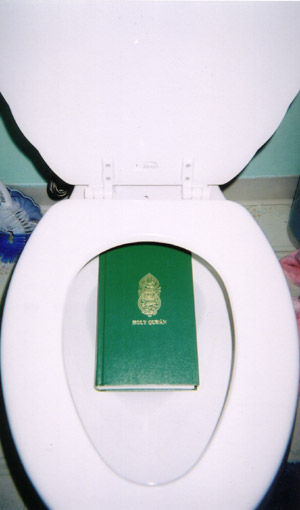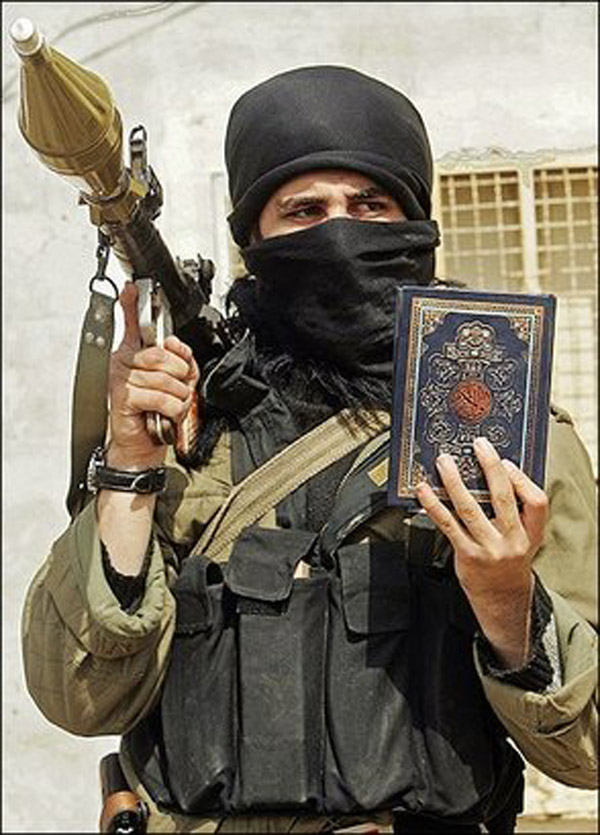
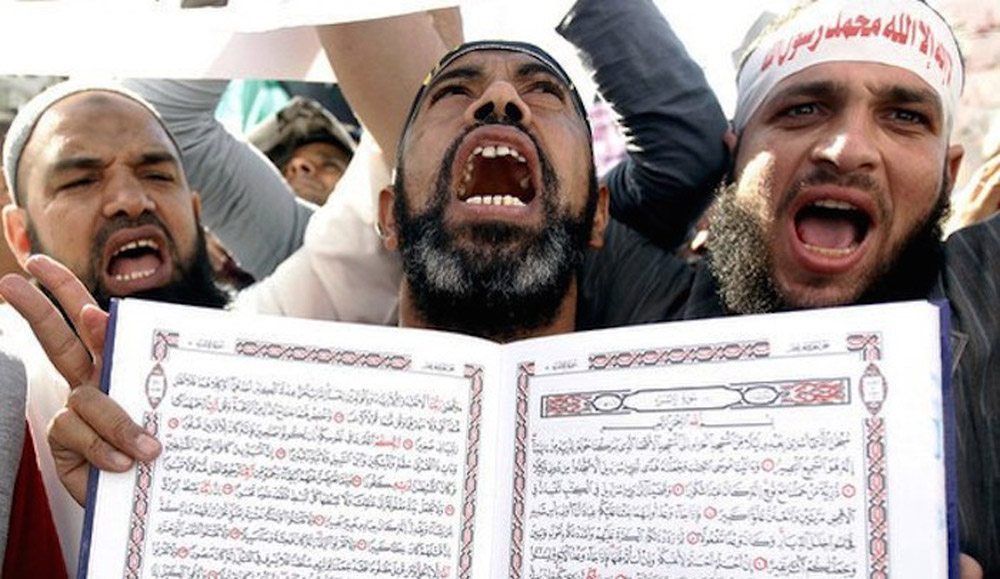
MUSLIM SCRIPTURE
Note: The Qur'an is a perfect book so says the Muslim god allah.
Qur'an 2:1-4 I, Allah, am the best Knower. This Book, there is no doubt in it, is a guide to those who keep their duty, who believe in the Unseen and keep up prayer and spend out of what We (demons) have given them, and who believe in that which has been revealed to you and that which was revealed before you, and of the Hereafter they are sure.
Note: The Qur'an is a book that verifies the accuracy of the Holy Bible.
Qur'an 6:93 And this is a Blessed Book We (demons) have revealed, verifying that which is before it, and that you may warn the mother of the towns and those around her. And those who believe in the Hereafter believe in it, and they keep a watch over their prayers.
1) The Qur'an has no structure per Western and Islamic scholars.
Western: The matter of the Koran is exceedingly incoherent and sententious, the book evidently being without any logical order of thought either without any logical order of thought either as a whole or in its parts. This agrees with the desultory and incidental manner in which it is said to have been delivered. McClintock and Strong's Encyclopedia, Volume 5, page 151.
Islamic: Unfortunately the Qur'an was badly edited and its contents are very obtusely arranged. All students of the Qur'an wonder why the editors did not use the natural and logical method of ordering by date of revelation. 23 Years, Ali Dashti, page 28.
2) The Qur'an was revealed in perfect Arabic so says the Muslim god allah.
Qur'an 12:2 Surely We (demons) have revealed it - an Arabic Qur'an - that you may understand.
Qur'an 13:37 And thus have We (demons) revealed it, a true judgment, in Arabic.
Correction: The Qur'an contains over 100 foreign (non-Arabic) words.
The Qur'an contains sentences which are incomplete and not fully intelligible without the aid of commentaries; foreign words, unfamiliar Arabic words, and words used with other than the normal meaning; adjectives and verbs inflected without observance of the concords of gender and number; illogically and ungrammatically applied pronouns which sometimes have no referent; and predicates which in rhymed passages are often remote from the subjects. 23 Years, Ali Dashti, page 48.
3) Mo-ham-mad claims his god created everything in eight days. (2+4+2=8)
Qur'an 41:9 Say: Do you indeed disbelieve in Him Who created the earth in two days, and do you setup equals with Him? That is the Lord of the worlds.
Qur'an 41:10 And He made in it mountains above its surface, and He blessed therein and ordained therein its foods, in four days; alike for all seekers.
Qur'an 41:12 So He ordained them seven heavens in two days, and revealed in every heaven its affair.
Correction: The Holy Bible states that everything was made in six days.
Genesis 1:31 Then God saw everything that He had made, and indeed it was very good. So the evening and the morning were the sixth day.
Exodus 20:11 For in six days the LORD made the heavens and the earth, the sea, and all that is in them, and rested the seventh day.
Exodus 31:17 "It is a sign between Me and the children of Israel forever; for in six days the LORD made the heavens and the earth, and on the seventh day He rested and was refreshed."
4) Mo-ham-mad claims that Abraham and Ishmael built the Kabah in Mecca.
Qur'an 2:125 And when We (demons) made The House a resort for men and a place of security. And: Take you the place of Abraham for a place of prayer. And We (demons) enjoined Abraham and Ishmael, saying: Purify My House for those who visit it and those who abide in it for devotion and those who bow down and those who prostrate themselves.
Correction: The Holy Bible states that Abraham did not dwell in Mecca.
Genesis 12:5 Then Abram took Sarai his wife and Lot his brother's son, and all their possessions that they had gathered, and the people whom they had acquired in Haran, and they departed to go to the land of Canaan. So they came to the land of Canaan.
Genesis 13:12 Abram dwelt in the land of Canaan, and Lot dwelt in the cities of the plain and pitched his tent even as far as Sodom.
Genesis 17:8 "Also I give to you and your descendants after you the land in which you are a stranger, all the land of Canaan, as an everlasting possession; and I will be their God."
5) Mo-ham-mad claims that Abraham settled some of his offspring in the valley of Mecca.
Qur'an 14:37 Our Lord, I have settled a part of my offspring in a valley unproductive of fruit near Your Sacred House, our Lord, that they may keep up prayer; so make the hearts of some people yearn towards them, and provide them with fruits; happily they may be grateful.
Correction: The Holy Bible states Ishmael never dwelt in Mecca.
Genesis 21:20-21 So God was with the lad; and he grew and dwelt in the wilderness, and became an archer. He dwelt in the Wilderness of Paran; and his mother took a wife for him from the land of Egypt.
Correction: The Holy Bible states that Abraham sent his other sons east toward Ur.
Genesis 25:6 But Abraham gave gifts to the sons of the concubines which Abraham had; and while he was still living he sent them eastward, away from Isaac his son, to the country of the east.
Correction: The Holy Bible states that Isaac never dwelt in Mecca.
Genesis 25:11 And it came to pass, after the death of Abraham, that God blessed his son Isaac. And Isaac dwelt at Beer Lahai Roi.
Genesis 26:6 So Isaac dwelt in Gerar.
Genesis 26:17 Then Isaac departed from there and pitched his tent in the Valley of Gerar, and dwelt there.
Genesis 35:27 Then Jacob came to his father Isaac at Mamre, or Kirjath Arba (that is, Hebron), where Abraham and Isaac had dwelt.
6) Mo-ham-mad claims that Moses was adopted by Pharaoh's wife.
Qur'an 28:9 And Pharaoh's wife said: A refreshment of the eye to me and to you - slay him not; maybe he will be useful to us, or we may take him for a son. And they perceived not.
Correction: The Holy Bible states that Moses was adopted by Pharaoh's daughter.
Exodus 2:10 And the child grew, and she brought him to Pharaoh's daughter, and he became her son. So she called his name Moses, saying, "Because I drew him out of the water."
7) Mo-ham-mad claims that Haman served Pharaoh in Egypt.
Qur'an 28:8 So Pharaoh's people took him up that he might be an enemy and a grief for them. Surely Pharaoh and Haman and their hosts were wrong-doers.
Qur'an 29:39 And Korah and Pharaoh and Haman! And certainly Moses came to them with clear arguments, but they behaved haughtily in the land; and they could not outstrip Us.
Correction: The Holy Bible states that Haman served in a Persian court centuries later.
Esther 3:1-2 After these things King Ahasuerus promoted Haman, the son of Hammedatha the Agagite, and advanced him and set his seat above all the princes who were with him. And all the king's servants who were within the king's gate bowed and paid homage to Haman, for so the king had commanded concerning him. But Mordecai would not bow or pay homage.
8) Mo-ham-mad claims that Mary was disobedient to her parents.
Qur'an 19:16-17 And mention Mary in the Book. When she drew from her family to an eastern place; so she screened herself from them. Then We (demons) sent to her Our spirit and it appeared to her as a well-made man.
Correction: The Holy Bible states that Mary was in her home town of Nazareth.
Luke 1:26-27 Now in the sixth month the angel Gabriel was sent by God to a city of Galilee named Nazareth, to a virgin betrothed to a man whose name was Joseph, of the house of David. The virgin's name was Mary.
9) Mo-ham-mad claims that Mary was in a remote place during her pregnancy.
Qur'an 19:22 Then she conceived him; and withdrew with him to a remote place.
Correction: The Holy Bible states that Mary was in a city in Judah.
Luke 1:39-40 Now Mary arose in those days and went into the hill country with haste, to a city of Judah, and entered the house of Zacharias and greeted Elizabeth.
10) Mo-ham-mad claims that Mary gave birth to Jesus Christ under a palm tree.
Qur'an 19:23 And the throes of childbirth drove her to the trunk of a palm tree. She said: Oh, would that I had died before this, and had been a thing quite forgotten!
Correction: The Holy Bible states that Mary gave birth in a stable for animals.
Luke 2:7 And she brought forth her firstborn Son, and wrapped Him in swaddling cloths, and laid Him in a manger, because there was no room for them in the inn.
11) Mo-ham-mad claims that soon after giving birth, Mary returned to Nazareth.
Qur'an 19:27 Then she came to her people with him, carrying him. They said: O Mary, you have indeed brought a strange thing!
Correction: The Holy Bible states that Joseph took Mary and Jesus to Egypt.
Matthew 2:13-15 Now when they had departed, behold, an angel of the Lord appeared to Joseph in a dream, saying, "Arise, take the young Child and His mother, flee to Egypt, and stay there until I bring you word; for Herod will seek the young Child to destroy Him." When he arose, he took the young Child and His mother by night and departed for Egypt, and was there until the death of Herod, that it might be fulfilled which was spoken by the Lord through the prophet, saying, "Out of Egypt I called My Son."
12) Mo-ham-mad claims that true believers pray toward Mecca.
Qur'an 2:144 Indeed We (demons) see the turning of your face to heaven, so We shall surely make you master of the qiblah which you like; turn then your face towards the Sacred Mosque.
Correction: The Holy Bible states that Jews prayed toward Jerusalem.
2 Chronicles 6:34-35 "When Your people go out to battle against their enemies, wherever You send them, and when they pray to You toward this city which You have chosen and the temple which I have built for Your name, then hear from heaven their prayer and their supplication, and maintain their cause."
Daniel 6:10 Now when Daniel knew that the writing was signed, he went home. And in his upper room, with his windows open toward Jerusalem, he knelt down on his knees three times that day, and prayed and gave thanks before his God, as was his custom since early days.
Note: Jesus Christ taught Christians not to pray towards a physical location.
John 4:21-24 Jesus said to her, "Woman, believe Me, the hour is coming when you will neither on this mountain, nor in Jerusalem, worship the Father. You worship what you do not know; we know what we worship, for salvation is of the Jews. But the hour is coming, and now is, when the true worshipers will worship the Father in spirit and truth; for the Father is seeking such to worship Him. God is Spirit, and those who worship Him must worship in spirit and truth."
13) Is a day for allah 1,000 or 50,000 years for mankind?
Qur'an 32:5 He orders the Affair from the heaven to the earth; then it will ascend to Him in a day the measure of which is a thousand years as you count.
Qur'an 70:4 To Him ascend the angels and the Spirit in a day the measure of which is fifty thousand years.
14) Mo-ham-mad claims that Jesus Christ did not die on a cross.
Qur'an 4:157 And for their saying: We have killed the Messiah, Jesus, son of Mary, the messenger of Allah, and they killed him not, nor did they cause his death on the cross, but he was made to appear to them as such.
Correction: The Holy Bible states that Jesus Christ died on a cross.
Philippians 2:8 And being found in appearance as a man, He humbled Himself and became obedient to the point of death, even the death of the cross.
15) Mo-ham-mad claims that Jesus Christ is not the Son of God.
Qur'an 9:30 And the Jews say: Ezra is the son of Allah; and the Christians say: The Messiah is the son of Allah. These are the words of their mouths. They imitate the saying of those who disbelieved before. Allah's curse be on them! How they are turned away!
Correction: The Holy Bible states that Jesus Christ is the Son of God.
2 John 1:9 Whoever transgresses and does not abide in the doctrine of Christ does not have God. He who abides in the doctrine of Christ has both the Father and the Son.
16) Mo-ham-mad claims that only white people will be saved and was a racist.
Qur'an 3:105-106 On the day when faces turn white and faces turn black. Then as to those whose faces are black: Did you disbelieve after your belief? So taste the chastisement because you disbelieved. And as to those whose faces are white, they shall be in Allah's mercy.
Correction: The Holy Bible states that salvation is found in Jesus Christ not skin color.
Galatians 3:28 There is neither Jew nor Greek, there is neither slave nor free, there is neither male nor female; for you are all one in Christ Jesus.
Note: The Holy Bible has been validated by the "Dead Sea Scrolls" and numerous Greek manuscripts.
THE WORD LOVE DOES NOT APPEAR IN THE INDEX OF THE QUR'AN
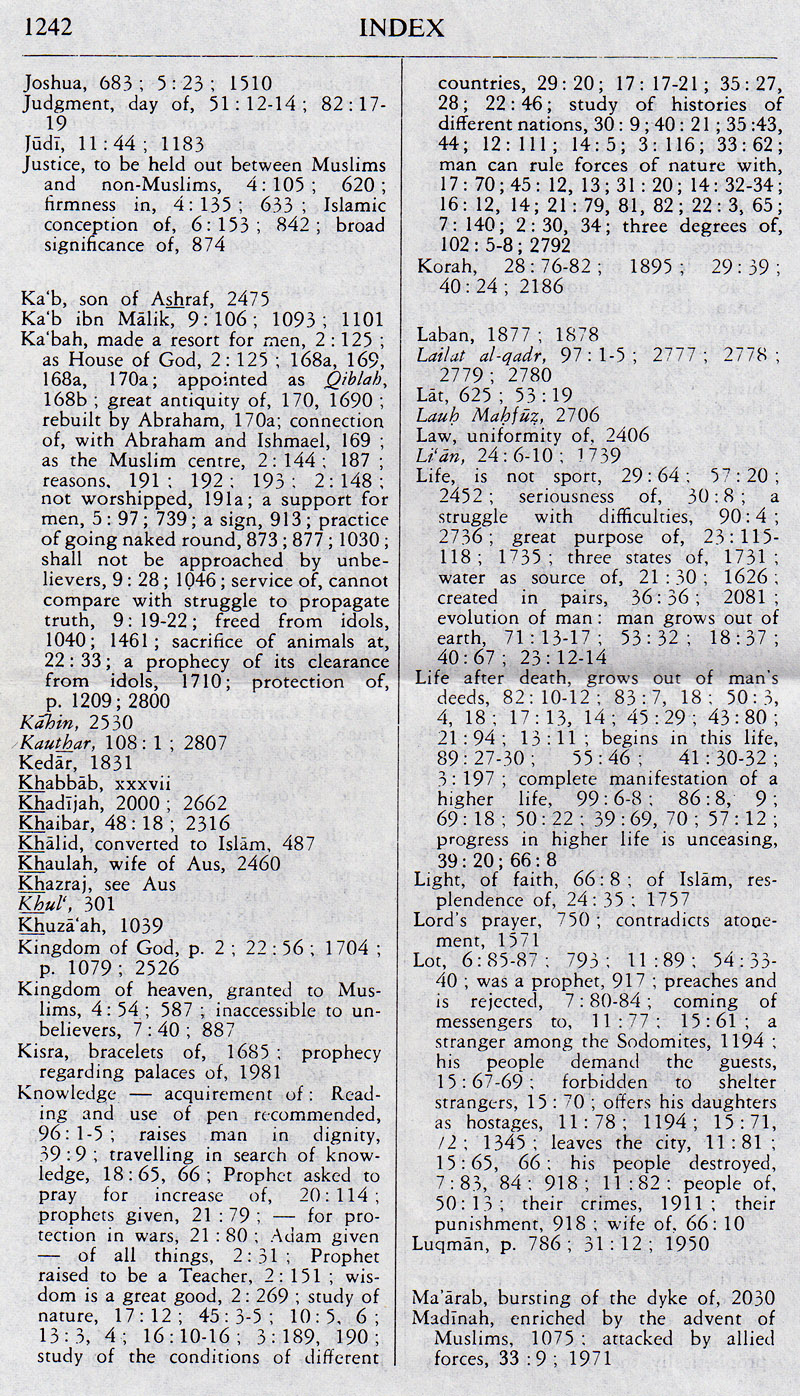
THUS, STRIFE, HATE, AND DEATH ARE THE TRUE PILLARS OF ISLAM.
World's Oldest Quran Supports Claim That Muhammad Changed Text Already in Existence
BY STOYAN ZAIMOV
CHRISTIAN POST REPORTER
December 23, 2015
New
information surrounding the oldest discovered written version of the
Quran, the Islamic holy text, has led some scholars to believe it was
compiled for Egypt's first mosque.
"It's
the most important discovery ever for the Muslim world," declared Jamal
bin Huwareib, managing director of the Mohammed bin Rashid Al Maktoum
Foundation, in a BBC News report on Wednesday.
The
story concerns 1,370-year-old fragments of the world's oldest Quran
uncovered by the University of Birmingham in the U.K. earlier this
year, which made international news.
Researchers
like Huwareib are now claiming there is evidence that the written work
was commissioned by Abu Bakr, a companion of the Islamic prophet
Muhammad, for Egypt's oldest mosque, the Mosque of Amr ibn al-As in
Fustat.
The
BBC report noted that academics were able to determine that the
Birmingham manuscript is an exact match of other Quran fragments held
at the National Library of France, which are known to have been kept at
the Mosque of Amr ibn al-As.
There
has been some dispute over the exact dating of the Birmingham
fragments, however, with some British scholars suggesting that the
written work actually predates the founding of Islam by Muhammad.
"This gives more ground to what have been peripheral
views of the Quran's genesis, like that Muhammad and his early
followers used a text that was already in existence and shaped it to
fit their own political and theological agenda, rather than Muhammad
receiving a revelation from Heaven," Keith Small of Oxford's Bodleian
Library said back in August.
Mustafa Shah of the University of London's School of Oriental and African Studies disputed the allegation, however.
"If anything, the manuscript has consolidated traditional accounts of the Quran's origins," Shah said.
Radiocarbon
testing is placing the date of the manuscript somewhere between 568 and
645, which leaves the question up for debate – as the recorded death of
Muhammad is in 632.
David
Thomas, Birmingham University's professor of Christianity and Islam,
suggested it is possible the writer of the oldest Quran might have
known the Islamic prophet.
Huwareib,
who has visited Birmingham to examine the manuscript, said that he
believes Abu Bakr commissioned the Quran that the fragments belong to.
"This
version, this collection, this manuscript is the root of Islam, it's
the root of the Quran," he said. "This will be a revolution in studying
Islam."
Huwaireb
added that the discovery of the "priceless manuscript" in the U.K.
rather than in a Muslim country suggests it is a sign of a call for
tolerance between religions.
"We need to respect each other, work together, we don't need conflict," he said.
Thomas
argued that the discussion and research will continue, however, as
academics will seek to narrow down the possible date of the manuscript
even further.
CHINA SAYS CLASH SUSPECTS MET TO STUDY QURAN
April 30, 2013
BEIJING (AP) -- The perpetrators of deadly violence last week in
China's Xinjiang region held secret Quran study sessions and possessed
extremist religious literature, authorities said Tuesday, accusations
likely to be used by Beijing as justification for its strict rules on
Islam in the vast northwestern territory.
The claims came amid new revelations about the April 23 clash in which
25 assailants, police officers and local government workers were killed
near the city of Kashgar. It was one of the deadliest incidents of
violence in Xinjiang since nearly 200 people were killed in a July 2009
ethnic riot in the regional capital, Urumqi. Police say they arrested
19 suspects and killed six others, all of them from the region's native
Turkic Uighur Muslim ethnic group.
The group was led by Kasmu Memet, who began hosting the Quran study
sessions in September, according to an account from the Xinjiang police
that was posted to official websites. In March, they began
manufacturing swords and conducting test explosions in preparation for
carrying out a major attack this summer in densely populated areas of
Kashgar, the account said.
Although official media accounts of the incident have differed,
Tuesday's report said the clash began after government inspectors
discovered bomb making materials. The inspectors were then grabbed by
the attackers and forced into their hideout.
Other attackers then arrived at the hideout and ambushed officers
rushing to the scene before setting the building on fire, killing those
held inside, the report said. Two assailants were shot to death in the
fighting.
Members of the group then began rampaging through a market in the area
and attacked the local township government headquarters, leading to the
shooting death of one attacker, the report said. Three others then
attacked a police barracks and records offices and were all killed, it
said.
The report did not further identify the literature that was found, but
said the group also possessed three flags inscribed with slogans
promoting Islamic holy war.
A sprawling region that borders Central Asia, Afghanistan and Pakistan,
Xinjiang sees recurrent violence pitting members of the Turkic Muslim
Uighur (pronounced WEE'-gur) group against the authorities and majority
ethnic Han Chinese migrants. Beijing says China faces an organized
terrorist threat from radical Muslim groups supported from overseas,
but has provided little hard evidence. Many believe violence to be the
product of resentments over Han migration, economic marginalization,
and restrictions on Uighur culture and religious life.
China imposes a raft of religious restrictions on Uighur religious
life, including barring children and government employees from mosques,
ordering young men to trim their beards and banning the wearing of
veils by women.
Beijing says it treats minorities fairly and spends billions of dollars on improving living standards in minority areas.
Muslims in Bahrain, Pakistan protest Quran burning
By KHALID TANVEER (AP)
September 9, 2010
MULTAN, Pakistan — A small American church's plan to burn copies of the
Quran is stirring outrage in Muslim nations, with lawyers protesting in
Pakistan and Bahrain's government calling the burning a shameful attack
on interfaith relations.
About 200 lawyers and civil society members marched and burned a U.S.
flag in the central Pakistani city of Multan, demanding that Washington
halt the burning of the Muslim holy book.
"If Quran is burned, it would be beginning of destruction of America,"
read one English-language banner held up by the protesters, who chanted
"Down with America!"
The Gainesville, Florida, fire department has denied Jones a required
burn permit, but he said lawyers have told him he has the right to burn
the Qurans, with or without the city's permission. The U.S. Supreme
Court has made clear that speech deemed offensive to many people, even
the majority of people, cannot be suppressed by the government unless
it is clearly directed to intimidate or amounts to an incitement to
violence, legal experts say.
U.S. Secretary of State Hillary Rodham Clinton has denounced the
planned burning and Gen. David Petraeus, the top U.S. and NATO
commander in Afghanistan, has said it could lead to attacks on
international troops there.
"This is a plan by Zionists to put the entire world into trouble, so it
should be foiled," Tariq Naeemullah, the head of the Joint Civic Front,
a coalition of non-governmental organizations in Multan.
The foreign ministries of Pakistan and the Gulf nation of Bahrain
issued some of the first official denunciations in the Muslim world,
with Bahrain calling it a "shameful act which is incompatible with the
principles of tolerance and coexistence." Bahrain is home to the U.S.
Fifth Fleet.
The president of Indonesia, the world's most populous Muslim nation,
has also sent a letter to President Barack Obama asking him to stop the
bonfire.
President Susilo Bambang Yudhoyono said images of the Quran in flames
could "threaten world peace," Heru Lelono, a special adviser to the
president, told reporters Thursday.
India's Home Ministry has asked the country's media to "exercise restraint" in reporting on the planned burning.
2 Afghans face death over translation of Quran
By HEIDI VOGT
February 6, 2009
KABUL (AP) — No one knows who brought the book to the mosque, or at least no one dares say. The pocket-size translation of the Quran has already landed six men in prison in Afghanistan and left two of them begging judges to spare their lives. They're accused of modifying the Quran and their fate could be decided Sunday in court.
The trial illustrates what critics call the undue influence of hardline clerics in Afghanistan, a major hurdle as the country tries to establish a lawful society amid war and militant violence.
The book appeared among gifts left for the cleric at a major Kabul mosque after Friday prayers in September 2007. It was a translation of the Quran into one of Afghanistan's languages, with a note giving permission to reprint the text as long as it was distributed for free.
Some of the men of the mosque said the book would be useful to Afghans who didn't know Arabic, so they took up a collection for printing. The mosque's cleric asked Ahmad Ghaws Zalmai, a longtime friend, to get the books printed.
But as some of the 1,000 copies made their way to conservative Muslim clerics in Kabul, whispers began, then an outcry.
Many clerics rejected the book because it did not include the original Arabic verses alongside the translation. It's a particularly sensitive detail for Muslims, who regard the Arabic Quran as words given directly by God. A translation is not considered a Quran itself, and a mistranslation could warp God's word.
The clerics said Zalmai, a stocky 54-year-old spokesman for the attorney general, was trying to anoint himself as a prophet. They said his book was trying to replace the Quran, not offer a simple translation. Translated editions of the Quran abound in Kabul markets, but they include Arabic verses.
The country's powerful Islamic council issued an edict condemning the book.
"In all the mosques in Afghanistan, all the mullahs said, 'Zalmai is an infidel. He should be killed,'" Zalmai recounted as he sat outside the chief judge's chambers waiting for a recent hearing.
Zalmai lost friends quickly. He was condemned by colleagues and even by others involved in the book's printing. A mob stoned his house one night, said his brother, Mahmood Ghaws.
Police arrested Zalmai as he was fleeing to Pakistan, along with three other men the government says were trying to help him escape. The publisher and the mosque's cleric, who signed a letter endorsing the book, were also jailed.
There is no law in Afghanistan prohibiting the translation of the Quran. But Zalmai is accused of violating Islamic Shariah law by modifying the Quran. The courts in Afghanistan, an Islamic state, are empowered to apply Shariah law when there are no applicable existing statutes.
And Afghanistan's court system appears to be stacked against those accused of religious crimes. Judges don't want to seem soft on potential heretics and lawyers don't want to be seen defending them, said Afzal Shurmach Nooristani, whose Afghan Legal Aid group is defending Zalmai.
The prosecutor wants the death penalty for Zalmai and the cleric, who have now spent more than a year in prison.
Sentences on religious infractions can be harsh. In January 2008, a court sentenced a journalism student to death for blasphemy for asking questions about women's rights under Islam. An appeals court reduced the sentence to 20 years in prison. His lawyers appealed again and the case is pending.
In 2006, an Afghan man was sentenced to death for converting to Christianity. He was later ruled insane and was given asylum in Italy. Islamic leaders and the parliament accused President Hamid Karzai of being a puppet for the West for letting him live.
Nooristani, who is also defending the journalism student, said he and his colleagues have received death threats.
"The mullahs in the mosques have said whoever defends an infidel is an infidel," Nooristani said.
The legal aid organization, which usually represents impoverished defendants, is defending Zalmai because no one else would take the case.
"We went to all the lawyers and they said, 'We can't help you because all the mullahs are against you. If we defend you, the mullahs will say that we should be killed.' We went six months without a lawyer," Zalmai said outside the judge's chambers.
The publisher was originally sentenced to five years in prison. Zalmai and the cleric were sentenced to 20, and now the prosecutor is demanding the death penalty for the two as a judge hears appeals.
Nearly everyone in court claims ignorance now.
The mosque's mullah says he never read the book and that he was duped into signing the letter. The print shop owner says neither he nor any of his employees read the book, noting that it's illegal for them to read materials they publish.
Zalmai pleaded for forgiveness before a January hearing, saying he had assumed a stand-alone translation wasn't a problem.
"You can find these types of translations in Turkey, in Russia, in France, in Italy," he said.
When the chief judge later banged his gavel to silence shouting lawyers and nodded at Zalmai to explain himself, the defendant stood and chanted Quranic verses as proof that he was a devout Muslim who should be forgiven.
Shariah law is applied differently in Islamic states. Saudi Arabia claims the Quran as its constitution, while Malaysia has separate religious and secular courts.
But since there is no ultimate arbiter of religious questions in Afghanistan, judges must strike a balance between the country's laws and proclamations by clerics or the Islamic council, called the Ulema council.
Judges are "so nervous about annoying the Ulema council and being criticized that they tend to push the Islamic cases aside and just defer to what others say," said John Dempsey, a legal expert with the U.S. Institute of Peace in Kabul.
Deferring to the council means that edicts issued by the group of clerics can influence rulings more than laws on the books or a judge's own interpretation of Shariah law, he said.
Judges have to be careful about whom they might anger with their rulings. In September, gunmen killed a top judge with Afghanistan's counter-narcotics court. Other judges have been gunned down as well.
Mahmood Ghaws said that even if his brother is found innocent, their family will never be treated the same.
"When I go out in the street, people don't say hello to me in the way they used to," he said. "They don't ask after my family."
Radical New Views of Islam and the Origins of the Koran
New York Times
March 2, 2002
By ALEXANDER STILLE
(Note from the editors of RIM.ORG: this article is reproduced here as printed in the New York Times, for non-profit educational purposes; it presents insight into ongoing academic studies of Quranic manuscripts by Western scholars; it is written from a secular perspective. Biblical manuscripts and parchments have been studied critically with great freedom for centuries of the history of the West, and the enormous number of manuscripts, and manuscript families up to the recent Dead Sea Scrolls attest to the unique veracity of the Bible. Openess and critical scholarship, debate and discussion are a part of Western tradition -- and as Christians in the West realize, present nothing to fear, for God's truth will stand firm and sure. Islam by contrast has maintained the image of the Quran's indubitability through fear and intimidation, a tradition dating back to the work of caliph Uthman who by the power of the sword sought to eliminate variant forms of the Quran.)
To Muslims the Koran is the very word of God, who spoke through the Angel Gabriel to Muhammad: "This book is not to be doubted," the Koran declares unequivocally at its beginning. Scholars and writers in Islamic countries who have ignored that warning have sometimes found themselves the target of death threats and violence, sending a chill through universities around the world.
Yet despite the fear, a handful of experts have been quietly investigating the origins of the Koran, offering radically new theories about the text's meaning and the rise of Islam.
Christoph Luxenberg, a scholar of ancient Semitic languages in Germany, argues that the Koran has been misread and mistranslated for centuries. His work, based on the earliest copies of the Koran, maintains that parts of Islam's holy book are derived from pre-existing Christian Aramaic texts that were misinterpreted by later Islamic scholars who prepared the editions of the Koran commonly read today.
So, for example, the virgins who are supposedly awaiting good Islamic martyrs as their reward in paradise are in reality "white raisins" of crystal clarity rather than fair maidens.
Christoph Luxenberg, however, is a pseudonym, and his scholarly tome ""The Syro-Aramaic Reading of the Koran" had trouble finding a publisher, although it is considered a major new work by several leading scholars in the field. Verlag Das Arabische Buch in Berlin ultimately published the book.
The caution is not surprising. Salman Rushdie's "Satanic Verses" received a fatwa because it appeared to mock Muhammad. The Egyptian novelist Naguib Mahfouz was stabbed because one of his books was thought to be irreligious. And when the Arab scholar Suliman Bashear argued that Islam developed as a religion gradually rather than emerging fully formed from the mouth of the Prophet, he was injured after being thrown from a second- story window by his students at the University of Nablus in the West Bank. Even many broad-minded liberal Muslims become upset when the historical veracity and authenticity of the Koran is questioned.
The reverberations have affected non-Muslim scholars in Western countries. "Between fear and political correctness, it's not possible to say anything other than sugary nonsense about Islam," said one scholar at an American university who asked not to be named, referring to the threatened violence as well as the widespread reluctance on United States college campuses to criticize other cultures.
While scriptural interpretation may seem like a remote and innocuous activity, close textual study of Jewish and Christian scripture played no small role in loosening the Church's domination on the intellectual and cultural life of Europe, and paving the way for unfettered secular thought. "The Muslims have the benefit of hindsight of the European experience, and they know very well that once you start questioning the holy scriptures, you don't know where it will stop," the scholar explained.
The touchiness about questioning the Koran predates the latest rise of Islamic militancy. As long ago as 1977, John Wansbrough of the School of Oriental and African Studies in London wrote that subjecting the Koran to "analysis by the instruments and techniques of biblical criticism is virtually unknown."
Mr. Wansbrough insisted that the text of the Koran appeared to be a composite of different voices or texts compiled over dozens if not hundreds of years. After all, scholars agree that there is no evidence of the Koran until 691 - 59 years after Muhammad's death - when the Dome of the Rock mosque in Jerusalem was built, carrying several Koranic inscriptions.
These inscriptions differ to some degree from the version of the Koran that has been handed down through the centuries, suggesting, scholars say, that the Koran may have still been evolving in the last decade of the seventh century. Moreover, much of what we know as Islam - the lives and sayings of the Prophet - is based on texts from between 130 and 300 years after Muhammad's death.
In 1977 two other scholars from the School for Oriental and African Studies at London University - Patricia Crone (a professor of history at the Institute for Advanced Study in Princeton) and Michael Cook (a professor of Near Eastern history at Princeton University) - suggested a radically new approach in their book "Hagarism: The Making of the Islamic World."
Since there are no Arabic chronicles from the first century of Islam, the two looked at several non-Muslim, seventh-century accounts that suggested Muhammad was perceived not as the founder of a new religion but as a preacher in the Old Testament tradition, hailing the coming of a Messiah. Many of the early documents refer to the followers of Muhammad as "hagarenes," and the "tribe of Ishmael," in other words as descendants of Hagar, the servant girl that the Jewish patriarch Abraham used to father his son Ishmael.
In its earliest form, Ms. Crone and Mr. Cook argued, the followers of Muhammad may have seen themselves as retaking their place in the Holy Land alongside their Jewish cousins. (And many Jews appear to have welcomed the Arabs as liberators when they entered Jerusalem in 638.)
The idea that Jewish messianism animated the early followers of the Prophet is not widely accepted in the field, but "Hagarism" is credited with opening up the field. "Crone and Cook came up with some very interesting revisionist ideas," says Fred M. Donner of the University of Chicago and author of the recent book "Narratives of Islamic Origins: The Beginnings of Islamic Historical Writing." "I think in trying to reconstruct what happened, they went off the deep end, but they were asking the right questions."
The revisionist school of early Islam has quietly picked up momentum in the last few years as historians began to apply rational standards of proof to this material.
Mr. Cook and Ms. Crone have revised some of their early hypotheses while sticking to others. "We were certainly wrong about quite a lot of things," Ms. Crone said. "But I stick to the basic point we made: that Islamic history did not arise as the classic tradition says it does."
Ms. Crone insists that the Koran and the Islamic tradition present a fundamental paradox. The Koran is a text soaked in monotheistic thinking, filled with stories and references to Abraham, Isaac, Joseph and Jesus, and yet the official history insists that Muhammad, an illiterate camel merchant, received the revelation in Mecca, a remote, sparsely populated part of Arabia, far from the centers of monotheistic thought, in an environment of idol-worshiping Arab Bedouins. Unless one accepts the idea of the angel Gabriel, Ms. Crone says, historians must somehow explain how all these monotheistic stories and ideas found their way into the Koran.
"There are only two possibilities," Ms. Crone said. "Either there had to be substantial numbers of Jews and Christians in Mecca or the Koran had to have been composed somewhere else."
Indeed, many scholars who are not revisionists agree that Islam must be placed back into the wider historical context of the religions of the Middle East rather than seeing it as the spontaneous product of the pristine Arabian desert. "I think there is increasing acceptance, even on the part of many Muslims, that Islam emerged out of the wider monotheistic soup of the Middle East," says Roy Mottahedeh, a professor of Islamic history at Harvard University.
Scholars like Mr. Luxenberg and Gerd- R. Puin, who teaches at Saarland University in Germany, have returned to the earliest known copies of the Koran in order to grasp what it says about the document's origins and composition. Mr. Luxenberg explains these copies are written without vowels and diacritical dots that modern Arabic uses to make it clear what letter is intended. In the eighth and ninth centuries, more than a century after the death of Muhammad, Islamic commentators added diacritical marks to clear up the ambiguities of the text, giving precise meanings to passages based on what they considered to be their proper context. Mr. Luxenberg's radical theory is that many of the text's difficulties can be clarified when it is seen as closely related to Aramaic, the language group of most Middle Eastern Jews and Christians at the time.
For example, the famous passage about the virgins is based on the word hur, which is an adjective in the feminine plural meaning simply "white." Islamic tradition insists the term hur stands for "houri," which means virgin, but Mr. Luxenberg insists that this is a forced misreading of the text. In both ancient Aramaic and in at least one respected dictionary of early Arabic, hur means "white raisin."
Mr. Luxenberg has traced the passages dealing with paradise to a Christian text called Hymns of Paradise by a fourth-century author. Mr. Luxenberg said the word paradise was derived from the Aramaic word for garden and all the descriptions of paradise described it as a garden of flowing waters, abundant fruits and white raisins, a prized delicacy in the ancient Near East. In this context, white raisins, mentioned often as hur, Mr. Luxenberg said, makes more sense than a reward of sexual favors.
In many cases, the differences can be quite significant. Mr. Puin points out that in the early archaic copies of the Koran, it is impossible to distinguish between the words "to fight" and "to kill." In many cases, he said, Islamic exegetes added diacritical marks that yielded the harsher meaning, perhaps reflecting a period in which the Islamic Empire was often at war.
A return to the earliest Koran, Mr. Puin and others suggest, might lead to a more tolerant brand of Islam, as well as one that is more conscious of its close ties to both Judaism and Christianity.
"It is serious and exciting work," Ms. Crone said of Mr. Luxenberg's work. Jane McAuliffe, a professor of Islamic studies at Georgetown University, has asked Mr. Luxenberg to contribute an essay to the Encyclopedia of the Koran, which she is editing.
Mr. Puin would love to see a "critical edition" of the Koran produced, one based on recent philological work, but, he says, "the word critical is misunderstood in the Islamic world - it is seen as criticizing or attacking the text."
Some Muslim authors have begun to publish skeptical, revisionist work on the Koran as well. Several new volumes of revisionist scholarship, "The Origins of the Koran," and "The Quest for the Historical Muhammad," have been edited by a former Muslim who writes under the pen name Ibn Warraq. Mr. Warraq, who heads a group called the Institute for the Secularization of Islamic Society, makes no bones about having a political agenda. "Biblical scholarship has made people less dogmatic, more open," he said, "and I hope that happens to Muslim society as well."
But many Muslims find the tone and claims of revisionism offensive. "I think the broader implications of some of the revisionist scholarship is to say that the Koran is not an authentic book, that it was fabricated 150 years later," says Ebrahim Moosa, a professor of religious studies at Duke University, as well as a Muslim cleric whose liberal theological leanings earned him the animosity of fundamentalists in South Africa, which he left after his house was firebombed.
Andrew Rippin, an Islamicist at the University of Victoria in British Columbia, Canada, says that freedom of speech in the Islamic world is more likely to evolve from within the Islamic interpretative tradition than from outside attacks on it. Approaches to the Koran that are now branded as heretical - interpreting the text metaphorically rather than literally - were widely practiced in mainstream Islam a thousand years ago.
"When I teach the history of the interpretation it is eye-opening to students the amount of independent thought and diversity of interpretation that existed in the early centuries of Islam," Mr. Rippin says. "It was only in more recent centuries that there was a need for limiting interpretation."
Iran's Culture
Minister:
Quran is Muslims' Manifesto
10/11/2005
Tehran, IQNA-
"Quran is the manifesto of Muslims and they should try to bring its teachings
into their daily lives". "Preserving Quran was crucial for the religion to live
on, and Muslims did what they could to preserve Quran throughout history," said
Iran's Culture Minister in the opening ceremony of the 13th international Quran
fair.
"What we have today as Quranic works reflects innumerable concerns Muslims have
had for preserving Quran and safeguarding it throughout history".
Commenting on the effect of Quran on all aspects of Muslims' lives, he added:"
Quran has been present in all moments of Muslims' lives since its revelation. A
muslim always has Quran with him, at the birth of his children, when his
children marry, when he's moving form a house to another and at last, when he is
to leave this world for the World After.
"Pattering Quran pages and calligraphy encourages the reader. Good reciting of
the Quran can also have a profound effect in the hearts of listeners. Exegeses
greatly help understanding the Quran. There have been great interpreters of the
Quran whose methodology has cultivated the art of interpretation of the Quran in
the Muslim world", said Saffar Harandi.
"We, as the guardians of the Quran, must go to the depths of the contents of the
Holy Book, to read between the lines and bring quranic awareness into our daily
lives, while caring about the external and apparent beauties. If we manage to do
so, even to a limited extent, we will soon achieve a great success".
Reporter afraid to reject Islam
Carroll agrees to study the Quran, but realizes it's a mistake. She ponders escape.
By JILL CARROLL and PETER GRIEF
The Christian Science Monitor
Tuesday, August 22, 2006
Um Ali – the wife of Abu Ali, my stubble-bearded captor – was my
constant companion during the first three weeks of captivity. She was
about 25, very pretty with big eyes.
Wherever I was moved, she came, too, along with some of her children.
At first, I thought she might be an ally or at least sympathetic. She wasn't.
One night – one of the first nights in a new house in Abu Ghraib – Um
Ali and I had lain down on the thin mattresses that served as beds by
night and seats by day. I had just taken off my head scarf when
suddenly a guard rattled the key violently in the lock and burst into
the room, flipping on the light.
In a frenzy, using very basic English, he ordered me up. I leapt up, my
hands shaking so much I couldn't get my head scarf re-pinned.
The guard started wrapping a red-and-white-checked kaffiyeh around my
mouth and head, violently and tightly. I opened my eyes wide in terror,
silently pleading for help to Um Ali, who was standing next to me.
Her gaze returned no sympathy. The guard whispered orders to her in Arabic that I couldn't understand.
"Hurry, hurry, quickly, quickly," the guard hissed angrily in Arabic.
"They're going to haul me out and shoot me in the head," I thought in panic.
He was so angry.
His hatred was obvious from the violence with which he wrapped the
kaffiyeh around my head. He didn't know me, but I was an American, a
symbol.
Um Ali had my glasses. As they moved me to a chair in the hall, I heard
a "click, click." Terrified, I thought it was a gun being cocked.
"If an American soldier comes here, you don't speak," he said.
That was the reason for the frenzy! He thought there were soldiers nearby. He then demanded that I recite the Quran.
"I just have to live through this. I just have to live through this," I
thought, sitting, head bowed, blind, and breathing with difficulty. I
was terrified.
After about 20 minutes it appeared no soldiers were coming.
He led me back into the room and barked a command to sleep.
There were no whispered words of comfort or explanation from Um Ali.
In my early days of captivity, at one of the first houses I'd been
held, an elderly woman who'd been visiting turned to Um Ali and sighed
that my captivity was thuloum, or an injustice.
"This is not thuloum," Um Ali snapped back.
My female companion/jailer/suicide-bomber-wannabe grew more irritated
and despondent as the days wore on. Um Ali was stuck with me in a dim
little room.
Then one evening she bounded in with a grin. She was delighted by the
news reports that thousands of homes in California had been destroyed
by forest fires.
"This is justice" wrought by God, she said, "because the soldiers destroy our houses."
Part of Um Ali's growing hardness toward me came as I tried to let her
know that, despite the many hours of reciting the Quran with her, I
didn't plan to convert to Islam.
In the beginning I was an eager student, as I saw how much it pleased
them whenever I showed an interest in learning. But I soon realized I
had made a dangerous mistake.
The more I let my captors teach me, the more they expected me to
convert. After a few weeks, the question was always, "Why haven't you
come to Islam yet?"
I tried to put the brakes on delicately, afraid of what they might do if they thought I was rejecting Islam.
One afternoon, when I was exhausted from listening to Um Ali repeat
verses of the Quran over and over so I could memorize them, I said, "I
don't understand the Arabic in the Quran, and so I can't understand
what it really means."
"We'll bring you an English Quran," said Abu Ali, who had overheard me. "You want this?"
"Oh, sure," I said.
Abu Ali whipped out his cell phone, and made a call. "You have a Quran in English?" he said. "Quickly, quickly, bring it."
He sounded almost frantic as he gave the person on the other end of the line directions about where to meet him.
After about 20 minutes he returned, bearing a small, green Quran.
Emblazoned in gold on the cover was "Le Qur'an." It was a French translation – not an English one.
Later, I tried telling Um Ali, gently, that I probably wasn't going to convert after all.
She said she would be angry if I didn't convert, given the time she had spent teaching me.
I thought about escape from the beginning and made several elaborate plans.
At one of the first places I was held, there was a small window in the
bathroom, about six feet up. If I reached up, I could peek out, just a
little bit.
I looked out two or three times. Each time, I would do it a little bit longer.
I saw a field of tall grass that stretched for about half a kilometer.
Behind that was a row of tall palm trees running roughly east, toward
Abu Ghraib. I'd overhead them talking about the prison. And the prison
meant a bazillion U.S. Marines.
But I'd been too brazen. After several days, a guard came in after
breakfast and said, "A man told me yesterday you were looking out the
bathroom window.
"You know, I have a very dark place under the ground. It's cold, with a
very small door," he said, repeating a warning I'd been given my first
night in captivity. "There's no light. I have this place."
They hammered a tarp across both the bathroom and bedroom windows. The
loss of sunlight was devastating. It may not seem like much, but it was
hugely demoralizing.
Escape looked impossible. All the things I had imagined about the
future – marriage, children – they were just gone. They were just gone,
and not going to happen.
One day, Ink Eyes, my chief captor, arrived for a chat. He sat just
outside the doorway, out of my field of vision. I leaned against the
wall, knees up, head down. I was afraid to even move.
He started by telling me about Abu Musab al-Zarqawi, the Jordanian who
was the leader of al-Qaida in Iraq. He called al-Zarqawi his "good
friend."
"He's such a good man. ... If you met him, you would like him so much," Abu Nour said warmly.
But al-Zarqawi wasn't the head of the mujahedeen any more, Abu Nour
told me, he was simply one member of something new: the Mejlis Shura
Mujahedeen Fil Iraq.
The Americans were constantly saying that the mujahedeen in Iraq were
led by foreigners, he said. So, the Iraqi insurgents went to al-Zarqawi
and insisted that an Iraqi be put in charge.
Al-Zarqawi agreed, the story went. An Iraqi named Abdullah Rashid was the new head of the council.
"You don't know who is Abdullah Rashid?" said Ink Eyes.
No, I indicated, I didn't.
"I am Abdullah Rashid!" he said.
I sat there in absolute panic. I couldn't even move. This man was
telling me he was friends with al-Zarqawi – someone who personally
beheaded hostages!
And this guy was al-Zarqawi's boss? What did this mean?
But as I saw in coming weeks, al-Zarqawi remained the insurgents' hero,
and the most influential member of their council, whatever
Nour/Rashid's position.
At various times, I heard my captors discussing changes in their plans
because of directives from the council and al-Zarqawi, including one in
Arabic I only partially understood: something about how my case should
be resolved "without money and without killing."
But that night – with the nature of those who held me spelled out for
the first time – I lay on my bed motionless in the dark.
"Come, come pray," I heard Ink Eyes, aka Abu Nour, aka Abdullah Rashid,
say in the next room. Someone else recited the call to prayer. They
must all be in there, gathered together.
"Allahu Akbar," the mujahedeen said.
"Allahu Akbar," they repeated. "Allahu Akbar, Allahu Akbar," they said, with every movement.
I listened, afraid to breathe. I had to cough, but I suppressed it. I
thought, "If I cough during their prayer, maybe they'll kill me."
I lay on my back, hands clasped across my stomach. Eventually I dozed off.
Next morning, I woke up in the same position.
That's the way I woke up every morning in that house – frozen in the
position I'd assumed after crawling into bed. I was too afraid to move,
even in my sleep.
New translation of Quranic verse ignites controversy
By Khalid Hasan
March 26, 2007
Daily Times
WASHINGTON: A “feminist” translation of a Quranic verse by a US-based
Iranian-American woman scholar is being denounced as inaccurate and misleading.
The academic, Laleh Bakhtiar, who has spent seven years on a translation of the
Quran is under fire because of her rendition of Verse 34 of the Surah Al Nisa.
The verse as translated by Abdullah Yusuf Ali says, “As to those women on whose
part ye fear disloyalty or ill conduct, admonish them (first), (next) refuse to
share their beds (and last) beat them (lightly) but if they return to obedience,
seek not against them means (of annoyance) for God is most high, great (above
you all)”.
Bakhtiar says the most common translation for the Arabic word “daraba” is not
hit or smite but to “go away”. She said when she came upon the verse she could
not believe that God would sanction harming another human being except in war.
Her translation is due for publication in April. There are at least 20 English
translations of the Quran in which the word “daraba” has been translated as
“beat, hit, strike, scourge, chastise, flog, make an example of, spank, pet, tap
and even seduce”.
According to a report in the New York Times, “When she reached the problematic
verse, Ms Bakhtiar spent the next three months on “daraba”. She does not speak
Arabic, but she learned to read the holy texts in Arabic while studying and
working as a translator in Iran in the 1970s and 80s.
Her eureka moment came on roughly her 10th reading of the Arabic-English Lexicon
by Edward William Lane, a 3,064-page volume from the 19th century, she said.
Among the six pages of definitions for ‘daraba’ was ‘to go away’. “I said to
myself, Oh, God, that is what the prophet meant,” said Ms Bakhtiar, speaking in
the offices of Kazi Publications in Chicago, a mail-order house for Islamic
books that is publishing her translation. “When the prophet had difficulty with
his wives, what did he do? He didn’t beat anybody, so why would any Muslim do
what the prophet did not?”
“The ‘beat’ translation contradicts another verse, which states that if a woman
wants a divorce, she should not be mistreated. Given the option of staying in
the marriage and being beaten, or divorcing, women would obviously leave,” she
said. There have been similar interpretations, but none have been incorporated
into a translation. Debates over translations of the Quran – considered God’s
eternal words – revolve around religious tradition and Arabic grammar.
Critics fault Ms Bakhtiar on both scores. Ms Bakhtiar said she expected
opposition, not least because she is not an Islamic scholar. Men in the Muslim
world, she said, will also oppose the idea of an American, especially a woman,
reinterpreting the prevailing translation.
The NYT report said that verse 4:34, with its three-step programme, is often
called a reform over the violent practices of seventh century Arabia, when the
Quran was revealed. The verse was not a licence for battery, scholars say, with
other interpretations defining the heaviest instrument a man might employ as a
twig commonly used as a toothbrush. Sheik Ali Gomaa, the Islamic scholar who
serves as Egypt’s grand mufti, said Quranic verses must be viewed through the
prism of the era. He said, “In our modern context, hitting one’s wife is totally
inappropriate as society deems it hateful and it will only serve to sow more
discord”.
The Atlantic Opinion Section
July 15, 2008
A priest writes:
A person in a free society is at liberty to burn his own Torah scrolls,
to tear up his own copy of the New Testament, to plunge his own copy of
the Koran in his own toilet, and to trample his own stock of communion
wafers. That should be recognized as protected religious or
anti-religious expression under the First Amendment.
However, no one is free to break into a synagogue, to take the Torah
scrolls enshrined there, and to burn them. Or to do that with a Koran
belonging to a mosque where he is visiting, or to take the Bible or the
Blessed Sacrament from a church and desecrate them. If a particular
religion gives its sacrament or sacred things only to its own members
and someone deceives the adherents of that religion in order to
desecrate their sacred rituals or objects, then that is a fraud and a
violation of the religious liberty of others.
Religions are entitled to make rules for their own members and to
demand that outsiders leave religious adherents in peace within their
own sacred precincts. The Catholic Church clearly did NOT intend to
give communion to someone like this fellow and did not invite him to
receive. Non-adherents are entitled to criticize or oppose from outside
but not to disrupt worship, to commit fraud against religious believers
they dislike, or to take religious goods from religious institutions
under false pretences.
For example, I regard Muhammad and Joseph Smith as false prophets and
say so openly. I regard the Koran and the Book of Mormon as being of
merely human origin. If I want to oppose Islam or Mormonism and even to
burn their allegedly inspired writings, I am free to do so. But I am
not free to go into Muslim or Mormon places of worship, deceive the
worshipers there, and then desecrate what they regard as sacred.
It's not a matter of punishing blasphemy but of the civil and religious right to be left alone.
SHOULD THE QUR'AN HAVE SPECIAL STATUS IN AMERICA?
MUSLIM FANATICISM OVER THE QUR'AN
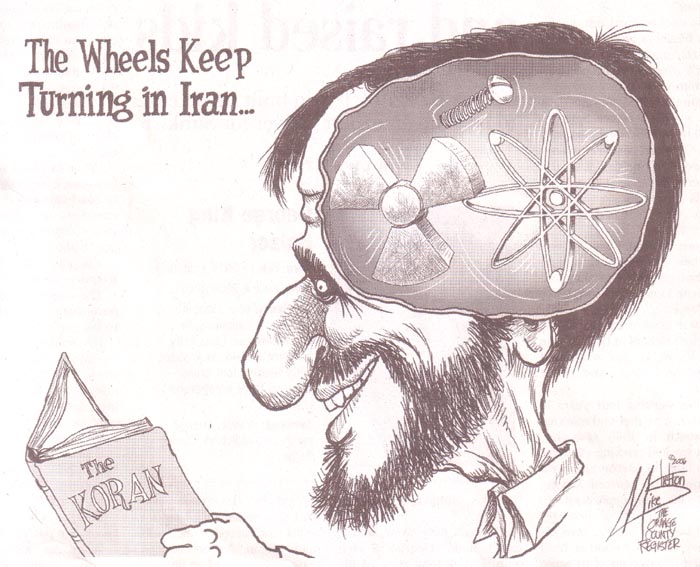
Iranian President Mahmoud Ahmadinejad is insane.
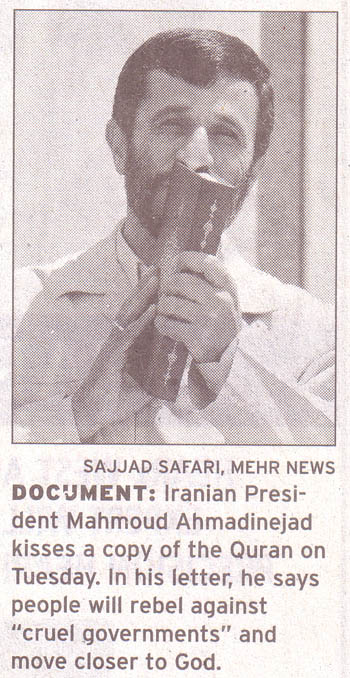
Interpretation: "Muslims will rebel against sanity and move closer to death."
Christianity vs. Islam debate between pastor, imam draws 3,000
By
PETE BISHOP
Monday, August 25, 2008
Naples Daily News
FORT MYERS — The theological disagreements weren’t resolved but the atmosphere remained civil during a debate between a Muslim imam and a Christian evangelist at First Assembly of God Church in Fort Myers on Sunday night.
“It went better than I expected,” Imam Mohamed Al-Darsani said after the two-hour debate. “We connected with people, we started a conversation and I hope we can keep that conversation going.”
About 3,000 attended the event, which was organized by the church and WRXY, a local Christian television station.
The debate was scheduled after Al-Darsani saw one of Pastor Reza Safa’s programs on WRXY and approached station manager Paul Lodato to ask for equal time.
Based in Tulsa, Okla., Safa is a former Shiite Muslim who converted to Christianity about 20 years ago. He is founder of World Harvest Ministries and TBN Nejat TV.
Al-Darsani is the founder and imam of the Islamic Center for Peace in Fort Myers.
He regularly organizes interfaith programs at the center and with Christian churches and Jewish temples in this region.
During the debate, Safa used his personal experience to stress the lack of “salvation” in Islamic theology and the religion’s emphasis on earning entry into heaven through good works.
Using verses from the Koran as evidence, he also said the religion is hostile toward Christians.
“If there’s so much love for Christians, how come there is not a single Islamic nation that allows Christians to practice their faith in freedom?” he asked.
Darsani said Safa was using a “cut and paste” approach with the verses, to misrepresent a peaceful religion. (Muslim clerics are habitual liars)
He also stressed that Islam is a religion that shares core beliefs with Judaism and Christianity, and that acts fueled by political feuds should not be used to judge the religion.
“Yes, there are acts of violence and crime, but does that mean Islam is behind it? Crimes are crimes no matter where they happen and who commits them,” he said.
Each clergyman presented his case for one-half hour, then each was given 15 minutes for rebuttal.
Both Safa and Al-Darsani also answered three questions from the audience.
The audience was polite and attentive, applauding only at the end of each presentation and rebuttal.
“I think overall it was very balanced,” said Jim Rusnell, a Fort Myers resident and First Assembly congregant. “Both sides presented their theology well, and left the audience with many things to think about. They kept things civil, dealing with a very controversial topic.”
Abdalla Kishta, an Egyptian immigrant and member of Al-Darsani’s congregation, said the debate was informative but that Safa misrepresented some aspects of Islam.
“He selected a way to go, becoming a Christian, and that’s OK,” said Kishta. “He tries to convince people to follow those footsteps, but why didn’t he find any truth in the Koran? (Answer: There is no truth in the Qur'an) And how did he know his prayers weren’t being answered when he was a Muslim? I would like to ask him those questions.”
Stephen and Olinka Blevins attended the debate after hearing about it on the radio.
“We are both Christians but my wife has a Middle Eastern background,” said Stephen Blevins. “She knew about Pastor Reza and I wanted to see what this is all about.”
Olinka Blevins is Syrian but also lived in Iran.
After the debate, both Safa and Al-Darsani were happy with the results.
“We didn’t meet in order to come to any conclusions,” said Safa. “It’s more a matter of exposing our differences and discussing them. A meeting like this would be impossible in a Muslim country.”
“Hopefully we’ll have more programs like this, more dialogues,” said Al-Darsani. “Then we can go more into the theological proofs — why we believe this and why we believe that, and why we don’t agree.”
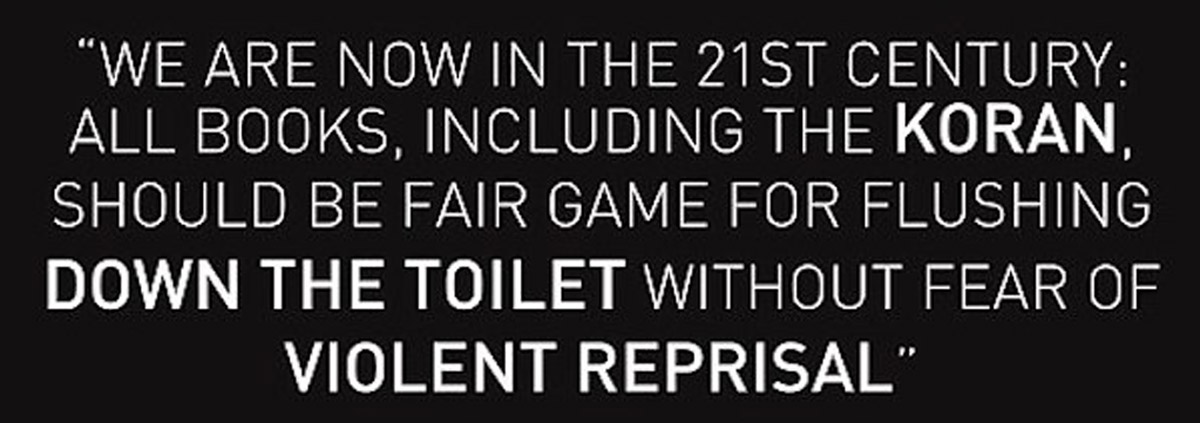
The Qur'an needs to be recognized as a hate manual and be flushed