ESCAPE FROM IGNORANT ISLAM
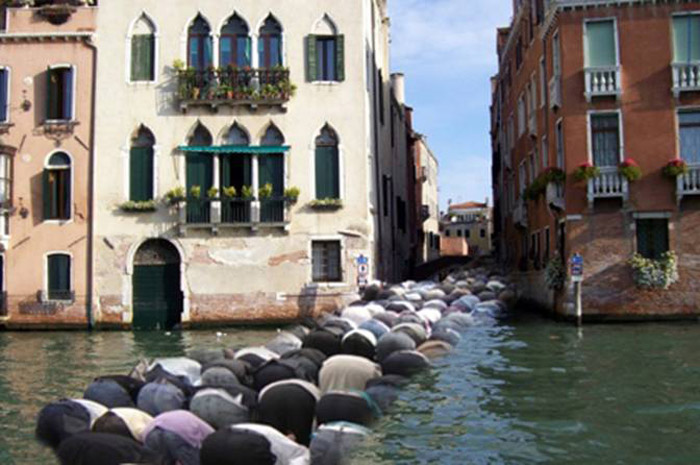
Ignorant Muslims Praying in
Venice, Italy
Why I Left Islam and Became a Christian
APR 12, 2025 11:00 AM
BY AMADOU NDENGBA
It
all started with a dream. I was seated quietly in a mosque in a West
African country, awaiting the Zuhr prayer after reciting the Adhan, the
Islamic call to prayer. It felt like any other day in my devout Muslim
life—until everything shifted. Suddenly, I was swept into a trance-like
state, standing alone in a vast desert. Above me appeared a figure
radiating light—so brilliant that the boundary between the light and
the person dissolved. A voice, gentle yet resolute, echoed, “Come to
me… come to me.” The figure extended a sword toward me and then
vanished. When I jolted awake, my heart raced. I told myself it was
just a hallucination and kept silent. Yet that dream clung to me,
refusing to fade.
A
few nights later, another dream came. The same radiant figure appeared,
proclaiming, “I am the way, and the truth, and the life.” Again, He
handed me a sword-like object. Overwhelmed, I shared this with my
Qur’anic teacher. He interpreted it as a call from the prophet ‘Isa
(Jesus) to wage jihad—but through preaching Islam. His words felt
heavy, but I trusted his guidance.
I
come from a deeply religious family. My father is an imam. He’s
polygamous, with three wives. From a young age, I memorized the Qur’an
under intense pressure. My brothers and I were often beaten if we
failed to recite the portions assigned for the day. I remember one day
when one of my aunts hired a Christian maid. Before a meal, the maid
made the sign of the cross. She was slapped and immediately dismissed.
That was the spiritual environment I grew up in.
Inspired
by preachers such as Dr. Zakir Naik, I immersed myself in dawah,
dreaming of becoming an Islamic apologist. But during one of Dr. Naik’s
lectures in my country, a Christian woman boldly challenged his Bible
interpretations. She was eventually kicked off stage, but her
confidence stunned me. What kind of faith gave her that strength?
Soon
after, I received two scholarship offers—one to a majority-Muslim
country (a partial scholarship) and one to a Communist country (a full
government scholarship through the ELAM Project). Upon getting the
government scholarship to study medicine in the Communist country, it
coincided with another scholarship I got to go to the Muslim country. I
had to choose between the two. As the communist country had a single
mosque in the whole country at the time (in the national capital,
funded by the Saudis), I decided to consult one of the most radical
preachers in my country. He told me to take the scholarship to the
Communist country, as it was the better option in the sense that it was
a full scholarship, and that I must never miss the Friday prayer ever
while there, and the rest of the prayers on other days I could do at
home. I chose to go to the Communist country, trusting his counsel
despite its challenges.
Fortunately,
upon my arrival, there were already many Chadians, Malians, Moroccans,
Palestinians, Yemenis, Syrians, and others on the medical campus and
student residence I was put in. These Muslims decided to turn the
entire school’s medical lab floor into a mosque five times a day with
their own imam, who later became very close friends with me. I led some
of them in prayer, especially during the Tarawih of Ramadan. My zeal
for Islam grew. As I preached to people on campus, I met one Christian
who started talking to me about Jesus Christ. He started quoting the
Bible, and everything he told me met with a counterargument I got from
my Zakir Naik videos. He couldn’t respond. All he kept saying was, “It
would only take the Holy Spirit for you to understand.”
Meanwhile,
the dreams returned. The voice, that light, the inner stirring—it grew
louder. I began critically examining Islam: the Qur’an’s compilation,
predestination, original sin, and the life of Muhammad. The deeper I
went, the shakier my faith became. Answers from Muslim scholars brought
more questions than peace.
I
stopped praying. I felt lost. If Allah was truly God, why was my search
for truth met with silence? One night, my roommates were watching an
Ahmad Deedat debate, which sparked my interest in Christian-Muslim
dialogues. I began comparing the Qur’an with a borrowed Bible. That’s
when I discovered Robert Spencer, David Wood, Jai, DoC, and Brother
Rachid. Their fearless scholarship cut through my confusion like a
sword through fog. Brother Rachid’s story mirrored mine. David Wood’s
boldness, Jai’s clarity, and Spencer’s historical grounding gave me
strength.
I
started praying differently: “I won’t call You Allah, Jesus, or any
name. I just want the truth. Lead me to You.” One day, alone in my
room, I was overwhelmed by a peace I had never known as I read the
Bible. With tears streaming down, I whispered, “Oh Jesus, I know little
about You, but I invite You into my life. I’m afraid, but I trust
You’ll walk with me.” At that moment, I surrendered to Christ.
When
I finally accepted Christianity in my heart, I did not want anyone to
know. I wanted to keep it a secret. But I was so much at peace that I
decided to at least tell the same Christian who approached to preach to
me many months ago. He was so elated he ran away and left me sitting
there to go pray and came back for us to discuss more about the next
steps—catechumen, baptism, and so on.
I
kept my conversion a secret and kept praying that God would make it a
secret for me as I was afraid of what would happen. I had a lot to
lose. Strangely one day, I had a dream about a certain medical student
being expelled from our medical school. I had never met this student in
my life. The university is such a huge campus! So, it was very strange
to me. To make it more strange, I was secretly coming from a Christian
meeting—Christians on campus organized short prayer meetings every
Thursday. I saw this same student sitting alone. As I approached him, I
could clearly recall him in my dream! I greeted him and asked for his
name. He introduced himself to me as Ed (I guessed it was short for
Edward, but I didn’t want to sound intrusive). I asked him what year he
was in. He said he was in Pre-Medicine (Pre-Med in that country is
basically a year of learning the nation’s language, coupled with all
other normal pre-med courses as in the USA). I could see in his eyes he
was going through a lot. I asked him if everything was okay. When I
asked him how he was doing, he started crying. He told me he was
finding many of his courses difficult and he’d started drinking a lot
and started sleeping around. He looked at me and saw me concealing my
small Bible that I had to conceal so nobody would notice. At this
point, many Muslims started asking me why I no longer attended the
mosque prayers and never showed to pray with them, and all I told them
was, “Don’t worry, I find my own time to pray.”
Seeing
that I was holding the Bible, Ed asked me if I was Christian, and I
told him yes. He wept even more. He started quoting Bible verses at me
as he cried. He asked if I could pray for him. It was already
nighttime, and we were alone. So, I started praying for him. We stood
up and held each other’s hands, and I started praying vehemently for
him. It was in the middle of that prayer that one of my country mates
just showed up out of nowhere. I could see him heading towards us and
then stopped right in his tracks as he saw my Bible in hand and me in a
prayer mood. It was there that I could not stop praying for Ed. I
didn’t want to stop mid-prayer for Ed. In my mind, I knew he’d already
seen me, but I told myself to calm down as God is in control. I did
pray for God to make my conversion a secret. If He allowed this to
happen, then this was His will. (We were the only three students from
my country who got the scholarship to study medicine in the Communist
country at the time.) By the time I was done praying, my countryman was
already gone.
The
following day, Christians who knew about my conversion started telling
me that my countryman had already started asking them if I’d converted.
I guess one of them confirmed to him that I did. Before I knew what was
happening, the ambassador from my country in that country at the time,
who was friends with my late uncle, was informed by him about my
conversion. I knew my family was soon going to be informed at some
point by him. He stopped inviting me to his residence. All benefits
stopped. Left to the ambassador alone, I would have been stripped of my
scholarship and sent back home. However, the scholarship I benefited
from came directly from the Communist government through the ELAM
Project. The whole university became aware. I started seeing the true
colors of Muslims. The Chadian Muslims started discussing amongst
themselves how to harm me with food poisoning. They were overheard by a
Christian lady who was a member of our Christian Thursday gathering.
She met me buying some tortilla near the Chadian students’ residence
and asked me not to eat from it as it may have been poisoned. Days
later, I found my water bottle tampered with, a strange residue
floating inside. I poured it out, shaken but resolute. Many of these
sorts of threats increased my faith, but also made me so angry. I told
my family, and I took to Facebook and announced that I left Islam. A
media house in my country made a headline about my conversion to
Christianity.
My
father disowned me right there. My mother lost consciousness and was
rushed to the hospital. One of my sisters called me several times,
cursing me in the name of Allah and said if anything happened to mum,
she’d personally hold me accountable. That was the last time I heard
from her and them. For seven years years, I didn’t hear from anyone
except my younger brother. But one day, out of nowhere, I received a
message from my brother, who is living in the US as a Navy officer,
offering me more than $6,000 for me to return to Islam. After many
attempts, back and forth, I said no. He got angry and went into
silence. Soon after, I received an anonymous call warning me that my
family had hired someone to track me down if I ever returned to my
country. I dismissed it at first, but the menace in the voice lingered.
With
all the negative stuff, I received a message from a female surgeon from
my country who told me that she was a secret Christian, and she
encouraged me to continue in my walk. She gave me her contact number
and said we should keep in touch.
One
of the students from South Sudan who was Christian but was fooled into
accepting Islam a few months before my conversion heard about my
leaving Islam. He came to me asking me my reasons. I talked to him
about the life of Muhammad and other topics. Then I referred him to
watch Robert Spencer, David Wood, and others. A few weeks later, he
recanted Islam and returned to Christianity.
I
was approached by the medical student imam of the school mentioned
earlier. He wanted to convince me to leave Christianity. I asked him
what good reasons he had for the truth of Islam. He started telling me
how the Bible has scientific errors. I swung my arm and gave him the
copy of my Bible to point out those scientific errors. A few minutes
ago, he was shouting at me that Genesis has scientific errors. When I
gave him the Bible, he couldn’t even locate Genesis. He went straight
to the New Testament. Seeing him struggle to get to Genesis, I stopped
him and told him not to rely on Muslim apologists for his understanding
of Christianity. A Cameroonian Muslim student was there when this
happened. He was sitting the whole time and saw how embarrassing the
moment was for the imam. The very next day, I received a threatening
letter inserted in the Bible! It was out there by him, I suspected, as
the letter said something along the lines of, “I saw the way you were
rudely talking to the imam. Our enemies are deceiving you, and if you
are not careful, you will pay for it dearly.” That same week, as I
walked through campus late at night, I heard footsteps behind me.
Turning around, I saw two figures slip into the shadows. My pulse
raced, but I kept walking, praying for protection as I ran as fast as I
could. I couldn’t report any of these to the school authorities, as the
Christian faith is heavily opposed by those same authorities! Instead,
I applied to get transferred to another medical campus located 3 hours
from the national capital until I finished my medical studies.
I
worked at a small clinic in the Communist country for many months as a
family physician after graduating. I wouldn’t have returned to my
country, but I lost my younger brother in my final year of medical
school. He was the only one who truly never stopped talking to me. Upon
graduating from med school and returning home, I called my family from
a new number. They didn’t know who it was. When I told them that I’d
graduated and that I was back, I was told there was no space for me in
the family. With the little money that I had, I took a taxi to a rental
zone, where I paid for a small apartment for three days. That first
night, I woke to the sound of glass shattering—a rock had been thrown
through my window, with a scrap of paper tied to it reading (in the
Mandinka language), “Apostate, die.”
I
immediately contacted the aforementioned surgeon in my country (the
secret Christian who gave me her contact details years ago) that I was
in the country. She put me in touch with a pastor who runs a secret
home for ostracized Christians from Muslim backgrounds. I called the
pastor, who asked me to meet him at a certain place, which I did. I met
him there with an old American woman. The old woman told me that she
was renting a complete house nearby and that I could go join her, that
the only problem was that the room had no bed. I told her I had no
problem with that, as I could sleep on the floor, as I was out of
money. She took me in.
It
was rough but I reminded myself that I only needed a few months to
register with the Medical and Dental Council in my country to get my
license to practice. A month later, I received my interview date with
the GMC. The head of the council himself interviewed me! Through his
line of questioning, I sensed a deep animosity—he must have read about
my conversion on the internet, as I suspected. After all, my native
land is a very small country! I could remember coming out of that
interview to find something to eat, and I was almost run over by
someone in a car. He attended the same junior school as me. He looked
me in the eyes and just nodded angrily.
I
waited for more than two weeks for a reply on my application to get my
license. As I worked during those times, I started getting those
threats concerning a former high school classmate whose secret
conversion to Christianity her family blamed me for. One evening, I
found my bicycle tires slashed, with a note tucked into the frame: “You
can’t hide forever.” The pastor who connected me with the American
woman urgently warned me to flee as soon as possible. He had received
credible information that my former high school classmate had fled to a
nearby West African country, and her family was now collaborating with
the police, intending to charge me with “disturbing the peace of
society.”
To
fund my escape, I sold my motorbike and other personal items, combining
the proceeds with my savings. Though I considered returning to the
Communist country and even attempting to enter the USA, I chose not to
break any laws. Instead, I learned I could transit through France
without a visa and booked a flight with a layover at Charles de Gaulle
Airport (CDG) in Paris to seek asylum.
Upon
arriving at CDG, I approached the airport police and requested asylum.
They took me to the Zone d’Attente pour Personnes en Instance
(Z.A.P.I.), where I stayed for nine days. After an interview with the
Office Français de Protection des Réfugiés et Apatrides (OFPRA), I was
granted permission to enter France while awaiting my asylum hearing. By
then, my money had run out. I slept at the airport and later at train
stations, carrying only a small Bible for comfort. Eventually, I
contacted the Office Français de l’Immigration et de l’Intégration
(OFII), which arranged a two-week stay in an apartment in Blois as I
waited for my interview date. From there, I was transferred to
Châteauroux, to a building for asylum seekers. I stayed there for a
month until my OFPRA interview in July. Two weeks later, I received
confirmation of my refugee status and a 10-year renewable residence
permit.
With
my status approved, I left the asylum housing to start anew. To support
myself, I began working as a laundry agent in Châteauroux. In my free
time, I studied French on my own, using books and practicing daily, as
I had no access to formal classes. After saving enough, I rented a
small apartment, where I currently live.
Now,
my priority is improving my French to meet the language requirements
for the Épreuves de Vérification des Connaissances (EVC) exams, which
foreign medical graduates must pass to practice in France. I am
committed to preparing for these exams to resume my career as a doctor.
A Former
Muslim’s Journey of Faith
MAY 30,
2020 10:30 AM
BY RAMI DABBAS
I am a
Jordanian Arab from a Muslim family born in 1989. In 2010, I decided to leave
Islam after becoming fed up with all the jihadist violence and intolerance and
persecution of non-Muslims. What made my decision final was the realization
that this violence and hatred is enshrined in the verses of the Koran and
Hadith.
From
2010-2012, I was an atheist, though I continued to seek the truth regarding God
and religion, even visiting Buddhist temples in Amman.
I was a
university student at the time, and announced my newfound atheism through
social media, which immediately turned many friends and colleagues against me.
They felt I was backwards in my thinking, and I came to feel the same about
them.
In 2011, I
created a group on Facebook under the name “Russian Defense League.” The group
advocated preventing the Islamization of Russia. I am half-Russian and was born
in the former USSR. The aim was to ally with other European “defense leagues,”
and through partnership with a like-minded Canadian of Russian descent, we
gained many followers.
But back to my
journey of faith.
As you are no
doubt aware, atheism is detested the Arab and Islamic world. I faced a lot of
hurtful opposition from those around me, but I kept my head down and focused on
completing my university studies. It wasn’t easy. There were those who tried to
have me kicked out because of my stance against Islam, but they failed!
In 2012, I
decided to visit a church and learn more about Christianity. I was curious
about Jesus. After four months of investigating, I joined an international
church under the auspices of an American priest. On the very first day, I was asked
to pray for salvation, after which one of the Christian brothers gave me weekly
Bible lessons. Shortly after, I was baptized in the Jordan River.
Jordan is seen
by many as a moderate Arab Muslim country. But even here, it is illegal to
leave Islam. The civil courts are still governed by Sharia Law, and to have
someone complain against you for rejecting Islam can result in criminal
punishment.
This didn’t
deter me, and in 2012 I made an online video telling people in Arabic about how
I’d become a Christian. Several days later, I was attacked by three radical
Muslims. I also received threats from a radical Salafi movement under the
leadership of Jarrah Rahahleh, an international terrorist who
used to send jihadists to Syria, Iraq and Afghanistan and was arrested many
times by Jordanian authorities. Further threats came from an Islamist
named Miqdad al-Dabbas (no relation to
me), who is currently in jail for terrorism charges and was in Syria, Iraq and
Afghanistan to fight with Al-Qaeda.
Back to the
Defense Leagues
At that time,
we were invited to participate in demonstrations in Europe against Islam. There
were a few members, but the movement did not grow very fast. The problem for me
was that I had a commitment to finish my studies, and others had jobs and
families, and couldn’t dedicate themselves wholly to such a cause.
And then came
the terrible terrorist attack by Andreas Breivik in Norway. Given claims of his
affiliation with a defense league based in England, European authorities then
tightened the noose on the entire movement.
But I had
already found my peace. From the darkness of Islam to the emptiness of atheism
and finally to salvation in Christ, my journey for truth had brought me to the
light of Jesus.
SHEIKH FROM
UGANDA FACES FATWA AFTER BEING A SECRET CHRISTIAN FOR TEN YEARS
12 March 2018
Open Doors
Hussein, a 68-year-old Sheikh (Muslim leader) from Uganda, is facing a fatwa
(death sentence) after publicly acknowledging that he has become a Christian.
He had kept his faith a secret for ten years.
COMING ACROSS 'ISA'
Hussein grew up in a Muslim home and started attending Islamic classes from the
age of seven. After he finished school in 1977 he was
granted a scholarship for further studies in Saudi Arabia. There he had
exposure to radical Islam, which never sat well with him.
While there, he also came across reference to Isa (the Arabic translation of
Jesus) in the Quran and Jesus Christ in the Bible as part of his Islamic
Apologetics studies. He started questioning Islam, which worried his lecturers.
Soon after the fall of Ugandan dictator President Idi Amin Dada, Hussein lost
his scholarship and was deported to Uganda. Hussein started teaching Arabic and
Islam at local schools and later became the leader of one of the biggest
mosques in the district. But his heart remained restless, and even after 30
years, he still wanted to find out more about Jesus.
SECRET FAITH
One day in 2006, Hussein attended an open-air Christian-Muslim religious
dialogue. “A pastor shared the gospel with us and explained the deity of Jesus
in relation to God the Father in the Bible. My heart was filled with joy
because the questions that had been plaguing my heart for so long were
answered! In my excitement, I shared the message with a Muslim friend, also a
sheikh, who cautioned me to never speak to him about Jesus again.
“When the Pastor invited us for a dialogue the second time, I asked to meet him
separately. He agreed. During our meeting I told him I wanted to give my life
to Jesus. He led me in a prayer of confession and I formally accepted Christ as
my Saviour.
“I continued to attend the Muslim-Christian dialogue but did not tell any of my
friends about my new faith. I kept it a secret for ten years, but in 2016
during another religious dialogue, I formally declared myself to be a
Christian. The news quickly spread and I immediately started getting
threats."
FORCED TO FLEE
“In July 2017, I offered my land to build a church. When the community got wind
of this, they threatened to burn the pastor’s vehicles. But God used the county
leaders to prevent the mob from causing destruction.
“That same night, three young men dressed in black with their faces covered
came looking for me. They told my wife they wanted Bibles and heard that they
could get them from me. My wife was suspicious and did not tell them where I
was. We later learned that the young men had been sent to kidnap and kill me
for apostasy. I learned that a fatwa had been called out against me. I sent my
wife and children to live with my in-laws while I fled to a nearby refugee
camp.
“No matter what I am going through now, I know God is in control. Although my
life may be in danger, I know my life is secure in God’s Hands. Although I am
old and have lost everything after clan leaders took my land, I have hope. I
also know that the best gift I will ever give my Muslim family and friends is
the Bible. I appreciate and thank God for the pastor and fellow Christian brethren
who are currently taking care of my needs. May God bless them greatly. Please
Christian brothers in the Lord Jesus Christ, remember me in your prayers.”
Hussein is being cared for by a pastor who has received training in cross
cultural outreach and new believer care from Open Doors.
5 common things Muslims lose by accepting Jesus
22 June 2016
Christian
Today
All over the Middle East and North Africa, Muslims who have converted to
Christianity struggle with their new identity in Christ. Islam is not just a
part of their lives, it is their entire life. From
praying in a set direction 5 times a day, to setting aside an entire month to
fast, the actions required to be a Muslim are all consuming. And society is not
always kind to those who disagree.
Following
Christ as a former Muslim might cost you these five things:
1. Your Family
Often, direct
relatives are the first and heaviest persecutors of believers from a Muslim
background. For many Muslim families, leaving Islam and converting to another religion
brings "shame" to the family. In moderate families, a new Christian
may be ignored or excluded. In stricter families; forced separation, divorce or
the removal of children are all common.
In cultures with a strong sense of shame and honour,
new believers face the most pressure. Family members in this situation can feel
that killing the converted family member is the only way to remove the shame
from their name.
2. Your Friends
Old friends
quickly become the most vocal opposition. Entire communities
pressure new believers to renounce their faith in Jesus. In Iran for example,
Christians from a Muslim background are considered to be unclean. Particularly
in rural areas, Muslims will not shake hands with Christians, touch them in any
way, or eat food they prepare.
In many Muslim countries, it's legally impossible for Christian men to marry
women from Muslim families. In Yemen, if a Muslim finds out a woman has started
following Christ, she will most likely be forced into marriage with a Muslim
man or placed under house arrest. This causes most converts to keep their faith
in Christ completely hidden.
3. Your Church
Almost nowhere
in the Middle East and North Africa is it possible for former Muslims to meet
at a church. In Saudi Arabia, there are no church buildings at all. Meetings of
former Muslims who have accepted Christ can only take place in secret and in
very small groups. Algeria is probably the most 'relaxed' country in this
regard but believers still face a high degree of persecution.
In Iran, fear among believers is rising, as the government has recently
increased surveillance of the house church movement. In 2015, several house
churches were raided by the police. More than a hundred Christians were
arrested, with many being sentenced to prison terms of varying lengths and the
additional punishment of torture.
4. Your Country
All over the
Muslim world, Christians who convert from Islam feel there is no option but to
leave their home countries. This is especially true for Christians in Iran and
the Arabian Peninsula. Death threats, constant discrimination and assassination
attempts all lead Christians to feel there can be no future for them in the
country of their birth. It is believed that there are currently more Saudi
believers living outside of the country than there are left within it due to
this.
Migrant churches in Europe and North America have seen their attendance rise as
refugees from the Middle East (former Muslims among them) worship with them in
freedom.
5. Your Life
Finally, people
who convert to Christianity from a Muslim background come to be known as
'Apostates' and may pay the highest price of all. Some Muslims are convinced
that everyone who leaves Islam should be killed. In Saudi Arabia and Iran, this
is enshrined in law. In other countries like Egypt, Pakistan and Malaysia the
majority of supporters for Sharia law also support death sentences for
apostates.[1]
Any apostate from Islam is, in theory, punishable by death if they do not
recant. This is based upon the prophet Muhammad's saying, as quoted in the
Hadith (Islamic tradition), "Whoever changes his religion, kill him."
Is Christ Worth It?
According to
our brothers and sisters who risk everything for His sake, the answer is a
resounding, "yes."
The apostle Paul, who himself gave his very life, agrees:
"Indeed,
I count everything as loss because of the surpassing worth of knowing Christ
Jesus my Lord. For his sake I have suffered the loss of all things and count
them as rubbish, in order that I may gain Christ" - Philippians 3:8
[1] Pew Research 2013, The World's Muslims: Religion, Politics and Society.
2015
testimony by female student at California State University at Berkeley:
If someone had told me six
years ago that I would leave Islam and end up an atheist, I would never have
believed him.
I was born and raised as a
Muslim. I grew up in a Muslim country — Pakistan — surrounded by other Muslims
who were convinced that their religion was the one true religion. My family, in
particular, followed moderate Sunni Islam, which is a more liberal approach
based on the “Sunnah,” or Prophet’s teachings. That was the path I set out on.
But now, as a Muslim apostate and atheist, my journey couldn’t have led me any
further from what I once knew to be true.
Until I was 14, I simply
accepted everything I’d been told about Islam. I was taught that being born
into a Muslim family is a blessing and is the greatest gift that Allah can
bestow upon someone. I initially thought the Sunni path I followed was the one
true path, just like my Shia, Bori and Ismaili
friends adhered to the teachings of the sects their families followed. I
noticed how everyone around me claimed to have a monopoly on the truth, which
made me question who was actually right. I started to view Islam — and religion
in general — as something dogmatic, irrational, unscientific and, most of all,
completely sexist.
A feminist since age 10,
it’s always been hard for me to reconcile my feminism with my faith. Even
though the Pakistani society in which I grew up was sexist, my family has
always been very progressive. As a result, I never accepted the male
superiority and traditional gender roles that were part of my society. For most
of my teen years, I felt torn apart by my contradictory beliefs. On one hand, I
was a radical feminist who supported gay rights. But on the other hand, I was a
practicing Muslim whose religion was clearly homophobic and placed men above
women.
At that point, I still
believed in an all-knowing God, and I felt that if I learned more about Islam,
I would be able to understand why it stated the things it did. I read the Quran
with translation and countless books on Islamic jurisprudence. I started taking
classes at Zaynab Academy and Al-Huda, two traditional Islamic organizations.
The Islam they preached was not the liberal, fluid Islam of my parents:
Instead, it followed the Quran very rigidly. While the moderate Muslims I knew
never encouraged hijab or gender segregation, these institutions differed in
their views. I started to follow a more ritualistic Islam, going as far as
giving up listening to music and wearing the hijab.
Stifled by orthodox Islam, I
decided to turn to a more liberal approach. I embraced Sufism, which is the
mystical side of Islam, and began to see God as an entity of love. Feminist
scholars, such as Amina Wadud and Leila Ahmed, gave
me a glimmer of hope that Islam and feminism could be compatible, although I
later found their arguments very selective. On the other extreme, I read
writers such as Ayaan Hirsi Ali, another ex-Muslim atheist, whose harsh
criticism of Islam was not always justified.
After trying to understand
Islam through a plurality of perspectives — orthodox, feminist, Sufi and liberal
approaches — I decided to leave Islam, but by that point, I had realized that I
didn’t need to look at things as black and white. I could leave Islam without
dismissing it or labeling it as wrong.
Going through all of these
versions of Islam has enabled me to gain a more comprehensive understanding of
the religion. Islam is no monolith, and with more than 1.5 billion followers,
it’s impossible to refer to Islam as a single entity. There are Muslim women
who cover every inch of their bodies except for their eyes, and there are also
Muslim women who wear short skirts. With so much variation amongst Muslims,
it’s hard to determine who really gets to speak for Islam.
Despite being one of the
fastest-growing religions in the world, Islam is still extremely misrepresented
and shrouded with stereotypes. I want to address these stereotypes and portray
Islam in all its diversity. I’ve experienced the religion firsthand and have
also viewed it as an objective bystander. I probably spend more time thinking
about God than most religious people; despite my skepticism, I’ve always
yearned for a spiritual connection. I want to share what I’ve learned about
Islam over the years. I plan to defend it and give credit where it’s due —
Islam, after all, gave women the right to work and own property back in the
seventh century — and I also plan to ruthlessly point out areas that need
reform (yes, Islam does allow men to have four wives and sex slaves).
If there’s one thing I’ve
learned about Islam, it’s that my former religion, just like any other
ideology, has its flaws. Religion should not be immune to criticism. It’s
important to have an honest dialogue about religion and identify what can be
improved — and that’s exactly what I plan to do.
MY JOURNEY
IN AND OUT OF ISLAM
December 28, 2013
by layla_murad
1. Introduction
My name is Layla Murad. I
left Islam in April 2013.
I’ve always been
intellectually curious. My story is a long one. A lot of my infatuation with
Islam was to do with my inquisitive nature… and of course… the internet.
2. Background
I was brought up in a practising but liberal Muslim household. My parents are
Pakistanis, both hailing from Muhajir families in Karachi. Even the most
religious among the Muhajirs are often highly progressive and secular minded
when it comes to politics and global affairs. My aunt in Pakistan, for example,
who started wearing niqāb after the death of her
paralysed daughter, has the same zeal for Farhat
Hashmi (a popular female Wahhabi preacher) as she does for the secular, ethno-centric
policies of the MQM.
Islam was not an obvious,
nor a quietist force in my life. It was just there…I didn’t, nor did anyone
else, think too much about it. My parents were the kind of people who would be
willing to drop me to a nightclub and pick me up again. Yet, they attributed
the good in life to the One God, prayed five times a day, fasted during the
month of Ramadan, gave charity. I saw my dad make the Hajj. The Islam that had
been passed on to me was the basics: the Five Pillars.
But this approach had always
seemed bland. I wanted something more.
3. Internet Islam
Hours I would spend online
snooping through internet forums, websites and lectures by Islamic scholars –
wondering how this religion came into existence and what it had to offer. I realised all this time I only subconsciously believed in
the supremacy of Islam, not consciously. The internet was critical in making me
more conscious of the colour of my skin, my beliefs
and the fact that the society around me was predominantly non-Muslim.
I was completely taken in by
the fatwās I had read online by Islamic scholars
(all with intensive training in the Islamic traditional sciences) who argued
that throughout the juristic history of Sunni Islam, the headscarf has always
been an obligation, and anyone who argues the opposite is a deviant
‘modernist’. Heck, I discovered that even the covering of the face was held to
be recommended or obligatory by most medieval Islamic jurists. I freaked out.
In some ways, the more Islam
began to serve a multidimensional purpose in my life (from the way I dressed to
the way I thought), the more I became closed off from those around me. My
parents were totally against the idea of me wearing the hijāb.
They just encouraged me to be modest and be reserved when it came to the
opposite sex. But I had made my mind up.
4. Headscarf
At the age of 18, I remember
uploading a photo of myself in a headscarf on Facebook and the outpouring of
support I received. “Oh mashAllah, beta, you look so
nice,” “Look at the nūr on your face,” “May
Allah grant you Jannah,” “SubhanAllah, I want my
daughter to start hijāb, too.”
I contemplated on whether I
should cover my hair in front of my male cousins… then intuitively gasped at my
absurdity. My maternal uncle – a vehement critic of the headscarf – scoffed:
“The only covering for women in Islam is the burqā.
Either you wear that or wear whatever you like. Not this stupid headgear where
your ass is still hanging out.” This was during a trip to America, where my
cousin was getting married to a handsome non-Muslim white guy. Many disproved
of the wedding, including myself at the time. I decided I wouldn’t wear the
headscarf properly until I’d get back to England. There was enormous pressure
on me to look good during the wedding season, and I ended up performing dances
with guys I didn’t even know.
Back in England, I reflected
upon my time in America. It sounds so petty now, but I was literally going
through this phase of ‘moral scrupulosity’. I felt bad for not only showing my
hair, but more importantly, dancing with/in front of men, blasting Bollywood
music, putting too much make-up on… normal stuff. I thought all of these things
were forbidden. But these were very personal and intellectual thoughts: I don’t
think anyone had an inkling of what I was going through. At times, I felt my
family (though they prayed and fasted) were too liberal, and other Muslims I
knew of (who wore the full face veil and once scolded
me for cutting my hair too short) were too extreme.
Going to gatherings at my
Desi-Muslim family friends’ houses with the headscarf was sometimes
embarrassing. Though many modern-but-religious Pakistanis had caught onto the headscarf
trend, I was still in a minority. Some couldn’t figure out how the same girl
who would crack the most jokes at parties, sing and dance, suddenly became so
religious.
5. Neo-traditional Islam
I made new friends online
who were quite interested dā’wa and learning
about the intricacies of the Islamic Tradition, and the ‘untold’ history of
Islam. I learnt that there were certain schools of jurisprudence in Sunni
Islam, that there were certain theological schools that made sure we didn’t anthropomorphise God like the Wahhabis do
[unintentionally]. In essence, this was the beginning of a sectarian mind, and
a mind worried about the finer details of Islam. Though I never categorised myself, I’d call myself a ‘neo-traditional’
Muslim.
Popular in the West, the
neo-traditional movement of Islam is characterised by
its advocacy of three main concepts:
• fiqh (jurisprudence) or maddhab
(legal school)
• aqīda (creed)
• tasawwuf (Sufism/mysticism)
These are based on the
Hadith of Islām—Īmān—Ihsān in Bukhari and Muslim. Its main figurehead in
America is Hamza Yusuf, and in the UK: Abdal-Hakim
Murad, both of whom are converts to Islam who spent a considerable amount of
time in the Middle-East studying the traditional Islamic sciences. I was mesmerised by their understanding of Islam and eloquence.
What was of particular interest to me was the way they gave medieval Islam a
modern and Western twist: Hamza Yusuf founded Zaytuna
College in California, and Abdal-Hakim Murad founded
Cambridge Islamic College, both a embarking upon a
quest to merge traditional learning with the liberal arts.
I remember giving a lecture
to my family about what maddhabs (schools of Islamic
law) are in Islam, and how the ‘ulemā (scholars)
are so vital to bringing foreword a valid interpretation of Islam. My dad
actually seemed impressed, but my mum and siblings just looked at me, thinking
I’d gone bonkers. Now they make fun of my ‘religious scholar’ phase and we
laugh about it.
One of the first signs of a
nascent sectarian mind was on the day of the Prophet Muhammad’s birth (12th
Rabi ul-Awwal). I shared with others the narrative
that it was the Wahhabis – those who deviated from traditional Islam and
orthodoxy – who didn’t commemorate the Prophet’s birthday because they viewed
it as an innovation (bid’a). The ‘true scholars’
throughout the ages, however, always maintained a sense of respect for this day
and did extra worship. Since the Prophet Muhammad was the most perfect man to
set foot on this Earth, some scholars even encouraged celebration, giving the
day the status of an Eid.
6. Doubts No.1
After a little while, I realised how hypocritical I was in searching for spirituality
online. I stopped wearing the headscarf, took a break from all the ‘Internet
Islam’, and just concentrated on my studies. Studying philosophy really took a
toll on the way I saw religion. I became doubtful of all the claims that had
been presented by devout Muslims – despite their attempts in presenting
themselves as ‘nuanced’ and ‘balanced’.
Worried about Pakistan, I
became sickened by interpretative Deobandi hegemony in the Subcontinent. Though
they were traditional Muslims (adhering strictly to the Hanafi legal school),
their regressive nature disgusted me. The ‘doors of ijtihād’
(independent reasoning), as more liberal Muslims complained, had been closed by
them. They were misogynists, openly supported the Afghan Taliban (based on the
obscure ‘Black Flags of Khurasan’ Hadith), prevented Pakistani public law from
being secularised, and were defensive about the
madrassa system. The Barelvis of the Subcontinent
condemned Muslim terrorism, but were just as regressive, prolonging the same
madrassa culture. The Tablighi Jamaat, a well-known proselytising
offshoot of the Deobandi movement, is very popular in Pakistan and elsewhere in
the Middle-East and the West.
The rockstar-turned-mullah
Junaid Jamshed, a member of the Tabligh, once visited
my house. He was asked by mother that if Muslims don’t study, how will they
move ahead? Jamshed, smugly replied, “Why do Muslims need to move ahead?” I
guess he shouldn’t have travelled to England by aeroplane,
then.
I became tired of religious
hypocrisy.
7. Sufi Encounter
One day, my dad came back
from work and told me he had met a Syrian-Algerian Sufi shaykh (Shaykh Bouafia) through his Syrian-born colleague, Mahmud. My dad
couldn’t get over the fact that this Syrian shaykh happened to know his [my
dad’s] long-lost shaykh in Pakistan. It was God’s will, he said, not a mere
coincidence.
My dad told me stories of
Shaykh Abu Nasr, a very old man who had escaped sectarian tyranny in his home
country, Syria. He was from Hama and travelled on foot to Turkey, elsewhere,
and finally settled – insofar as nomads do – in Karachi, Pakistan. My dad, as a
very young child, had a special relationship with this affectionate, sweet
90-year-old man, who emanated a deep-rooted spirituality.
I was fascinated and thought
this could be a missing link between me and God. I visited Mahmud and his wife Khudriya’s house, where the Syrian Shaykh Bouafia was staying. He was in his early 50s and came to
England for medical treatment, but spent a lot of time preaching about the
Islamic Sufi path at Mahmud & Khudriya’s house.
Separate gatherings were held for men and women.
As soon as I met the shaykh,
his face lit up and said that I would become a big ‘ālima
one day. Khudriya, a fat, pale, blue-eyed woman in a
loose Syrian abāya, translated. In front of the
other women who had come to meet the shaykh, Shaykh Bouafia
told me sing a nasheed, specifically Tala al-Badru ‘Alayna. Both the shaykh and Khudriya
showered me with compliments.
My dad visited the shaykh
with his Indian friend, Jalil. The shaykh asked Jalil the name of his daughter
and then remarked, “An angel tells him this was the name of your grandmother.”
My dad and Jalil were amazed: this was truly a sign of
God.
My mother and I, at the
behest of my enthusiastic father, began to visit the shaykh frequently. My mum
was always sceptical. Her spiritual-but-rational
brother told her not to get involved with these Sufi fraudsters. She felt
awkward at the Sufi gatherings. There was an obsession with dhikr (lit.:
remembrance of God; in Sufi terminology: mystical session), where we would
sometimes rock back and forth chanting the 99 Names of Allah. Soon, we were
both (my mum was pushed by my father) initiated into the shaykh’s tariqa
(mystical path). The initiation ceremony was bizarre. All the women sitting in
the room held hands in a circle and had to touch the same water the shaykh had
touched. He claimed this was a Sunna. Then we had to recite some verses from
the Quran and the wird.
Like my mother, I began to
feel uncomfortable at these dhikr gatherings. My mum stopped going because she
thought this kind of shaykh-worshipping version of Islam was completely
different to the straightforward Islam of her Pakistani parents. The shaykh
told us to renounce worldly pleasures, yet, ironically, he had come all the way
from Syria for modern medical treatment. Plus, Khudriya
– the shaykh’s disciple – had the most beautiful house.
Khudriya,
once, in a gathering shouted in her broken English and thick Arabic accent when
translating the shaykh, “It is Sharia with Tariqa… not one or the other. You
cannot pick and choose! If there is any woman who doesn’t wear hijāb in public then they are committing KUFR! I tell
you KUFR! And the shaykh will have nothing to do with her.” I felt sick to my
stomach. For starters, I had stopped wearing the headscarf, and even if I did
wear one, I thought to myself, how extremist is Allah that showing ones hair to an ‘unrelated man’ is akin to disbelief?
Khudriya
and the shaykh peddled the Sufism vs. Wahhabism narrative (conspiracy theory):
the view that
• the
biggest enemies of Islam are the Wahhabis as they call other Muslims
disbelievers and demolish sites of early Muslim heritage in the name of monotheism
• the Wahhabis have taken over Mecca from the traditional ‘ulemā who accepted Sufism as a true science of Islam;
• the
Wahhabis are extremists.
Truth be told, Khudriya was no less of an extremist. Once, she told my
mother that she doesn’t even have time to brush her hair as she “only lives for
Allah (subhanawata’ala).”
The last straw was when Khudriya and her husband Mahmud themselves had fallen out
with the shaykh. They told everyone who had been initiated into the tariqa that
another ‘better’ shaykh would soon replace Shaykh Bouafia.
The reasons were not properly disclosed. My dad, who had become spiritually
attached to the shaykh, demanded an answer. Mahmud and Khudriya
explained to my father that the shaykh was a political man, and that he had
connections with Shaykh Ramadan al-Bouti, a Sunni
scholar who was siding with the ‘Alawi Assad regime. Khudriya,
in niqāb, said to my father that she had doubts
from day one, when Shaykh Bouafia told her to take
her niqāb off in front a male doctor. Well, if
she had ‘doubts from day one’, why was she up his arse
all the time? She would begin every single sentence with, “They shaykh said…”
The result of this Sufi
shenanigan, which lasted almost 3 months, was disaster.
Yet again, I became
disillusioned with Islam. Its Pakistani form was too bland and involved
cherry-picking, its internet form was hypocritical, its ‘Quran-and-Hadith-only’
form was obviously too extreme, its traditional form was about living in the
antiquity, and its Sufi form was another kind of extreme.
8. Doubts No. 2
Not entirely sure of what I
wanted to do at university, I took a gap year. I became disengaged with my
friends, and spent a lot of time philosophising over
what the meaning of life was. I had reached the conclusion that Islam, in its
many forms, was pretty absurd, but could not come to reject Islam itself. What
was Islam, then? If it is the True religion, then why is there so much
ignorance?
Why doesn’t Islam, as practised by Muslims, ever make sense?
9. The Murabitun
I would often read the books
and articles of a man named Shaykh Abd al-Qadir as-Sufi. His works deal with
the Muslim condition, Sufism and political solutions.
Shaykh Abd al-Qadir was a
Scottish actor and playwright, initially called Ian Dallas, who converted to
Islam in the 1960s under the tutelage of Shaykh Muhammad ibn al-Habib of Meknes
(Morocco). He was appointed to become the spiritual leader (shaykh) of a
worldwide community of a few thousand Sufi followers in the West. His movement
is known as the Murabitun, named after one of the two
historical Muslim Empires in Spain (in English: the Almoravids.)
A serene looking man with a
small white beard, it became apparent to me that Shaykh Abd al-Qadir is an
intellectual in his own league. He successfully combined Sufism with a vision
for Muslim politics. The Murabitun’s appeal lay in
many things, as they combined knowledge with action:
1) Most the members of the Murabitun are converts to Islam, predominantly (Spanish),
but some also of black Caribbean origin. It attracted the intellectually
curious, confused socialists and the impoverished.
2) There is a huge emphasis
on community and deep criticism of individualism. Without community, there is
no Islam, for the Murabitun. Wherever he goes, Shaykh
Abd al-Qadir establishes a ‘traditional’ Muslim community: a mosque is founded
with a learned Imām(s), and an Emir is
appointed, who collects the community’s Zakāt.
There are four main communities: one in Norwich (England), one in Granada
(Spain), Malaysia and another in Cape Town (South Africa). France is the next
stop.
3) Shaykh Abd al-Qadir’s
philosophy was essentially a critique of modern man. It called upon us moderns
to truly question the nature of our existence. I began to question the very
nature of education itself. What is education? What is its purpose? Had I
really learnt anything? What is progress? What is freedom?
4) Whilst
intellectually and philosophically being opposed to modernity, the members of
the Murabitun looked modern and attractive. Handsome
Spanish converts with well-shaped, small beards and women who wore fashionable
clothes. Sometimes they wore headscarves, sometimes they didn’t, and when they
did, it was literally just a headcovering showing
their entire form. Shaykh Abd al-Qadir called the niqāb
an innovation, whilst other traditional scholars often praised women who
covered their faces. Women were at the forefront of the Murabitun
movement.
5) Shaykh Abd
al-Qadir’s call to a revival of ‘human nature’ was the most appealing aspect of
his idiosyncratic philosophy. Fitra is the Islamic
conception of human nature: the pre-mordial state of
man, or the natural disposition. Human-beings are born sinless. Everything that
is good is in line with Fitra, and everything that is
bad is against Fitra. Fitra
did not need to be qualified by anything. If someone asked, “Why do we enjoy
going outside?” anyone from the Murabitun would have
replied: “Fitra”.
6) Many of the members of
the Murabitun had more than one wife. They backed
this up by invoking Fitra, yet again. The Murabitun argued that only modernists say that Muslim men
cannot have up to four wives.
7) The Murabitun
offered an in-depth critique of capitalism and their solution to capitalism was
to ‘establish Islam’. Its members argued that our freedom is fake. Behind this
fake freedom is the power of global corporate finance that rules the world.
Like the Matrix. Real freedom is through Islamic rule. Shaykh Abd al-Qadir
viewed the Enlightenment freedom as a farce.
8) The Khilāfah
is obligatory according to traditional Muslims and Islamists alike, and for the
Murabitun, it is no different. But how (neo-)
traditional Muslims vs. Islamists understand the nature of Khilāfah
is where the difference lies.
Despite Islam’s genuine call
to polity, the Islamists turned Islam into an ideology, an ‘-ism’. The modern
Islamists imposed mechanistic, materialistic, static structures onto
traditional Islamic governance. The Sharia, therefore, became a ‘constitution.’
Essentially, the Sharia that
Ibn Khaldun, Ghazzali, and other ‘Islamic greats’
spoke of was different to the post-modern Sharia of groups like Hizb ut-Tahrir and the Muslim
Brotherhood. The Murabitun presented the days of the
Caliphates and successive sultanates as rules of anarchy with basic law, as
opposed to fascist dictatorships.
Though traditional Muslims
believe in the Khilāfah being restored, their
approach varies. Most say that the Mahdi (Messiah) will restore the Caliphate.
However, the Murabitun have a pro-active approach.
And the Caliphate means local, traditional justice for them.
9) The solution to the
Muslim Ummah’s problems was to “establish Islam,” as the Quran says. Every
Islamic group: from the capitalism-worshipping Wahhabis, to the Islamists, the
door-knocking Tablighi Jamaat, the esoteric Sufis and the singing folk Barelvis, had deviated, according to the Murabitun. They held that modern Muslims, of all
ideological leanings, have so deeply internalised the
systems of the kuffār, yet on the surface they
appear to be pious and God-fearing.
10) I had already noticed
the Muslim obsession with headcoverings, and finally
Shaykh Abd al-Qadir seemed to make sense of it all when he said that the
fixation on hijāb was symptomatic of how modern
Muslims had deviated. The Murabitun’s view was that hijāb was a distraction from the real issues:
establishing the Zakāt, which is the ‘fallen
pillar of the Dīn’ and the key to ‘establishing’
Islam.
They also berated modern
Muslim women for wearing the hijāb, covering
from head to toe, yet working in banks and being servitude of the global
banking system.
11) The Murabitun
held that Zakāt was no longer really Zakāt because paper money is inherently usurious and
therefore harām. Ribā
(interest) is a sin in Islam. They argued that all the pre-modern literature on
Zakāt involved transactions based on gold. The
only way to solve the problem of Zakāt is to
revive gold currency, separate to that of the ‘currencies of the Wall Street bankers’. Islamic banking is not Islamic. They base this on
a Hadith of the Prophet Muhammad (with an obscure chain of narrators) in the Musnad of Imām Ahmed: “There
will certainly come a time over mankind when there will be nothing of value
except the value of the Dinar (gold currency) and the Dirham (silver
currency).”
Of course, the appeal of the Prophetic ‘predictions’ and apocalyptic Hadith are
what keeps many Muslims attached to Islam.
12) The Murabitun
had a whole host of literature and availability of scholars in the West: Shaykh
Ali Laraki, Shaykh Abdussamad
Clarke, Shaykha Aisha Bewley, Shaykh Abd al-Haqq
Bewley. The literature was well written and well referenced.
13) The Murabitun’s
zealous advocacy of the Māliki legal school was probably
both their ideology’s main appeal and main flaw. They argued that this school
of jurisprudence was perfect for Muslims in the West because of flexibility,
cultural adaptability and the fact that it was successfully practised
in Islamic Spain. The concept of Amāl al-Ahl al-Madīna (The Actions
of the People of Medina) as a source of law was what distinguished the Māliki school from the other established four. In
Shaykh Abd al-Qadir’s controversial book, titled, Root Islamic Education, he
calls for all the other four schools of jurisprudence to look back to the Amāl al-Ahl al-Madīna.
14) Whilst the Murabitun, like most traditional Muslims, accept the
Martial Jihād as an orthodox and obligatory part
of Islam, they take a definitive stand against suicide bombing, unlike the
obfuscated opinions of many Pakistani clerics on this very issue, and genuinely
believe that terrorism is a deviance from the true Islamic tradition.
For me, these ideas, in some
ways, were revolutionary. Islam was finally answering all my questions. There
was purpose, spirituality, philosophy, politics, solution and community spirit.
And there was scriptural basis for all these things.
9.1. Madrassa
I found out that the Murabitun have set up a madrassa for boys in Spain and
another madrassa for girls in a small town in Morocco. Both were Quran schools,
where students memorised the Quran by the traditional
luhw method. This is where you write verses from the
Quran to memorise on a wooden board or tablet (luhw) with natural ink and wash the board once you know the
verses off by heart.
I begged my parents to send
me there, not telling them completely what the Murabitun
were about. I wanted to explore them for myself. My dad was wary. He researched
online and found the movement to be cultish. However, after a few months of
discussion (argument), I convinced him and my mum to send me. I just had to do
this for myself and find out if Islam was worth it.
Before leaving for Morocco,
I met up with a woman whose sister was studying at the madrassa. She was a
second-generation white Anglo-Saxon Muslim: her parents were converts. I told
her that I have this spiritual vacuum within me and want to experience
something new… away from Britain. She told me that it would be a good idea to
go there, but not to have such high expectations. She explained to me how the
girls who study at the madrassa are really beautiful and all the Moroccan
locals love them.
So, without notifying any of
my friends, or even extended family, I arrived in Morocco in August 2012.
There, I met the woman who ran the madrassa, a convert to Islam who left the
corporate world in her 20s/30s and went by the name of Hājja
Saleema.
I entered the madrassa,
which was basically a house situated in a typical Moroccan alleyway.
Altogether, there were seventeen girls studying with me. All were from the Murabitun and initiated into Shaykh Abd al-Qadir’s tariqa or
mystical path (the Habibiyya-Darqawiyya). Almost all
were of Spanish origin; two were Germans and five from England, including
myself. The girls greeted me warmly with as-salamu ‘alaykum. The two head-girls (yes, there were head-girls)
were around the same age as me: one was a Spanish girl named Habiba Cruz and
the other was English girl named Khalila Millington.
They were both beautiful.
I got into the daily routine
quite quickly. We had to wake up at 6am, be in class at 8am until 5pm, where
we’d sit on the floor and recite Quran the whole time. My Quran teacher was
called Hāfidha Jamila, a very petit Moroccan
lady in her mid-30s who was completing a degree in Islamic Studies at the
University of Tetouan through distance learning. Hāfidha Jamila wore braces. (I had noticed that braces
were a commonplace amongst people above the age of 30 in Morocco.) Her first
language was Moroccan Darija, but she also spoke Fusha
(Standard) Arabic, a little French and broken English. We would always try to
help her improve her English. She was a sweet lady.
I recited some Quran to Hāfidha Jamila on the first day. She seemed impressed
but since I only remembered very few chapters (sūra)
of the Quran, I started from almost scratch. At the end of 7 months I was
there, I had not memorised a lot: At the end of 7
months, I had not memorised a lot: altogether I now
knew chapters Rahmān, Nabā,
Tāriq and the last hizb
(in total there are 60 hizb). I loved writing on my
tablet. The teacher would dictate to us individually. Completing each chapter
felt as if I had really achieved something. I would feel relieved. Whenever
someone finished a hizb or a long chapter, we would
bake a cake and celebrate. The same happened for birthdays.
After 5pm, we would go
upstairs and prepare food. We all had tasks: cleaning, cooking, and shopping
which would alternate between designated groups. The madrassa area downstairs
would be open to local children from the neighbourhood.
They were all so cute. Some were from very impoverished families; a few were
bright children from well-to-do families who studied at French-medium schools.
On Wednesdays we would have
Arabic classes given by a woman called Rahimu. She
was not a good teacher, but a good woman.
Thursday and Friday would be
our weekend. Our iPods and phones would be returned to us and we were free to
listen to music (not exactly like a typical madrassa, was it). We could also go
out on Thursdays, providing we were back by 7pm. Fridays were a little more
hectic as everyone had to wake up early and get ready for the Jumu’ah prayer
which we would pray inside the madrassa but follow the Imām
of the local mosque. Hājja Saleema
would live upstairs. Most of her time was spent watching TV and Hollywood films
on her laptop or sorting out the legal issues of the madrassa. She would come
downstairs to have lunch with us everyday. She knew
little Quran herself and was the wife of the man whom the madrassa was named
after.
After dinner – I once made
biryani for everyone – we had to recite the wird. It
was the most tedious thing, ever. The wird, or
litany, was specific to the Murabitun’s tariqa. After
that, one girl would be chosen by Hājja Saleema to say the dū’ā
(supplication/prayer) out loud. Some of the girls would feel shy to do so, and
often they would only make dū’ā for their
‘own community’.
One of the younger German
girls who I became close to was a skilled street dancer. She found a lot of her
time at the madrassa suffocating as she had pushed into a religious education
by her parents when her real passion was for dance. She said she secretly
wished to become a professional dancer and set up a dance studio.
All in all, most these girls
were pretty normal. They were Westernised, sometimes
looked down upon the local Moroccan people as not Westernised
enough, yet at the same time not understanding why the Moroccan women did not
covering up as much as the convert madrassa girls. I remember eating the skin
and bone of food we had (as Moroccans do) and the English head-girl Khalila she looking at me disgusted; sometimes asking
questions like, “I’m sure it’s the same in your culture, too?”
Catfights were bound to
happen: I fell out with both of the head-girls for a few weeks. But overall,
the girls were lovely. The Spanish girls made me feel beautiful, always
showering me with compliments about my eyes and complexion. In England, I often
felt like an outsider – those memories of being bullied at primary school for
the colour of my skin had still not been resolved – I
observed that the Europeans tended to treat my ethnic background as ‘exotic’,
whereas living in England, there was nothing exotic about being Pakistani. The
madrassa and being with the Moroccan people, was like a boost of confidence.
A woman, named Malika, used
to visit the madrassa nearly every week with a friend. Sometimes, she would
come in the entire week. She was around 60-years-old and would recite the Quran
beautifully. She bought me gifts and would give me the warmest hug whenever she
saw me. Malika insisted that I give her my number. Islam, the sisterhood, the
community spirit meant everything to her and this is what the madrassa was
providing for the poorer, working-class people in this small fishing town, in
some ways.
9.2. Meknes and the Desert
In November, we had a small
vacation where we travelled to Meknes and the desert.
In Meknes, we stayed at the
Zawiya of Shaykh Muhammad ibn al-Habib. A zawiya is a Sufi lodge. Muhammad ibn
al-Habib’s only living wife lived in the house conjoined with the Zawiya which
also contained the shrine of the shaykh. There was a blind man who would recite
Quran, chant the names of Allah and supplicate next to the shrine all day.
Apparently, he could see ever-so slightly now and everyone attributed to the
miraculous nature of being in Zawiya.
The house was antique, old,
and dusty, but striking. It was so cold. There was no heating or anything. The
only sign of modernity I saw was the tattered stove. The women would even make
the couscous from scratch. Shaykh Muhammad ibn al-Habib’s wife and the other
women at the Zawiya would tell us stories about Muhammad ibn al-Habib and how
there was a lion but when he would recite the names of Allah, the lion would
roar or something. They told us that Muhammad ibn al-Habib as a child was very
pious and would speak to djinns and when his grave had to be moved, it was
opened it again, but his face was shining. The women told us about their past,
how they used to study at traditional Moroccan madrassas and wear the
Moroccan-style niqāb. They told us stories
about the Day of Judgement over coffee, mint tea and biscuits: how there would
be a line sharper than a needle we had to cross. We sang qasīdas
with them, too. They were such sweet, old ladies, but I never believed anything
they said.
Did I feel like it was
miraculous or spiritual? I don’t know. It just felt nice to be there. I didn’t
believe in any of the mysticism stuff we were being told about. I failed to see
the connection between saint worship and Islam scripturally. It seemed the Murabitun relied too much on the interpretation of their
own scholars, intuition and continually peddled the Sufism vs. Wahhabism
narrative. There was less mention of the Prophet, and more mention of shaykh
Muhammad ibn al-Habib and, of course, their leader Shaykh Abd al-Qadir as-Sufi.
In the desert, we spent time
with members of the Murabitun who were studying with
the ‘shaykhs of the desert’. Life in the desert was so simple. Meknes was only
simple in the Zawiya itself; otherwise it was a functioning city with
hospitals, shopping centres etc. The clear blue sky,
soft sand, mud houses build around palm trees… how could I ever forget? The
women of the desert, wrapped in their large sheets, were so hospitable, free,
and loving. They made the most delicious food. I had this instant connection with
them. Some of them told me they watched Bollywood films and knew of Kareena Kapoor. As a Bollywood lover, I found that the
power of Bollywood to connect people together was even greater than that of
Islam. We had a dance night, too, when the women of the desert invited us to
their houses for a good-bye meal. I borrowed this bright blue sequin dress and
danced to their old-school Moroccan tunes played in a dusty old cassette
player. The kind ladies also applied Moroccan-style henna to our hands.
We spent time at famous
shaykh’s house in the desert. He welcomed us into his house with, “Ahlan wa sahlan”,
and we were whisked away to the women’s quarter. We were, yet again, served
delicious food, spoiled with Moroccan mint tea and a whole host of deserts. We
sang qasīdas and recited the wird
the whole time. It got a little frustrating after a while. The elderly ladies,
covered in white sheets, really enjoyed our company. They knew a lot of the wird and qasīdas off by
heart. As soon as the eldest lady entered the room – like the matriarch of the
house – everyone went over to kiss her hand and take her blessings. All the
girls were mesmerised: excitedly whispering to each
other about the spiritual authority of this woman. She was a big lady;
olive-skinned and kept praying for everyone. I just didn’t see what the fuss
was about. I secretly thought to myself: I never want to be like this in spite
of the overt ‘piety’. What was so special about these ‘pious ladies’ over my
own grandmother, anyway? Had my grandmother been sinful for learning a little
English, not covering her hair, wearing sarees in her youth, wanting to be
educated and embracing modernity?
The visit to the
recently-built madrassa in the desert was a particularly interesting part of my
experience. It was for both boys and girls, but obviously segregated. The
students studied Quran, reading and writing Arabic, and a little bit of
geography. They were of all ages. Their recitation was powerful, as they would
recite Quran to us altogether in the same ‘tune’ and tone. Plus, the madrassa
was really stunning from the inside.
Zawiya of Shaykh Muhammad ibn al-Habib
Inside the Zawiya of Shaykh Muhammad ibn al-Habib
Madrassa in the desert
9.3. The Opposite Sex
The Murabitun
openly recommended polygamy as the natural way of life. Some of the girls’
fathers had more than one wife and they told me about the problems it caused
and how their family lives were disrupted in some ways.
I remember the Moroccan man
in his 30s who had a basic education (he could speak English) and spent time
with us in both Meknes and desert… almost like a guardian. He always smiled at
me, in a perverted way. Everyone in the madrassa really looked up to him.
Whilst the Murabitun approach to gender relations was much more
open-minded than other traditional Muslims, there was still this definitive
stance that ‘a woman is a woman’ and ‘a man is a man’. The man was allowed to
objectify the woman. I wondered why woman couldn’t do the same. There were
around ten guys from the Murabitun movement studying
in a traditional madrassa in Fez and they came over to stay at our madrassa.
The head-girls told us to cover properly as “young men are about to come to the
madrassa and would feel uneasy!” The girls were obsessed and dressed up a lot.
This was contrary to the ‘normal’ gender relations within my own family.
Indeed, cousin marriages were not uncommon but there was no “oh the men are
coming, cover yourselves” kind of mentality. Plus, I felt objectified even more
with the hijāb.
We had a big end of year
dhikr ceremony where many men also attended. The event was segregated by a
curtain, but everyone could basically see one another. People were doing the hadhra, which is where you stand up, rock back and forth
and chant the Names of Allah. I was literally scarred for life. The entire
dhikr was like a matrimonial service, anyway.
Most of the girls in the
madrassa had been in relationships with guys before. Some, after coming to the
madrassa, were shocked to discover that kissing before marriage is forbidden.
9.4. Hijāb
Despite the Murabitun’s annoyance over the fixation on hijāb, the girls at the madrassa were generally
obsessed with how they wore their headscarves, what colour
would match their clothes, how much they needed to cover for a specific
occasion, whether or not to wear the Murabitun-style
headscarf or wear it the ‘proper’ Muslim way etc. For the head-girl Khalila, the headscarf seemed like the most important thing
in Islam:-
• “OMG, you can see your hair!”
• “Will you ever wear hijāb when you go
back to England?”
• “Did you know: in the Maliki maddhab, covering
everything – Including feet – except for the face, is obligatory? Layla, don’t
use us as a blueprint for the Maliki madhhab, haha.”
• “The only thing I’ve ever done wrong in the past is not wear hijāb since the day my periods started. Other than
that, I’ve always been a good girl.”
• “Student X, wear your
hijāb properly! We are madrassa girls!”
• “Hāfidha
Jamila, did you know that girl Zahra that came here last year from Spain? She
is studying art at university she can’t even wear hijāb
anymore. Every where there is kufr!”
• “Hāfidha
Jamila, me, X, Y, Z are the only ones that wear hijāb.
Did you know Layla doesn’t wear it, either?!”
• “Layla, does you mother wear a scarf?” – “No.” – “What? How come?!”
• “Do Pakistani women
wear headscarves?”
I never knew how to respond
to these hijāb comments. I’d just shake my head,
inside, feeling this burden of scepticism. Often Khalila wouldn’t even take her headscarf in front of women
and scolded me for doing so once.
9.5. Progress, philosophy,
cult, sectarianism and conspiracy theories
I wrote in my diary:
Promises to myself… DO NOT
BE BRAINWASHED:
• Memorise at least the last hizb
• Don’t lose critical
thinking
• Modernity is amazing
The Murabitun
were philosophically against the Western notion of progress and scientific
materialism. Despite some of the Murabitun
figureheads having degrees in mathematical physics and whatnot before
converting to the ‘natural way’ of Islam, for them, university education was
pointless and taught kufr. But the rejection of ‘Western’ or a rational
education had a detrimental effect on these girls who had been brainwashed into
believing in the ‘default truth’ of their movement:
• “It’s the Jews.”
• “The Jews own EVERYTHING!!”
• “What the frig, man,
why can’t we get over the Holocaust.”
• “I hate how when
someone does something wrong, it’s okay, but when a Muslim does it, it’s a big
deal.”
• “OMG. Who was the guy
that was a really good person and was hanged?” – “Saddam Hussein?” – “Yeah,
him!” – “He wasn’t a good person. He was like Osama Bin Laden.” – “Osama Bin
Laden and Saddam Hussein are the same thing.”
• “India was in Pakistan.”
• Khalila once tried to subtly endorse the Murabitun’s call to gold. She said that when Churchill
returned Britain to the Gold Standard (1925), it was great for the economy. I
just nodded my head, imagining myself doing about a hundred ‘face-palms’.
The regressive nature of the
Murabitun stood out to me when Shaykh Ali Laraki visited the madrassa. He gave a speech concluding:
“Muslims went to the West for dunya, but you
(students) are coming back to the Maghrib for the Dīn.”
Instinctively, I found this
statement reprehensible. Had I took on his worldview,
it would mean my own parents who came to England for a better life were
‘materialistic’: only living for the worldly life. What was wrong with the
worldly life, anyway? The truth was Shaykh Ali Laraki’s
own daughters were obsessed with celebrities and he himself divided his time
between UK, Paris, Cape Town (oh the West!). He remarked, “The people of
Morocco are simple.” Yet they still rely on the modern basic needs of hot
water, gas and electricity. Science actually works. Do neo-spiritualists
condemning the worldly life have any physical solutions?
Oh, but the Murabitun did have a solution: the revival of gold
currency.
The failure of neo-spiritual
and anti-modernity philosophies became evident to me when we had to evacuate
the madrassa twice because of fire. Smoke began to come out from the fuse box
in the entrance, only to realise in a matter of
seconds that the madrassa had almost lit on fire. As we evacuated, most of the
girls were uncovered and some had to run to the local mosque in their
leggings/t-shirt to call for help. The entire neighbourhood
came out to help us. Looking for the good in the situation, the head-girls
pointed out that we wouldn’t have even met any of these lovely neighbours had it not been for the electrical fault. All
the girls sighed al-hamdulillah (praise be to God). I
didn’t want to cry but ended up crying. Most of the girls comforted me thinking
I was freaked out by the fire. They began to chant the wird
(litany) and sing qasīdas. I was like what the
actual f. I was crying because I realised the
importance of worldly knowledge over so-called ‘sacred knowledge’. If Islam was
‘established’ politically, it wouldn’t do anything for the people. Islamic
knowledge and neo-spiritualism does not save peoples’
lives: it does not fit a simple electric wire into the fuse box of a house.
Science works.
But we kept being told that
scientific materialism was wrong. Hājja Saleema told us that the fuqara
& shaykhs of the tariqa had spoken about the dire consequences of the
‘hidden shirk’. This was when we attribute things to anything other than God.
For example, if we are eating food… then it is not the food that has ‘fed’ us,
but Allah. Though the concept in itself was powerful, I found it hypocritical,
and very difficult to accept.
Despite the fact that we had
a washing machine, we were encouraged to wash our clothes by hand. If modernity
and science was just that bad, then the madrassa shouldn’t have had a washing
machine, stove or fridge. Rarely do [devout] Muslims seem to invent these
things, anyway, but use them all.
The worst aspect of the
rejection of [modern] science was the Murabitun’s
aversion to modern medicine and promotion of ‘alternative medicine’… what they
believed to be Islamic medicine. I was ill for some time and visited the doctor
– much to their dismay – who gave me an inhaler. One of the girls argued that
inhalers gave her mother arthritis. I remember Khalila
reading out loud from The Medicine of the Prophet, by the medieval scholar Imam
Suyuti. The ‘Hadith of the Fly’ (disproved by
science) was an interesting one. Khalila became
worried about the ‘fact’ that the Prophet forbade the use of milk and fish
together, complaining that Spanish food often was guilty of this.
I had already anticipated
the cult mentality, but it became too much when they would begin almost every
sentence with, “The shaykh [Abd al-Qadir] said…” and they would specifically
talk about their own community all the time. For example, when discussing any
human being, the first question would be, “Is he/she from the community?”
They were also obsessed with
the Maliki maddhab and its medieval rulings. Though
this was obvious in Shaykh Abd al-Qadir’s books, I thought it may not manifest
itself in real life conversations so much… but it did:
• “Yes, Maliki is the best maddhab. The Hanafis aren’t bad. But Malikis
are the best.”
• “I swear in parts of England, there are only Wahhabis. Malikis are the truth!”
• “Oh my God, our [Murabitun] mosque in Norwich
is the best mosque. All the other mosques are rubbish.”
I quietly observed.
Furthermore, with regards to
the cultist nature of the Murabitun, it was strange
how Hāfidha Jamila (our Quran teacher) knew nothing
about the Murabitun, or that the founders of this
madrassa were trying to ‘establish Khilāfa’ in
an idiosyncratic, novel way. Similarly, I found it surprising that Hājja Saleema and the girls
were not aware of Hāfidha Jamila’s Salafist (but
apolitical) leanings.
Salafis
practice the pure and pristine Hadith-based Islam of the first four generations
of Islam (the Salaf). Hāfidha
Jamila expressed disapproval to me at the state of the dhikr ceremonies we had
in the madrassa and the fact that we prayed behind a grave once (not with the
intention of praying to it, but simply because we were standing inside the
mausoleum). Her reading of our trip to the shrine of Shaykh Muhammad ibn
al-Habib in Meknes echoed Salafist-style scepticism.
For Hāfidha Jamila – though she did not reject
Sufism completely – these were innovations. Fundamentalism was closer to
rationalism, in some ways. To top it all off, Hāfidha
Jamila’s favourite scholar was Yusuf al-Qaradawi – the spiritual leader of the Muslim Brotherhood –
who the Murabitun vehemently attacked in their
literature.
In fact, let’s face it. The
Islam of Hāfidha Jamila was very different to
that of the Murabitun. She was not a hippy. For her,
establishing more hospitals that encouraged modern medicine would have been
‘Islamic’. Hāfidha Jamila, as I had understood,
was from the post-90s generation of Muslims in the Middle-East who left their
more traditional Sufi roots, and turned to ‘Quran & Hadith-only’, (tel)evangelical scholars. I noticed that Salafism, in its various
strands, was growing in Morocco as both a reaction to the King’s perceived
secularism, but also a reaction to indigenous mystical absurdities.
When I mentioned the name of
the Murabitun, Hāfidha
Jamila innocently thought I was referring to the historical Berber movement in
Islamic Spain. In her mind, as she had joined the madrassa only a year or two ago, she was just stunned that flocks of Westerners
were just converting to Islam. It was as simple as that for her. But after I
had a few personal conversations with her over secret coffee dates, Hāfidha Jamila was completely shocked to find out the
realities behind this madrassa project. Undoubtedly, this madrassa was a source
of employment and blessing for her: being a local Quran teacher suited her fundamentalist
but soft nature. But the Murabitun had been
dishonest. And I was amazed. I felt sorry for Hāfidha
Jamila.
Sectarianism, therefore - an
important aspect of all Muslim movements - was central to the Murabitun’s neo-traditionalist dogma, too. There was a
major prejudice against Shia Muslims. I was not from a sectarian family. Though
intermarriages were not common in my Sunni family, they weren’t looked down
upon either. Once, Khalila was discussing with the
girls about the Murabitun community and who is
married to whom. For political reasons, someone from their community had
married a Shia woman. Khalila remarked:
“He’s married a Shia.
They’re not even on the Dīn. They actually
believe Ali is god. They’re kuffār.”
I felt stick to my stomach.
One of the girls was a gothic punk rocker back in Spain and was often mocked
for being ‘different’ by the girls. One day, when she was listening to gothic
music and had been roaming the streets of Morocco with her mother – both
without the hijāb – she was scolded by the
English head-girl Khalila:
“Remember, we are MUSLIMS!
We have to LOOK like Muslim women. We have to have good ādāb
(manners). Get real about Islam! Don’t be like kuffār
women. We have to have pride about being Muslim! All you girls who don’t wear a
scarf yet, WEAR A SCARF when you go back to your homes in Spain and elsewhere.
At least dress a little modestly, but wear do wear a scarf! Look at me, it’s
not that difficult! I wear one! And in England, no one says anything to me. Do
Muslims buy tell the truth? YES. Do Muslims listen to bad music? NO. Do Muslim
women cover themselves? YES. Do Muslims buy stuff from Israel and the Jews? NO!
Do we support the banking system? NO!”
The anti-Shia, anti-Israel
and unintelligent banking comments did it for me. It made no sense, anyway,
since many of Khalila’s (and the other girls’)
headscarves and clothes were from H&M, Top Shop… and various other labels
which are all a product of capitalism.
10. Doubts No. 3
10.1. Doubts in Morocco
The more and more I learnt
about the Murabitun, the more I cherished my own
brain. I was able to think freely, and many of these girls weren’t. As I have
said before, they had been brainwashed into the default truth of their movement
by birth. They regurgitated anything and everything their shaykh(s) said.
My questions became
limitless.
I didn’t understand what was
so wrong with science.
I didn’t understand why I
couldn’t ask any questions in the madrassa.
I didn’t understand how it
was possible for my Quran teacher NEVER to break her wudū.
I didn’t understand why God
would care if we covered our feet during prayer or not.
I didn’t understand why
[Sunni] Muslims, not only differences in their minor practices, but even in
their major practices like prayer, there are differences.
I didn’t understand how our
prayer would be invalidated if a bit of our hair was showing.
I didn’t understand why God
would allow the Muslim obsession with hijāb to
reach such unimaginable levels.
Are humans making history,
or is Allah?
Is the fact that I am here
at the madrassa really part of God’s plan?
I was the one who decided
all this for myself. I made my own choices. I brought myself here.
My disillusionment with the Murabitun’s bizarre and non-practical philosophy was one
thing. But what about my own personal relationship with God?
Did this Quranic God I was
continually invoking really exist?
The Murabitun
dared to ask the nature of Western education, but what was the nature or
purpose behind an Islamic education?
Was this Quran I was attempting
to memorise really the word of God?
If so, why does the Quran
allow men to ‘beat’ women (4:34)? I saw it with my own eyes in both the
Translation and traditional Tafsir. I overlooked it for a while, but always
retained this feeling of discomfort. In fact, one of the madrassa girls
specifically came up to and pointed out the verse in the Translation. She
expressed sadness; it was as if her whole worldview had crashed, but I said
nothing to avoid being accused of brainwashing the other girls.
I cried to Allah nearly
every day for the last couple of months during night prayers to just send me
sign. But there was no sign.
One night, I prayed and
cried so much only to discover this liberating intuition that I was just
praying to myself. I burst out laughing, whilst upstairs on the roof alone.
If there was an
interventionist god(s), then it sent me a sign by introducing me to Hannah.
This was a girl I had met outside the madrassa in the music school. I had lunch
with her and she was a typical Westoxified,
non-religious teenager.
She had lived in Canada for
6 years with her mother, and intended to go and study there. For 6 years now
she had been playing the guitar, piano and singing for longer than that. She
was amazing: Rihanna, Lady Gaga, Arabic songs… you name it. Her friend, who
wore a headscarf, performed an Evanescence song in front of me and then both
sang Whitney Houston together. Both girls wanted to become singers. “Can you learn me English?” Hannah would insist. Wanting to know more
about the political climate of Morocco, I asked her if she liked the King
(whose picture was on everyone’s wall in Morocco, including the madrassa), she
replied: “Everyone likes the King! Like some don’t but like most do. Like he’s
okay, but sorta like fat. Hehe.” We spoke about
minority rights, and she said, “You know there’s like two things like Shia and
Sunni? Well, if you’re Christian or Shia, you can’t be Moroccan. You have to
leave. Moroccan Jews can live here but not Christians or Shias. One boy in my
class told me was Christian, but told me not to tell anyone otherwise he’d be
taken away. He had to sit in Islamic studies classes.” I wondered what they
taught in the mainstream Moroccan Islamic studies syllabus. “Right now we’re learning about community spirit and values.” I realised how cut off this madrassa experience and the
ideology of the Murabitun was from the realities of
Morocco. The conversation with Hannah only consolidated my doubts about Islam.
I needed to talk to someone.
I needed to make sense of what was going on. Was I sinful? So
I went to the internet café and tried to get in touch with a person named Luke
who I had befriended a long time ago on Facebook, but later lost contact. He
was a a convert to Islam familiar with the works of
the Murabitun. I had no one else to share my thoughts
with and, to my delight, I found out that Luke,
after 9 years, was also questioning Islam.
10.2. Doubts in Britain
Those exchanges had a
profound impact on me. Time for the anti-climax: I thought now was the time to
study Islam critically for myself and find out whether it was true. I ordered a
few books and began to look into the Quran and Hadith directly.
The Quran had so many
contradictions. One minute Allah was merciful, the
next minute He was cursing the disbelievers.
I found that Muslims tended
to quote Hadith that suited them, but never mentioned any Hadith that were
completely absurd, even when their ‘chains’ were ‘authentic’.
And the fact that Hadith
were formulated a good 200 years after the Prophet. Take this stupidity for
example:
Narrated Abu Huraira: The
Prophet said, “Were it not for Bani Israel, meat would not decay; and were it
not for Eve, no woman would ever betray her husband.” (Sahih Bukhari, Hadith
3083)
If the Islam of today’s
Muslims – in its medieval form or the form of the Quran and the Hadith – was
formulated, or even just formed, a long time after the Prophet, then what was
the Islam of those who had no access to Hadith?
What was Islam of those who
Muslims who lived between the period of Muhammad’s death and the Hadith
scholars like Bukhari?
The neo-traditional Islam
movement was ever so wrong in presenting to the Muslim youth this one and only
‘orthodox’ view of Islamic history: that everyone followed a madhhab and
accepted, Hadith, accepted Sufism etc. It was parochial and obscure.
I read Ziauddin Sardar’s
book Desperately Seeking Paradise: Journeys of a Sceptical
Muslim, and could relate to his description of the Murabitun
movement, who coated Islam in anti-modern, anti-capitalist philosophy, but
never looked at the philosophical roots of Islam itself. In other words, its
rise, fall, historical events were never studied critically. The traditional
Muslims argued that Islam must been seen through an ‘Islamic worldview’ to make
sense, but this was not good enough for me.
Where Islam was lacking,
they told us ‘context’. Where context was lacking, they told us just to believe
in Islam.
I looked at the society around
and Islam seemed superfluous. I noticed that the Islam I had grown up with was
not interested in proselytism or anything of that sort. My parents were
pro-progress; they weren’t overly philosophical and lived with the times.
Granted, it was a cherry-picking approach, but this how religion naturally
evolved.
In fact, the only reason the
Murabitun were able to successfully establish a
madrassa in Morocco was for that very reason. Moroccans were not terribly
religious, and were, for the most part, secular-minded. Though there are human
rights abuses and Shias & Christians face discrimination, the King has done
a great job of controlling Islam within Morocco, empowering women, which makes
it one of the most stable Muslim-majority states today.
Islam is always superior to
culture, no matter how much Muslims argue that Islam enriches culture. Islam
acted as a deterrent to me immersing myself in my Indian roots. I always
admired the Eastern traditions and their rich culture of dance and the arts. In
Islam, at a textual level, enjoyment becomes limited. A woman dancing in front
of men is forbidden, how can I accept this when I like to be the centre of attention at Asian weddings?!
Maybe I just don’t want to
submit, they say.
No, I don’t want to submit
to a religion that regards human culture as a shameful.
When someone does try to
bring about a liberal interpretation, they are often accused of blasphemy and
apostasy. This is not a new thing, and has manifested itself throughout the
history of the Islamicate. The punishments for
blasphemy, apostasy, fornication are worrying. The
fact that many modern Muslims feel that denouncing these Quranic punishments is
akin to apostasy itself and would make them look less ‘orthodox’, is even more
worrying.
In the end, I came to the
conclusion that Islam was just like any other religion, in the sense that it
could be explained naturally.
All these interpretations
were man-made.
Though science has been one
of the main reasons why Muslims tend to leave the religion, my reasons for
leaving were based more on a personal exploration of the way Islam is
practiced. Indeed, I later learned that the so-called verses on embryology in
the Quran and its verses on the ‘seven heavens’ are taken from Galenic and
Ptolemaic natural philosophy. Islam’s textual incompatibility with modern
science only strengthened my decent (or ascent?) from the religion.
11. A learning experience
Through my experience, I
learnt that Islam’s mystical traditions, which are often romanticised,
can be as problematic as more literalist interpretations.
Is Islam as dangerous as it
is presented in our world today? It can be. Sometimes Muslims are the biggest
victims of a religion which can be so easily manipulated to further violent or
political agendas.
But the reality is that,
Muslims can’t even come together and settle on which day to celebrate
Eid/Ramadan without bickering, let alone bring about some global caliphate. I’m
not trying to play down anything, here. I can differentiate everyday Muslims,
from Islamists.
In some ways, the greatest
flaw of conservative (modern?) Islam – which is takfir and sectarianism – is
its greatest strength for those of us who wish to sustain a liberal and
rational society. It keeps the so-called Ummah separated into various groups:
some interpretations having more hold than others.
Now that I think back, it
seems surreal that I went this far to discover the veracity of my faith. I’m in
a better position, intellectually, than I ever was before. We all search for
clarity, and even though I still believe we may never know everything, I know
something, and it feels good.
Boko Haram,
Gaddafi’s fall boost Christian population- Bishop Okah
on DECEMBER 17, 2011
BY FESTUS AHON
Vanguardngr.com
As Nigeria battles to stem
activities of the dreaded Islamic sect, Boko Haram, Warri based Reverend (Dr)
Simeon Okah, Bishop of the Flock of Christ Mission,
says the sect’s activities are inadvertently helping to convert more people to
Christianity as Nigerians and elsewhere do not like to be associated with
violence. He also speaks on insecurity and other issues of national interest.
Excerpts:
It is reported that you
believe that Boko Haram is working in favour of the
expansion of the gospel. Can you throw more light on this?
I know, for the interest of
those who understand the power of the gospel and how the gospel itself moves. I
know that the gospel itself is a gospel of peace. When there is peace, then we
can have more effect in terms of Boko Haram, knowing well it is extremism on
the part of Islam. Right now, the youths in Europe are scared of Islam, because
you know they are more civilized.
They are also more
economically opportune. A religious body where the extremists are always
killing human beings without thinking twice; it is difficult to get a younger
person into Islam in Europe and I believe that the same thing is already
happening here in the Northern part of Nigeria.
A lot of youths who are
Muslims are turning to Christ; turning en mass to
Christ. A young person will be looking for a place where you can give him
hope; where you can give him job and so on and so forth. That is why I feel
that this violence will make Muslims lose. In the time past, they were losing
members, not to talk of now when there is all kind of violence and wickedness.
Look at this whole thing
about Boko Haram; it is an offshoot of wickedness. How do you kill a fellow
human being? Every Nigerian that loves this country should be able to know that
Boko Haram does not mean well for this country. Look at the bombing of the
United Nation’s building in Abuja.
If not for the way the
government handled it, that would have given us a very bad image in the international
world. So that is one of the reasons I said if the church continues to preach
the word and be kind to fellow human beings, there is no way the Boko Haram
issue is not going to give the church more members and increase the number of
Christians in the country.
What do you recommend
Government should do for churches that were burnt in the North and Christians
who were killed since Boko Haram started?
The government should think of how to compensate those who Boko Haram have killed
their people. Do you know there was a week I was unable to sleep because of
those Boko Haram killed. All Boko Haram killed, government should compensate.
When government does that,
it makes them sit up, because this lousy attitude which has made nation
building very expensive will not happen again. Bring these people to book. Boko
Haram members are not spirits, they are human beings. It took the federal
government too long a time to bring these people to book. General Useni (Rtd) made some confession.
The government should rise
up to its responsibility to follow that confession that was made by the retired
General. Government should see how it can raise the standard of security,
because you read everyday in the newspapers that the
president is travelling here and there to showcase the image of the country to
attract investors; it is good but who wants to invest where there is violence?
Governors from the North
should not forget that these boys, according to history, it was they who used
them for elections. They set them up, financed them. Let them rise to solve
this problem, if not, watch the Northern states, the unemployment is going to
rise because nobody want to go where there is no
peace. Who will invest money in a place where there is no peace?
I also feel that the police
in this country; we always talk of the negative part; that they are corrupt. We
should agree that the army too is corrupt. Nigerians should be made to realize
that army reduced the police to nothing during the military era.
So
let the police be equipped. With the little knowledge I have, we have good
Nigerian police. Are you aware that most of these police officers you see are
graduates? And they sleep on bare floors and these people have wives, children.
To me, as much as we have said they are weak, we should also see to how the
police will be equipped. For example, in this country, every little thing, they
call the soldiers. You only bring in soldiers when the worst is taking place.
The police should be
trained. Because they are not trained they don’t know
how to handle riots. During riots you see Nigerian police using live
ammunition. You can remember about two months ago, it
was that young man that the police in England short that resulted to that
violence that shook the government of the country. So, for police, something
just happened at Uzere, soldiers came and killed
three Uzere boys which made the rest boys say if it
is death, let all of us die. The police should be equipped and given the
necessary support. Let us see to it that if we see our policemen, we should
respect them. By so doing it will help us.
I want to also add that the
judiciary, any country that does not have good police and good judicial system
cannot go far. So the judiciary should also be
reformed. I am happy that Judges are now better paid compared to the past which
is good. But go to some courts today; they are just like juju houses. No fan
let alone air-conditioners. The judiciary should be given the needed attention.
Is the church is doing
enough to address the issue of Boko Haram, given the loss of lives and property
of Christians particularly in the Northern part of the country?
I think the church has been
trying but we Nigerians have never taken nationhood as a priority. Europeans
built Europe, Chinese built China and Americans built America. Nigerians should
try and build Nigeria. When you talk of the church, you are talking of a very
large body, because the information we are getting now is that Christianity has
out numbered in Islam in terms of population.
We are doing all that we
can. You know how painful it is to hear that a pastor who is in the church is
killed. They killed one, killed two, some cases 15 were killed. We have been
doing the little we can; we contribute money, we also send food. Sometimes ago,
we loaded trailers through PFN and through CAN to our affected members in the
North.
We have tried, but if the
church can wake up to the reality of number one, brotherhood; number two,
building of the nation only then I think we can do much better.
How will you rate the
population of Christians to Muslims in the country today? Is it in anyway
affected by the violence in the North?
Before the violence, the
Christian percentage has been higher. Even before the emergence of Boko Haram,
the percentage of Christians were over 50 against about 40 percent of Muslims.
There is a valid document that stated so, even before the existing of Boko
Haram sect. With this Boko Haram, it is obvious that the percentage of
Christianity is going to rise to between 60 to 65percent. I think, right now,
it is close to 60 percent.
Then another thing that is
going to give the growth of the church in the world is the death of Gadhafi.
Because Gadhafi, you know when he came into this country, he came like a god.
He disregarded all our security arrangements; came with his own security, came
with his own vehicles and all that. And not only that, the man boasted that he
would spread Islam across Africa. You know, when you are talking of Africa,
Nigeria is more than 50 percent. So now that he has fallen, it is also going to
affect the population of Islam negatively.
How will you describe the
performance of the National Inter-Religious Council, NAREC?
NAREC is even worse than
even a political party or political organization. It is now that Pastor Ayo Oritsejafor as CAN President is bringing some sense of
morality into NAREC. Otherwise before now, it was just collecting money from
the federal government and doing nothing.
But now with Pastor Ayo, we
have seen some changes and I wish all members of NAREC to key into the
philosophy that Pastor Ayo is trying to introduce. Not only will it help NAREC,
not only will it help the Christian and Muslim bodies of the country, it will
help a great deal in the building of the country because when the religious
leaders live together in peace, respect one another - like we who are the
church leaders in PFN, we don’t force anybody to join Christianity.
Preach your message and I
preach my message. Bring your philosophy and I bring my philosophy. But where
one religion says that whether you like it or not, it is by force, is bad.
Even God doesn’t force
people to worship him. Go and preach, that is why He raised Pastors; that is
why He raised Apostles, that is why He raised Prophets that will preach and
project the message and then when you are willing, then you serve Him. That is
where NAREC has failed.
It failed. It naturally
failed politically and failed morally. But thank God for Pastor Ayo. He has
served now for about one year. He still has more years. We all should pray for
him, because it is not easy. But with God all things are possible.
You will recall that the
security challenge facing the country escalated after the 2011 presidential
election. Have the churches in Nigeria made any strong recommendations for
better elections in the country?
We are all Nigerians. There
are very few of us in the church who believe that before you tell people about
heaven, they have a life to live. And the person who doesn’t live his life well
here will not go to heaven.
We are doing all we can, we
are already listing out the flaws, the mistakes then we are also trying to
shortlist some politicians who are looking for power but has no ideology. You
have heard what I said about the police, some of us, especially myself has put
in so much tofight for the police. Then we are also
trying to see that the judiciary is reformed.
Because for example now you
see that the tribunal for the political cases, this time is quicker than what
happened last time. It is better, but it can still be better than this. Then
INEC, the church is also trying to see that we give INEC all the needed backing
because the Chairman of INEC, Prof. Attahiru Jega, to
me has a right heart, but you know one finger cannot get lice from the hair.
So he
need that backing. We the churches are trying to do all we can to give him that
backing, because a true child of God don’t care
whether the person is a Muslim or if a he is serving juju, provided he has the
moral character to help to build a nation. Some of us who sit in the church,
what we are looking for are people with moral capability to hold these
positions.
For example
look at the Governor of Lagos State, I support his programmes.
I am a Minister of the gospel, he is not a Christian. Oshiomole I was in Benin. I mobilized the major part of the
church for the little thing he did when he was in NLC, we knew had something to
offer. Now when they maneuvered the election, I came out openly in the pulpit
to say Oshiomole should be given the chance to rule,
he won.
Then through the work of God
the court came in and ruled in his favour. So we are working. And also I want
to tell people that this country is changing; though gradually, things are
becoming better. We all should put hands together or the church to be able to
build a very sound country.
Do you foresee an end to the
Boko Haram crisis? How and when? And what is your view on Islamic banking?
The issue of Boko Haram
should be addressed once and for all if not it is going to destroy the Islamic
religion because no youth want to die. No youth who has food to eat will want
to die. Boko Haram activity will affect the religion, it will affect the
economy of the North and if care is not taken it can affect this whole country.
On Islamic Banking,
sometimes we Nigerians are full of sentiments and that thing has not helped on
national issues. We should be bold enough to address issues the way they should
be addressed. I am not against people having their own bank, but using the
central Bank, using the Federal Government money and government to influence
Islamic Banking is evil. If the federal government thinks it is taking the
church for granted, taking Nigeria for granted, leave them. If the Christians
want to have their own bank, let them share principle, guide all banking;
because you can’t put money in one bank and say it is for this set of religion,
so that is my position.
Finally
Sir, what is your counsel to Christians in the North presently going through
hard times over the crisis?
Number one let them stand
firm for their faith. They should not be intimidated let them defend their
faith. Number two let them be united; let them co-ordinate information; let the
network with facts and let them be united. Number three, if the federal
government remain negligent, they should defend themselves. They should use
anything they have to defend themselves. The Bible itself tells us that we
should defend ourselves, kill the killer before he kills us. If you have a
father who can’t protect you, you better protect yourself. If the state and
federal government want to pay lip service to the lives of the people they better defend themselves: That is my
suggestion.
Islam Was Not For
Me
Amil Imani
13 Nov 2011
My breach
with Islam started as far back as I could discern things. More to the point, I
never embraced Islam in the first place, although I was born and raised in a
Muslim family.
For one
thing, I had a very difficult time following a so-called religion whose founder
and followers had butchered my ancestors, raped and sold our women, burned our
libraries, and destroyed our magnificent culture. Islam was forced down the
throats of Iranians with the sword of Allah. In my heart, I never considered
myself a Muslim. However, I didn’t reveal this until later in life for fear of
retribution by radical Muslims.
Sharia law
stipulates that any Muslim who turns his back on Islam should be given a chance
to revert to the faith. For an unrepentant male apostate, death is the
proscribed punishment and life imprisonment for the female apostate.
“Kill
whoever changes his religion.” __Sahih al-Bukhari 9:84:57
Islam considers
an apostate as a person who unilaterally breaks the covenant he has made with
the faith. An apostate is condemned as guilty of turning his back on Allah’s
immutable eternal religion.
I came to
the realization that the root cause of my peoples’ degradation and suffering
was Islam. It was a creed imposed on an enlightened, tolerant and free people
at the point of the sword by savages hailing from the Arabian Peninsula during
the seventh century with promises of booty and women in this world and glorious
eternal sensual rewards in the promised paradise of Allah in the next. With
each passing day, I rejoice more and more in my good fortune; in my ability to
avoid the yoke of Islamic slavery and its blinders that imprisons a billion and
half people by walls of superstition, hatred of others, and a celebration of
death.
Things
Islamic not only did not resonate with me, they often clashed head on with what
I valued and loved. What appealed to me and even enchanted me were more often
than not, taboo in Islam or anathema to the creed. I loved life, beauty in all
its forms, poetry, ancient Iranian culture and traditions. I loved laughter,
celebrations of joy such as birthdays; our yearly festivities of Nowruz, my
favorite, lasts for thirteen days. Nowruz, this ancient festival, has been
celebrated for thousands of years by my people; it ushers in the spring,
welcomes renewal of life, and expresses optimism for the year ahead to bless us
with good health, abundant food, family, and friends in the land of a civilized
and free people.
I have
always believed one cannot possibly be a Persian and hold to the lofty tenets
of the ancient Iranian Zoroastrian triad of good thoughts, good words, good
deeds, and remain a Muslim. In the same fashion, one cannot cherish American
values, the Bill of Rights and the United States Constitution and be a true
Muslim. They are comprehensively incompatible with Sharia Law.
Iranian
Muslims are victims of the Islamic virus that has destroyed in them their
traditional respect for diversity. It is the Iranian ancient fundamental belief
in the validity and value of diversity that is enshrined in the Cyrus the Great
Cylinder, the unconditional respect for the complete rights of all the people
of the world (an anathema to the Islamists’ credo) that has held the nation
together over the millennia. Although Islam was imposed on Iran some 1,400
years ago, Iranians deeply value their own ancient non-Arab identity and have
never fully surrendered to the Arab culture.
Currently,
a large number of Iranians are completely fed up with Islam and they want to
leave this dogma of hate and violence. In fact, many already have, but they
simply aren’t able to come forward and announce it, for obvious reasons.
Such
duplicity exists within the Iranian culture. Originally, Iranians were forced
to accept Islam to save their lives from Arab invaders, but deep within the
heart of every single Iranian alive today, exists a burning resentment of the
Arab-Islamic invasion of their homeland and culture. It is ironic that many
Iranians may actually confess to being Muslims; yet, an overwhelming number of
Iranians have never read the Quran or understand its language. The events in
history have toughened present day Iranians. They have become great pretenders.
But the totality of 1400 years of Islamic barbarity and savagery must end. We
no longer need to pretend that we are practicing Muslims; when in fact, we are
not.
Realistically
speaking, there is perhaps 10-15 percent of the population that continues to
support the clerical system in varying degrees. Many in this group are
government employees, Mullahs, and hired thugs such as the Basiji.
Also, the regime has some backers among the poor, the less educated, and the
deeply religious. Yet, the alienation from the regime and Islam spans the
entire spectrum of the Iranian society with the intelligentsia and the
university students leading the determined opposition to end Islamic rule.
Masses of
Iranians are irreparably alienated from a corrupt and oppressive Islamic rule.
The rule of the Islamic Republic of Iran (IRI) is crumbling. The previously
solid edifice, or at least the appurtenance of it, is finally showing many
cracks that continue to grow. There are just too many fault lines to list here.
My fellow
secularist Iranians and I have indeed done, and continue to do, what we can to
help our compatriots in Iran, who are on the front line
fighting Islam and the Islamic Regime.
The 2009
protests were just as much against the Islamic Republic as they were about
Shi’a Islam. In fact, much of it was against Islam itself. People have
experienced what a primitive and defective system of belief Islam is and aim to
abandon it for good. Many will still hang on to it to some extent for some
time. Yet, a great many would simply leave Islam and even actively oppose it.
There are
still those who foolishly claim that Muhammad was a messenger from God and the
Quran is a divinely revealed book. My suggestion is that they use their
intellect and read the Quran fully for themselves without the assumption that
the book is the literal word of God and that Muhammad was their messenger.
Without this assumption as their starting point, they will find better than 90%
of the book is about violence, threats of hell, exclusion of people, and the
like. What kind of God would dictate things like what you find in the Quran? It
took Muhammad 20 years to reveal this hodge-podge book that reads more like
expressions of a delusional individual with multiple personality disorder.
I bemoan
the plight of my native land and the people who have suffered and continue to
suffer under Islam. Without Islam there wouldn’t be any Muslims to hoist the
banner of hate and violence against non-Muslims. A few claim
that Islam has done some good in the past. Well, that's debatable. There are
those who are equally convinced that Islam has inflicted a great deal of
suffering on others from its inception to the present. What we all must agree
on is that Islam and its sharia laws, at the very least, do not fit in today's
world.
Islam is a
creed of an ignorant people in a primitive and barbaric age. It is fixated in
time and place; it harbors the ambition of taking the 21st century world back
14 centuries and ruling it by its dogma of violence, intolerance, injustice and
death. Yet, Islam is not only an obsolete vestige of a defunct era, but itself
is an infinitely fractured belief that can hardly put its own home in order.
The numerous Islamic sects are at each other’s throats; sub-sects and schools
despise one another as much as they hate non-Muslims. Hatred, not love, drives
Islam.
I am not
against Muslims. I condemn Islam with all its derivatives and those who support
and promote it. Muslims are patients and Islam is a disease. You want to help
the patients to rid themselves of the affliction. You want to eradicate a
horrifically communicable disease. Although many prefer to tackle the militant
version of Islam "Islamism," for all intents and purposes, there is
no sharp demarcation between, Islamists, Jihadists and Islamism. One and all
are progeny of Islam itself. Any differences among the three are of degree and
not kind. When one addresses Islamism and jihadism, their source is also
addressed.
Regrettably,
Islam cannot be reformed. Keep in mind that Islam claims it is the perfect
eternal faith for mankind. Splits have occurred and will continue to occur in
Islam. Yet, reformation has not happened in nearly 1400 years and is not going
to happen. Islam is carved in granite, just the way it is. No change. Allah's
book is sealed.
In the
monumental task of dealing with Islam and its variations, every individual,
group and government must combine their resources and energies to prevail. We
must urge all people to resist Islam’s encroachment and not be deceived by its
sanitized version presented in non-Islamic lands. The destiny of civilized life
hangs in the balance. Shirking of this responsibility would be an unpardonable
act of every enlightened human being and organization that values human liberty
and dignity.
Amil Imani is the author of a new book
“Operation Persian Gulf.”
They Need
to Be Liberated From Their God
The 'Son of Hamas' author on
his conversion to Christianity, spying for Israel, and shaming his family.
By MATTHEW KAMINSKI
The Wall Street Journal
MARCH 5, 2010
'I absolutely know that in anybody's eyes I was a
traitor," says Mosab Hassan Yousef. "To my family, to my nation, to
my God. I crossed all the red lines in my society. I didn't leave one that I
didn't cross."
Now 32, Mosab is the son of Sheikh Hassan Yousef, a
founder and leader of the Palestinian terrorist group Hamas. Throughout the
last decade, from the second Intifada to the current stalemate, he worked
alongside his father in the West Bank. During that time the younger Mr. Yousef
also secretly embraced Christianity. And as he reveals in his book "Son of
Hamas," out this week, he became one of the top spies for Israel's
internal security arm, the Shin Bet.
The news of this double conversion has sent ripples
through the Middle East. One of Mr. Yousef's handlers at the Shin Bet confirmed
his account to the Israeli daily Haaretz. Hamas—already reeling from the
assassination of a senior military chief in Dubai in January—calls his claims
Zionist propaganda. From the Israeli prison he has occupied since 2005, Sheikh
Yousef on Monday issued a statement that he and his family "have
completely disowned the man who was our oldest son and who is called
Mosab."
For the past two years, Mosab Yousef has lived near San
Diego, where he's kept a low profile out of concern for his security. The U.S.
is currently weighing his application for political asylum, and until his
confession to espionage and the publicity blitz that accompanied it this week,
only knew him as the son of a terrorist who sometimes attends evangelical
churches in California. The book is intended to launch a new life in America.
Mr. Yousef, whose large,
engaging eyes sit prominently on an oval face, says he was confused for many
years himself, and realizes many people will be as well. His family has been
shamed and old friends refuse to believe him. The book, a Le Carréesque thriller wrapped in a spiritual coming-of-age
story, is an attempt to answer what he says "is impossible to
imagine"—"how I ended up working for my enemies who hurt me, who hurt
my dad, who hurt my people."
"There is a logical explanation," he continues
in fairly fluent English. "Simply my enemies of yesterday became my
friends. And the friends of yesterday became really my enemies."
The first half of his memoir describes a childhood in
Ramallah marked by close familial ties and the Israeli occupation. He describes
a kind and unusual Muslim father who cooks dinner, treats his mother well, and
cares for his neighbors. An imam trained in Jordan, Sheikh Hassan Yousef rises
to prominence in their hometown, and in 1986—along with six other men including
the wheelchair-bound cleric from Gaza, Sheikh Ahmed Yassin—forms Hamas at a
secret meeting in Hebron. The first Palestinian Intifada—or uprising—breaks out
the following year. Mosab did his part, throwing stones at Israeli settlers and
army vehicles.
"Most people heard about Hamas after Hamas started
carrying out terrorist attacks," he says now, speaking near his agent's
home here in Nashville. "Hamas started out as an idea. Let's say a noble
idea—resisting occupation." Those early clashes with the Israelis begat
worse violence, and the cemetery near his house began to fill up with cadavers.
Palestinians also turned on each other. A corrupt and authoritarian Palestinian
Liberation Organization (PLO) sparred with the rising Hamas and other groups.
All of them used accusations of "collaboration" as an excuse to
torture and kill rivals or the weak.
Mr. Yousef traces his awakening to his first sustained
exposure to Hamas cruelty. In 1996, he was arrested by the Israelis for buying
weapons. He says he was beaten and tortured badly in custody. It was then that
the Shin Bet approached him. He says he thought about becoming a double agent.
"I wanted revenge on Israel," he writes. But when he was sent to
serve his term at the Megiddo prison in northern Israel, he says he was more
shocked by the way the maj'd, Hamas's security wing,
dealt with other prisoners.
"Every day, there was screaming; every night,
torture. Hamas was torturing its own people!" he writes. The Muslims he
met in jail "bore no resemblance to my father" and "were mean
and petty . . . bigots and hypocrites."
By agreeing to work with the Shin Bet, he got out of
prison early. He says he was curious about the Israelis and fast abandoned his
idea to become a double agent. Though he took money from Shin Bet and stayed on
their payroll for a decade, his handlers in the early years didn't ask much of
him. They encouraged him to study and be a model son. His code name was the
Green Prince: green as in the color of the Islamist Hamas flag, and prince as
the offspring to Hamas royalty.
During those quiet years he met a British cabbie in
Jerusalem who gave him an English-Arabic copy of the New Testament and invited him
to attend a bible study session at their hotel. "I found that I was really
drawn to the grace, love and humility that Jesus talked about," he says in
"Son of Hamas."
As a spy, Mr. Yousef wasn't fully activated until the
outbreak of the second Intifada in September 2000. A few months before at Camp
David, the late PLO chief Yasser Arafat had turned down the Israeli offer of
statehood on 90% of the West Bank with East Jerusalem as the capital. According
to Mr. Yousef, Arafat decided he needed another uprising to win back
international attention. So he sought out Hamas's
support through Sheikh Yousef, writes his son, who accompanied him to Arafat's
compound. Those meetings took place before the Palestinian authorities found a
pretext for the second Intifada. It came when future Prime Minister Ariel
Sharon visited the Temple Mount in Jerusalem, site of the Al-Aqsa Mosque and
the Dome of the Rock. Mr. Yousef's account helps to set straight the historical
record that the uprising was premeditated by Arafat.
Mr. Yousef tells me that he was horrified by the
pointless violence unleashed by politicians willing to climb "on the
shoulders of poor, religious people." He says Palestinians who heeded the
call "were going like a cow to the slaughterhouse, and they thought they
were going to heaven." So, as he writes in the book, "At the age of
twenty-two, I became the Shin Bet's only Hamas insider who could infiltrate
Hamas's military and political wings, as well as other Palestinian
factions."
Mr. Yousef claims some significant intelligence coups
for himself, and he says he isn't telling the world everything. Early on, he
was first to discover that the Al-Aqsa Martyrs Brigades, a terrorist group born
during the second Intifada, was made up of Arafat's guards, who were directly
funded by international donors. He says he found the most lethal Palestinian
bomb maker and foiled assassination plots against President Shimon Peres, then
foreign minister, as well as a prominent rabbi. He says he broke up cells of
suicide bombers about to attack Israel. And he helped convince his father to be
the first prominent Hamas leader to offer a truce with Israel.
His handler—a "Captain Loai,"
now retired from the Shin Bet—corroborated many of these stories to Haaretz.
The paper said the Shin Bet considered Mr. Yousef "the most reliable and
most senior agent."
Mr. Yousef strains to justify himself, but ultimately
"the question is whether I was a traitor or a hero in my own eyes."
So we're back to why?
The motivation, he says, was to save lives.
"I'd seen enough killing. I was a witness to lots
of death . . . Saving a human life was something really, really beautiful . . .
no matter who they are. Not only Israeli people owe me their lives. I guarantee
many terrorists, many Palestinian leaders, owe me their lives—or in other words
they owe my Lord their lives."
He says he used his influence at Shin Bet to get the
Israelis to try to arrest Hamas and other Palestinian figures rather than blow
them up with missile strikes. He says he saved his father from the fate of
Sheikh Yassin and other Hamas leaders whom the Israelis killed by secretly
arranging to have him arrested. "I know for sure that my father is alive
today, he still breathes, because I was involved in this thing," he says.
Mr. Yousef has some of the evangelist in him, even as he
insists he is not a particularly devoted Christian and
is still learning about his new religion. He wants Palestinians and Israelis to
learn what he did from the Christian God.
"I converted to Christianity because I was
convinced by Jesus Christ as a character, as a personality. I loved him, his
wisdom, his love, his unconditional love. I didn't leave [the Islamic] religion
to put myself in another box of religion. At the same time
it's a beautiful thing to see my God exist in my life and see the change in my
life. I see that when he does exist in other Middle Easterners there will be a
change.
"I'm not trying to convert the entire nation of
Israel and the entire nation of Palestine to Christianity. But at least if you
can educate them about the ideology of love, the ideology of forgiveness, the
ideology of grace. Those principles are great regardless, but we can't deny
they came from Christianity as well."
Mr. Yousef says he felt burned out and decided to stop
working for the Shin Bet in 2006, against their wishes. He made his way to
friends in southern California whom he'd met through bible study.
As the son of a Muslim cleric, he says he had reached
the conclusion that terrorism can't be defeated without a new understanding of
Islam. Here he echoes other defectors from Islam such as the former Dutch
parliamentarian and writer Ayaan Hirsi Ali.
Do you consider your father a fanatic? "He's not a
fanatic," says Mr. Yousef. "He's a very moderate, logical person.
What matters is not whether my father is a fanatic or not, he's doing the will
of a fanatic God. It doesn't matter if he's a terrorist or a traditional
Muslim. At the end of the day a traditional Muslim is doing the will of a
fanatic, fundamentalist, terrorist God. I know this is harsh to say. Most
governments avoid this subject. They don't want to admit this is an ideological
war.
"The problem is not in Muslims," he continues.
"The problem is with their God. They need to be liberated from their God.
He is their biggest enemy. It has been 1,400 years they have been lied
to."
These are all dangerous words. Of the threats issued to
his life by Islamists, he says, "That's not the worst thing that can
happen to you. I'm OK with it, I'm not afraid. . . .
Palestinians have reason to kill me. Some Israelis may want to kill me. My goal
is not to defeat my enemy. It is to win over my enemy."
Mr. Kaminski is a member of the Journal's editorial
board.
Islam Professor Converts from “Believer” to “Non-Believer”
By Dr.
Sami Alrabaa
October 05 2008
Passages that
incite to violence, hatred, and discrimination against women in the Koran and
Sunnah must be removed, or viewed in their historic context if Islam and
Muslims want to be accepted by the world community.
The German
media reported early September 2008 that the German Professor Sven (Muhammad)
Kalisch, a Muslim convert, who teaches Islam theology at Münster University,
Germany, doubts it very much that Muhammad, the Prophet of Muslims “has ever
existed.”
In a public
lecture at Bielefeld University, Germany, (27.7.2008), Kalisch laid out his
latest position about Islam and the Koran. He said that either Muhammad was a
fictitious figure that never existed, or someone like him had existed and later
was declared a prophet after his death.
It is good
that an Islam expert has dared say that at a time when everybody is intimidated
to criticize Islam and its symbols. Almost two years ago though, Kalisch
thought and lectured differently. In another public lecture also at Bielefeld
University (16.3.2006) he defended Al Shri’a as the
law of God. As I confronted him with atrocious passages from the Koran inciting
to violence, hatred, and discrimination against women, (check Islam is a
violent Faith) he started stuttering and did not know what to say.
Obviously,
Kalisch has drastically changed over the past two years, from a dogmatic
(convert) Muslim to a “liberal” one. What happened? We do not know. But one
thing is clear. Now for many fanatic Muslims, Kalisch is a heretic and
apostate. And most certainly one of those grand muftis in the Muslim world will
issue a fatwa urging “pious” Muslims to kill Kalisch.
In an
interview with the German daily Taz (29.12.2004)
Kalisch was asked why he converted to Islam. He answered, “because rationality
prevails in Islam”. “Rationality”!? This is laughable. The Koran and the Sunnah
are replete with threats, fear, hatred, violence, and discrimination against
non-Muslims and women. The word “Islam” means “submission”.
Kalisch’s
students are also stunned how the man has changed. On condition of anonymity,
one of those students told me, “I don’t know what happened to Professor Kalisch.
He used to defend every word in the Koran, even archaic and obsolete things.
Now he is rejecting them, and demanding that Islam be reformed. He even said,
Islam needs a Martin Luther.”
Kalisch’s
students, who in one year will be released to teach Islam at schools, are split
between those who follow a moderate course of Islam and those who follow a
dogmatic one. Lamya Kaddor,
Kalisch’s assistant is still teaching a dogmatic course of Islam.
Ms. Kaddor is indeed popular among her Muslim students (the
majority of which are native Turks or Arabs) at the University of Münster and
at the Glückauf Pubic School in Western German city
of Dinslacken-Lohberg near Essen, as Speigel Online claims on March 14, 2008, and that is so for
one simple reason, which Der Spiegel did not mention.
Kaddor
repeats ad nauseam in front of her students that the whole world is afraid of
Islam because it has the stronger arguments, and sooner or later the Muslim
Caliphate, the Muslim empire is coming and will prevail all over the world.
Therefore, rejoice!
According to
the Turkish Daily Zaman, Kalisch rejected Kaddor’s
doctorate dissertation because it was full of plagiarism. Kalisch also accuses
his assistant of having peculated huge amounts of research money.
A moderate
student of Kalisch told me that the majority of his colleagues would teach a
dogmatic variety of Islam.
The Ministry
of Education in NRW, the German federal state which commissioned Kalisch to
train Islam teachers for schools has been presented a general outline of an
Islam course at the NRW schools. The details were left out.
Ayub
Axel Köhler, the Chairman of the Central Council of Muslims in Germany and some
of Kalisch students insist that Islam teachers at German schools must teach the
Koran and the Sunnah as they are: “They are word of Allah.”
Wolfgang Borgfeld, who after converting to Islam changed his name to
Muhammad Siddiq, established an association he called “The House of Islam” in
the south of Frankfurt. The “House”, which used to be a hotel and harbours several halls for seminars and conferences, is
financed by the Saudis and Kuwaitis. It is, however, largely a Koran school
without any official control.
Recently I
visited “The House of Islam” and Mr. Siddiq was delighted to show me his school
and meet his students. I was curious and wanted to know what the students (8 –
18 years old) have learned. I asked a 16 year old girl why she was wearing a headscarf . She said she was proud of it because with it she
is fulfilling the commandment of Allah. I asked a 15 year old
student what Jihad meant. His answer: “It is fighting for Islam to prevail.” I
asked further, also with weapons? “If need be, yes.” He heftily replied.
Siddiq’s House
has around 60 students. One third of them are converts. And they are quite
zealous about Islam. Uta Rasche wrote in the
Frankfurter Allgemeine (September 1, 2004), “The number of those who converted
to Islam (in Germany) is between 13,000 and 60,000, according to estimates. In
any case, they make up only a small share of Germany’s more than 3 million
Muslims.
But many
converts have a very special story. Often they are
extremely attached to their religion—and sometimes, they are particularly
dangerous. They want to prove to themselves and their new fellow worshipers
that they take their conversion seriously and therefore have a strong desire to
demonstrate their religious commitment.”
Rasche
also says, “Certainly, not every visit to an Islamic school produces an
extremist, and naturally, not every convert becomes a terrorist. But when
Islamic fundamentalists are looking for people in Germany whom they can use for
their purposes, young converts have proven to be an ideal target group: They
are enthusiastic, want to prove themselves, have severed all their ties and
left their western circle of friends behind for the sake of the Muslim
community. And there are decisive practical advantages: They have a German
passport, can travel without restrictions within Europe, often speak good
English and do not look suspicious at all.”
Gudrun Krämer, an Islam Professor at Berlin University (FU) rushed
all of a sudden to support Professor Kalisch that the Muslim leader, Muhammad
“maybe never existed”. She claimed that she had thought of that and came to the
same conclusion. If that were the case, why did she then defend the fictitious
Koran in most of her published articles and books?
For instance,
she tries to justify the Koran discriminating against women as witnesses. She
argues that the testimony of a woman is half as valid as that of a man,
according to the Koran, because when women get their menstruation they do not
think and remember clearly. Besides, she added, women were illiterate. The
truth of the matter is the vast majority of men were also illiterate during the
rise of Islam.
In fact, Krämer is not the only relativist among Islam experts in
the West. So far, none of these experts has had the courage to criticize the
Koran and the Sunnah which preach violence, hatred, and discrimination against
women and followers of other faiths.
George Stauth, another Islam relativist, defends Islamism as a
reaction to Western colonialism and modern consumerism. Stauth
adds, Islamism is a “protest movement” against corruption and despotism in the
Muslim world.
This might be
the case, but the Islamists, who are inciting to violence, hatred, and
discrimination against women inspired by the Koran and Sunnah, are the least
qualified to change the status quo situation. If Islamists took over, they
would replace the evil by a worse one. They simply reject political and
religious pluralism. They reject the others completely.
In any case,
we Muslims have the right to practice our religion like followers of other
faiths do. But at same time we must skip all those passages in the Koran and
Sunnah which preach commandments against human rights, freeze them, or discuss
them in their own historic context. Followers of other religions have already
done that; the Christians, the Jews, and the others.
Whether the
Prophet Muhammad existed or not is insignificant. Islam, however, is a fact of
life. But if we, Muslims want to be accepted by the world community, then we
must renounce violence, hatred and discrimination against women. We must accept
the other faiths as they accept us.
The way up to
all that seems to be quite long and thorny. Both peace-loving Westerners and
Muslims must work on reaching that aim. Preaching relativism and being fearful
to spell out the bitter truth would only strengthen the Islamists and their
destructive ideology. There must the fight against extremism and fanaticism
begin.
Ex-Muslim calls on her people to reject hatred By Lisa
Friedman
Washington
Bureau - Los Angeles Daily News
Sunday, June 05, 2005 - WASHINGTON -- Nonie Darwish was
8 years old and living in Gaza when her father, an Egyptian military officer
who led Arab attacks inside Israel, was killed by assassins.
"Which one of you will avenge your father's death
and kill Jews?" Darwish recalls friends, family and neighbors asking her
and her siblings.
Her life could not have taken a more different path.
Today Darwish, 56, makes her home in the San Fernando Valley and runs an
"Arabs for Israel" Web site.
A Muslim who converted to Christianity, Darwish also is
making a national name for herself as an outspoken critic of radical Islam, as
well as of moderate Muslims whom she believes don't do enough to fight what she
calls the "culture of hatred" in Arab countries.
"I might sound a little harsh talking and judging
my culture of origin, but it is time for Arabs and Muslims to start doing some
soul-searching," she said recently in Washington, D.C., where she was
speaking to the Israel Project, a pro-Israel public relations group.
"The silent Muslim majority has to rise and end
this insanity -- teach children peace instead of war, teach them respect for
other religions," she said. "We need to promote that in the Arab
world."
Darwish's newfound role as an editorialist and public
speaker has come at a price.
She writes under a pseudonym: "Nonie" is a
family nickname, and "Darwish" is her grandfather's last name. She
asked that the community where she lives not be printed because she receives
periodic death threats.
Jennifer Laslo Mizrahi,
president of The Israel Project, called Darwish "courageous" and
asked her to kick off the group's newest initiative, Teach Kids Peace.
"If you do searches of courageous Muslim leaders
willing to speak out, there aren't very many of them," Mizrahi said.
But Ibrahim Hooper, director for the Council on
American-Islamic Relations, a Muslim civil rights group in Washington, said he
thinks Darwish is "a notorious Muslim-basher."
Referring to the story Darwish tells of growing up
indoctrinated against Jews and other non-Muslims, Hooper said, "If that
was her experience, it's not the experience of the majority of Muslims
worldwide."
Born in Egypt and raised during the 1950s in Gaza --
then under Egyptian control -- Darwish spent her school days memorizing and
reciting daily poetry about the pride of martyrdom. The lyrics of her
playground songs referred to Jews as "dogs."
Her father was a high-ranking officer in the Egyptian
military, and his job, Darwish said, was to lead undercover attacks inside
Israel "and cause as much damage and destruction and death inside Israel
as possible."
Even so, Darwish said, both anti-Semitism and strict
Islamic followings were absent from her home life. Her father, she said,
treated his job as an unwanted duty.
When her father was assassinated in 1956, Darwish said,
he was hailed as a national hero and a square in Gaza was renamed in his honor.
But her mother, Darwish said, saw no glory in the husband dying a
"martyr" and struggled as a single parent.
A government pension afforded Darwish the ability to
attend Catholic school, an education that led her on a path to the American
University in Cairo and later to a position as an editor for the Middle East
News Agency. Along the way, Darwish met and married a Christian, converted to
Christianity herself and moved to Southern California in 1978.
The 9-11 terrorist attacks triggered something inside
her, she said. Listening to Islamic leaders claim the terrorists were not truly
Muslim, Darwish found herself furious that no one was taking responsibility for
the glorification of cultural violence on Arab television and in schoolbooks.
Darwish began writing opinion pieces for newspapers, as
well as for the conservative online journal FrontPage Magazine, criticizing
what she saw as a dearth of Muslim outrage at Islamic fundamentalists.
"They just want to divorce themselves from being
responsible for producing people like that," she said.
Rep. Brad Sherman, D-Sherman Oaks, who is pushing to
divert at least $150 million of U.S. foreign aid to the Palestinian territories
into creating new textbooks and school curricula that don't glorify suicide
bombing, called Darwish's perspective valuable.
"We can't lie to ourselves and believe what she
describes isn't happening," he said. "A whole hate industry is
operating in the Middle East."
Kamal Nawash, a Palestinian
native who was raised in the U.S. and who now runs a group in Washington called
Free Muslims Against Terrorism, praised Darwish's work, but said her decision
to leave Islam dilutes her message.
"She left the religion and now she's trying to
reform it," Nawash said. "We support her as
much as possible, but the only people she can really speak to are the
choir."
Still, he said, Darwish's voice is an important one no
matter who listens to it.
"The Muslim community needs the controversy,"
he said. "For too long there has been a monopoly on who spoke for
us."
For her part, Darwish said, she has made peace with her
role. And she believes her father's spirit is guiding her.
"Really inside me, I think he's directing me in
what I'm doing," she said. "I think my dad would be proud."
Christian enclave ties future to life outside Iraq
Mon Aug 15, 2005
Reuters
By Luke Baker
ANKAWA, Iraq (Reuters) - It looks much like any other
Iraqi town, until you notice the number of shops selling alcohol, the young
women walking the streets at night in jeans and tight T-shirts, and the church
spires.
Ankawa, a town of about 15,000 people
just outside the capital of the northern Kurdish region, is almost entirely
populated by Christians and has become a bastion of that declining -- some say
dying -- community in mainly Muslim Iraq.
Legend says Ankawa was founded
in the 2nd century by Saint Thomas the Apostle. It is one of the oldest
Christian settlements in Iraq, a land that has deep roots for several Christian
denominations, including Chaldeans and Assyrians.
In the early 1990s, Iraq's Christian community was
estimated at more than 1 million with large populations in Baghdad, Basra and
the northern city of Mosul.
But since 1991, and particularly over the past 2 1/2
years, the community has fallen into disarray. Christians are fearful religious
violence after churches were bombed and Muslim militants targeted
Christian-owned alcohol shops.
Many Christians have sought refuge abroad.
Father Youssef Sabri, a priest at St Joseph's Chaldean
church, maintains broad connections across the Christian community in Iraq and
says the numbers may now have dwindled to 600,000 or less out of a total
population of around 27 million.
Far away from most of the bombs that plague the country,
Ankawa has emerged as a refuge for Christians seeking
to escape violence. It has also become a jumping off point for those looking to
flee Iraq.
SWEDISH HONEYMOON
Around 250 families have come to Ankawa
from Baghdad, Mosul, Samarra and other towns in the past year, according to
Sabri, while hundreds more have left, moving to Sweden, Australia, Canada,
Britain and the United States.
"People here say, 'Rather Ankawa
than Baghdad'," said Father Tariq Choucha,
another Chaldean priest in the town. "But what they really want is a visa
to go abroad and stay there."
In Ankawa, Iraqis who have
fled the violence of Baghdad can relax and plan the next stage of their
journey, knowing that at least they will not have to take the dangerous road to
Baghdad's airport.
As well as alcohol stores, Ankawa
has several restaurants, an ice-cream parlor, an Internet cafe and antiques
shops. There are two churches and three chapels.
Foreign security companies in the area have set up bases
in the town, finding the lifestyle more relaxed than conservative Arbil, the
region's capital. Young men and women can walk the streets together, and their
dress is as relaxed as in Europe.
Because of the possibility of attack, and the presence
of foreigners, security is tight but there have been no problems.
"It is a good community. We even get Arabs coming
to visit," said Paulus Danha, 52, who owns an
alcohol shop. Business is strong thanks to demand from the security companies
and international non-governmental organizations, he said.
The town has also become richer thanks to remittances
from abroad. There are 3,000 people from Ankawa
living in Sweden, more than 2,000 in Australia and a similar number in Canada,
according to Sabri.
Most of those who have left are young men, leaving
behind a disproportionate number of young women. But rather than weakening the
community, Sabri says it has worked out well.
"Now we see the young men coming back to find
wives," he said, introducing a 26-year-old Iraqi now living in Stockholm
and his bride-to-be, a trainee doctor from Ankawa.
While anxious about Iraq's wider Christian community,
Sabri, who lived in the United States for 13 years and returned to Iraq after
the war in 2003, sees some reason to hope.
"It's good for the young
people for now if they are abroad and secure, but eventually I think they will
come back," he said. "The community is strong and Ankawa
is where their hearts are."
Despite threats, ex-Muslim speaks out
Because she has
dared to speak publicly against the Islamist violence that has alarmed
millions, but against which millions of others have kept silent, Wafa Sultan has suffered threats against her life.
But threats like
darkly worded e-mails and phone messages might not shake Sultan. She has seen
the blood, up close.
While still studying
medicine in her native Syria in 1979, she and fellow students watched in horror
as gunmen of the Muslim Brotherhood, an extremist group that at the time sought
to undermine the secularist President Hafez al-Assad, burst into their
classroom and brutally killed their professor.
"They shot
hundreds of bullets into him, shouting, 'God is great!’” she told the New York
Times.
The effect led her
and her husband and family to leave the Middle East for America and,
eventually, to lead a comfortable middle-class life as a doctor now living
outside Los Angeles. But although she had repudiated her Muslim upbringing and
would declare herself a "secular human being," the terror of that day
at the University of Aleppo had left her with a burden to express her anger.
The Internet gave
Sultan her first outlet - a Web site called Annaqed,
or The Critic, run by a Syrian who now lives in Arizona. It also features posts
by experts on the Middle East, such as Daniel Pipes.
That led to an
invitation by the Arab news network al-Jazeera, which
asked Sultan to appear Feb. 21 opposite Ibrahim al-Khouli,
an Egyptian professor of religious studies, for a debate on "the clash of
civilizations."
But Sultan insisted
the confrontation had nothing to do with contemporary civilizations.
"It is a clash
between two opposites, between two eras," she told al-Jazeera.
"It is a clash between a mentality that belongs to the Middle Ages and
another mentality that belongs to the 21st century. It is a clash between
civilization and backwardness, between the civilized and the primitive, between
barbarity and rationality."
By available
accounts, al-Khouli seemed more or less outgunned.
"If you are a heretic, there is no point in rebuking you, since you have
blasphemed against Islam, the prophet and the Quran," he countered
clumsily.
"These are
personal matters that do not concern you," Sultan shot back.
"Brother, you can believe in stones, as long as you don't throw them at
me. You are free to worship whoever you want, but other people's beliefs are
not your concern."
That was enough to
boil the blood of many Islamic hardliners, but she was hardly finished.
"We have not
seen a single Jew blow himself up in a German restaurant. We have not seen a
single Jew destroy a church," she said. "Only the Muslims defend
their beliefs by burning down churches, killing people and destroying embassies. . . . The Muslims must ask themselves what they can do for
humankind, before they demand that humankind respect them.
"The Jews have
come from the (Holocaust) and forced the world to respect them, with their
knowledge, not with their terror," she told al-Jazeera.
It was not the first
time Sultan had appeared on al-Jazeera to denounce
violence in the name of Islam. She had been a guest in July for a debate
against Algerian religious politics professor Ahmad Bin Muhammad about suicide
bombers.
To her pointed
questions about the cynicism of sending young men to kill themselves that
others might die, Bin Muhammad responded feebly with hyperbolic questions about
the misdeeds of other nations. He clearly was unwilling to approach the matters
of his own religion's responsibilities; he never addressed them.
But it was the
February appearance and her remarks about the example provided by the Jews that
escalated Sultan's name on Islamic militants' hate lists.
Among non-Muslims,
the response to Sultan's statements has been as mixed as it has been muted. A
humanities professor from the University of California-Irvine fretted in a
letter to the Times that hers is a "secularist viewpoint rather than one
of an engaged, thoughtful and practicing Muslim. This makes her views suspect or
worse in the Muslim world."
That is bona-fide
hair-splitting. Because she is Arab, was brought up Muslim and said the Jews
came off better than Muslims, and did so before one of the largest Arab
audiences to be found in the world, her current religious standing instantly
became irrelevant, especially where practicing Muslims are concerned.
Those who think
otherwise should spend time clearing the death threats from Sultan's e-mail and
voice mail boxes.
But the news may not
all be dark. The transcript or video of her appearance on al-Jazeera
has been viewed more than 1 million times on the Web site of the Middle East
Media Research Institute, and a recent profile about her has been one of the
New York Times' most e-mailed stories.
Of course, many of
these accesses may have kept the pot of resentment and hatred at a boil among
hard-liners. But many Muslims who take the difficult path of seeking reform in
their religion also might be adding her clear-eyed and unapologetic criticism
to their arguments in favor of change.
In either case,
Sultan continues undeterred. She told the Times she is working on a book, which
she has tentatively titled "The Escaped Prisoner: When God Is a
Monster."
"It's going to
turn the Islamic world upside-down," she predicts.
Ex-Muslim terrorist turns away from hate
Thursday, April 6, 2006
BY CHARITA M. GOSHAY REPOSITORY STAFF WRITER
NORTH CANTON - Only in America
could a former Muslim terrorist speak at a Catholic university for a program
sponsored by Jewish organizations.
On Wednesday, Ibrahim Abdullah
visited Walsh University, where he shared his journey from harboring a visceral
hatred of Jews to his conversion to Christianity.
Abdullah was born in Dearborn,
Mich., home of the nation’s largest Muslim population.
“I grew up as a cultural Muslim,
but an avid Palestinian,” he told the audience of more than 200. “I was born
and raised to hate the Jews ... . Unfortunately, many
Muslims around the world, regardless of where they live, hate the Jews.”
At his parents’ urging, Abdullah
said he immigrated to Israel at age 18, where he joined Fatah, the main,
radical arm of the Palestine Liberation Organization.
Palestinians, he noted,
specifically hate America for its support of Israel and because America is seen
as a stumbling block to the spread of Islam.
Abdullah said he was prized by
Fatah for his American passport and his fluent English.
“I was recruited the second day
I was there,” he said. “I was excited. I hated the Jews. I was taught to
believe they were responsible for every evil in the world. I had the same
mind-set as a suicide bomber.”
Abdullah was arrested by the
Israeli Army, but released two weeks later on the condition that he never
return.
Upon coming home, Abdullah
embarked upon an intense study of Islam.
“I was captivated by it,” he
said, adding that he also began a four-year study of the Bible.
“I was determined to find proof
the Bible was wrong.”
Instead, he said he found God.
Abdullah said that in contrast to the Koran, the Bible has scientific and
archeological proof and eyewitness accounts.
“The more I was amazed, the more
depressed I became,” he said. “It took a year to go from my head to my heart.
There was an ‘ice block’ there because I hated the Jews.”
Knowing the dangers of
converting to another faith, Abdullah said he initially hid his conversion from
his wife, but she later converted to Christianity after her own study.
“I came to love the Jews,”
Abdullah said. “I love them as much as I love my own people. I came to the
conclusion that we’re all the same in God’s eyes.”
Asked whether the Palestinians’
anger is justified, Abdullah replied that the Palestinians have been repeatedly
used as “frontline fodder” for the Arabs’ desire to destroy Israel.
“Arabs have been the
Palestinians’ worst enemy,” he said.
Abdullah’s appearance was sponsored by the Arlene Knell
Education Fund of the Canton Jewish Community Federation and the university’s
Ed & Ruth Wilkof Jewish Studies Project.
Former Muslim: Islam causes Middle East violence
By DOMINIC ADAMS
LimaOhio.com
07/20/2006
LIMA — Daniel Shayesteh knows
firsthand of the fighting in the Middle East.
And he said he knows why Hezbollah militia is fighting
Israel from Lebanon.
“Islam is not a peaceful religion,” Shayesteh said.
“We see that Islam is fighting all nations. They blame America. No, look at the
Quran. Quran is saying this.”
Shayesteh, 50, was born in Iran and was a
self-proclaimed militant Muslim. He helped Ayatollah Khomeini rise to power and
force the Shah of Iran into exile in 1979.
Israel and Lebanon have been fighting since July 12. Two Israeli soldiers were
captured by Hezbollah guerillas and prompted an aggressive offensive response
from the Jewish state.
“The current situation really is not the fighting of two groups of people. It’s
the holy war of Islam against the Jews, and it stems from the pages of the
Quran,” Shayesteh said. “The Quran is clearly written
that Jews should be demolished, and tradition says there should not be a single
Jew in Israel.”
Shayesteh has been in Ohio since Monday speaking
about his interdenominational organization, “Exodus from Darkness.”
A converted Christian, he will speak at 9 a.m. Sunday at
Shawnee Alliance Church, 4455 Shawnee Road. He also spoke in Wapakoneta and in
Lima on Wednesday.
“Unless we read the chapters of each others’ lives, a
good relationship will not be possible in our society,” said Shayesteh, who became an Australian citizen in 1991. “Let
us search for the truths together. Come out from your personal zone and
research other religions. You pick the best one, and I guarantee you’ll come to
Christ.”
Ralph and Beth Miller invited Shayesteh to stay in
their Lima home for two days.
The three of them discussed Shayesteh’s life in Iran
late Tuesday night.
“He’s got a passion and his first love is the Lord, and he wants that for
everyone,” Beth Miller said. “I don’t think we can understand what he’s been through.”
If Shayesteh returns to Iran, he will be executed.
His mother and brothers are still in Iran.
“It makes us realize our freedoms,” Ralph Miller said.
A violent ideology
The people in Iran cannot stand President Mahmoud
Ahmadinejad, Shayesteh said. He said more than 95
percent of Iranians hate their government.
Iran fuels the fighting in Lebanon, and Shayesteh
said Iran funds Hezbollah.
“This Iranian president is a suicide bomber,” Shayesteh
said. “He is just ready to die for Islam and demolish Israel.”
Muslim ideology is cloaked in violence because of the status of its creator,
Muhammad, Shayesteh said. He said because the prophet
fought in ancient wars, the Muslim holy book seeps with violence.
Following the terrorist attacks on the World Trade Center on Sept. 11, 2001,
the U.S. government vowed to eliminate terrorism and any factions that harbored
the individuals responsible.
President George W. Bush focused his sites on capturing Osama bin Laden. Laden
is not the problem, Shayesteh said.
“Osama bin Laden is the servant of Islam. Islam is the enemy of this country,”
he said. “Osama bin Laden can be changed, but Islam cannot. Osama bin Laden is
just a tool in the hand of Islam.”
Shayesteh was heavily involved in the Iranian
Fundamentalist Revolution and taught Islamic and religious philosophy in Iran.
After Khomeini was in power, Shayesteh
helped spread propaganda and gain support from other militant Muslims near his
hometown of Talesh in northern Iran.
His candidacy for the Islamic parliament forced Shayesteh
to be on the run for the rest of his life.
Ruling with fear
When Shayesteh attended university in Iran, he
deepened his militant Muslim ideologies. Iran was in political turmoil when Shayesteh aligned himself with Khomeini.
“Anyone who followed Ayatollah Khomeini must be a radical Muslim,” Shayesteh said. “We were eager to overthrow the kingdom in
Iran, and to do that you have to be a militant and radical Muslim.”
Khomeini put Shayesteh in charge of a revolutionary
army that had a primary goal of killing all Jews in Israel and recapturing the
Holy Land for Arabs.
Shayesteh then began spreading propaganda and
training young Muslims.
“That was our main goal to mobilize all the boys and girls of the country and
to teach them the terrorist actions,” Shayesteh said.
“You have to terrorize Christians and Jews by frightening them. By killing
them, you can take Islam to the countries and to the rest of the world.
“Islam is a harsh religion. There is no peace in Islam.”
However, when questions crept into his mind, Shayesteh
wanted to discuss them in parliament.
He was silenced, sentenced to death and thrown in jail for six months.
A friend released him and he fled to Turkey in exile.
“Islam does not believe in freedom and democracy. You have to blindly follow
the leader,” Shayesteh said. “If you criticize Islam
and Muhammad, your fingers should be chopped first and then your head.”
Reluctant convert
Once in Turkey, Shayesteh began visiting a Christian
church that was harboring Iranian refugees.
He only went there because there were people there in his situation. He was not
interested in Christianity.
“We as Muslims were always taught, ‘Do not touch Christians. They were
impure,’” Shayesteh said.
He returned to the church week after week and grew interested in its message.
Christians preaching respect of their enemies amazed Shayesteh.
One night he had a dream and Jesus spoke to him, he said.
He was in his father’s house. There were people dying around him, and he was
scared to leave the house.
The next week’s sermon spoke of what Shayesteh
dreamed.
“He said, ‘Come out of your father’s house, which is the house of killing, of
revenge and of pain and live in the house that Jesus has built for you,’” he
said. “It is a house of absolute joy, of freedom and peace.”
Shayesteh has been spreading the word ever since.
The Journey From Hate to Love:
A Former Terrorist Speaks Out
By Yitta
Halberstam
Jewish Action
March 20, 2007
People would rather believe that Walid Shoebat is an
undercover operative working for (choose one): A. the Arabs, B. the Israelis,
C. the Americans, than what he is in reality—a former PLO terrorist who repented,
converted to Christianity and now travels throughout the United States, Canada
and England, advocating for Israel and the Jewish people, on his own initiative
and at his own expense.
Tragically, we can more readily believe in people’s capacity for evil than in
their capacity for goodness and change. A Charles Manson we can accept as
flesh-and-blood reality, but a Walid Shoebat makes us wonder if he’s genuine.
I first learned about Shoebat from—where else?—the
Internet. An online magazine published a report on Shoebat’s successful forays
onto troubled college campuses where turbulent clashes among Arab and Jewish
students had taken place. In September 2002, Binyamin Netanyahu, former prime
minister of Israel, had been forcibly blocked from delivering a scheduled
speech at Concordia University in Montreal by Muslim students, but Shoebat’s
pro-Israel speech on the same campus in March 2004 went off without a hitch.
Perhaps the Arab students were seized by the same insatiable curiosity as
everyone else, with the oddity of a reformed PLO terrorist piquing more
interest and astonishment than ire. Certainly, those were my reactions.
I tracked down Shoebat and learned that by chance he would be in the New York
area, where I live, within the week. We made arrangements for me to sit in on
two different speeches he would be delivering to Jewish audiences—at the Hebrew
Academy of Nassau County high school on Long Island and at Lincoln Square
Synagogue in Manhattan.
Shoebat is short and wiry, dark haired and olive skinned, intense, edgy, with
flashing brown eyes that alternately narrow in scrutiny, grow soft in sorrow,
or blaze in anger. It’s hard not to feel the tug of his personality pull you
into his orbit.
He opens his talk at HANC with a dramatic flourish. “I come here today to
confess to you —like an alcoholic confesses in AA. AA states that confession is
the beginning of healing. I come here today to confess to you that I once was a
PLO terrorist. One day, I hope that I, too, will be completely healed.”
Shoebat was born in Beit Sahour (a village just
outside Bethlehem), the grandson of its Muslim mukhtar (chieftain). Shoebat’s
wealthy grandfather was an intimate of Haj Amin al-Husseini, the grand mufti of
Jerusalem, who was notorious for forging alliances with Adolf Hitler. His
family members—at least from his father’s side—had been prominent landowners in
the area for generations, and were securely ensconced in the life of their
community. But the DNA that Shoebat inherited from his mother was altogether
different, and perhaps ultimately accounts for the dramatic U-turn his life has
taken in the last ten years.
“My mother’s saga eerily resembles the storyline of the Sally Field movie Not
Without My Daughter,” Shoebat tells both audiences. “She was an American and a
Christian, the daughter of the mayor of Eureka, California. She met my
handsome, irresistible father in the mid-1950s at Humboldt State University
where both were students. She fell prey to his charm and became pregnant with
my sister. Abortion wasn’t legal then, but it also wasn’t an option she would
have considered anyway. She was utterly infatuated with my father, and so she
married him. Her first mistake,” Shoebat adds wryly.
“My mother didn’t know anything about my father’s religion, but willingly
agreed to convert to Islam. She gave birth to my sister and brother here in the
United States, and was pregnant with me in 1960 when my Palestinian grandmother
fell ill. She accompanied my father on what she believed would be a short trip
to Bethlehem to visit his ailing mother.
That was her second mistake. She remained trapped there
for forty years. You know the song ‘Hotel California’? The lyrics say ‘You can
check out … but you can never leave’? That’s the way it was with my mother. My
father took away her American passport, and his family conspired with him to
keep her a virtual prisoner inside their ancestral home. My mother made
repeated attempts to escape, but each time they were foiled.”
Shoebat’s mother was consigned to the kitchen, together
with the other women of the household (the entire extended family of aunts,
uncles and cousins lived under one roof), and Shoebat’s father took charge of
his sons’ education. Shoebat was enrolled in a Jordanian-run kindergarten,
where, at the tender age of five, he learned his first nursery song: “Arabs are
Beloved, Jews are Dogs.”
Shoebat begins crooning in a soft, sweet voice the Arabic nursery songs he was
taught at school. These are gentle melodies—the lulling notes of the universal
nursery song. But when Shoebat translates the lyrics into English, chills run
down my spine.
“Sharpen my bones and make them swords.
I come in the name of death. Kill all the Jews;
Your blood is kosher to us.”
“My people don’t know that your nursery songs are only about peace and love,”
Shoebat tells the audience. “Our songs and our days, are filled with hatred.
You Jews have been painted as monsters; your rabbis portrayed as people who dip
matzah into our blood.”
Shoebat’s mother tried on occasion to enlighten her son about “the outside
world,” but she was rarely given an opportunity to spend time alone with him.
Her rights, both as a female in an intensely patriarchal society, and as a
mother, were severely restricted. In a traumatic episode that Shoebat still
recalls with a shudder, his mother finally gave vent to her frustration at
being ignored.
Shoebat’s mother rarely saw or interacted with her husband; by day he worked as
a principal of a Muslim school, and in the evenings he
incessantly played backgammon with the other men of the household, oblivious to
her needs and lack of company. One evening, she angrily approached the group of
men huddled over the table intent on their game, grabbed the backgammon set and
hurled it to the floor, where it broke into a hundred little pieces. Shoebat’s
father beat her with a hammer until blood gushed from her head. Shoebat, then
eight, grabbed his mother’s arm and ran outside with her, looking for help, but
local residents refused to get involved in a marital dispute. Finally, the two fled
to a church, where the nuns stitched her up and sent her back home.
When Shoebat was ten, his mother made her first serious attempt to escape. Over
the years, she had concealed a growing cache of money in the hollowed portion
of a towel rack. Flight was perpetually on her mind, but opportunities were
limited: She was constantly being watched by the other females of the household
and, as the only American woman in her village, was regarded with suspicion and
hostility by the neighbors. There was no one to whom she could turn for help.
But one fateful day when circumstances augured well for a safe passage to West
Jerusalem, she fled with her children to the King David Hotel, where she stayed
overnight. In the morning, she headed to the American consulate, where she knew
she could find sanctuary. Her heart expanded with thanksgiving and joy as the
building came into view, haven only a few feet away. Giddy with relief, she
advanced quickly, and then she saw them. Lined up in front of the consulate
gate was a platoon of her husband’s family members, waiting grimly. Before she
could dart into the refuge the consulate would have provided, the men snatched
her and dragged her away. There would be many subsequent attempts to escape
after this one, but it would be another thirty years before Shoebat’s mother
would finally be free.
“And so I rarely had access to my mother,” Shoebat
says. “My education was mapped out for me by my father, and the hatred of the
society in which I lived was my reality. Because of that education—the same
education that all Palestinian children are given today—I was brainwashed with
tremendous hatred for the Jew. Not the Israeli, the Jew. As a result, I refused
to believe that the Holocaust had really taken place; I was sure it was a fabrication.
I used to watch the Holocaust shows on Israeli television and roar with
laugher. I wondered where they found those skinny actors to portray the
victims.”
By the time he was fourteen, Shoebat was already the successful product of this
indoctrination, well on his way to becoming a martyr for the cause. He threw
Molotov cocktails at Israeli soldiers, hurled stones at Jewish worshipers at
the Wailing Wall, joined in anti-Israel riots and demonstrations and
participated in the near-lynching of an Israeli soldier in Bethlehem. The
gratuitous violence was propelled by the teachings of Islamic eschatology,
Shoebat explains—the concept that the “end times” could not be ushered in until
all the Jews were killed. “Among the phrases drummed into our heads was the
prophecy: ‘The day of judgment shall not come to pass until the tribes of Islam
defeat the tribes of Israel. And it was asked of the prophet where will this
be, and he said Jerusalem and its neighbors.’”
At fifteen, Shoebat was already serving time in a Jerusalem prison. Ironically,
it was there that he was inducted into the PLO, and immediately upon his
release, he began working with Fatah bomb makers. He was given his first
mission when he turned sixteen: Destroy the Israeli Bank Leumi in Bethlehem. He
was instructed to take a loaf of bread filled with explosives, smuggle it past
the Israeli checkpoint and place it in a garbage can outside the bank. “But
when I got to the bank, I saw Arab children playing nearby, and I was afraid to
hurt them. So instead I hurled the bomb onto the roof of the bank, where it
exploded with a deafening noise. When I saw black smoke pouring out of the
bank, I fled.”
Later Shoebat would learn that no one had been seriously hurt in the incident,
and much, much later he would rejoice in the fact that there was no real blood
on his hands—neither Arab nor Jewish. But still the episode left him shaken and
depressed. “It was my first major terrorist attempt, and also the first time I
encountered the possible consequences of my deeds,” he recalls. “Up until then,
I didn’t really think about what it means to kill. I didn’t enjoy what I did,
but I felt compelled to do it because it was my duty. How else was I going to
go to heaven and bring salvation to my family?”
Shoebat’s initial twinges of disillusionment with the PLO came after a second
unsettling episode. In this instance, he was told to place a bomb in a certain
spot at precisely noon. The time was emphasized repeatedly by his superiors.
Shoebat wondered why the exact time was so important, and, following a hunch,
he flouted orders and placed the bomb at the assigned target a few minutes
earlier. Then he hid nearby to watch. The bomb exploded—at precisely noon. He
had not volunteered, nor had he been told, but had he followed the instructions
he had been given, he would have become a suicide bomber.
Alarmed at the violent path his son was treading, Shoebat’s father, who deeply
valued education, shipped him off to America, where at the age of eighteen he
was enrolled at Loop College in Chicago. There, he continued his activism,
albeit in a somewhat different form. He recruited for the PLO on campus, raised
funds, organized rallies and served as the college representative of thousands
of Palestinian students in the Chicago area.
In an eerie echo of his father’s youthful experiences, Shoebat proved
irresistible to his female classmates, and began a relationship with an
American student. Shoebat assumed that she, like his own mother, was a
Christian with no real ties to her faith. The woman was so smitten with Shoebat
that she constantly prevaricated about her background. Her religion was
meaningless to her, but she knew it would be of tremendous significance to him.
She didn’t want to lose him—so how could she tell Shoebat that she was Jewish?
Six months after the couple married, Shoebat’s new wife took him to visit her
aunt, who lived in Chicago. Shoebat was stunned to see a mezuzah affixed to the
doorpost. His wife’s elusive family history—her secretive manner, her constant
equivocations, her clearly contrived vagueness—suddenly made sense. “You’re
Jewish, aren’t you?” he spat out at her. Hoping that their six months together
had cemented their relationship, she admitted the truth. To Shoebat, however,
her “sin” was unforgivable. At home, he beat her, and the next day, he filed
for divorce.
Despite his residency in the United States for the next fifteen years, his
exposure to American values and a pluralistic society, and despite his own
unwitting marriage to a Jewish woman, Shoebat’s hatred for the Jewish people
continued to run deep. Aside from his first wife, Shoebat actually had no
experience with either Jews or Israelis; he had never interacted or even talked
briefly with them. But hatred isn’t rational. Still, the keen intelligence that
had saved him from becoming a suicide bomber also led to a natural curiosity
that was hard to contain. When in 1991, Shoebat found himself seated next to a
religious-looking Jewish woman on an Air France flight from Paris to Israel, he
decided to seize the opportunity and engage in discourse with the “enemy.”
“Hi, my name is Bill, and I’m from Dallas,” he dissembled, mimicking a Texas
drawl. “This is my first trip to Israel. Where are you from?”
“Oh, I’m an Israeli,” the woman answered politely.”
“Really?” he leaned forward eagerly. “What’s it like living in Israel? I hear
you guys like to oppress Arabs; is that true?
“Oh, no!” the woman protested. “That is not true at all.” And then she began to
cry.
“Why are you crying?” Shoebat asked.
“My daughter is in the army,” she said.
“So how would you feel if your daughter killed Arabs?” he asked.
“I would hate it if my daughter had to kill anybody,” she answered. And then
she cried some more. “But I’m so worried that they will kill her.”
What kind of Jew are you? Shoebat remembers thinking during the dialogue.
You’re not the Jew I learned about.
Shoebat never told the woman that he was in fact a Palestinian and that this
was his first conversation with an Israeli. He doesn’t remember her name, and
he is sure that she in turn attributed little significance to their talk. But
for Shoebat, communicating with and connecting to an Israeli humanized the
enemy. “This discussion affected me tremendously, and softened my heart,”
Shoebat recalls. “It conflicted with the notion of the Jew as monster that I
had been taught all along.” A seemingly inconsequential conversation that
reverberated with profound aftereffects helped shape the beginning of Walid
Shoebat’s transformation.
The first stirrings began almost as soon as he deplaned and was met at the
airport by his uncle. During the car ride home, Shoebat suddenly became aware
of the fact that anti-Israeli and anti-Semitic graffiti was splashed on every
single building, sign and wall that they passed.
When my family learned of my conversion I was denounced as a traitor and
immediately disowned.“Uncle!”
Shoebat exclaimed in dawning recognition. “Do you realize that there is not one
square mile here that isn’t plastered with hatred? Why is there so much graffiti
everywhere?”
And then, abruptly, he stopped himself. “Why am I asking you this? I’m the one
who used to write it!”
Later that week, the crack in his armor of hatred would widen, as he witnessed
an incident that was commonplace in Hebron—an incident that he previously would
have been oblivious to, or simply dismissed. “I watched an armored bus of
Jewish passengers drive through the streets of Hebron on its way to the
settlement of Kiryat Arba.
There was wire mesh around the outside of the bus, and the passengers looked
like they were inside a cage. When the bus stalled for a minute, Arab women on
the street starting throwing large rocks at it. For the first time in my life,
I felt anguished by our treatment of the Jews. This is not right, I thought. Jews
have to travel like caged animals to their homes and we travel freely about and
without fear. How can the Jews live like this? People shouldn’t have to travel
and live like this! Who’s treating whom badly? For the first time, I watched
with different eyes. This incident affected me a lot.”
But the real breakthrough for Shoebat occurred in 1993 when he was back in the
United States, living in California: He met his second wife.
Maria wanted to marry Shoebat, but she wasn’t pliable or easily influenced when
it came to changing faiths. Shoebat asked that Maria convert to Islam, but she
was from a Catholic family and reluctant to abandon her religion. Instead of
complying with Shoebat’s dictates, she challenged him theologically. What made
him so sure that Islam was the true religion? Had he ever actually read the
Bible? No? Just the Koran? So how could he eschew the teachings of the Bible
when he didn’t even know what they were?
“I set out to convert her,” Shoebat says with a laugh. “But what happened was that
she converted me instead. Maria challenged me to read the Bible and find
mistakes and inconsistencies. I claimed that the Jews had corrupted the Bible
and were prophet-killers. ‘Prove those claims,’ Maria said. So
I purchased my first Bible [the King James Edition] to show her the
contradictions and corruptions introduced to it by the Jews. I did not begin my
Bible study for pure reasons. It was pure selfishness that motivated me: I
wanted to convince my wife to become a Muslim. But as I read the Koran and the
Bible side by side, I was struck by the discrepancies between them. The Koran
was a holy work, the foundation of our religion, but it was filled with hatred.
The Bible, on the other hand, overflowed with kindness and compassion. I also
began to understand the spiritual link between the Jewish people and their
land. I was surprised to see their deep connections to Israel mentioned
throughout and at the very beginning of the Bible. As a Palestinian, I had
always been taught that Israel was ours—that the Jews had expropriated it from
us. But after reading the Bible, I saw this was patently false. I had also been
taught in school that Abraham, Jacob and Moses were all Palestinian Arabs.
“After I finished poring over the Bible, I began to study the Prophets and was
startled to read thousands of ancient predictions that I knew had already come
true—many of them had come true in my own lifetime. And I asked myself: How
could it be that Allah is the true God if the Six-Day War in 1967 resulted in
the greatest victory for the Jews since Joshua’s encirclement of Jericho? And
how do I explain to myself that Muslim conquests have always been filled with
rape, pillaging and massacres, but in contrast, Israel’s victories have only
brought freedom for all people and religions”
A few months later, Shoebat was baptized and became a Christian. The
reverberations—at least within his own family—were irrevocable and profound.
“Converting to a different faith from Islam is considered an act of apostasy
punishable by death,” Shoebat says. “When my family learned of my conversion I
was denounced as a traitor and immediately disowned. The land in Bethlehem I
rightfully stood to inherit was taken away from me. My brother made death
threats, and I was warned never to set foot in Beit Sahour
again. Islam allows no rights [whatsoever] to born Muslims who leave the
faith—including the right to life.
“To compound matters,” Shoebat says, “I didn’t merely become a Christian. I
became an evangelical Christian, a Christian Zionist.”
Upon his conversion, Shoebat embarked on a path of reconciliation, experiencing
deep regret for his past actions as well as anger toward those who had
indoctrinated him to carry them out. He remains haunted by the memory of the
young Israeli soldier he almost lynched, and wishes he could find him and beg
his forgiveness. His only clue to his identity is the name “Amnon,” which he
heard another soldier call him. “If I could find Amnon, I would beg him to
understand that I underwent an educational occupation of hatred, which
brainwashed my mind to hate Jews. I would say: ‘We were crazy and blinded with
frenzy. Please forgive me and become my brother.’ I truly want to do teshuvah [repentance].”
Meanwhile, although he hasn’t yet found Amnon, Shoebat is busy making amends in
myriad other ways. “When I finally realized the lies and myths I was taught, I
felt strongly that I must speak out. The Jews don’t speak up as much as they
should, so I try to do it for them. I want to fight for Israel both from
theological and political perspectives. Israel is a small state, and the Muslim
world is a giant. My personal goal is to give strength to the Jewish people, to
give them encouragement. I had a change of heart, and this is the way I atone.”
Shoebat has become a one-man pro-Israel campaign, traveling across North
America and England, delivering passionate speeches to Christian and Jewish
audiences. His aim, he says, is to build a “grass-roots movement like Martin
Luther King.” He is particularly interested in going to universities and facing
down the Palestinian students. At Concordia University in Montreal, Shoebat
confronted his own cousin in the audience—Samer El Tarash,
the Palestinian student leader who had successfully instigated the riots that
blocked Netanyahu from delivering his speech there in 2002.
“My cousins remain passionate Palestinian activists,” he says. “One cousin ran
his taxi into a Chicago synagogue several years ago. Another cousin was on his
way to Ben Yehuda Street with a bomb when he was intercepted by Israeli
soldiers and killed. That night, my aunt—according to the dictates of our
society—distributed candies to the other women in her town, in celebration of
her son’s martyrdom. But at night, alone, she wept.
“I, too, thought I would die as a martyr. But now it may be for an entirely
different cause that I will die…. There is a ten-million-dollar bounty on my
head. I don’t know how long I will last. Yes, I am afraid. But I feel it is my
duty and my mission to seek justice for Israel and the Jewish people.
Eventually, I hope to go back to Israel and to live there, and to establish a
program for the Palestinians, to un-brainwash them. This is essential if there
is ever to be peace in the region.
“The occupation is not that of Israel occupying the land,” Shoebat says. “The
true occupation is of the minds of the Palestinians, who are taught hatred.
“I am still a terrorist,” Shoebat says with a laugh, “but now I terrorize
intellectually instead of physically.
“Don’t ever think that you can’t make a difference,” Shoebat tells the HANC
students gently, as he winds up his speech. “That you’re only one person, that
you’re not gifted enough. Moses was a stutterer who couldn’t even speak. I
didn’t know how to speak either, when I first started on my crusade. What’s
important is to believe in what you’re doing, even if the whole world tells you
you’re wrong. Noah warned his society of the impending flood, but they laughed
at him.
“He lived. They drowned.“
“Yes, I’ve lost my entire family,” Shoebat states sadly. “But,” he says
bravely, pointing to the members of the audience, “look how much family I’ve
gained instead.”
Committee for Ex-Muslims to be launched in the
Netherlands on Tuesday
By The Associated Press
9-10-07
A Dutch organization for Muslims
who renounce their religion will be launched on Tuesday, joining similar groups
that have sprung up around Europe.
The groups hope to add a
new voice to the debate about - and within - Europe's Muslim communities,
presenting themselves as diametrically different to the disenchanted and
sometimes violent youth who grab headlines, or to immigrants who live
cloistered among their own.
Instead, they seek
recognition from the Muslim mainstream for freethinkers, empowered Muslim
women, homosexuals and those who want to renounce their religion without
fear.
Under some fundamentalist
interpretations of Islam, apostasy is forbidden, or is a heresy punishable by
death.
"We want to support
people who want to change their religion, but their parents, their society have
them clasped in it and won't let them out," Ehsan Jami, 22, said in an
interview with The Associated Press on Monday. "They would realize that
they are not standing alone."
Jami knew he was making
himself a target for radical Islamists when he decided to launch the Committee
for Ex-Muslims. Five months and three physical assaults later, his organization
is officially being launched.
The latest attack on Jami
last month, when he was struck and pushed to the ground at a shopping center by
three youths, was widely publicized in the Netherlands. The assailants were
arrested, but Jami was forced into hiding, and receives police protection.
He said an earlier attack
was even more dangerous, when he was surrounded by a large group of youths at
night and had a knife held to his throat.
He had anticipated death
threats, he said, but had not fully appreciated what they meant.
"It's like the death
of family," Jami said. "You know it will come, but you don't know how
much pain it will bring."
Leaders of ex-Muslim groups
from Germany and England plan to attend Tuesday's launch, before meeting the
European Commission in Brussels on Wednesday.
"Very clearly our
intent is to break the taboo within Islam against renouncing religion,"
said Maryam Namazie, who in June founded The British
Council of Ex-Muslims.
"The first step is
making it easier to do that. You could compare it to when the first gays came
out of the closet," she said.
Other groups have formed in
the Scandinavian countries. Altogether, the European groups have total
membership of no more than several hundred.
"But the ex-Muslims
say they are determined to show that not all people from Muslim countries are
religious," said Arzu Toker,
vice president of Germany's Council of Ex Muslims, the first and largest of the
organizations.
"If we don't show it,
many people (in the West) will think 'all these people are just the same,' and
that's simply not true," she said.
Toker, a Turkish-born journalist, says
membership in Germany has grown to more than 100 from 18 founders in January.
"Hundreds more have written to show their support, but are unwilling,
unable or afraid to join."
Akbar Ahmed, who chairs the
Islamic Studies department at American University in Washington, said the
advent of such groups is not surprising.
"Expatriates may be
intellectually questioning, given the freedom they have from being
abroad," he said. "A few may decide they are fed up with Islam -
others become much more vigorously Islamic."
He gave the example of
Muslim girls living in the West who wear veils, but never would have done so in
the country they immigrated from.
"It is wrong to say
Islam endorses killing apostates, though some of the Hadith, or sayings
attributed to Mohammed, appear to endorse it - when taken out of context,"
he said.
Salima Belhaj,
who is not a member of Jami's group, says she has been branded as an apostate
because of her modern lifestyle. "It's others who decide that I'm an
ex-Muslim, because I wear short skirts or don't go the mosque and drink a glass
of wine now and then," she told the newspaper Trouw.
She said she still
considers herself a Muslim, but "I don't think that others should decide
how I live my life. As I see it, Islam is something between you and God."
Ayaan Hirsi Ali, a
Somali-born Dutch lawmaker who abandoned Islam and lived under threat for years
for her provocative criticism of fundamentalism, said she was shocked by the
attack on Jami.
"The rule of law, the
basis of a state with civil liberties, is hollow if it becomes dangerous to do
your shopping," Hirsi Ali said in a statement from the United States,
where she took up residence last year after quitting the parliament.
Mosab
Hassan Yousef, son of Hamas leader, becomes a Christian
The son of one of the most
revered leaders of the Palestinian Islamist group Hamas has renounced his
religion to move to America and become an evangelical Christian.
By Catherine Elsworth
in Los Angeles and Carolynne Wheeler in Ramallah
24 Aug 2008
Telegraph.co.uk
Mosab Hassan Yousef, 30, said
that his decision to abandon his Muslim faith and denounce his father's organisation had exposed his family to persecution in his home
town of Ramallah and endangered his own life.
But despite the cost, Mr Yousef told The Daily Telegraph that he is convinced
that speaking out about the problems of Islam and the "evil" he
witnessed back home would help to address the "messed-up situation"
in the Middle East and one day bring about peace and enable him to return.
"I'm not afraid of them,
especially as I know that I'm doing the right thing, and I don't see them as my
enemies," he said. "I do think about this a lot. But what are they going
to do? Are they going to kill me?
"If they want to kill me,
let them do it. I'm not going to stop anyone. It's going to be my freedom.
"My soul's going to be free
of my body, not flesh any more."
Mr Yousef, who is known as Joseph
by friends at the Barabbas Road church in San Diego, California, arrived in
America 18 months ago but only recently made "the biggest decision of my
life" to go public with his conversion to draw attention to how the
Palestinian leadership is "misleading" and exploiting its people.
"Palestinians look really
ugly in front of everybody in the world and they are very, very good people ...
they are misled, and their picture is very dark because of this leadership.
"They need some help, they
need people to stop lying to them, and lying to the world."
Mr Yousef was raised as a Muslim
by his politically powerful family. His father, Hassan Yousef, a highly
respected sheikh born in the West Bank town of al-Ghaniya
near Ramallah, is a founding member of Hamas, whose military wing has
instigated dozens of suicide bombings and other attacks against Israel since it
was formed in 1987.
Hamas now governs the Gaza strip
after ousting the more moderate Palestinian Authority led by Mahmoud Abbas,
whose administration now only controls the West Bank.
Mr Yousef said that the decision
to leave the home he loves and his family including five brothers and two
sisters had made life hard for them.
"They are definitely
suffering because of what I've done," he said. "They are not a
regular family, they are a very famous family, and Muslims around the world
praise my family, praise my father. So when I came
with a step like this, it was impossible to think about, it was crazy.
"I knew from the beginning
my family would face an impossible situation. It wasn't their choice but they
have had to carry it with me. It's difficult for my mother, she's crying all
day long. Every time I talk to her, she's crying."
His mother, Salsabin,
told The Daily Telegraph that she and her children were "in daily contact with
Mosab" but she declined to comment further on his new life.
Mr Yousef said that his father,
who has spent more than a decade in Israeli jails for his involvement with
Hamas, was in prison when he "got the worst news in his life" - that
his son had become a Christian and left Ramallah. "But at the same time he sent me a message of love.
"Everybody is asking him to
disown me. You understand if he disowns me he will
give terrorists a chance to kill me. "He loves me as a son and he believes
that what I've done was something I believed in, but at the same time it's very
difficult for him to understand and he won't be able to understand."
Many saw him as heir apparent to
his father, who retains great influence both within Hamas and in Palestinian
society, winning election to the Palestinian Legislative Council in January
2006 from his prison cell.
But Mr
Yousef said that his questioning of Islam and Hamas began early. His father, a
pragmatist who has even suggested Hamas would be willing to talk to Israel under
certain conditions, would often accept his concerns, such as the targeting of
civilians.
Mr Yousef said that his doubts
about Islam and Hamas crystallised when he realised not all Hamas leaders were like his father, a
moderate who he describes as "open-minded, very humble and honest".
Mr Yousef said that he was
appalled by the brutality of the movement, including the suicide bombers
seeking glory through jihad.
"Hamas, they are using
civilians' lives, they are using children, they are using the suffering of
people every day to achieve their goals. And this is what I hate," he
said.
It was after a chance encounter
nine years ago with a British missionary that Mr
Yousef began exploring Christianity.
He found it
"exciting", he said, and began secretly studying the Bible, struck by
the central tenet "love your enemies".
Nevertheless he does not advocate the
"collapse of Islam", but rather for people to acknowledge that after
1,400 years "it's not working any more".
He said: "It's not taking
them anywhere. It's making them look ugly."
He hopes that Muslims will begin
to question their religion and "fix it" by rejecting the parts that
call for "killing others, cutting hands, cutting legs, torturing people
and asking for destruction of entire civilisations".
He said that after he converted
to Christianity, he decided he had to escape and "live my life away from
violence because
I couldn't coexist with that
situation as a Christian."
"I was thinking, what is my
responsibility now? To see people dying every day or to stand up and say, this
is wrong, this is right and be strong about this? So I
had to make this move."
He plans to write a memoir about
his "transformation" that he hopes will inspire others and to found
an international organisation to educate young people
about Islam and preach a message of "forgiveness", the only way he
thinks "the endless circle of violence" between Israelis and
Palestinians can be broken.
"I know this take a longer
time, but this is the right way to do it, to build a new generation, a new
generation who understand how to forgive, how to love."
It is a vision his new church shares. In a posting on the Barabbas Road
website entitled "Joseph's story", the most unlikely member of the
congregation is described as "a miracle" who left a society steeped
in "brutal and bloody warfare" and instead "turned to
Jesus".
"He is most certainly the
face of things to come; an Ambassador to those oppressed by Islam. He is
passionate about liberating his brothers and sisters from the darkness of a
false religion, and living the truth that Jesus is the Way, the Truth, and the
Light."
Back in the West Bank, however,
many are distressed about his move.
"It is upsetting not only
to his community and to his family but to all Muslims," said Abdel-Jaber
Fuqaha, an Islamist parliamentarian and friend of the family who described Mr Yousef as "a straightforward, observant
Muslim".
"But the worst impact is on
his family, and his father. This is a thing that is more unique to our Middle
Eastern culture. It is the most difficult thing, to convert from one religion
to another."
He suggested that Mr Yousef may have been pressured into conversion in
exchange for financial help or permission to stay in the US, given his
background - allegations Mr Yousef rejects.
"I didn't come to
Christianity for money, I came to Christianity because this is the way we can
live a better life," he said.
"I love my people. They
have the right to live like any other nation on Earth. But at the same time, I
want to help them [get] on the right track."