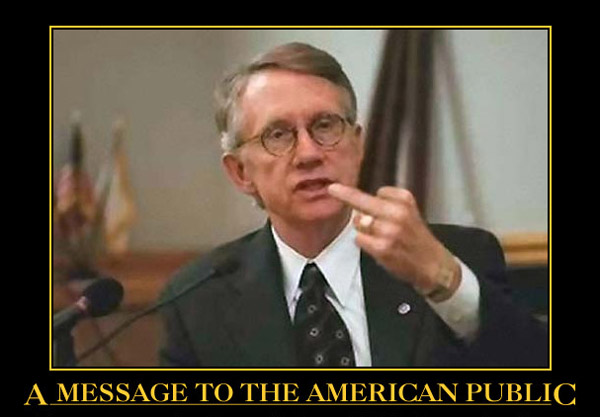
Mormon Politicians
Mormon United States Senator Harry Reid
(Mormon politicians are religious fanatics and hypocrites who can not be trusted)
Taxpayer-Funded Abortion on Demand, Courtesy of a Catholic and a Mormon
By
Eileen McDevitt and Larrey Anderson
American Thinker
March 20,
2010
It
is beyond ironic that a Mormon, Senate Majority Leader Harry Reid, and
a Catholic, Speaker of the House Nancy Pelosi, are in charge of passing
ObamaCare. If passed, the legislation will federally fund elective
abortions in every state. Reid's and Pelosi's respective religions,
both of which (at least according to the churches' official doctrines)
ardently oppose abortion, are letting them get away with it.
Apparently, in this day and age, the powerful are exempt from following
God's laws.
While having been formed centuries apart and on different continents,
the Catholic Church and the Church of Jesus Christ of Latter Day Saints
(LDS, or Mormons) share some strikingly similar attributes. The leader
of the Catholic Church, its Pope, and the leader of the LDS Church, its
President, are selected from the innermost ring of their churches'
hierarchies. In each church, this ring is representative of the
original twelve apostles of Jesus Christ. Each church believes that its
respective leader is divinely inspired and speaks for God.
Both churches have clear and exacting positions on what they believe to
be God's teachings and the tenets to which humans must adhere in order
to live a morally honorable life. Failure of a church member to adhere
to core and fundamental doctrines results in discipline -- and can even
lead to excommunication (expulsion).
Yet it appears that both churches are becoming more humanistic by
turning a blind eye to some of their core teachings -- as well as by
making exceptions to crucial doctrines for the political class. Did God
stop talking to these leaders?
The Catholic Church has ten core tenets referred to as the Ten
Commandments. The fifth of these commandments includes a provision that
prohibits the killing of humans, commonly referred to as murder. For
centuries, the Catholic Church has held that abortion is murder and
accordingly has forbidden the practice.
In November of 1974, Pope Paul VI, considered the most open and
modernizing Pope in recent history, set forth a twenty-seven-point
"Declaration on Procured Abortion." It remains the current position of
the Catholic Church:
The right to life is no less to be respected in the small infant just
born than in the mature person. In reality, respect for human life is
called for from the time that the process of generation begins. From
the time that the ovum is fertilized, a life is begun which is neither
that of the father nor of the mother, it is rather the life of a new
human being with his own growth. It would never be made human if it
were not human already.
Nevertheless, a small group of sixty American nuns, who have allegedly
devoted their lives to the Catholic Church, sent a letter to the U.S.
Congress supporting abortion. This is a position in direct
contravention of the divinely inspired teachings and declarations of
the Catholic Church.
In response, the Council of Major Superiors of Women Religious, the
sanctioned society representing women of over 103 Catholic service
organizations in America, sent a letter to Congress officially opposing
the proposed health care bill:
In a March 15th statement, Cardinal Francis George, OMI, of Chicago,
president of the United States Conference of Catholic Bishops, spoke on
behalf of the United States Bishops in opposition to the Senate's
version of the health care legislation under consideration because of
its expansion of abortion funding and its lack of adequate provision
for conscience protection.... Protection of life and freedom of
conscience are central to morally responsible judgment. We join
the bishops in seeking ethically sound legislation.
No action has been taken by the Vatican to discipline the sixty rogue
nuns who chose to openly and defiantly misrepresent the Catholic
Church's position on abortion to Congress, to U.S. citizens, to the
world.
Pope Paul VI was equally clear that it is a violation of the Catholic Church's basic tenets to support and/or vote for abortion:
It must in any case be clearly understood that whatever may be laid
down by civil law in this matter, man can never obey a law which is in
itself immoral, and such is the case of a law which would admit in
principle the liceity of abortion. Nor can he take part in a propaganda
campaign in favor of such a law, or vote for it.
Nancy Pelosi, purportedly Catholic, has long been an open proponent for
abortion and today is the leading champion for nationally funded
abortion. Pelosi was granted an audience with the sitting Pope. The
Pope merely criticized Pelosi for her position and failed to take any
disciplinary action for Pelosi's open "propaganda campaign in favor" of
abortion. Meanwhile, Pelosi's local priest in San Francisco continues
to give her communion -- even though the Pope has stated that those who
support abortion should not take part in the Catholic sacrament.
The official position of the LDS (Mormon) Church on abortion closely
mirrors that of the Catholic Church. The LDS Presidency has
emphatically stated the position of their church, likening abortion to
murder:
Abortion must be considered one of the most revolting and sinful
practices in this day, when we are witnessing the frightening evidence
of permissiveness leading to sexual immorality.
Members of the Church guilty of being parties to the sin of abortion
must be subjected to the disciplinary action of the councils of the
Church as circumstances warrant. In dealing with this serious matter,
it would be well to keep in mind the word of the Lord stated in the
59th section of the Doctrine and Covenants, verse 6, "Thou shalt not
steal; neither commit adultery, nor kill, nor do anything like unto
it." [Emphasis added.]
But the Mormon Church has taken no "disciplinary action" against Harry Reid. According to the Salt Lake Tribune:
Senate Majority Leader Harry Reid keeps a copy of the Book of Mormon in
his office just off the chamber floor. There's a second copy handy to
give away to someone in need of spiritual guidance.
The Temple-recommend-carrying Reid is very active in his church, say fellow members in the Washington area.
Only the most obedient of Mormons are given "temple recommends." These
recommends allow faithful members access to the Church's sacred temple
ceremonies. Harry Reid, despite his vocal and public support for
legislation that provides federal funds for abortion, is known to have
such a "temple recommend."
Abortion is murder unless one is the Senate Majority Leader or Speaker
of the House, just as advocating abortion is a sin unless one is the
Senate Majority Leader or Speaker of the House.
In the ultimate slap in the face to the Catholic Pope and the Mormon
President, Pelosi and Reid have joined in the demand that the
congressional health care vote be set for Sunday. Under both Catholic
and Mormon doctrines, Sunday is a day of rest, a day set aside for the
worship of God. Yet on this Sunday, in the middle of Lent, America's
most powerful Catholic and Mormon are abandoning God in favor of
nationally funded abortion on demand.
Eileen McDevitt is a retired attorney. Larrey Anderson is a writer, a
philosopher, and submissions editor for American Thinker. He is the
author of The Order of the Beloved, and the memoir Underground: Life
and Survival in the Russian Black Market.
Utah Senate leader resigns 1 day after his arrest
The Associated Press
Jan. 16, 2010
SALT LAKE CITY — State Senate Majority Leader Sheldon Killpack resigned
from office Saturday, a day after he was arrested on suspicion of
driving under the influence.
The Syracuse Republican said in a statement he decided to quit after discussing his options with his family and friends.
"My heart weighs heavy. I have a tremendous amount of respect for the
legislative process, my legislative colleagues and for my
constituents," said Killpack, 41.
"At this time, the Legislature would be a distraction from what is most
important and, frankly, I find that I have become a distraction to the
Legislature. In light of that, I have decided to tender my resignation
... effective immediately."
Killpack, whose father was killed by a drunken driver when Killpack was
a teenager, supported and sponsored drunken-driving measures during his
six years in office.
The Utah Highway Patrol said a trooper pulled over Killpack early
Friday in Salt Lake City after observing his vehicle driving
erratically.
The trooper detected a "strong odor of alcohol" and asked Killpack to
perform field sobriety tests. Killpack did the field tests but refused
to take a breath test. The patrol got a warrant to take blood, and
Killpack was booked into jail and later released. The patrol has said
blood results could take anywhere from two weeks to a month.
Killpack was appointed to the state Senate in 2003, then won election in 2004. He earned a second four-year term in 2008.
He was elected to the No. 2 position in Senate GOP leadership last year and was viewed as a rising star in Utah politics.
State GOP Chairman Dave Hansen criticized Killpack in a statement
Friday, saying it was "inexcusable for anyone, especially those in
positions of public trust, to violate our laws."
Senate President Michael Waddoups, R-Taylorsville, said he did not advise Killpack on whether to quit.
"I told him it was a personal matter, that he should decide it in
consultation with his family, and I'd support him if he stayed and I'd
support him if he left," Waddoups told the Salt Lake Tribune.
But Waddoups added it would be tough for Killpack to face his
conservative constituents. Killpack is a member of the Mormon church,
which counsels its members not to drink alcohol.
Killpack apologized in a statement Friday, saying he must be held accountable for his actions.
He had attended a fundraiser for state Rep. Greg Hughes, R-Draper, on
Thursday night, but no alcohol was served at the event. Former state
Rep. Mark Walker was his passenger when he was pulled over.
With tough election ahead, Bennett pens LDS book
'Leap of Faith' » Campaign denies senator's book timed to politics
by Thomas Burr
The Salt Lake Tribune
08/25/2009
Washington » Sen. Bob Bennett knows The Book of Mormon is true, and in
a new book he tells others how he came to that conclusion. (with no
facts to support that conclusion)
The book, published by LDS Church-owned Deseret Book, comes as the Utah
Republican faces a tough re-election challenge from within his own
party ranks. In fact, Deseret Book's news release was issued the same
day the conservative group Club for Growth launched a blistering attack
on Bennett's bipartisan health-care-reform bill co-sponsored by Oregon
Democratic Sen. Ron Wyden. (no non-LDS church owned publisher would
touch this book of fiction)
Bennett's campaign says the timing of the book's release has nothing to
do with politics, resting entirely in the hands of the publisher. (He
is trying to get reelected based on religion in Utah)
In the book, Leap of Faith , Bennett applies four forgery tests to
determine whether the book is a fake, according to the news release.
(scientific tests have already concluded it is fiction)
Deseret Book said Bennett decided to write the book after becoming
upset with the "shallow" media coverage of The Book of Mormon leading
up to the 2002 Winter Olympics in Salt Lake City. (loyal cult members
will always get upset when confronted with the facts)
"Most of it was evenhanded, but publications that discussed The Book of
Mormon in any degree of detail almost universally treated it as a
fabrication," Bennett said in a release, "one whose claims and history
were so bizarre that no one with any common sense could believe it to
be authentic." (many scientific persons in different fields of
expertise are correct in their analysis)
The Book of Mormon, according to the LDS Church, was translated from
ancient gold plates revealed by an angel to church founder Joseph
Smith. It is held out as the documented history of God's interactions
with Israelites who came to America before the birth of Jesus Christ.
(pure fiction)
Bennett acknowledges that the book "requires a leap of faith" to believe. (no facts support it)
"I offer it in the hope it will convince all who have an interest in
The Book of Mormon, be they believers or skeptics, that any decision
with respect to its origins requires a leap of faith," Bennett wrote in
the preface to his 318-page book. (no one else would write the preface)
The three-term senator faces three GOP competitors in his 2010
re-election bid, all of them portraying themselves as more conservative
alternatives to the incumbent. (Bob Bennett is out of touch with
reality)
The timing of the book's release immediately raised questions about political motives. (correct)
"Certainly, it's hard to believe it is purely a coincidence that the
same time he's running for re-election he's also working on this book
and releasing it in advance of the [potential] primary," said
University of Utah political science professor Matthew Burbank. (Bob
Bennett is running scared)
Under Utah's system, the top two vote-getters in a state Republican
convention face off in a primary unless one secures 60 percent of the
delegate vote -- and thus the nomination -- at the convention. (Bye Bye
Bob Bennett)
Burbank, though, said Bennett might be trying to answer a question that
voters don't have: They already know he is Mormon. But he says it
likely will give him a buzz in LDS circles. (Bob Bennett is running
scared)
"It may remind some people that they like him," Burbank said, "but I
doubt it will change anybody's mind." (Bob Bennett is trying to get
reelected based on religion in Utah)
Utah Attorney General Mark Shurtleff, who is soon to release his own
book on the U.S. Supreme Court's Dred Scott ruling, said he doesn't
believe Bennett's book has anything to do with the election. (Looks
like Shurtleff is off the mark)
But another GOP challenger, Tim Bridgewater, wasn't so sure. (Tim is trying to find the bridge to Washington riches)
"The timing seems strange, but other than that I'll reserve judgment
until having read the book," he said. (I wouldn’t waste my time reading
about Bob Bennett’s gut feelings)
The campaign denied any political motive in the book's publication. (bullshit)
The senator's son and campaign manager, Jim Bennett, said the campaign
has no involvement in the book and Deseret Book was responsible for the
timing of its release. (The entire family has a financial stake in Bob
Bennett’s reelection)
"This book is in the works for something around seven years," Jim
Bennett said. "This has been going through the editing process at
Deseret Book for quite some time. No one anticipated one way or another
what the political climate would be when this was released." (bullshit)
Bennett, according to the news release, honed his skills in applying
forgery tests while working as public-relations director for the late
billionaire Howard Hughes. Bennett previously applied similar tests to
disprove Clifford Irving's supposedly authorized Hughes biography,
which infamously turned out to be a hoax, and later the fake Hughes'
will purporting to leave a big part of his fortune to Utah gas-station
owner Melvin Dummar. (Bob Bennett probably came up with the bogus
Howard Hughes Mormon will via forgery)
Bennett's book applies four approaches: Is the book consistent within
itself? Is there evidence to back up the book's claims? Would someone
have a motive to fake the book? Is there a revelation in the book that
someone faking the text would not have known at the time? (The answer
to the third question is yes.)
His findings? Bennett says that there are legitimate issues with the
book and that he fairly addresses those rather than hide them. Deseret
Book calls it a "remarkably balanced approach." (The LDS church will
back up any book that supports the BOM)
In the end, the book's conclusion is that it takes faith to believe the
origins of The Book of Mormon. (no facts to support the BOM)
"No one should make that leap without having heard all sides of the
argument," Bennett writes in the preface. (Senator Bob Bennett is a
religious fanatic)
End LDS-legislator huddle
Rebecca Walsh
The Salt Lake Tribune
1/26/2009
Mormon church elders met with state legislative leaders at 50 E. North Temple last week.
It happens every year -- like General Conference or political neutrality statements. Republican lawmakers hashed over their legislative agenda with a church apostle, the presiding bishop, a church lobbyist and PR staffers. Two weeks ago, it was Democrats' turn.
After consulting the oracles, the Senate president and House speaker reported back: LDS Church leaders might be willing to do away with private club memberships if lawmakers come up with a system for scanning driver licenses.
Utahns are so used to it, we don't even blink anymore. It was a routine news story, rather than an unconstitutional outrage.
"There's not much separation of church and state going on there," says Joe Conn, a spokesman for Americans United for Separation of Church and State. "It is a clear violation of American democratic principles. The implication is that one church will have more influence than any other group in the state."
More than an implication, it's reality. The ring kissing has settled into policy over generations -- from 1851, when Mormon prophet Brigham Young was inaugurated governor of the Utah Territory, to today, when more than 80 percent of lawmakers are faithful members of The Church of Jesus Christ of Latter-day Saints.
Meetings at North Temple are a shortcut -- for governors hoping to end-run opposition to their plans to liberalize liquor laws, lawmakers trying to build public support for controversial legislation or gay-rights groups hoping to gather up crumbs in the wake of Prop 8. Any smart reporter first asks, "Have you checked with THE CHURCH?"
It's realpolitik. "The overwhelming majority of legislators are LDS," says Will Carlson, public policy manager for Equality Utah. "If the LDS Church made a statement of opposition, the [Common Ground] bills would have no chance."
Church and legislative leaders try to shellack their closed-door meetings with a veneer of objectivity. LDS spokesmen say legislators request the meeting each year. The church hires a lobbyist like every other special interest. And, they note, the elders didn't take a stance on any particular pieces of legislation, including the Common Ground bills.
Church spokesman Scott Trotter says the annual luncheon allows LDS leaders to "remind" legislators of the church's political neutrality. The 15-year-old tradition was started to help lawmakers "gauge their constituents' opinions on important issues."
Lawmakers argue that they meet with all denominations -- Catholic, Baptist, Lutheran. Mormon elders are just a few among many. And church approval is no guarantee of legislative success; legislators still refused to approve a hate-crimes bill that listed sexual orientation. But church opposition leads directly to the round file.
Conn says the mountaintop meetings might be a pragmatic acknowledgement of Utah demographics. But that doesn't make it all right. Nowhere else in the country do lawmakers consult with one denomination in this way -- not Boston, not Birmingham. It's one thing for lawmakers to consult privately with individual Mormon bishops and stake presidents. It's another to make an annual political event out of it.
"It is a clear violation of American democratic principles," he says. "It not only looks like theocracy, it suggests there is a theocracy."
There's an easy way to fix this: End the annual meetings. Send church lobbyist Bill Evans to the hearings with everybody else.
Mormons' Uneasy Victory
By Stephen Stromberg
Washington Post
Monday, November 24, 2008
The Church of Jesus Christ of Latter-day Saints is becoming a potent political force. Last year's story was that Mormons had risen to some of the highest offices in America -- Senate Majority Leader Harry Reid belongs to the church, as does former Massachusetts governor Mitt Romney. This year's headline is that, with the encouragement of their religious leaders, Mormons gave loads of money and man-hours to pass Proposition 8 in California, which banned same-sex marriage in the state. Indeed, they were probably the most organized and consequential force behind the measure's passage. But in the face of post-election protests outside its temples, the church doesn't seem to want to take much credit.
Michael Otterson, a church spokesman, recently told the Associated Press that he was "puzzled" by the protesters' targeting of Mormons. "This was a very broad-based coalition that defended traditional marriage in a free and democratic election," he said. "It's a little disturbing to see these protesters singling out the Mormon Church."
There are Mormons who fought hard against the measure, drawing attention to the extent of Mormon involvement by outing fellow members on donor lists. There are Mormons so upset they're thinking of renouncing their church membership as well as Mormons who wholeheartedly supported the initiative. And then there are those who gave money out of obedience to their leaders, without much thought to the policy it was being used to support. Regardless of where they fall on this spectrum, many probably feel a bit like Otterson: uneasy with all the attention.
It's unusual for an institution to shrink from responsibility for a victory at the ballot box. But being Mormon isn't quite like being, say, Southern Baptist. The highly centralized LDS church makes a lot of Americans nervous, and it has done so since Joseph Smith founded the movement, which was driven out of state after state before settling in the Salt Lake Valley. Where some see an efficient religious organization that requires unusual devotion from its members, others see conspiracy, even cult.
It's an impression that has its roots in, among other things, the church's practice of polygamy in the 19th century, and it has been self-reinforcing since. Non-Mormons see the church as outside the mainstream; Mormons feel under attack, which fosters a tight communalism within their congregations, and they try to avoid confrontation. Hence Otterson doing his best to play down the role church members had in the victory of Proposition 8 in the face of throngs demonstrating in front of temples.
This is new and awkward territory for many Mormons. Members of a virulent anti-Mormon fringe have protested at LDS churches and temples for years. The church, meanwhile, has always had a difficult relationship with gay men and lesbians. But now it has drawn the focused attention of that large, vocal and organized segment of America, with which huge swaths of the country sympathize. Boycotts of some Mormon-owned businesses are underway. One Californian spelled out an obscene insult to Mormons in large, block letters on his hillside balcony.
This attention presents the church and its members with some big decisions. They have gotten a taste, sweet and bitter, of what this remarkable organization of souls can do -- and the reactions it can provoke -- in the rough world of American politics. After Proposition 8's passage, the church's reputation will likely be on the upswing among religious conservatives, some of whom have typically been the most ardent anti-Mormons. For many of these people, the most important vote Nov. 4 was on Proposition 8, not Barack Obama.
The church, which can easily mobilize its members with a word from Salt Lake, can now become a prominent player in the culture wars. There will no doubt be more battles over gay marriage in the states. Will the church ask Mormons to send in more checks? And will they respond as enthusiastically the next time? One thing is clear: If the church decides to continue flexing its political muscle, it cannot expect to escape criticism, some of it pretty harsh.
Even if it chooses the other course -- shrinking away from the political scene, as it has after other forays into politics -- the anger over Proposition 8 will probably smolder for some time. If Mitt Romney runs for president again, Americans will address, with renewed passion, the question of whether he would be a puppet of Salt Lake City in the Oval Office. And with all the old narratives about Mormons floating around -- that they are secretive, rich, excessively traditional and theologically odd -- it will be hard for the church to stay comfortably out of the political spotlight.
Stephen Stromberg writes for The Economist in its Washington bureau.
Reid's religion not an issue in Senate
By Thomas Burr
The Salt Lake Tribune
11/23/2006
Washington - The day after it was clear the Democrats would rule the U.S. Senate, President Bush invited its top two leaders to the White House for conversation and coffee.
It's a good bet that Sen. Harry Reid didn't partake of the latter.
The Nevada Democrat, a faithful Mormon, won't touch coffee, tea or alcohol.
"He doesn't even drink soda. I'm sure it was orange juice" Reid sipped during the presidential chat, joked Tessa Hafen, Reid's former spokeswoman.
It's a small but important detail to note for Reid, who was elected last week to lead the Senate when Democrats take over in January.
He'll assume the role of majority leader and take his place in history as the highest-ranking elected Mormon in U.S. history.
Observers say that shows that Mormonism, long a religion seen outside Utah as peculiar, is becoming more mainstream.
"It's an important symbol," says John Green, a senior fellow at the Washington-based Pew Forum on Religion and Public Life. "That has always been a mark of religious groups in American society, that in some important sense the group has become part of the mainstream."
Mormons already hold several key positions in Washington. Former Utah Gov. Mike Leavitt is secretary of Health and Human Services; two federal departments have Mormon chiefs of staff; and five senators and about a dozen representatives are Latter-day Saints.
But Reid has gone further than any of them.
Born in a small mining town in Nevada, Reid now attends services at a ward house a block outside the District of Columbia every Sunday he is in town. He always finishes his home teaching - where members check on a few families to ensure they're well - and once taught a Gospel doctrine class. There's a copy of the Book of Mormon on his office bookshelf.
"He's always looking after other people," says his bishop, Michael Seay, the lay leader of his ward. "He's very much loved by the members."
And while he doesn't push issues simply because of his faith, friends say Reid's religion and his stands as a senator are inseparable. Reid, the father of five boys, is anti-abortion and pro-death- penalty and opposes same-sex marriage and gun control. But he's no Republican-lite; he takes liberal-to-moderate stands on issues such as education.
"His faith clearly affects who he is," says Kai Anderson, Reid's former deputy chief of staff. "It's a big part of what makes him a decent, kind, loving man. But he doesn't legislate it."
Unlike many other Mormon politicians, Reid is not often identified by his religion. Many news outlets across the country noted his faith only after he was elected majority leader. It does not appear to be an issue in the Senate.
"It's a historical milestone that I'm sure LDS scholars will note," says Sen. Bob Bennett, a Mormon Republican from Utah. "Interestingly, in the Senate no one seems to care."
Sen. Barack Obama, D-Ill., wasn't aware that Reid would be the highest-ranking elected Mormon, and it didn't seem to matter to him.
"Religion is not a factor," Obama says. "Obviously, members of the Church of Jesus Christ of Latter-day Saints have risen to the heights in business and government - look at Orrin Hatch, for example - so, in some ways, it's not considered particularly newsworthy."
Same for Sen. Patrick Leahy, D-Vt., who noted that Reid is a Mormon, Majority Whip-elect Richard Durbin is a Catholic and Charles Schumer, head of the Democratic Senate Campaign Committee, is Jewish.
"Religion is becoming less and less significant in everybody's mind," Leahy says. "I have never ever once heard anybody - in Harry's presence or not - mention anything about his religion."
More important to the Democrats, with their narrow majority, is Reid's propensity for negotiation and compromise.
While he'll throw bombs when necessary, "One thing about him is he is balanced, prudent and very easy to work with," says William Nixon, a Washington lobbyist, former Hill staffer and an LDS stake president. "He is the example that the Democratic Party is not going to allow itself to be co-opted by the far left."
Reid calls Iraq war 'worst foreign policy blunder' in U.S. history
By Tad Walch
Deseret Morning News
October 9, 2007
PROVO — U.S. Senate Majority Leader Harry Reid called the U.S. invasion
of Iraq in 2003 "the worst foreign policy blunder in our country's
history" during a speech Tuesday at Brigham Young University.
A substantial portion of the 4,091 students, faculty, staff and
visitors at the Marriott Center for the University Forum applauded
Reid's statement. An equal number then applauded when he gave equal
time to the other side: "Some say this war of choice was our only
reasonable alternative."
The senator from Nevada's wide-ranging, well-received talk covered his
rise from an impoverished childhood and the constant questions about
his membership in the Democrat Party and in The Church of Jesus Christ
of Latter-day Saints.
"It is not uncommon for members of the church to ask how I can be a
Mormon and a Democrat," he said. "Some of you have wondered, too, huh?"
Reid said the Republican majority among church members is simply
cyclical. "Democrats have not always been in the minority, and I
believe we won't be for too long."
Reid believes his faith informs his politics. "I am a Democrat because I am a Mormon, not in spite of it," he said.
He discussed his faith, bearing testimony of his belief in Heavenly
Father, Jesus Christ, the Book of Mormon and the prophethood of both
church founder Joseph Smith and LDS Church president Gordon B. Hinckley.
He also described his and his family's faithfulness, noting that all
five of his children attended BYU and married in LDS temples. The three
boys served LDS missions.
"Prayer has always been an important part of my adult life," he said.
Abortion is a major reason many LDS turn to Republican circles, but
Reid called himself is proof someone can be pro-life and a Democrat,
and said he has been so through 25 years in Congress.
Calling his position as leader of Senate Democrats "the world's best
job," he declined to take sides in the Democratic presidential primary.
What about fellow Mormon Mitt Romney, who is running for the Republican nomination?
"I hope that Mitt Romney's presidential bid is determined by his
political stands, and not his religion," Reid said, drawing applause
from the majority of the audience.
Reid spent the first half of his 40-minute speech describing his
journey from an underprivileged, non-religious childhood in tiny
Searchlight, Nev., to his position as the highest-ranking Mormon in
American government.
Reid and his wife Landra joined the LDS Church while students at Utah State University. The Reids now have 16 grandchildren.
Reid said his hero is Franklin Delano Roosevelt.
"Social security is the most successful social program in the history
of the world," he said. "Roosevelt tackled the greatest economic crisis
we ever had with the three Rs: relief, recovery and reform. And let's
not forget, Franklin Delano Roosevelt was the commander-in-chief of the
greatest military ever assembled at a time of great crisis in the
world."
Reid credited unions with creating the 40-hour work week, decent wages
for workers and safe working conditions. He called global warming an
environmental emergency.
At the end of his speech, Reid earned a standing ovation from a small
percentage of the crowd and grateful applause from the rest.
"I was impressed with him," said Stacie Borneman, a 22-year-old
political science major from Farmington who said she is a Republican.
"I thought he did a good job expressing his feelings and our
responsibility to serve in our communities."
There were no organized protests of Reid's visit and no protest signs.
One person did walk out between the end of Reid's speech and the
traditional closing prayer and called out that students should not be
deceived by Reid.
"It's good to hear differing opinions and to be respectful even if you
don't agree politically," Borneman said, "and he gave both sides of the
issues he raised."
Reid encouraged students to give public service and told them the American dream is alive.
His father was a hard-rock miner. To make ends meet, his mother took in laundry from the town's 13 brothels.
"I learned in America, it doesn't matter the education of your parents,
what their religion is or isn't, their social status — we had none —
the color of their skin or their economic status.
"I am an example of this. If I made it, anyone can."
Reid speaks out against past Mormon leaders
Reno Gazette Journal
10/11/2007
PROVO, Utah (AP) -- Senate Majority Leader Harry Reid said Mormons were ill-served by the conservative politics of past church leaders.
The Nevada Democrat, who is Mormon, specifically named Ezra Taft Benson, president of the Church of Jesus Christ of Latter-day Saints from 1985 to May 1994 and U.S. agriculture secretary during the Eisenhower administration.
"Members of the church are obedient and followers in the true sense of the word, but these people have taken members of the church down the path that is the wrong path," Reid told reporters Tuesday after speaking at church-owned Brigham Young University.
Reid said he joined the church at age 19.
"My faith and political beliefs are deeply intertwined. I am a Democrat because I am a Mormon, not in spite of it," he told more than 4,000 people at BYU's Marriott Center.
The LDS religion is the dominant faith in Utah, the world headquarters of the LDS church. Utah also is among the most conservative states, regularly supporting Republican candidates for president.
Vice President Dick Cheney gave the commencement speech last spring at BYU.
The church said it does not endorse, promote or oppose political parties, candidates or platforms. Spokeswoman Kim Farah said the church had no comment on Reid's remarks.
Mitt Romney, a Mormon, has found Utah to be a fertile place to raise money for his GOP presidential run. He was in charge of the 2002 Salt Lake City Winter Olympics.
Reid said voters who like Romney should be influenced "by his political stands and not his religion."
He said Mormons must recognize there are more important issues than abortion and gay marriage. Reid opposes abortion.
"We have a country that needs to do something about health care. Global warming is here. We have a president who doesn't know how to pronounce the words," Reid told reporters, referring to President Bush.
Mr. Neels is an HNN intern.
January 8, 2008
In a classic comparison of
father and son, one of many in American political history, Mitt Romney
(Republican hopeful for the 2008 election) has experienced a campaign remarkably
different from his father’s, George Romney, some forty years ago.
The 1968 presidential campaign was one of those elections that make the
textbooks. Coming at the high water mark of the Vietnam War, and following on
the revelation by President Lyndon Johnson that he would not seek another term
in office, the stakes were certainly high and the list of possible candidates
was limitless.
Joining George Romney, names dropped for possible nomination by the Republican
Party included former Vice President Richard M. Nixon and California Governor
Ronald Reagan. For the Democratic Party, hopefuls included New York Senator
Robert F. Kennedy and current Vice President Hubert Humphrey.
Romney’s role in the election was short but memorable. A former chairman of
American Motors from 1954 to 1962, Romney had risen in the ranks of the
Republican Party, winning three consecutive terms as governor of Michigan before
declaring his run for the White House. A late 1967 poll ranked him as the number
one candidate among moderate Republicans. And although his religious affiliation
was well known, it played virtually no role in his candidacy.
Rather, during the time of his candidacy a much larger issue for the Romney
campaign was whether or not Romney, born to American parents in Chihuahua,
Mexico could be classified as a naturally born citizen – a stipulation that
applies only to those seeking the presidency. However, this issue also took a
back seat to a more crucial one – one that would ultimately cause him the race.
All signs suggest that Romney’s future pointed in no other direction than up.
But, following a televised comment that attributed his support for the Vietnam
War to “brainwashing by the U.S. military” Romney’s campaign became
enshrouded in an escalating controversy that dropped his ratings in the polls
and caused him to finally concede the race shortly before the 1968 New Hampshire
primary.
In an interview later in life, Romney insisted that his comments regarding
Vietnam had nothing to do with his bowing out. Rather, he attributed the true
nature of his concession to Nelson Rockefeller joining the race. Between
Rockefeller and Nixon, Romney stated he had no chance. Whatever the cause of the
demise of his career historians and journalists agree that his life-long
membership in the Church of Jesus Christ of Latter-day Saints was a non-issue in
those early days of the 1968 race.
The 1968 campaign may not have been about religion, but the 1960 campaign
certainly was. The questions regarding the influence of the Pope on a potential
Catholic president weighed heavily on the minds of many Protestant voters and
prompted JFK to make a speech regarding the influence of his faith on his
possible presidency. By 1968 the Vietnam War and the social changes of the 1960s
seemed far more important to the electorate than a candidate's religion.
In regards to questions of Mitt’s religious loyalty, Senator Ted Kennedy has
said, “that issue died with my brother, Jack.” But headlines that say quips such
as, “Does Romney’s Mormonism Matter?” “Romney’s Evangelical Problem,” and “Will
Faith Hurt Bid for the White House?” make it clear that the issue is very much
alive in modern-day American politics.
And though he was never questioned during the campaign on his faith, George
Romney’s political career, and his life as a whole, was certainly influenced by
his faith. In December of 1968, just following Romney’s appointment as Secretary
of Housing and Urban Development by president-elect Richard Nixon, a New York
Times article stated that Romney “sees himself bringing the idealism of his
Mormon religion to business and politics in general.” Still, it is to be noted
that clips such as this usually noted Romney’s religion as an advantage to his
position, not a weakness, and did not spring up until after he had left the
race.
Mitt Romney simply does not have the luxury of avoiding the topic of religion
like his father did because religion has become such an influential part of our
public debates, whereas it was almost nonexistent in the political realm of the
‘60s. Certainly religion played a prominent role in the 2000, 2002, and 2004
elections, as Kevin Coe and David Domke demonstrated in an
article published on HNN a few weeks ago. Almost certainly religion will
continue to play an outsized role.
SALT LAKE CITY (AP) — Transcripts of 1996 meetings involving the governor at the time discussing how to incorporate Mormon principles into policy will remain available to the public because the talks involved state business, an official said Monday.
Mike Leavitt, now U.S. secretary of health and human services, had asked the Utah State Archives to review the transcripts' classification after they were obtained by The Salt Lake Tribune and the subject of a story Sunday.
The documents are transcripts of "Early Morning Seminary" meetings involving Leavitt, staff members and others at the governor's mansion.
Meetings opened with a prayer, followed by stories from the Book of Mormon and discussion of how the lessons could apply to government.
Leavitt had argued that some people at the meetings expressed beliefs that were personal or "even sacred." But archivist Patricia Smith-Mansfield said the records appear to involve state business and will remain accessible.
During one session, Leavitt and others talked about King Benjamin, who in the Book of Mormon encourages people to serve one another. Leavitt said the king's era would be a "prime one to look at" when studying the success of civilizations.
Senator Smith's marriage remarks raise questions for opponent
Jeff Merkley's camp wonders whether the senator defended polygamy when speaking of persecuted Mormon ancestors in regards to gay marriage
Saturday, June 14, 2008
HARRY ESTEVE
The Oregonian Staff
U.S. Sen. Gordon Smith caused a political stir this week when he linked the raging debate over same-sex marriage to persecution of his Mormon ancestors -- a comparison that his Democratic opponent said amounts to a defense of polygamy.
During a gay-rights panel discussion earlier this week at the Center for American Progress, Smith, a Republican, was asked about his views on same-sex marriage. What followed was a lengthy, deeply personal response, including comments about his Mormon ancestry.
"Part of what I fear, as you start defining marriage -- we have a long history of doing that in this country, and my Mormon pioneer ancestors were the victims of that," Smith said. "They were literally driven from the United States in the dead of winter for following their religious beliefs. I don't want that coming back."
Smith prefaced his comments with, "My campaign people will kill me for saying this, but . . ." which quickly caught the attention of Oregon House Speaker Jeff Merkley, Smith's Democratic opponent in the November election.
"We're not certain what he is saying," said a Merkley spokesman, Matt Canter. "It appears he is defending polygamy and believes it was wrong for the government to establish a definition of marriage as between one man and one woman. But Sen. Smith will need to clarify his remarks."
Smith has supported a federal law that defines marriage as between one man and one woman. In a statement to The Oregonian on Friday, Smith said: "I have been a strong proponent of gay rights -- such as domestic partner benefits, ENDA (anti-discrimination laws) and stronger prosecution of hate crimes," Smith said, "but I oppose changes in the current definition of marriage. I regret using a clumsy historical analogy to make that point."
He did not respond directly to Merkley's charge that he was defending polygamy. Early Mormonism was associated with plural marriages with more than one wife, a practice the church later rejected and no longer condones.
In the past, Smith has said his Mormon background helped him empathize with victims of discrimination, saying he knows what it's like to be in a minority and have people make assumptions.
In his response during the panel discussion, Smith said he voted for the federal marriage definition because "I didn't want federal judges to impose it on other states that were voting differently."
He went on to say that changing the definition of marriage has broad implications that go beyond the gay and lesbian community. "What I'm telling you from the bottom of my heart is I'm trying to do the best I can without creating a much bigger problem," Smith said.
Canter
called Smith's statement and response part of a pattern. "This has happened a
number of times now. Smith says something very confusing that offends people and
then backpedals when the press starts asking questions."
Mormon MP adds Utah stop to bill
Darrell Giles
September 14, 2008
A STATE Opposition MP has billed taxpayers for a US trip to visit fellow members of the Mormon church.
David Gibson, the Liberal National Party Member for Gympie, claimed a $305 daily allowance during his week in Utah in June.
Mr. Gibson, a devout Mormon (Church of Jesus Christ of Latter-day
Saints) who is the Opposition's climate change spokesman, justified the
trip as a study tour because he visited Utah State University's
sustainable building and irrigation engineering program.
He also billed taxpayers for attending The Art of Political Campaigning
conference in Washington, where one of the sessions taught delegates
how to dig the dirt on rival politicians.
Mr. Gibson said the three-day Washington conference was relevant because he was the Opposition campaign spokesman.
One of the presentations was called "Dumpster Diving: How to find and use opposition research".
Conference promotional material read: "Nothing says 'gotcha' to an
opponent like finding good dirt . . . and how to best use it to boost
your candidate's campaign."
Another session was "Effective spin: Damage control and crisis management".
Mr. Gibson said he did not attend the "dirt-digging" presentation.
Mr. Gibson claimed for 10 days of his 17-day trip with his wife Alicia,
at a cost to taxpayers of $3050. But his brief travel itinerary tabled
in State Parliament last week revealed only seven days which might have
related to parliamentary business.
He also presented a concise eight-page report to Parliament outlining
the "great value" of the trip. It was much lighter reading than a
report provided by Premier Anna Bligh after her one-week US trip in
June, which totaled a hefty 215 pages.
While in Utah, Mr. Gibson and his wife saw a rehearsal of the Mormon
Tabernacle Choir and visited the church's family history library.
The MP also dined with a church friend in Salt Lake City, and said he
met senior Mormon church identity and Utah Governor Jon Huntsman to
discuss environmental issues.
The church website in Utah provided details of Mr. Gibson's trip to the Mormon Brigham Young University and church headquarters:
"The experience . . . will give Mr. Gibson the insight of how things
can be done on a very large scale and a benefit to his political
career."
In New York, Mr. Gibson met members of the Design Trust for Public
Space, and a member of Mayor Michael Bloomberg's planning and
sustainability unit.
Mr. Gibson's report said his US objective was to "gain an understanding and appreciation for new approaches in campaigning".
He told The Sunday Mail the total trip cost him $15,000; he paid fares,
accommodation and meals, and claimed $3050 taxpayer money as part of
the stipulated daily overseas travel allowance: "I did not do anything
under-handed. I made the Premier aware of everything" and she approved
the 10-day allowance.
Mr. Gibson's report contained a 37-word summary, including: "The trip .
. . was very informative. The conference in Washington was extremely
interesting and the associated visits were also of great value in
determining different approaches in a range of sustainability and
environmental issues."