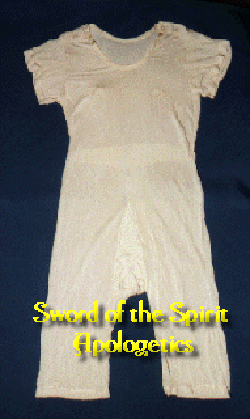
Mormon Underwear
THE SACRED UNDERWEAR OF MITT ROMNEY
Personal Preparation for Temple Blessings, Ensign (CR), May 2001, p.32
Dressmaker creates dream gowns for Mormons - sleeves included
by Jaimee Rose
- Dec. 20, 2008
The Arizona Republic
Mormons hate talking about their underwear.
They're as uncomfortable talking about their underwear as they are wearing their underwear.
A symbol of their faith, the to-the-knee, sleeved underwear is bunchy and billowy and decidedly not modern.
But eventually it must be discussed because they don the church-designed underwear every day. And while they sleep. And on special occasions - even on their wedding day. And to the anguish of Mormon brides, most wedding dresses don't come with sleeves.
Suzanne Novak watches the brides as they sift through the racks of silk and chiffon in her Gilbert bridal shop, their hope dwindling as they try on dress after impossible dress. She watches them fall in love with ivory strapless lace, with sleeveless satin and rhinestones, with spaghetti straps of all sorts, some crafted entirely out of beads.
Novak, owner of Suzanne's Bridal Boutique, sees the corners of their mouths drop when they find the small rack of dresses they can wear tucked away in the back of her shop: high-necked, high-backed, sleeves to the elbows. Dowdy and Matronly Row, Novak says. The dresses all look alike, very '80s prom, deeply Cinderella chic.
But brides today don't want to look like Cinderella, Novak says. They want to look like Heidi Klum.
"I'll fix it, honey," she promises the brides who prance about the store wearing strapless gowns, desperately twining stray sashes around their arms. "We can fix it."
Novak is the sleeve goddess of Gilbert. Her name is whispered among Mormon brides as a miracle worker, a seamstress divine, who can conjure fabric from the ether and turn a trendy strapless dress into a gown both modern and Mormon-approved. She sews sleeves on almost 200 wedding dresses a year, about a third of the dresses she sells.
She sits in the back room of her sunny Gilbert shop for up to 14 hours a day, sewing barefoot, a collection of pens stuck through the graying dark bun piled on top of her head. She is 56 and Hawaiian. She feeds the strip-mall cat, has been known to fetch her UPS man lunch and will bead sleeves until her eyes are blurry to make her brides happy. She loves almost all of them - "Sometimes, we get a stinker," she says - and they love her.
Novak can fix anything. She knows how to drape chiffon just so around the shoulders, how to turn tank-style tops into elbow sleeves. She orders fabric from the dress manufacturers to get the match just right. She can craft white bodysuits to wear beneath tulle and plays patchwork with lace. She folds damask into sleeves so intricate it's impossible to believe they weren't there before.
She has brides try on sleeve templates, just to catch the vision. Then she draws the imaginary gown, sticks her pen in her bun and heads to the workroom to bring it to life.
Bodice wrangling
As a Christian, Novak has never worn Mormon underwear, but she has the contours down pat. The sleeves on women's underwear measure 5inches from the tip of the collarbone downthe arm, the lace-trimmed V-neck hits just at the top of the decolletage and the shorts go to the knee.
The guys have it easier: Their underwear looks like a T-shirt and boxers, only longer, and a tuxedo disguises all. The ladies must wear their underwear beneath pantyhose and even bras, and they scour malls for clothes to cover them, hoisting up low-rise jeans, bemoaning every tank top in sight.
The underwear comes in fabrics such as cotton, nylon and polyester. Some, Novak says, work better than others.
"Honey, you're wearing the wrong ones," Novak tells 20-year-old bride Afton McAferty one evening. McAferty had fallen in love with a gown with spaghetti straps, and her friends had shared the legend of Novak: She won't ask you to explain the underwear; she'll just work around it.
"The cotton is all bunchy, and that's why you can't move your arms," says Novak, who cut the bodice off McAferty's dress and started over. "Try the silky ones next time you come, OK? They fit a little closer to the body."
Sometimes, Novak will put sleeves on a gown and watch a Mormon bride get a little wistful.
"They fell in love with the dress the way it was for a reason," she says. It's hard for them, sometimes, to resist the gowns they see on everyone else, say, the strapless Ariana with the whipped-cream bottom. Sometimes, Novak says, "It depends on whether the mother's with them or not" - a bride might wish out loud that she could wear a strapless dress.
She admires their dedication to their faith and the underwear that it implies.
"They know they have to deal with it," Novak says, "and they do."
Promises and princesses
The "garments," as they call the underwear, are among the most sacred traditions held by members of the Church of Jesus Christ of Latter-day Saints, or Mormons. When faithful church members reach adulthood, they are eligible to attend Mormon temples, a building separate from regular church meeting houses. Inside, weddings and other sacred covenants take place. After members attend the temple for the first time, the underwear is worn every day as a reminder of the covenants made within.
The official church statement on garments goes like this: "Garments are worn beneath street clothing as a personal and private reminder of commitments to God. Garments are considered sacred by Church members and are not regarded as a topic for casual conversation."
The underwear hasn't evolved much in silhouette since 1979, but wedding dresses have.
The '80s were good to Mormon brides: the days of puffed sleeves, Dallas and Princess Diana. The '90s were harder, when less became more, when Vera Wang and Calvin Klein put lace and beads upon skewers, and brides wanted the slinky sleeveless gown of Carolyn Bessette Kennedy.
Now, the bridal trends are just plain Mormon torture: strapless, sleeveless, backless, cut-to-there, even see-through tummies. Brides want red carpet, not castle. In the latest issue of Martha Stewart Weddings, there are 154 dresses. Three of them would cover Mormon underwear.
Novak thinks about this a lot. She calls manufacturers and begs them to stop sending such Disney-like dresses.
"No one wants 'em. Just because you want to be modest and covered up doesn't mean you want dowdy and matronly," Novak says. "They want to look pretty."
I feel pretty
It's not so hard, Novak thinks, to pacify this one little corner of the female psyche. You listen. You linger. You invoke the word "beautiful" as many times as necessary. You watch their faces for the moment when it clicks, when they feel pretty, too.
She has been calming the addled panic of dress-seeking females for more than 30 years, outfitting eight years of Miss Arizonas, spending decades in Valley bridal shops. For the past seven years, she has presided over her own, where the motto is "happy brides." She has always loved weddings.
She grew up poor, she says.
"We didn't have dolls. We didn't have toys," she says. "My mom says now I'm just playing with my life-sized dolls."
She just married off her only daughter, and while she sews and beads at her shop, she plays mom to the pack of young salesgirls who flit about. ("What did I tell you about marriage and compromise?" she tells them. "You're the woman. You're going to be making a lot of compromises. It's usually us.")
But a wedding dress, Novak thinks, should be sacrosanct from compromise. She thinks she can fix this, too. Sometimes, Novak daydreams about designing her own line of Mormon-friendly gowns: pre-sleeved, but glamorous, too. There's a market for it: More than 361,800 Mormons live in Arizona.
Today is Emily Streeter's last fitting. She's wearing a lacy strapless gown that Novak nipped into a mermaid style to show off Streeter's tiny physique. The dress started strapless but now boasts sequined lace sleeves, a high Victorian collar and a long row of tiny buttons down the back.
"I feel magic," says Streeter, 22, of Tempe.
"Your fingers are magic, Suzanne," a salesgirl whispers.
Novak beams.
"Suzanne reminds me of, like, an aunt - an aunt that takes care of you," says Streeter, who doesn't want to take her dress off. She can't wait to show her sister.
"My sister can't believe I want to cover up," Streeter says. But hard as they are to dress around, the Mormon underwear has its bonus, she says. Streeter watched her sister wrestle with her own wedding dress on the big day. She did not marry in the temple and was in full strapless regalia, yanking, tugging and wiggling all day to keep her dress up where it belonged. The sleeves Novak added to Streeter's gown will knock out all such nonsense.
"The temple is a really sacred place to me, so it's important to wear what's appropriate," Streeter says. "When you're going, you want to be able to be focused on feeling (God's) spirit, and not, say, falling out of your dress."
Airman says commander told him to remove Mormon undergarments
SALT LAKE CITY A Mormon airman claims his Air Force commander threatened to kick him out of his entertainment unit unless he removed his sacred undergarments.
Airman First Class Andrew Howells of Salt Lake City says the commander complained that the garments, worn by observant Mormons, showed through his uniform.
Howells told the church-owned Deseret Morning News that he finds the situation ironic because he's in the military "to defend religion and freedom."
Mormons are instructed to wear the white garments, which are symbolic of purity, at all times and remove them only for very specific activities.
Utah Congressman Matheson has filed an inquiry on Howell's behalf with the Air Force Congressional Liaison Office.
Latter-Day Sportswear
Do Mormon athletes wear the temple garment under their uniforms?
By Michelle
Tsai
March 16,
2007
On Thursday night, Brigham Young University's men's basketball team was narrowly defeated in its first NCAA tournament game in three years. Do athletes from the Mormon school wear temple garments during games?
No. The Church of Jesus Christ of Latter-Day Saints allows athletes to forego the traditional underclothes during games because they're impractical. Mormons are encouraged to wear the temple garments at all times, although they can swap them out if they're playing sports or going for a swim. (Hall of Fame quarterback and devout Mormon Steve Young used to take off his temple garments before each 49ers game.) In situations where the garments might draw attention or mockery—like an army barracks, for example—Mormons can also put on regular underwear. Those willing to field questions from curious bunkmates, though, can pick up a set of brown, military-style temple garments.
Not everyone on the BYU team wears the temple garments when they're off the court. Only church members who have gone through a ritual of commitment called endowment can don the special clothes. In this ceremony, members are washed, anointed, and dressed in ceremonial clothing before they are ushered through re-enactments of the Lord's creation of the world. Members make formal promises and learn about sacred signs during this rite, which usually takes place before a Mormon goes on a two-year mission for the church or when a woman gets married. The basketball team probably has both players who have and have not been endowed.
According to Mormon doctrine, the garments are reminders of each person's covenant with God. In fact, they're so sacred that they can't be discussed in casual conversation, and you can buy them only from the church's Beehive Clothing stores with proof of church status. (Occasionally an anti-Mormon will sell garments on eBay.)
The white, sleeved undergarments come in a one-piece suit or a shirt and shorts made from cotton, nylon, or fabrics that wick moisture. The design covers the torso and extends to the knee. Men's shirts commonly feature scoop necks, while women's shirts often have cap sleeves and lace trimming and are to be worn under bras. Embroidered symbols called the "compass" and the "square" decorate each side of the chest, while single embroidered lines grace the navel and right knee. Each of these marks serves as a witness to the covenant. The line at the knee, for instance, is a Biblical reference to Philippians 2:10-11: "Every knee should bow, in heaven and on earth and under the earth, and every tongue confess that Jesus Christ is Lord, to the glory of God the Father."
Explainer thanks Kim Farah of the Church of Jesus Christ of Latter-Day Saints, Carri Jenkins of Brigham Young University, David Knowlton of Utah Valley State College, and Arlene White.
The Sacred Garment of Mormon Theology
Beehive Standard Weekly
The Temple Garment: A Symbol of Progression in Spiritual Matters
It is true that some Mormons wear an undergarment unique to the Mormon
faith. As a curious reader, you should know that the "garment" as
Mormons refer to the article of clothing is sacred and in the Mormon
faith is believed to be representative of the covenants God made with
man since Adam and Eve. As such, those who mock or ridicule the garment
are not only inconsiderate of the faith and beliefs of others, but
strike at one of the most sacred items within the Mormon belief system.
In short, having a knowledge of the garment should help others
recognize what the article of clothing is and how to interact with
Mormons when the topic comes up in discussion.
In general, the garment is obtained through a process of obedience to
commandments and knowledge of Mormon doctrine. Where the entrance to
the Mormon faith is baptism by immersion in the name of "the Father,
the Son and the Holy Ghost," the garment is representative of a higher
level of commitment to establishing the Kingdom of God upon the earth.
To understand how the garment fits into a person's spiritual
progression, it would be helpful to start at the beginning and follow a
standard course of a convert.
Let's first assume that a person decides that the Mormon faith is true
and correct and they join the church. They would first be baptized and
then they would receive the gift of the Holy Ghost. Baptism is
accomplished by going into a pool of water and then being fully
immersed in the water by someone having authority from Christ to
perform the ritual.
The next step is to receive the Gift of the Holy Ghost. In the Mormon
faith, the Holy Ghost is believed to be a member of the Godhead and a
personage of spirit that can enter into the physical soul of man to
testify of truth. In other words, when the message of Christ is shared
with another person, the Holy Ghost enters into the soul of that man or
woman and there is a confirmation of the truth of the message by the
workings of the Holy Ghost. It is a physical manifestation of truth.
Every soul upon the earth is entitled to this physical manifestation of
the Holy Ghost or special witness in order to help them find truth, or
more specifically, to find the message that Christ is the Son of God
and Redeemer of mankind.
After about a year after baptism and the receipt of the Gift of the
Holy Ghost, adult men receive the priesthood so they can begin to
minister in supporting roles in the church. The Mormon faith has a lay
clergy, or rather, they do not have paid ministers or pastors. Women do
not receive the priesthood in the Mormon faith, but are vital in their
leadership and service in the church. After a full year, women have had
many opportunities to serve and contribute to their congregations as
well.
In each case, after a full year of activity in the church, the man or
woman should have had many experiences to help confirm their faith and
advance the work of Christ upon the earth. At this point, those who
desire to enter the LDS Temples to make a higher level of commitment to
Christ are typically given the opportunity -- especially married
couples.
It is within the Mormon Temples that the most sacred covenants between
mankind and God are made.
But Isn't Baptism Enough?
Many would ask at this point, why is anything other than baptism
necessary for salvation? It is a valid question.
Baptism is for the individual and one of the most important steps in
one's progression. In truth, baptism is the entrance to the Kingdom of
God and is essential. It does not, however fully define God's realm.
Higher covenants are reflective of the commitment one makes to a
spouse, a person's family and to God.
Mormonism's first prophet and founder, Joseph Smith, taught that
marriage is a sacred ordinance and covenant, just like baptism. When a
man marries a woman, that union is just as important as the baptismal
covenant because it allows a man and a woman to participate together in
the Kingdom of God as servants with Christ. in Mormon theology, this
marriage covenant is essential to one's eternal progression. Through
marriage, men and women become part of the hierarchy and government of
the Kingdom of God. They are primarily responsible for their children
and families, but also share the responsibility to share the gospel and
care for the entire human family.
So where baptism is relevant to one's personal salvation, the covenants
in the temple represent one's commitments to others, first to God, then
one's spouse, then children, then the other Children of God upon the
face of the earth. That commitment, along with a showing of obedience,
qualifies a person to participate at a higher level within the gospel.
On a side note, some would argue that one cannot be saved by works and
Mormons would not argue against this point. They would, however, state
that without works their faith would be dead and as such the covenants
they make to work in the Kingdom of God upon the earth simply
illustrates their level of faith. Mormons believe that you are saved by
"grace" after all you can do.
A Symbol of Commitment to Others
Mormon marriages are performed in the holy temples. Before a man or
woman marry each other, they enter into covenants with God to honor the
pledges to be made in the marriage. These covenants state that they
will respect the marriage covenant into which they will be entering as
well as follow the commandments of Christ.
During the process of taking on these covenants, men and women are
clothed in garments which represent these higher covenants and
commitments. In essence, the garment reflects the promise to each other
and to God to obey God's laws for their own benefit, for the benefit of
their marriage and ultimately for their families.
Those married in the temple are significantly more likely to stay
married than those married outside of the LDS temples. At one time, the
divorce rate was only ten percent, though this figure has been
increasing in recent years.
Eternal marriage also allows the woman to participate in the priesthood
covenants of her husband without directly receiving the priesthood. In
a similar fashion, by example, a queen shares the royal privilege of
the king, who may have the authority to reign in a kingdom. Through
marriage and the sharing of the covenants made in the temple, woman are
entitled to the same blessings as their husbands, nothing more and
nothing less. The men, however, by receiving the priesthood directly
are responsible for the administrative affairs and church governance.
Now, let's return to the discussion of the garment.
The Mormon Garment is not worn in such a manner as to display the
covenants made by the individual to the world. Where a pastor or
preacher might wear a white collar or robe to indicate authority and
covenants to God, Mormons are very personal in their commitments and
wear the garment under their clothing. In short, it is a statement that
the covenants established are between that person and God and the
opinions of others don't count. There is no show-and-tell because the
covenants are sacred, and because of their personal nature, secret. It
is somewhat like medical records or financial information. It is not
something that is considered appropriate for public disclosure. As they
say, it is what you do when people are not watching that really
matters.
The Garment and Society
It is inevitable with millions of Mormons in the United States, that
everyone will at some point encounter a Mormon wearing the garment.
Between locker rooms, gyms, public pools, dressing rooms, hospitals and
the like, it is almost unavoidable. This is especially true in the
military where general housing of troops will most certainly reveal the
differences in under-attire during the course of a day.
So how does one react when it is clear that the person dressing next to
you is wearing the garment? First, the Mormon man or woman is already
aware that they stick out like a neon light in a mine shaft, so
bringing additional attention to that fact doesn't really help matters.
In truth, Mormon men and women probably won't think much about it if
you don't say anything. Just don't stare. Mormons get enough of that
already. Go on about your business as if they were wearing BVDs or
Fruit of the Looms.
If for any reason you needed to handle the garment, such as in an
emergency at a hospital, understand that the garment should not touch
the floor. If ever you come into possession of a garment, you should
place the garment into a plastic sack and give it to a loved one or
church leader, even if it is soiled. There is a proper procedure for
destroying the garment that should be respected. The garment is not
like "underwear" to Mormons. They reverence the garement like a soldier
would respect the American flag. To see the garment treated like
Fruit-of-the-Loom briefs would be offensive to Mormons.
In terms of when the garment is to be worn, Mormons are counseled by
their leaders to wear the garment as often as possible; however, there
are times and places where it would be inappropriate. For instance, in
a football game or at a gym, where a great deal of activity would be
exerted by its bearer (the garment is not suitable for athletics).
Likewise, a stage performance where the bearer might subject the
garment to ridicule or scorn would also be inappropriate. Despite the
exceptions, the garment is intended to be worn while sleeping or
lounging about the home, during work - even construction type jobs, and
play, such as going to the park or easy hikes.
Some may wonder if the garement interferes with normal marital
relations. It would be unusual for Mormon couples to wear the garment
during intimate encounters.
Ultimately, when to wear the garment is a personal decision, though it
is clear that the leadership of the Church would prefer it be worn most
of the time, both day and night.
The Mormon Mafia
Mormons have a little secret. It is the way Mormons identify other
temple-worthy Mormons. Non-Mormons can identify Mormons the same way,
or at least the worthy Mormons who have entered into the temple
covenants. The temple garment usually has a t-shirt like appearance
under one's shirt. For men, this is not a tell-tale sign as many men
wear t-shirts underneath their dress shirts and even casual shirts;
however, for women, it is a little more obvious. For women, the garment
is often trimmed in lace.
To see if a person you know is Mormon, man or woman, look for an
undergarment "line" stopping at or about the knee. If you see such a
line, you are probably talking to a temple-worthy Mormon.
Young women in the Mormon faith who want to know if a Mormon man is
worthy to marry them in the temple will often let their hands
"accidentally" rest on the man's knee to see if they can feel the
garment below. If it is not present, the dating might take a quick step
back as the man has not yet established his worthiness to marry in the
temple -- an all important step in Mormon culture. Men don't have the
same advantage. In Mormon culture, men receive their garment shortly
after receiving the ministering priesthood, before they go on two year
missions for the church. This is at about the age of nineteen. Women
normally receive their garment immediately before being married. As
such, Mormon men have no excuse to touch the knees of their dates.
Of course, peer pressure can cause unworthy persons to go through the
temple simply for the appearance of worthiness, so the garment is only
a single step in determining another person's dedication to the faith.
A person inquiring into the worthiness of a Mormon would typically
consider other factors such as whether a person is from a family of
actively attending members, whether the person has gone on a mission
(both men and women can go on missions), what position of
responsibility the member has held in the volunteer oriented church,
whether they regularly read the scriptures or pray frequently, etc. Of
course, with great scrutiny can also come great deception, so Mormons
look upon these conditions as guide posts, not facts of worthiness and
dedication.
Some call this screening activity the basis of a "Mormon Mafia" a
humorous reference to a secret society of harmeless do-gooders. It is
the functional equivalent of the Little Rascals Club Super Secret Code
Word. It might get you in the club house, but after you are in, it is
all cheese and crackers.
Of course, like any major movement, just because a person claims to be
a Mormon and wears the garment doesn't mean that they are honorable or
trustworthy. In fact, Mormons and Non-Mormons alike should be very
cautious of those who are engaging in irregular behavior who are
wearing the garment. If they can't live up to the covenant of their God
and spouse, to what degree should they be fully trusted?
This, of course, is an oversimplification. Some men struggle with
alcohol or tobacco addiction who have made the commitment to live at a
higher level and are having a tough time staying away from old habits.
Such addictive behavior is hardly a commentary on trustworthiness, but
rather human frailty and imperfection; however, seeing a man or woman
in a strip club is an entirely different matter as the covenants
Mormons make deal directly with sexual purity. Sexual promiscuity is
considered a major sin in the Mormon faith.
Seeing a person wearing garments should be a sign of trustworthiness,
but it is not a guarantee. In other words, Caveat Emptor (Buyer
Beware).
Culture Lesson
To Non-Mormons the garment should never be used as a ego lesson to
demean another person. For instance, in an argument, a person who would
use the garment as a means to prove a point or win a battle of words is
shallow and base. For instance, let's assume that you have had a
disagreement with a general contractor who you know is Mormon and is
wearing the garment. To say to him in heated discussion "I can't
believe you would wear your holy garment and then lie to me to my
face," is a pretty low blow. A difference of opinion or even a human
frailty is common to all men -- including Mormons.
The garment and what it represents is between that man or woman and
their God. Trying to use that to your advantage in a dispute or
argument is a classless act. Even Mormons in the most heated disputes
would not sink that low. Don't use your knowledge of the garment as a
way to get leverage over Mormons. That would simply be improper. It
doesn't mean that you can't challenge the person to do the "right
thing." That works much better on Mormons as they are typically grilled
by spiritual leaders to conduct themselves honorably in business and
their personal lives.
Voyeurs Not Welcome
There are those who want to find out every little detail about the
Mormon garment for mere voyeuristic curiosity. There is not a single
website on the Internet sponsored or endorsed by the Church of Jesus
Christ that exists that describes the garment in detail. The reason, of
course, is that the garment and what it represents is sacred to
Mormons. Of course, that won't stop thousands from satisfying their
carnal desire to take a peak at unofficial, and often times slanderous,
websites that demean and poke fun at the religious beliefs of Mormons.
For those seeking such religious pornography, the information is there
for the taking, though you might consider taking a shower after reading
some of the articles.
The temple garment is unique to the Mormon faith and even within the
faith. Children do not know the meaning of the garment until they go
through the temple as adults. It is a rite of passage and in a perfect
world, should be an expression of worthiness. The garment is rarely
discussed, even in church settings among those who wear it. Those who
are not familiar with the concepts underlying the garment should
refrain from discussing it in detail out of respect for those who have
made the commitments and hold the garment sacred.
One of the basic tenants of the Mormon faith is to respect and show
tolerance for others and their beliefs. Mormons only ask the same in
return.
At the Beehive Standard Weekly,
our Internet analysis tools allow us to see what some people are
searching for on search engines such as Google, Yahoo! and the like.
Time and again, we see searches for "Mormon Underwear" coming up in our
keywords section.
There appears to be some appetite for those who are curious as to the
undergarment that some Mormon men and women wear. Rather than the
void being filled with some anti-Mormon lunatic or those who might only
desire to ridicule, we thought it would be appropriate to give a
discrete response to those who might be genuinely curious, but who
don't want to read the bigoted slander that exists on the world wide
web.
Webmaster Note: Mormons demand respect and tolerance but rarely show those qualities when questioned about their beliefs and religious practices.
Rick Majerus: Is Nothing Sacred? Not Even Underwear?!
Mar 25, 2008
Back in January Rick Majerus offended local Catholics (and particularly Archbishop Raymond Burke) when the Saint Louis University basketball coach publicly stated his support of stem-cell research and abortion rights.
SLU coach Rick Majerus prefers Hawaiian shirts to "magic underwear."
Now it seems Majerus has insulted yet another religious populace: the Church of Jesus Christ of Latter-day Saints. Speaking on the syndicated radio program The Dan Patrick Show last week, Majerus opined that nothing -- not even Mitt Romney or Mormons' "magic underwear" -- would help Brigham Young University defeat Texas A&M in the first round of the NCAA basketball tournament.
The comments came at the close of a ten-minute interview on Monday, March 17, in which host Dan Patrick asked Majerus to quickly provide his picks for the tourney. "Let me run down the list," said Patrick. "You just say who you like. You don't have to tell me why unless it's a really insightful comment that the listeners will say, 'Damn, that was insightful.'"
When asked about the BYU-Texas A&M matchup, Majerus responded, "A&M. I don't like BYU from my Utah days. The magic underwear Mitt and those guys send themselves."
Huh? During his tenure at University of Utah, Majerus apparently learned quite a bit about the Mormon culture, including the practice of wearing temple garments under their clothes. The garments -- often referred to as "Mormon underwear" -- are traditionally worn by adherents as a reminder of their promise to live a virtuous life. Though as Slate reported prior to BYU's entrance in last year's tournament, few Mormons wear the garments while competing in sports.
In response to Majerus' comment, a laughing Patrick quickly changed the subject: "You're going to get me put on probation." But not everyone was willing to forgive and forget so quickly.
Posting last week on the sports site bleacherreport.com, blogger Andrew Perkins compared Majerus' comment to Don Imus' ill-fated musings on Rutgers' women's basketball team last year. "Whether or not he has any love towards Mormons is not the issue," wrote Perkins. "The issue is that Majerus said something that is discriminatory and disrespectful to a specific group of people."
Perkins isn't the only one whose shorts are bunched over the remarks. Responding to Perkins' blog post, a reader named Tracy Hall commented, "If Majerus had made a derogatory comment about a Jewish player's 'magic beanie,' he would have been fired on the spot. It's time to realize that anti-Mormons and anti-Semites belong to the same Klan."
No matter whom you support -- the SLU coach or the Mormons -- you can't argue with the coach's pick. The ninth-seeded Aggies beat number-eight seed BYU 67-62.