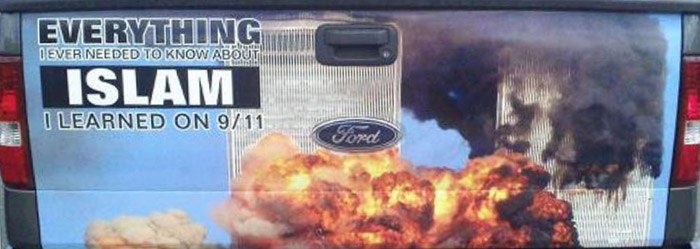
The history of Muslim hate is that of violence.
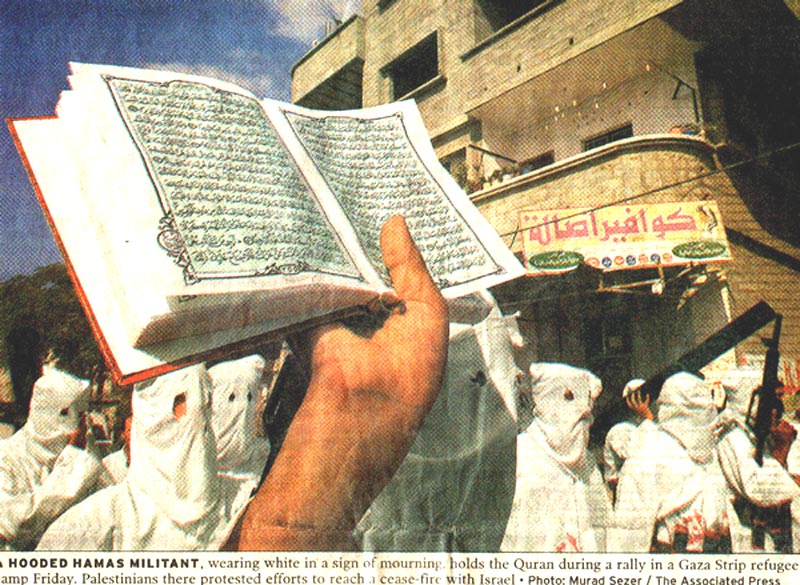
MUSLIM HATE REQUIRES GUNS AND THE QUR'AN FOR GUIDANCE
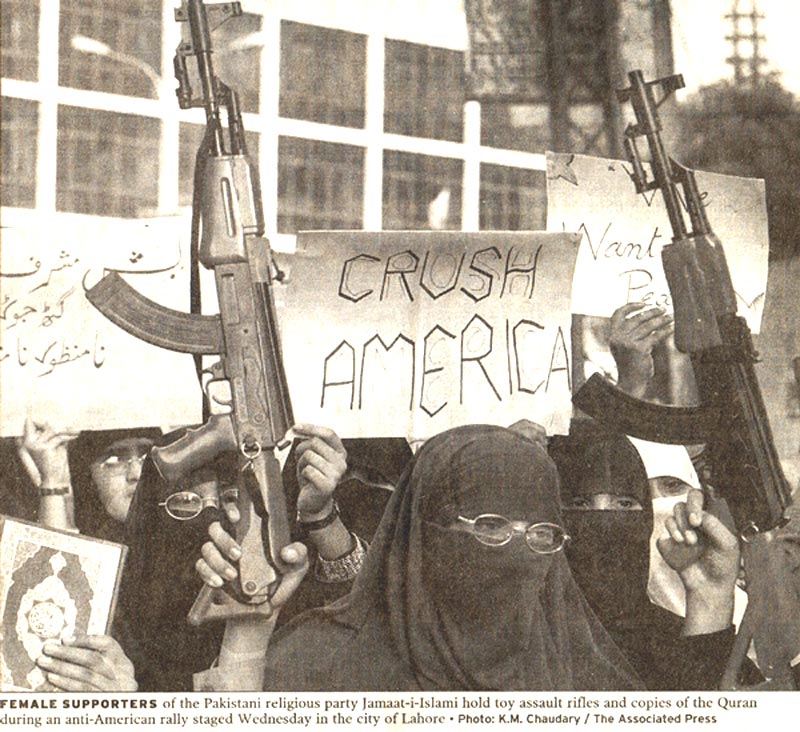
DEVOUT MUSLIMS WILL HAPPILY MURDER YOU FOR THEIR FAITH
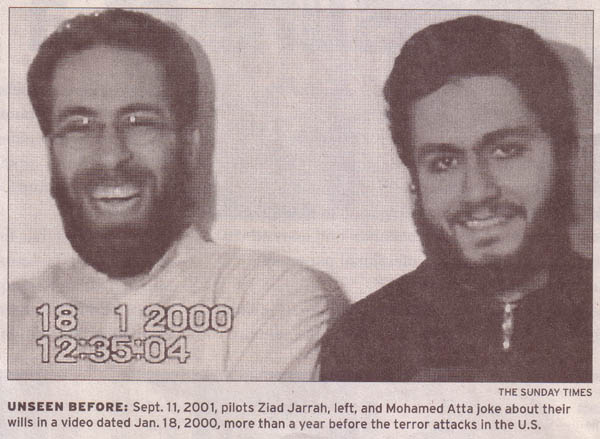
9/11 Muslim murderers celebrating the planned murder of thousands of innocent people.
ISIS LEADER: ‘ISLAM IS THE RELIGION OF WAR
TRANSCRIPT: AL-BAGHDADI’S LATEST MESSAGE
By Michael S. Smith II
On
14 May 2015, DA’ISH propagandists and supporters were atwitter about a
forthcoming address from Abu Bakr al-Baghdadi, who is also known to his
followers as “Caliph Ibrahim.”
Shortly
after 6:00 PM (GMT), DA’ISH propagandists began distributing via
Twitter a link to a JustPaste.it post that contained a link to this
nearly 35-minute-long audio message, titled “March Forth Whether Light
or Heavy.” Initially, this JustPaste.it post contained a link to an mp3
file posted to Archive.org, which has become a clearinghouse for
jihadist propaganda. Within hours, links to English- (Word document),
Russian- (Word document), Turkish- (Word document), French- (PDF file),
and German-language (Word document) transcripts of the message — all of
which are available via Archive.org — were added to the original
JustPaste.it post. At Approximately 9:00 PM (GMT), this JustPaste.it
post had been viewed nearly 11,000 times.
As
the message concluded, al-Baghdadi addressed imprisoned jihadis, whom
he advised, “We will not hold back any strength or spare any effort or
miss any opportunity, until we free the last one of you, with Allah’s
permission.” Around the time the message was released, online jihadist
chatter indicated DA’ISH fighters had launched an assault on Palmyra
prison in eastern Syria.
The
following is the text of the English-language transcript of the message
that was promoted by DA’ISH propagandists on 14 May 2015:
March Forth Whether Light or Heavy
An Address from the Khalīfah of the Muslims,
Ibrāhīm Ibn ‘Awwād al-Husaynī al-Qurashī
(Hafidhahullāh)
Indeed,
all praise is due to Allah. We praise Him, seek His aid, and ask for
His forgiveness. We seek refuge with Allah from the evils of our souls
and the wickedness of our deeds. Whomsoever Allah guides, then none can
misguide him; and whomsoever Allah leaves astray, then none can guide
him. I testify that there is no god but Allah alone, who has no
partner, and I testify that Muhammad is His slave and messenger. As for
what follows:
Allah (the Mighty and Majestic) said, {Fighting has been enjoined upon you while it is hateful to you} [Al-Baqarah: 216].
And
He (the Mighty and Majestic) said, {So let those fight in the cause of
Allah who sell the life of this world for the Hereafter. And he who
fights in the cause of Allah and is killed or achieves victory – We
will bestow upon him a great reward} [An-Nisā’: 74].
And
He (the Mighty and Majestic) said, {O you who have believed, what is
[the matter] with you that, when you are told to go forth in the cause
of Allah, you adhere heavily to the earth? Are you satisfied with the
life of this world rather than the Hereafter? But what is the enjoyment
of worldly life compared to the Hereafter except a [very] little. If
you do not go forth, He will punish you with a painful punishment and
will replace you with another people, and you will not harm Him at all.
And Allah is over all things competent} [At-Tawbah: 38-39].
And
He (the Glorified) said, {And those who are killed in the cause of
Allah – never will He waste their deeds. He will guide them and amend
their condition, and admit them to Paradise, which He has made known to
them} [Muhammad: 4-6].
O
Muslims! O you who are pleased with Allah as your Lord, and with Islam
as your religion, and with Muhammad (peace be upon him) as your prophet
and messenger… O you who testify that there is no god but Allah and
that Muhammad (peace be upon him) is the Messenger of Allah… Speech
will not benefit you without action, for there is no faith without
action.
So
whoever says, “Allah is my Lord,” it is incumbent upon him – if he is
truthful – to obey Allah (the Mighty and Majestic) who enjoined
fighting, meaning that He made it obligatory upon those who believe in
Him, and commanded the performance of jihād for His cause, and promised
reward for those who obey His command, and threatened those who disobey
Him.
And
whoever says, “My prophet is Muhammad (peace be upon him),” it is
incumbent upon him – if he is truthful in his claim – to follow his
example (peace be upon him). And he is the one who said, “By He in
whose hand is Muhammad’s soul, if it were not that I would be placing
hardship on the Muslims, I would never stay behind when a detachment
departs to fight for the cause of Allah. But I do not find any means so
that they can accompany me, nor are they pleased with staying behind
when I depart. And by He in whose hand is Muhammad’s soul, I would love
to fight for the cause of Allah and be killed, and then fight for the
cause of Allah and be killed again, and then fight for the cause of
Allah and be killed again.”
So
where are you O Muslim in relation to the command of your Lord, who
commanded you to fast in one verse, and commanded you with jihād and
fighting in dozens of verses? Where are you in relation to your Prophet
(peace be upon him), whom you claim to emulate, and who spent his whole
life (peace be upon him) as a mujāhid for the cause of Allah, fighting
His enemies? His lateral incisor tooth was broken in battle, his
forehead was wounded, two rings from his chainmail cut his cheeks, his
helmet was broken on his head, and blood ran down his face. May my
father, my mother, I, and all of mankind be sacrificed for him.
O
Muslim! O you who claims to love Allah (the Mighty and Majestic), and
claims to love His Prophet (peace be upon him)… If you are truthful in
your claim, then obey your beloved and fight for the cause of Allah,
and emulate your beloved (peace be upon him), and do not die except as
a mujāhid for the cause of Allah. {Alif, Lām, Mīm. Do the people think
that they will be left to say, “We believe” and they will not be tried?
But We have certainly tried those before them, and Allah will surely
make evident those who are truthful, and He will surely make evident
the liars. Or do those who do evil deeds think they can surpass Us?
Evil is what they judge. Whoever should hope for the meeting with Allah
– indeed, the term decreed by Allah is coming. And He is the Hearing,
the Knowing. And whoever strives only strives for [the benefit of]
himself. Indeed, Allah is free from need of the creation} [Al-‘Ankabūt:
1-6]. {Go forth, whether light or heavy, and strive with your wealth
and your lives in the cause of Allah. That is better for you, if you
only knew} [At-Tawbah: 41].
O
Muslims! Indeed, Allah’s way (the Blessed and Exalted) is for the
conflict between truth and falsehood to continue until the
establishment of the Hour. {And you will not find in the way of Allah
any change} [Al-Ahzāb: 62].
And
indeed, Allah (the Glorified) tested His slaves with this conflict in
order to distinguish the wicked from the good, the liar from the
truthful one, and the believer from the hypocrite. {And We will surely
test you until We make evident those who strive among you [for the
cause of Allah] and the patient, and We will test your affairs}
[Muhammad: 31].
Indeed,
your Lord has made jihād for the cause of Allah obligatory upon you and
has commanded you to fight His enemies so that He may forgive your
sins, raise you in rank, take from among you martyrs, purify the
believers, and destroy the disbelievers. Otherwise, He Himself (the
Glorified) is capable of prevailing over them. But it is in order to
test you. {And these days [of varying conditions] We alternate among
the people so that Allah may make evident those who believe and [may]
take to Himself from among you martyrs – and Allah does not like the
wrongdoers – and that Allah may purify the believers [through trials]
and destroy the disbelievers. Or do you think that you will enter
Paradise while Allah has not yet made evident those of you who fight in
His cause and made evident those who are steadfast?} [Āl ‘Imrān:
140-142].
O
Muslims! Whoever thinks that it is within his capacity to conciliate
with the Jews, Christians, and other disbelievers, and for them to
conciliate with him, such that he coexists with them and they coexist
with him while he is upon his religion and upon tawhīd (monotheism),
then he has belied the explicit statement of his Lord (the Mighty and
Majestic), who says, {And never will the Jews or the Christians approve
of you until you follow their religion} [Al-Baqarah: 120]. {And they
will continue to fight you until they turn you back from your religion
if they are able} [Al-Baqarah: 217]. {Neither those who disbelieve from
the People of the Book nor the polytheists wish that any good should be
sent down to you from your Lord. But Allah selects for His mercy whom
He wills, and Allah is the possessor of great bounty} [Al-Baqarah: 105].
So
this is the condition of the disbelievers in dealing with the Muslims
until the establishment of the Hour. {And you will never find in the
way of Allah any alteration} [Fātir: 43].
Indeed,
fighting the disbelievers, hijrah (emigration), and jihād will remain
until the establishment of the Hour. Allah’s Messenger (peace be upon
him) said, “Hijrah will not cease [to exist] until repentance ceases
[to be accepted], and repentance will not cease [to be accepted] until
the sun rises from the West.” He (peace be upon him) also said,
“Goodness – reward and booty – will be in the forelocks of horses until
the Day of Judgment.” He (peace be upon him) also said, “There will not
cease to exist a group from my nation fighting upon the truth, manifest
until the Day of Judgment. Then, Jesus son of Mary will descend, and
their leader will say, ‘Come and lead us in prayer.’ So he will say,
‘No. You are leaders over one another as an honor from Allah for this
nation.’”
O
Muslims! Do not think the war that we are waging is the Islamic State’s
war alone. Rather, it is the Muslims’ war altogether. It is the war of
every Muslim in every place, and the Islamic State is merely the
spearhead in this war. It is but the war of the people of faith against
the people of disbelief, so march forth to your war O Muslims. March
forth everywhere, for it is an obligation upon every Muslim who is
accountable before Allah. And whoever stays behind or flees, Allah (the
Mighty and Majestic) will be angry with him and will punish him with a
painful torment. {O you who have believed, when you meet those who
disbelieve advancing [for battle], do not turn to them your backs [in
flight]. And whoever turns his back to them on such a day, unless
swerving [as a strategy] for war or joining [another] company, has
certainly returned with anger [upon him] from Allah, and his refuge is
Hell – and wretched is the destination} [Al-Anfāl: 15-16]. {If you do
not go forth, He will punish you with a painful punishment and will
replace you with another people, and you will not harm Him at all}
[At-Tawbah: 39]. {And whoever strives only strives for [the benefit of]
himself. Indeed, Allah is free from need of the creation} [Al-‘Ankabūt:
6].
So
there is no excuse for any Muslim who is capable of performing hijrah
to the Islamic State, or capable of carrying a weapon where he is, for
Allah (the Blessed and Exalted) has commanded him with hijrah and
jihād, and has made fighting obligatory upon him.
And
we call upon every Muslim in every place to perform hijrah to the
Islamic State or fight in his land wherever that may be. And do not
think that we are calling upon you to march forth out of weakness or
incapability, for we are strong by Allah’s bounty, strong by Allah,
strong by our faith in Him, our seeking of His aid, our seeking refuge
with Him, our reliance upon Him alone without any partners, and our
good expectation of Him. This is because the battle is one between the
allies of the Merciful and the allies of Satan, and so Allah (the
Mighty and Majestic) will support His soldiers, grant His slaves
authority, and preserve His religion, even if the days alternate
between victory and loss, even if war is competition, and even if
wounds afflict both parties. We do not call upon you O Muslim out of
weakness or inability. We call upon you out of advice for you, love for
you, and compassion for you. We remind you and call you so that you do
not attain Allah’s anger, torment, and punishment, and so that you do
not lose this good that the mujāhidīn for Allah’s cause obtain. This
good of the worldly life and Hereafter entails the expiation of sins,
obtainment of good deeds, raising of ranks, getting closer to Allah
(the Mighty and Majestic), and accompanying the Prophets, the truthful,
the martyrs, and the righteous. We call upon you so that you leave the
life of humiliation, disgrace, degradation, subordination, loss,
emptiness, and poverty, to a life of honor, respect, leadership,
richness, and another matter that you love – victory from Allah and an
imminent conquest.
O
Muslims, Islam was never for a day the religion of peace. Islam is the
religion of war. Your Prophet (peace be upon him) was dispatched with
the sword as a mercy to the creation. He was ordered with war until
Allah is worshipped alone. He (peace be upon him) said to the
polytheists of his people, “I came to you with slaughter.” He fought
both the Arabs and non-Arabs in all their various colors. He himself
left to fight and took part in dozens of battles. He never for a day
grew tired of war. He (peace be upon him) passed away during the period
he was preparing the expedition of Usāmah (may Allah be pleased with
him). And from his last instructions – peace be upon him – was,
“Dispatch the expedition of Usāmah.”
His
companions after him and their followers carried on similarly. They did
not soften and abandon war, until they possessed the Earth, conquered
the East and the West, the nations submitted to them, and the lands
yielded to them, by the edge of the sword. And similarly, this will
remain the condition of those who follow them until the Day of
Recompense. Our Prophet (peace be upon him) has informed us of the
Malāhim (bloody battles) near the end of time. He gave us good tidings
and promised us that we would be victorious in these battles. He is the
truthful and trustworthy, peace be upon him. And here we are today
seeing the signs of those Malāhim and we feel the winds of victory
within them.
And
if the Crusaders today claim to avoid the Muslim public and to confine
themselves to targeting the armed amongst them, then soon you will see
them targeting every Muslim everywhere. And if the Crusaders today have
begun to bother the Muslims who continue to live in the lands of the
cross by monitoring them, arresting them, and questioning them, then
soon they will begin to displace them and take them away either dead,
imprisoned, or homeless. They will not leave anyone amongst them except
one who apostatizes from his religion and follows theirs. And you will
remember what I now say to you, and I entrust my affair to Allah.
O
Muslims, the Jews, the Christians, and the rest of the disbelievers
will not approve of you nor abandon waging war against you until you
follow their religion and apostatize from yours. This is the word of
your Lord (the Mighty and Majestic) and the tidings of your Prophet,
the truthful and trustworthy, peace be upon him. America and its allies
from amongst the Jews, Crusaders, Rāfidah (Shiites), secularists,
atheists, and apostates claim that their coalition and war is to aid
the weak and oppressed, help the poor, relieve the afflicted, liberate
the enslaved, defend the innocent and peaceful, and prevent the
shedding of their blood. They also claim to be in the camp of truth,
good, and justice, waging war against falsehood, evil, and oppression,
alongside the Muslims! Rather, they claim to defend Islam and the
Muslims! Indeed, they lie. And Allah spoke the truth and His Messenger
(peace be upon him) spoke the truth.
O
Muslims, the apostate tyrannical rulers who rule your lands in the
lands of the Two Holy Sanctuaries (Mecca and Medina), Yemen, Shām (the
Levant), Iraq, Egypt, North Africa, Khorasan, the Caucasus, the Indian
Subcontinent, Africa, and elsewhere, are the allies of the Jews and
Crusaders. Rather, they are their slaves, servants, and guard dogs, and
nothing else. The armies that they prepare and arm and which the Jews
and Crusaders train are only to crush you, weaken you, enslave you to
the Jews and Crusaders, turn you away from your religion and the path
of Allah, plunder the goods of your lands, and rob you of your wealth.
This reality has become as obvious as the sun in the middle of the day.
No one denies this except for one whose light Allah has obliterated,
whose foresight Allah has blinded, and whose heart Allah has sealed.
Where
are the jets of the Arabian Peninsula’s rulers towards the Jews who
desecrate the destination of our Messenger’s Isrā’ (al-Quds), peace be
upon him, and who afflict the people of Palestine from amongst the
Muslims with the worst of torment? Where is the support of Āl Salūl and
their allies for a million of the weak Muslims who are all without
exception being exterminated in Burma? Where is their chivalry towards
the barrel bombs of the Nusayriyyah and their cannons, which demolish
the Muslims’ homes upon the heads of their dwellers from amongst the
women, the children, and the weak in Aleppo, Idlib, Hama, Homs,
Damascus, and elsewhere. Where is the jealousy of the Arabian
Peninsula’s rulers towards the noble women who are raped daily in Shām,
Iraq, and the various lands of the Muslims? Where is the relief of the
rulers of Mecca and Medina for the Muslims in China and the Muslims in
India against whom the Hindus commit the worst of crimes daily,
including murder, burning, rape, severing of joints, looting,
plundering, and imprisonment? Where is their relief for them in
Indonesia, the Caucasus, Africa, Khorasan, and everywhere else? The
Arabian Peninsula’s rulers have been exposed and disgraced and have
lost their supposed “legitimacy.” Their treachery has become clear even
to the laymen of the Muslims. And their reality thereby became
apparent. So their masters from amongst the Jews and Crusaders had no
more use for them. And so their masters began to replace them with the
Safawī (Safavid) Rāfidah and the Kurdish atheists.
When
Āl Salūl realized their masters’ abandonment of them, their disposal of
them like tattered shoes, and their replacement of them, they launched
their supposed war against the Rāfidah of Yemen. And it is not a storm
of resolve, rather it is the kick of a dying person, by Allah’s
permission, as he struggles during his last breaths.
Āl
Salūl, the slaves of the Crusaders and allies of the Jews, do not wish
that any good should be sent down to the Muslims from their Lord. They
remained for decades not caring about the tragedies of the Muslims all
over the world generally, and in Palestine particularly. Thereafter,
they remained for years allied with the Rāfidah of Iraq in a war
against Ahlus-Sunnah (the Sunnis). Thereafter, they remained observing
the barrel bombs of death and destruction in Shām for years, enjoying
and taking delight in the scenes of Muslims being killed, imprisoned,
slaughtered, and burned, and their honor raped, their wealth plundered,
and their homes destroyed, all at the hands of the Nusayriyyah.
Today
they claim to defend Ahlus-Sunnah in Yemen against the Rāfidah! Rather,
they have lied, failed, and lost. Their war is nothing but an attempt
to prove themselves once again to their masters from amongst the Jews
and Crusaders. It is nothing but a desperate attempt to turn the
Muslims away from the Islamic State whose voice is high everywhere and
whose reality has become clear to all the Muslims and therefore the
Muslims began to gradually rally around it. Their storm is nothing but
a storm of delusion after the fire of the Rāfidah scorched their
thrones and after the Rāfidah’s march reached the people of the Arabian
Peninsula, a matter that will lead thereafter to the Muslim public in
the Arabian Peninsula rallying around the Islamic State since it
defends them against the Rāfidah. This is what frightens Āl Salūl and
the rulers of the Arabian Peninsula and makes their thrones tremble.
This is the secret of their supposed “storm,” which, by Allah’s
permission, will be their imminent end, for Āl Salūl and the rulers of
the Arabian Peninsula are not people of war nor do they have the
patience for it. Rather, they are people of luxury and extravagance,
people of intoxication, prostitution, dances, and feasts. They have
become accustomed to the defense of the Jews and Crusaders for them and
their hearts have drunk humiliation, disgrace, and subservience.
O
Muslims everywhere, has the time not come for you to realize the truth
of the conflict and that it is between disbelief and faith? See on
which front the rulers of your lands stand and to which camp they
belong. Has the time not come O Ahlus-Sunnah for you to know that you
alone are the targets? This war is only against you and against your
religion. Has the time not come for you to return to your religion and
your jihād and thereby bring back your glory, honor, rights, and
leadership? Has the time not come for you to know that there is no
might nor honor nor safety nor rights for you except in the shade of
the Caliphate?
And
what saddens us and eats at our souls is to see some of the women,
children, and families of Ahlus-Sunnah seeking refuge in the areas
controlled by the Rāfidah and Kurdish atheists in Iraq. They stand at
their doors, humiliated, disgraced, and displaced in the lands. And
there is no might nor strength except by Allah. Those who carry the
blame for the displacement of these Muslims and their humiliation are
the evil scholars from the supporters of the apostate tyrants, the
callers at the gates of Hellfire, those who confuse those poor people
and portray the Islamic State to them as being the cause of evil and
the source of hardships. They say, “If not for them, you would live in
safety, extravagance, luxury, and peace.” They portray the Crusaders,
Rāfidah, atheists, and apostates to them as being people of good,
justice, mercy, and compassion, and that they are the peaceful
defenders of Ahlus-Sunnah! There is no doubt that these are the years
of deception.
O
Ahlus-Sunnah in Iraq, and specifically our people in al-Anbār, be
certain that our hearts are broken on account of your leaving of your
homes and your lands, and your seeking of shelter in the territory of
the Rāfidah and the Kurdish atheists, and your being forced to wander
the lands. And even if some of your relatives are apostates waging war
against the religion of Allah and allied with the Rāfidah and the
Crusaders, then we don’t hold you accountable for their crimes. So
return to your lands, and remain in your homes, and seek shelter –
after first seeking shelter with Allah – with your people in the
Islamic State, for you will find therein, by Allah’s permission, a warm
embrace and a safe refuge. For you are our people. We defend you, your
honor, and your wealth. We want you to be mighty and noble, we want you
to be safe and secure, and we want your salvation from Hellfire.
So
seek shelter – after Allah – with the Islamic State. What do you wait
for after the truth has become clearer than the day and after the
spiteful Rāfidah exposed their reality? Here they are today
slaughtering everyone considered from Ahlus-Sunnah in Baghdad and
elsewhere. No one was saved from them, even their allies, supporters,
aids, tails, and dogs from the apostates who had once belonged to
Ahlus-Sunnah, those in the Sahwah, army, police, and elsewhere, those
whom the evil scholars confused into fleeing the implementation of
Allah’s law in the territory of the Islamic State. So they became
homeless, humiliated, fearful, and worrisome of the Rāfidah’s cruelty,
whereas the Muslims live in the territory of the Islamic State with
might and honor, secure by Allah’s bounty alone, with a life of
comfort, going about the affairs of their business, livelihood, and
trade, enjoying the grace of living under the rule of their Lord’s law,
and all praise and grace is Allah’s. Therefore, O Muslims, seek shelter
– after Allah – with the Islamic State.
We
direct a renewed call towards those who remained in the ranks of the
Rāfidah and the Crusaders in the army, police, and Sahwah so that they
repent to Allah and abandon their support of the disbelievers against
the Muslims, and so that Allah accepts their repentance and forgives
them and they are thereby saved from Hellfire. Rush towards repentance
for its gate will not be closed until the sun rises from the West.
Repent so that you might save your Hereafter before it is too late, for
you have lost the worldly life, so do not lose with it your Hereafter
for the sake of someone else’s worldly life. Repent before the hands of
the mujāhidīn reach you, for there will be no repentance for you
thereafter, and you will lose both the worldly life and Hereafter.
Repent, turn back, and return to your people. Repent and you will find
them merciful towards you. Your repentance is more beloved to us than
killing you or expelling you. Repent for we do not call you out of
weakness. Rather, we call you while our swords are at a distance of two
bow lengths or nearer from your necks. If you repent, you will not find
from us anything except good and kindness.
O
soldiers of the Islamic State, be firm, for you are upon the truth.
Seek help through patience, for victory comes with patience and triumph
is for those who are patient. Be patient, because the Crusaders are
bleeding to death, the Rāfidah are faltering, and the Jews are
horrified and in dread. Your enemies have become weaker than they were
yesterday – by Allah’s grace – and are growing weaker and weaker, and
all praise be to Allah. You have become mighty by Allah’s grace. We say
this without boasting. You are growing stronger and stronger by Allah’s
grace. So be patient, for it is one of two good outcomes, and it is
just one soul, so sacrifice it cheaply for Allah’s cause. {Indeed,
Allah has purchased from the believers their lives and their properties
[in exchange] for that they will have Paradise. They fight in the cause
of Allah, so they kill and are killed. [It is] a true promise [binding]
upon Him in the Torah and the Gospel and the Qur’ān. And who is truer
to his covenant than Allah? So rejoice in your transaction which you
have contracted. And it is that which is the great attainment}
[At-Tawbah: 111].
I
will not conclude without commending the brave lions of creed, the
soldiers of the Caliphate, those in Baghdad, in its north and south,
who are holding onto hot coals, who are firmer than stone, those who
humiliate the Rāfidah in their strongholds and their major fortresses
every day. How good you are! How good you are! We consider one of you
equal to a thousand. If the Muslims are heedless of the greatness of
your actions and the terror you inflict, then enough for you is Allah.
Indeed, nothing is hidden in the earth nor in the heaven from Allah
(the Exalted).
And
I commend the valiant men of tawhīd, the heroes of Islam, the brave
mujāhidīn from the muhājirīn and the ansār in the defiant region of
Baiji, the fortress of Ahlus-Sunnah in the north, and the mujāhidīn in
the defiant region of Kirkuk who contest the coalition of disbelieving
nations against the Muslims and who proved that the boots of the
Islamic State today are from the heaviest of boots and its voice is
from the loudest of voices. They have presented their blood and corpses
as an evidence for that, and they offered their souls cheaply to defend
Islam and its people. They made the Jews and the Crusaders in America,
Europe, Australia, and Canada sleep with rage filling their hearts,
powerlessness burdening their backs, and fear pounding their beds. How
good you are! How good you are! You have proven that the Muslims will
not be defeated as long as they hold firm to the Book and the sword
with which our Prophet (peace be upon him) was dispatched. Be firm, may
I be sacrificed for you. Be firm, because your assaults on the Rāfidah
and their allies in Iraq not only make the Crusaders bleed and
strengthen the pillars of the Caliphate, but will make the Nusayriyyah
in Shām and the Houthis in Yemen collapse.
And
I commend the lions of walā’ and barā’ (allegiance and enmity for
Allah’s sake), the predators of al-Anbār who demolished the strongholds
of the apostates, who made them swallow cups of humiliation and
bitterness, who scattered them and expelled them, and who snatched
al-Anbār from the eyes of the apostates and the throats of the Rāfidah,
in spite of America and its allies. How good you are! How good you are!
You have taught a lesson to the world that to Allah belongs all honor,
and to His Messenger, and to the believers. Be firm. How good you are!
Your next engagement by Allah’s permission, will be Baghdad and Karbala.
And
I commend the lions of the Caliphate, the muwahhidīn (monotheists) of
the Sinai Peninsula, the mighty and defiant who disbelieved in pacifism
and treaded the path of honor, dignity, and manhood. They refused
humiliation and subservience and offered their blood and lives for
their religion. How good you are! How good you are! We consider you to
be amongst those whom the Master (the Mighty and Majestic) described by
saying, {men who are true to what they promised Allah} [Al-Ahzāb: 23];
we consider you such and Allah is your judge. We ask Allah (the
Glorified) to allow us to see you in al-Quds very soon. It is a
sufficient deed for you with Allah that you have pounded the beds of
the Jews with terror.
And
I commend the lions of the Caliphate in Raqqah, Mosul, Aleppo, Dijlah,
al-Furāt, al-Jazīrah, al-Barakah, al-Khayr, Homs, and Hama. How good
you are, O heroes of Islam! How good you are! You are recording the
Malāhim and restoring the glories of Islam. Be patient and firm, and be
cautious, for the enemies of Allah are mobilizing, thundering,
increasing, and threatening the people of Mosul. We believe that their
mobilization will be for Raqqah and Aleppo before Mosul. So be cautious.
And
I commend the lions of the Caliphate in Damascus and Diyala, the
patient, the firm, the warriors. How good you are! How good you are! A
nation with people like you can never be defeated.
And
I commend the soldiers of the Caliphate, the valiant heroes of Libya,
Algeria, and Tunisia. How good you are. Be firm and be patient, for the
final outcome is for you, with Allah’s permission.
And
I commend the mujāhidīn from the soldiers of the Islamic State in
Khorasan and West Africa. We congratulate them on their pledge of
allegiance, and we ask Allah to make them firm and grant them victories
and consolidation. How good they are!
And
I commend the soldiers of the Caliphate in Yemen. We congratulate them
on their advance and look forward to seeing more from them. How good
they are!
I
will not forget to mention the captives in the prisons of the apostate
tyrants everywhere. I say to them: We have never forgotten you for a
day and we will never forget you, by Allah’s permission. We will not
hold back any strength or spare any effort or miss any opportunity,
until we free the last one of you, with Allah’s permission. So be
patient and firm. I mention in particular the seekers of knowledge in
the prisons of Āl Salūl. May Allah humiliate Āl Salūl and their
supporters.
O
Revealer of the Book, O He who is swift to account, O Allah, defeat the
parties, defeat them and make them tremble. O Allah, deal with America
and its allies from the Jews, the Crusaders, the Rāfidah, the
apostates, and the atheists. Our Lord, obliterate their wealth and
harden their hearts so that they do not believe until they see the
painful torment. Our Lord, forgive us our sins and the excess committed
in our affairs and plant firmly our feet and give us victory over the
disbelieving people. And the last of our call is: Praise be to Allah,
Lord of the creation.
ISLAMIC FORCED CONVERSIONS—PAST AND PRESENT
May. 16, 2013
The Blaze
Raymond Ibrahim
The lost history of Christians forced to convert to Islam—or die—is reemerging, figuratively and literally. According to the BBC: “Pope Francis has proclaimed the first saints of his pontificate in a ceremony [last Sunday] at the Vatican—a list which includes 800 victims of an atrocity carried out by Ottoman soldiers in 1480.They were beheaded in the southern Italian town of Otranto after refusing to convert to Islam.”
The BBC adds in a sidebar: “The ‘Martyrs of Otranto’ were 813 Italians beheaded for defying demands by Turkish invaders to renounce Christianity. The Turks had been sent by Mohammed II, who had already captured the ‘second Rome’ of Constantinople.”
Historical texts throughout the centuries are filled with similar anecdotes, including the “60 Martyrs of Gaza,” Christian soldiers who were executed for refusing Islam during the 7th century Islamic invasion of Jerusalem. Seven centuries later, during the Islamic invasion of Georgia, Christians refusing to convert were forced into their church and set on fire. Witnesses for Christ lists 200 anecdotes of Christians killed—including some burned at the stake, thrown on iron spikes, dismembered, stoned, stabbed, shot at, drowned, pummeled to death, impaled and crucified—for refusing to embrace Islam.
If history is shocking, the fact is, today, Christians—men, women, and children—are still being forced to convert to Islam. Pope Francis alluded to their sufferings during the same ceremony: “As we venerate the martyrs of Otranto, let us ask God to sustain those many Christians who, in these times and in many parts of the world, right now, still suffer violence, and give them the courage and fidelity to respond to evil with good.”
Consider some recent anecdotes:
In Pakistan, a “devoted Christian” was butchered by Muslim men “with multiple axe blows [24 per autopsy] for refusing to convert to Islam.” Another two Christian men returning from church were accosted by six Muslims who tried to force them to convert to Islam, but “the two refused to renounce Christianity.” Accordingly, the Muslims severely beat them, yelling they must either convert “or be prepared to die. . . . the two Christians fell unconscious, and the young Muslim men left assuming they had killed them.”
In Bangladesh some 300 Christian children were abducted in 2012 and sold to Islamic schools, where “imams force them to abjure Christianity.” The children are then instructed in Islam and beaten. After full indoctrination they are asked if they are “ready to give their lives for Islam,” presumably by becoming jihadi suicide-bombers. (Even here the historic patterns are undeniable: for centuries, Christian children were forcibly taken, converted to and indoctrinated in Islam, trained to be jihadis extraordinaire, and then unleashed on their former Christian families. Such were the Janissaries and Mamelukes.)
In Palestine in 2012, Christians in Gaza protested over the “kidnappings and forced conversions of some former believers to Islam.” The ever-dwindling Christian community banged on a church bell while chanting, “With our spirit, with our blood we will sacrifice ourselves for you, Jesus.”
Just as happened throughout history, Muslims today regularly “invite” Christians to Islam, often presenting it as the only cure to their sufferings—sufferings caused by Muslims in the first place.
In Pakistan, a Christian couple was arrested on a false charge and severely beaten by police. The pregnant wife was “punched, kicked and beat” as her interrogators threatened to kill her unborn baby. A policeman offered to drop the theft charge if the husband would only “renounce Christianity and convert to Islam,” but the man refused.
In Uzbekistan, a 26-year-old Christian woman, partially paralyzed from youth, and her elderly mother were violently attacked by invaders who ransacked their home, confiscating “icons, Bibles, religious calendars, and prayer books.” At the police department, the paralyzed woman was “offered to convert to Islam.” She refused, and the judge “decided that the women had resisted police and had stored the banned religious literature at home and conducted missionary activities. He fined them 20 minimum monthly wages each.”
In Sudan, Muslims kidnapped a 15-year-old Christian girl; they raped, beat and ordered her to convert to Islam. When her mother went to police to open a case, the Muslim officer of the so-called “Family and Child Protection Unit,” told her: “You must convert to Islam if you want your daughter back.”
Indeed, because Christian females are the most vulnerable segments of Islamic societies, they are especially targeted for forced conversions. In 2012, U.S. Congress heard testimony about the “escalating abduction, coerced conversion and forced marriage of Coptic Christian women and girls [550 cases in the last five years alone].Those women are being terrorized and, consequently, marginalized, in the formation of the new Egypt.”
As my new book Crucified Again: Exposing Islam’s New War on Christians documents, wherever there are large numbers of Muslims—whether in the Arab World, Africa, Asia, or even in the West—Christians are being persecuted. Forced conversions are the tip of the iceberg, and certainly not anomalies of history.
Muslim world awaits its great separation
That so many followers of the faith take offence at the slightest
perceived insult betrays a deep sense of insecurity within the Islamic
mind
By Robert Sibley
Postmedia News
October 13, 2012
When the English political philosopher Thomas Hobbes published his
masterwork, Leviathan, in 1651, Europeans were barely beginning to
recover from the Wars of Religion that had devastated the continent
since the early 16th century. Responding to this violence, Hobbes
provided an argument for the establishment of political orders free of
unwarranted religious influence, an argument that has deeply influenced
the formation of western liberal democracy.
Leviathan was a book born of necessity. For more than a century and a
half - from the German Peasants' War in 1524 to the English Civil War
in the mid-17th century - Catholics and Protestants had slaughtered
each other in the name of the one true God. The Thirty Years War alone,
between 1618 and 1648, devastated Europe to a degree not seen again
until the wars of the 20th century.
Only in 1648, with the signing of the series of treaties known as the
Peace of Westphalia, were Europeans able to bring their religious wars
to an end. The treaties not only established the principle of
non-interference in the domestic affairs of sovereign states, but they
also laid the groundwork for the separation of religion and politics, a
concept that over time became a fundamental principle for liberal
democratic order.
Thus, Christian Europe achieved the Great Separation, the result of
which was the gradual withdrawal of religion from the public sphere and
its relegation, more or less, to private life. By some accounts this
separation of religion and politics is one of the hallmarks of western
civilization, a philosophical achievement that, along with advances in
science and economic power, enabled the rise of the West.
No such separation has occurred in the Muslim world. And that lack -
some call it a failure - is, arguably, the deep source of the recent
violence in the Muslim world, not some risible video mocking the
Prophet Muhammad. It should be evident to everyone, except perhaps the
Obama administration, that hardcore Islamists have used the video, The
Innocence of Muslims, to push a political agenda that has as its
ultimate aim a religious purpose.
The Islamists can get away with promoting violence by means of faux
religious outrage because of the totalitarian nature of Islam.
I do not use the word "totalitarian" to be unnecessarily provocative. I
mean that Islam is a totalitarian religion in the sense that it
attempts to encompass the totality of human life, whether cultural,
political, social or religious. In the words of one prominent Islamic
scholar, Jaafar Sheikh Idris: "Islam cannot be separated from the state
because it guides us through every detail of running the state and our
lives. ... For Muslims, the word 'religion' does not only refer to a
collection of beliefs and rituals, it refers to a way of life which
includes all values, behaviours, and details of living."
Given this definition, it is understandable why those who question or
mock Islam are deemed enemies of Islam. Someone who insists all of
life's activities must be religiously grounded cannot help but incline
toward extremism when something "offends" his or her faith. Questions
create doubt, which undermines the coherence of that person's
existence. The only way to eliminate that doubt is to eliminate its
source, all in the name of God, of course. And therein resides the
great potential for violence. As political theorist Michael Allen
Gillespie remarks: "When men come to think of themselves as enacting
God's will, or indeed be gods themselves, the political consequences
are inevitably horrifying."
To be modern, as commentator Fouad Ajami points out, is to tolerate
things that offend you. The fact that so many Muslims take offence at
the slightest perceived insult betrays a deep sense of insecurity
within the Islamic mind. Not that the leaders of the Muslim world are
any more secure than the mobs that they use. They, too, betray their
unease with modernity in wanting "Islamophobia" declared "a crime
against humanity." Turkish Prime Minister Recep Tayyip Erdogan has
called for "international legal regulations against attacks on what
people deem sacred." Can you imagine an American president demanding
international laws against Christianophobia?
Behind the events that spark "Muslim rage" - from the 1989 fatwa
against novelist Salman Rushdie and the 2004 murder of filmmaker Theo
van Gogh, who made a film about Islamic culture's abusive view of
women, to the 2005 Danish cartoons and, now, the blasphemy of a
14-minute video - is the refusal of Islam's elites to accept that their
religion requires its own Great Separation if it wants to be part of
the modern world. Lacking such a reformation we now have Muslim
theocrats and political leaders demanding that the West adopt Islamic
cultural standards, including bans on "blasphemy." This is nothing more
than the logical extension of Ayatollah Ruhollah Khomeini's death
sentence on Rushdie over his supposedly blasphemous novel, The Satanic
Verses.
What is most troublesome is the willingness of western leaders,
including the president of the United States, to placate Muslim
religious "sensitivities" while undercutting fundamental principles of
western political order.
"The future must not belong to those who slander the prophet of Islam,"
Barack Obama said in his recent speech to the United Nations. The
statement is problematic because it effectively entails a rejection of
the right to free speech of those critical of Islam.
"When one finishes parsing the sentence, one is left thinking the
president of the United States agrees with Muslim mobs, and denouncing
those who cause offence by ridiculing what others hold sacred can only
mean admitting free speech should be abridged," says Salim Mansur, a
political scientist at the University of Western Ontario.
There are dangers to placating Islamists. "The greatest danger of the
growing menace was that good men would commit intellectual suicide and
call it peace," writes Salman Rushdie in Joseph Anton, his recently
published memoir of his years under the fatwa. "Good men would give in
to fear and call it respect."
No doubt, most Muslims in the West want to assimilate peacefully, to
enjoy the benefits of the West while continuing to practise their faith
in private. But too many are happy to live in Brussels or London or
Toronto while listening to fundamentalist mullahs who promote the
Islamist agenda at the local mosque. The fact that Muslims living in
the West are only too willing to riot at some "insult" to their faith
reinforces the notion that there will be increasing demands for the
institution of Shariah laws and, hence, Islamic governance, as the
Muslim population within western societies grows.
But then what we are seeing in the cities of the West is what
commentator Daniel Pipes calls the "separation of civilizations" -
Muslim-only enclaves where Shariah laws pertaining to matrimony,
education, economics and even calendar time hold sway.
This augurs ill for the future. The West has imported the conditions
that allow for the emergence of the kind of religious conflict that
Hobbes warned against in Leviathan. The question, of course, is whether
westerners will shed the illusions of multiculturalism and reject the
Islamist effort to impose medieval religious laws antithetical to a
modern liberal society. Unless they do, the result may well be what
Hobbes most feared: a war of all against all.
Robert Sibley is a senior writer for the Ottawa Citizen. His new book,
The Way of the Stars, was published in September by the University of
Virginia Press.
Muslim violence a fact, not prejudice
Mark Durie
The Sidney Morning Herald
March 25, 2011
Those who denounce critics of Islam should allow that, like all global
faiths, Islam has its detractors and a religion will be judged on what
its followers say and do.
There is a debate going on about Islam. The question being asked is:
Does Islam itself - not just poverty or social exclusion - provide
ideological fuel for extremism and violence?
It is all too tempting to promote one-dimensional explanations of
religious violence. Monash University doctoral candidate Rachel
Woodlock said on this page on Wednesday that social exclusion was the
root of Islamic radicalism.
On one hand, there are those who, like Woodlock, demand that critics of
Islam be stigmatised as ignorant, right-wing racists. On the other
hand, Islam's problems cannot be simplistically reduced to social or
economic factors.
Violence in the name of Islam is well-attested in nations in which
Muslims are dominant, and it is non-Muslim minorities that suffer the
exclusion. It does not do to argue that religion has no relevance to
such events.
In Muslim-majority Pakistan on December 3, Pakistani imam Maulana
Yousuf Qureshi, in his Friday sermon, offered a $6000 bounty to anyone
who would murder Asia Bibi, a Christian woman who has also been accused
of ''blaspheming Allah''. Pakistani minister for minorities Shahbaz
Bhatti and Punjab governor Salman Taseer were subsequently assassinated
because of their opposition to Pakistan's blasphemy laws.
These laws are supported by Pakistan's Islamic elites. The killer of
Salman Taseer, Mumtaz Qadri, was praised by religious leaders from
mainstream schools of Pakistani Islam, and when he was being led to
court on January 6, 400 Muslim lawyers showered him with rose petals,
offering him their legal services free of charge.
There has also been a rush of recent assaults on Copts and their places
of worship in Egypt, sparked by a wild tirade by a leading Egyptian
cleric.
Closer to Australia, there have been well-publicised attacks on
Ahmadiyah Muslims in Indonesia, including brutal murders. These were
undoubtedly influenced by a theological belief that Ahmadiyah adherents
are apostates from true Islam. Although prominent Indonesian leaders
were quick to express abhorrence for the attacks, many Indonesian
Muslims have called for Ahmadiyahs to be outlawed.
These events demonstrate the ugly effects of stigmatising minorities,
and it would be deplorable to simple-mindedly extrapolate the religious
views of Pakistani, Egyptian or Indonesian Muslims and apply them to
Australia.
However, it is irrational to insist that any and everyone who seeks to
expose the religious roots of such hatred must themselves be decried as
haters.
All over the world, every religious belief is disliked by someone or
other. Christianity has its prominent detractors, too, from Bertrand
Russell to Richard Dawkins. A Google search for ''Evils of
Christianity'' yields tens of thousands of hits.
Australians can be thankful for a culture of tolerance, which has been
carefully nurtured over decades. Tolerance is strengthened when people
are able to debate ideological issues freely - especially those which
impact profoundly on human rights - without being shouted down.
Victorian Supreme Court Justice Geoffrey Nettle, in his findings on the
case of the Islamic Council of Victoria v Catch the Fire, pointed out
that criticism - or even hatred - of a religion should not be conflated
with the hatred of people who hold those beliefs. It is one thing to
promote tolerance, quite another to mandate it.
Perhaps the most powerful evidence against Woodlock's thesis - that it
is exclusion, and not religion, that drives some Muslims to terrorism -
is the fact that across the globe the most diverse religious minorities
do not resort to violence, even when persecuted.
There are no Falun Gong terrorists in China, despite all the bitter
persecution. The same can be said for persecuted Christians in many
nations.
Even in Australia, many ethnic and religious groups have been subjected
to disadvantage and exclusion, but none have produced the level of
terrorist convictions of our own home-grown Islamic radicals.
It is a bitter pill for the vast majority of Australian Muslims to
swallow that their faith has been linked, globally and locally, to
religious violence.
Unfortunately, this link cannot be dismissed as the product of media
prejudice or ''Islamophobic'' propaganda. It is in part an issue of
some Muslims behaving very badly, and their often strident claim is
that they do this in the name of religion.
Taking such claims seriously and debating them publicly must not be
equated with stigmatising law-abiding and peaceable Australian Muslims.
Mark Durie is a Melbourne Anglican vicar, human rights activist, and author of The Third Choice: Islam, Dhimmitude and Freedom.
The Truth about Islam and Violence
Jihad.
It was once a word unfamiliar to American
ears. But in recent years it has become all too familiar. The actions of Muslim
militants and terrorists have seared the word into American consciousness.
Yet even with thousands of innocent civilians killed on American soil by Islamic
terrorists, the full significance of the Muslim concept of jihad has not
been grasped by the American public.
In the days after September 11, 2001, American leaders rushed to portray Islam
as a peaceful religion that had been "hijacked" by a fanatical band of
terrorists. One hopes that these assurances were merely tactical—that nobody was
meant to believe them and that they were meant to assure the Muslim world that
the inevitable American reprisals were not directed at their religion as a
whole.
If the world Muslim community perceived America as attacking Islam in general
then the duty of every Muslim to fight for his religion—the duty of jihad—would
have been invoked on a broad scale. The war against terrorism, instead of
simmering with occasional flare-ups, like the Cold War, would have boiled over
into a global conflagration, with the Muslim countries of the world—1.2 billion
strong—mobilizing against America and the West.
Muslim apologists also rushed forward to assure the public that Islam was a
peaceful religion. They disingenuously declared that the word Islam means
"peace." And they tried to portray the terrorists as a fringe group outside the
mainstream of Islam.
These were lies.
The usual meaning of Islam in Arabic is not "peace" but "submission." And
if the terrorists were so far outside the mainstream, why did Muslims all over
the world burst into joyful, spontaneous celebrations when the hijacked
jetliners slammed into the World Trade Center and the Pentagon? Why are Islamic
governments afraid to show "too much" public support for the war against
terrorism? Further, why are all the governments that covertly support terrorism
centered in the Muslim world?
The truth is that Islam is not a religion of peace. This is not to say that
every Muslim is violent at heart. Many are not. Muslims have the same
aspirations for living peaceful lives that people have the world over. But they
also have the same potential for violence as others, and Islam as a religion and
an ideology seeks to exploit that potential.
Though there are millions of Muslims who want peaceful relations with the West,
millions who aspire to live in free societies like America, there nevertheless
remains a deep and powerful strain of violence within Islam, and it is important
that Americans understand it.
They will have to face it in the future.
The Muslim Worldview
To understand the connection between Islam
and violence, one must understand certain facets of the Muslim worldview. One of
the most important is the fact that, according to the historic Muslim
understanding, there is no separation between religion and government—what in
Christianity would be called the separation of church and state.
We are not speaking here of the secularist idea that the state should
marginalize religion and discourage people from voting their consciences as
Christians. We are talking about the idea that church and state are not the same
thing and that they have different spheres of activity.
This idea of a separation between religion and government is not characteristic
of most peoples in world history. It is a contribution to the world of ideas
that was made by Christians—indeed, by Christ himself. In his book Islam and
the West, historian Bernard Lewis explains:
"The notion that religion and political authority, church and state, are
different and that they can or should be separated is, in a profound sense,
Christian. Its origins may be traced to the teachings of Christ, notably in the
famous passage in Matthew 22:21, in which Christ is quoted as saying: ‘Render
therefore unto Caesar the things which are Caesar’s; and unto God the things
that are God’s.’ This notion was confirmed by the experience of the first
Christians; its later development was shaped and in a sense even imposed by the
subsequent history of Christendom. The persecutions endured by the early Church
made it clear that a separation between the two was possible."
During much of Christian history church and state were united in that each
Christian state had an official church, whether it was the Catholic Church or
one of the Orthodox or Protestant churches. In many countries that is still the
case. Nevertheless, the awareness remained that the two institutions were
distinct and had different functions and different spheres of legitimate
authority. They could in principle disagree and go their separate ways when
necessary.
Most peoples in world history have not shared this understanding. In most
societies, religion and government have been inseparably linked. This is true in
Muslim society as well. Lewis explains:
"In pagan Rome, Caesar was God. Christians were taught to differentiate between
what is due to Caesar and what is due to God. For Muslims of the classical age,
God was Caesar, and the sovereign—caliph or sultan—was merely his vice-regent on
earth. This was more than a simple legal fiction. For Muslims the state was
God’s state, the army God’s army, and, of course, the enemy was God’s enemy. Of
more practical importance, the law was God’s law, and in principle there could
be no other. The question of separating church and state did not arise, since
there was no church, as an autonomous institution, to be separated. Church and
state were one and the same."
This means that, in the historic Muslim understanding, Islamic society is or
should be a theocracy—a society in which God himself is the monarch, reigning on
earth through subordinates.
In the earliest days of Islam, the subordinate was the prophet Mohammed, who
founded Islam and conquered the Arabian Peninsula. Thereafter the subordinate
was the caliphs and in the centuries after Mohammed’s death they expanded Muslim
society by conquering peoples as far west as Spain and as far east as India. In
the process, they absorbed half of Christian civilization. Eventually, the power
of the caliphs waned, and new leaders—such as the Ottoman sultans—were the
subordinates. Throughout it all, God himself was regarded as the ruler of
Islamic civilization.
Islam as Ideology
That Islam sees itself as a theocracy has
enormous ramifications for how it regards itself and for the behavior of
Muslims.
First, it means that Islam is not only a religion. It is also a political
ideology. If the government of the Muslim community simply is God’s
government, then no other governments can be legitimate. They are all at war
with God. As a result, Muslims have typically divided the world into two
spheres, known as the Dar al-Islam—the "house of Islam" or "house of
submission" to God—and the Dar al-Harb, or "house of war"—those who are
at war with God.
Second, it means that Muslims have believed themselves to have a "manifest
destiny." Since God must win in the end, the Dar al-Harb must be brought
under the control of Muslim government and made part of the Dar al-Islam.
Third, since the Dar al-Harb by its nature is at war with God, it is
unlikely that it will submit to God without a fight. Individual groups might be
convinced to lay down their arms and join the Muslim community by various forms
of pressure—economic or military—that fall short of war. In history some groups
have become Muslim in this way, either fearing Muslim conquest, desiring Muslim
military aid against their own enemies, or aspiring to good trade relations with
the Muslim world. But many peoples would rather fight than switch. This has been
particularly true of Christians, who have put up more resistance to the Muslim
advance than have pagan and animistic tribes.
Because of the need to expand God’s dominion by wars of conquest, Islam’s
ideology imposes on Muslims the duty to fight for God’s community. This duty is
known as jihad (Arabic, "struggle, fight"). Although it is binding on all
Muslims, it has been particularly incumbent on those on the edges of the Muslim
world, where there was room for expansion. Only by continual jihad could
the manifest destiny of Islam to bring the world into submission to God be
fulfilled.
As eminent French sociologist Jacques Ellul notes, "Jihad is a religious
obligation. It forms part of the duties that the believer must fulfill; it is
Islam’s normal
A fourth and final consequence of Islam’s view of itself as a theocracy is that
in theory all Muslims should not only form one religious community but should be
subject to one government as well—God’s government, a kind of Muslim superstate.
Yet this has not happened. Muslims have been ruled by different governments
since the early days of Islam.
path to expansion."
Ideology Meets History
The fact that Muslims are not united under
a single government is due to a variety of historical factors. As Muslim
territory expanded the problems with the idea of uniting all Muslim peoples
under a single government became all too obvious. Islam grew from a tribal base,
and tribal societies are not known for stability. The factions and rivalries
that are inherent in such societies manifested as Islam grew and made it
difficult to keep Muslims under a single head.
Another factor that kept a stable Muslim superstate from developing is the fact
that—especially in a pre-technological world—local areas have to be governed
locally. Large empires have had to cede large amounts of autonomy to local
governments, and therein lay the seeds of their eventual dissolution. As local
governments grew in power, they desired more and more autonomy, desiring
eventually to throw off the yoke of their masters and to be truly independent.
As a result, even in the classical period of Islam the Muslim community was
divided politically, with rivalries between various parties—for example, between
the Ottomans and the Persians, who maintained a tense and sometimes violent
rivalry for centuries. The conflicts within the Muslim community helped slow its
expansion and helped lead to stagnation and decay.
A threat also was growing in the non-Muslim world.
Europe for centuries had been terrified by the Muslim advance, with continual
warfare on its borders to the west and to the east as Christians struggled at
first to check the Muslim advance and later to reclaim their homelands.
The fight was not easy for Europe and, for a long time, it did not go well.
Lewis notes of medieval Christendom: "Split into squabbling, petty kingdoms, its
churches divided by schism and heresy, with constant quarrels between the
churches of Rome and the East, it was disputed between two emperors and for a
while even two popes. After the loss of the Christian shores of the eastern and
southern Mediterranean to the Muslim advance, Christendom seemed even more
local, confided in effect to a small peninsula on the western edge of Asia which
became—and was by this confinement defined as—Europe. For a time—indeed, for a
very long time—it seemed that nothing could prevent the ultimate triumph of
Islam and the extension of the Islamic faith and Muslim power to Europe."
As chronicler of Muslim expansion Paul Fregosi notes, "‘From the fury of the
Mohammedan, spare us, O Lord’ was a prayer heard for centuries in all the
churches of central and southern Europe. Fear of the jihad has not
entirely vanished even now, particularly among peoples who have known Muslim
domination." Muslims conducted raids to capture slaves as far west as England
and Ireland. They attacked Iceland. And they plunged deep into Europe.
They captured Sicily and invaded the Italian mainland. "Naples, Genoa, Ravenna,
Ostia, and even Rome itself were all for a time pillaged or occupied by the
Saracens. Human beings became a cheap and abundant commodity. In Rome, in 846 .
. . the Muslims even looted the churches of St. Peter and St. Paul, and the pope
had to buy off the invaders with the promised tribute of 25,000 silver coins a
year. Pope Leo IV then ordered the construction of the Leonine Wall around the
city to protect St. Peter’s from further assault."
The threat continued for centuries, with Muslim forces laying siege in 1529 and
1683 to Vienna, the capital of the Holy Roman Empire, located in the heart of
Europe.
But as Islam stagnated, new doors opened to Europe, particularly through the
discovery of the New World and the vast material resources it offered. As Europe
grew economically, technologically, and militarily through its colonies and the
rise of global trade, the balance of power shifted, and the Islamic world became
vulnerable.
Even before the discovery of the New World, Christians in both western and
eastern Europe had begun to reclaim their conquered homelands from Muslim
dominion, and the tremendous new resources that Europe had at its disposal as a
result of the Age of Exploration only made things worse for Muslim aspirations
to world political supremacy. Their own governmental structures—particularly the
Ottoman empire—began to lose power and disintegrate, with Europeans stepping in
to take control as colonialization progressed.
For three centuries the Muslim world lost ground, and by the first half of the
twentieth century almost all of it had been reduced to being colonies or
protectorates of European powers.
Lewis notes, "By 1920 it seemed that the triumph of Europe over Islam was total
and final. The vast territories and countless millions of the Muslim peoples of
Asia and Africa were firmly under the control of the European empires—some of
them under a variety of native princes, most under direct colonial
administration. Only a few remote mountain and desert areas, too poor and too
difficult to be worth the trouble of acquiring, retained some measure of
sovereign independence."
What was the Muslim reaction to this alarming sequence of developments?
Shock and Awe
In the seventeenth century it had begun to
sink into Muslim consciousness that something was desperately wrong in the
world. Though Muslim society had previously been more advanced economically and
in some ways culturally than European society, it began to dawn on Muslim
leaders that the barbarian infidels of Europe were catching up and in certain
ways were ahead of Muslim society.
It is difficult for Westerners to realize just how crushing a realization this
was, but it was devastating given Muslim self-perception.
The triumphal advance of Islam seemed to confirm to Muslim minds that they were
the chosen of God and that civilization itself was identical with Islam, with
only ignorant barbarians and infidels outside its borders.
In What Went Wrong?: Western Impact and Middle Eastern Response, Bernard
Lewis notes that Christian Europe was seen "as an outer darkness of barbarism
and unbelief from which there was nothing to learn and little even to be
imported, except slaves and raw materials. For both the northern [European] and
southern [African] barbarians, their best hope was to be incorporated into the
empire of the caliphs, and thus attain the benefits of religion and
civilization."
Shock and awe thus were the responses of Muslims as they saw their civilization
collapsing and their former enemies—Christian Europeans—seizing control of their
homelands. How could this happen? How could God’s people suffer such a reversal
of fortune? How could their former might be so completely outclassed by the
overwhelming economic and military might of Christendom, whose religion was
their only serious rival for the role of a world faith?
Angry about the present and fearful of the future, Muslims began a process of
introspection, explains Lewis.
"When things go wrong in a society, in a way and to a degree that can no longer
be denied or concealed, there are various questions that one can ask. A common
one, particularly in continental Europe yesterday and today in the Middle East,
is: ‘Who did this to us?’ The answer to a question thus formulated is usually to
place the blame on external or domestic scapegoats—foreigners abroad or
minorities at home. The Ottomans, faced with the major crisis in their history,
asked a different question: ‘What did we do wrong?’"
A debate followed, with various Muslims trying to analyze and propose remedies
for the developing situation. "The basic fault, according to most of these
memoranda, was falling away from the good old ways, Islamic and Ottoman; the
basic remedy was a return to them. This diagnosis and prescription still command
wide acceptance in the Middle East."
These twin explanations for the recent misfortune of Islam—that it was caused by
a failure to observe Islam in its pure form and by the malicious meddling of
foreigners (first Europeans and now Americans)—bode ill for tomorrow.
The Clash of Civilizations
European domination of the Muslim world was
short-lived, ending in the 1960s with the close of the de-colonialization that
followed World War II. Yet it had an enormous effect on the Muslim psyche.
This effect was somewhat muffled by the Cold War and the tense balance of power
between the Western and Soviet spheres. The new Muslim states—the borders of
which had been largely and not always skillfully drawn by the withdrawing
colonial powers—were too weak to be assertive and fell into the orbits of either
of the United States or the Soviet Union. Nationalistic assertiveness was
subsumed during the tense, global standoff.
But with the collapse of the Soviet Union and the end of the Cold War, matters
changed. At first, some hailed the event as "the end of history," but other,
wiser observers pointed to new dangers in the world, including Islamic
militancy.
Samuel Huntington, director of Harvard University’s John M. Olin Institute for
Strategic Studies, presciently warned that the end of the Cold War would lead to
a period he referred to as "the clash of civilizations." A major flash point he
envisioned in this conflict, unsurprisingly, was between Islam and the West.
"After World War II, the West, in turn, began to retreat; the colonial empires
disappeared; first Arab nationalism and then Islamic fundamentalism manifested
themselves. . . . [The] centuries-old military interaction between the West and
Islam is unlikely to decline. It could become more virulent. The Gulf War left
some Arabs feeling proud that Saddam Hussein had attacked Israel and stood up to
the West. It also left many feeling humiliated and resentful of the West’s
military presence in the Persian Gulf, the West’s overwhelming military
dominance, and their apparent inability to shape their own destiny."
Huntington noted a common consensus that an inevitable clash between Islam
and the West, a clash initiated by the former, was soon to come: "On both sides
the interaction between Islam and the West is seen as a clash of civilizations.
The West’s ‘next confrontation,’ observes M. J. Akbar, an Indian Muslim author,
‘is definitely going to come from the Muslim world. It is in the sweep of the
Islamic nations from the Maghreb to Pakistan that the struggle for a new world
order will begin.’"
That confrontation came with the terrorist attacks of September 11, 2001 and the
inauguration of the war against terrorism.
What did the terrorists hope for?
They hoped for a conflict with the West that would end the long, dark winter
that Islam has experienced. They hoped that the fortunes of their religion and
civilization would be reversed. They hoped for a war that would smash the might
of the West and allow a wave Islamic revolutions to sweep away the worldly
tyrants ruling Muslim nations. They hoped for a return to purer, stricter Islam,
free of Western corruption and values. They hoped that the blessings of God
would descend upon their civilization, allowing it to return to its rightful
place at the head of nations, with a resurgence of Muslim nationalism that would
give birth to the Islamic superstate that long had eluded them.
And they hoped for a new wave of expansion that would allow Islam to establish
its destiny of bringing the entire world under Muslim control. In the famous
al-Qaeda "dinner conversation" found on videotape in Afghanistan, Osama bin
Laden expressed the view that the war he initiated would lead to a wave of
Muslim expansion not seen since the religion’s first century, when it consumed
half of Christian civilization.
These dreams of a renewed, purified Islam, of the overthrow of existing Muslim
governments, of a triumphant smashing of the West, and of expansion through a
new jihad are far from confined to bin Laden and his terrorists. They are
the dreams that inspire the seething rage of "the Arab street," which so often
breaks forth into violent demonstrations at political events beyond its control.
Taming the Dragon?
Within the Muslim world, government
officials have been trying to cling to power in the face of rising anger on
their streets. Trying to buy time, they have funded radical Islamic schools,
media establishments, and even the terrorists themselves, hoping to direct and
diffuse ineffectual Muslim rage toward the West as a scapegoat.
The West has responded with the war against terrorism, which Muslim governments
would like to see succeed in ridding their society of its most radical elements,
which seek their overthrow. Yet they hesitate to support the war too much lest
they hasten their own demise through coup d’ etats.
Some in the West have suggested trying to cure the economic roots of the
dissatisfaction and despair in Muslim society that contribute to radicalism and
terrorism. The problem is not lack of wealth. Many Muslim countries are oil-rich
and have had money in abundance for decades, yet the elites have refused to
pursue policies leading to greater economic prosperity for their populaces.
Instead, they have enriched themselves and shut their own people out of economic
development.
Many in the West have proposed trying to spread freedom and democracy in the
Muslim world, thinking that greater political involvement and opportunity would
help dry up the roots of terrorism.
While democracies generally have done better helping secure economic development
for their populations, it is unclear how freedom and democracy could be brought
to the Muslim world. It would mean effective regime change in the countries in
question, and it is unlikely that many countries would change their own regimes
voluntarily, though some might be pressured into making reforms in this
direction. To introduce any form of truly representative government in many
countries would require armed intervention, as it did in Afghanistan.
There is then the question of how democracy could be sustained in the Muslim
world. Muslims have no historical experience of Western freedom and democracy.
Middle Eastern society is still largely dominated by tribalism, which has a
tendency to subvert the democratic process, with one tribe coming into power and
then brutally suppressing its rivals.
The only halfway democratic Muslim country is Turkey, which actually is a
country where the military holds power but does not govern. It allows political
parties to vie for and exercise governance within Turkey, but only on condition
that they do not transgress limits set by the military.
If genuine democracy were achievable, what would the results be? Given the
current state of the Arab street, the results would not be pretty. In his
analysis, Samuel Huntington argued:
"Many Arab countries, in addition to the oil exporters, are reaching levels of
economic and social development where autocratic forms of government become
inappropriate and efforts to introduce democracy become stronger. Some openings
in Arab political systems have already occurred. The principal beneficiaries of
these openings have been Islamist movements. In the Arab world, in short,
Western democracy strengthens anti-Western political forces."
The introduction of freedom and democracy to the Muslim world is thus fraught
with problems and, in any event, is not a solution to problems in the short
term.
One thing that can be done in the short term—as illustrated by the interventions
in Afghanistan and Iraq—is the use of military force. Could this help? It
certainly has dealt a tremendous blow to the al-Qaeda terrorist network, even
though that organization is not yet out of business.
Some have argued that the use of military force will inflame Muslim hatreds and
produce a new crop of terrorists. Undoubtedly some Muslims will become
terrorists on the pretext that the West has used force. But then some Muslims
would become terrorists if the West didn’t use force. Indeed, to a significant
degree the al-Qaeda terrorists of September 11 were the product of the view that
the United States was a faltering, weak superpower that could be defeated just
as the Soviet Union had been humiliated in Afghanistan.
Muslims respect strength. They cheer whoever displays it. Regardless of how many
times their towns change hands during an armed conflict, the populace will turn
out to cheer their newest liberators, whether they are genuinely on a mission of
liberation or not.
Due to its effectiveness in dealing at least temporarily with problems in the
Muslim world, the use of military force in finding a long-term solution is
likely to be essential. It certainly must be wielded with discretion and in
keeping with the Church’s just war doctrine, but its use is likely unavoidable.
It also is certainly not sufficient. Military force will have to be used in
conjunction with other initiatives, including diplomatic and economic ones.
But is a solution achievable?
Paradise and Power
Can the historic connection between Islam
and violence be broken?
Some would argue that it can. After all, our own forebears in Christendom were
more violent than we are. Europe was riven by conflict between petty kingdoms
for centuries, but eventually a society developed from it that is stable and not
at constant war with either itself or its neighbors. Perhaps Muslim society
could be led or forced down the same path.
Perhaps. But the proposition is not quick, easy, or certain.
The development of a stable Europe took centuries of bloody conflict that
finally wore out the resolve of Europeans to keep killing each other and
prompted them to try a different path. This was not achieved until, in the first
half of the twentieth century, Europe underwent two massive convulsions of
violence, the First and Second World Wars. Key to both of these was the
intervention of the United States, which at the end of the Second World War
pacified Europe and refused to let its states continue to pursue their bitter,
historic rivalries in ways that could destabilize Europe and lead to another
war.
Post-war Europe also was united by an outside threat: Soviet Communism, which
dominated Eastern Europe. It was the continued presence of U.S. forces in
Western Europe during the Cold War that helped protect it from Soviet invasion
while new, more healthy political and economic ties were developing between its
states as they sought to form a united front against the Soviet threat.
The sequence of events that led to the current state of affairs in Europe is
unique and may not be repeatable. Trying to force the Muslim world down the same
path is an uncertain proposition, and, even if it could succeed, it might well
require the same dramatic military interventions and conflicts as the
pacification of Europe. It might require world wars and cold wars.
And then there is a factor that makes the pacification of Islam less likely than
the pacification of Europe.
The Roots of Muslim Violence
It is simplistic to characterize any of the
major religions as being strictly "of violence" or "of peace." As Solomon
pointed out, "For everything there is a season; a time to kill, and a time to
heal; a time for war, and a time for peace" (Eccles. 3:1, 3, 8). That’s the way
life works in a fallen world, and every religion capable of serving as the basis
of a culture has recognized both the need for peace and the need for the use of
force in certain circumstances.
Sects that are totally pacifistic have to rely on the good graces of others who
are willing to use force to protect them, while sects that are totally given
over to violence do not survive long since they kill themselves off or are
broken up by their neighbors as a matter of self-protection. For a religion to
serve as the basis of a culture, it must seek to preserve peace but also be
willing to use force. All major religions tend toward this mean.
Yet some religions are far more prone to violence than others. Among the major
religions, Islam is by far the most violent. This may be seen by comparing it to
the religions most closely related to it, Judaism and Christianity.
Though belief in the true God goes back to the dawn of mankind, Judaism in its
traditional form was founded by Moses, who, if evaluated politically, could be
considered a warlord, leading the tribes of Israel toward the Promised Land and
the conquest that would follow. The Old Testament contains numerous commands to
use violence to protect and promote the nation of Israel. This potential for
violence is reigned in, though, by the fact that Judaism is a religion for just
one ethnic group confined to one territory.
Christianity, by contrast, is a universal religion, meant for all peoples in all
countries. It has much greater breadth, and much lower intrinsic potential for
violence. Its founder—Christ—was a martyr, who refused to fight to save his
life. Though the New Testament acknowledges that the Old Testament revelation is
from God, it does not contain new commands to use violence, as Christianity was
not to be allied from its birth to a state in the way Judaism was.
The fact that in Christianity church and state are distinct means that as a
religion Christianity has less potential for violence since it is not called
upon to use force in the way a state is. This, coupled with Jesus’ own example
and his "love thy enemy" teachings (e.g., Matt. 5:44), gives Christianity less
innate potential for violence.
In contrast, Islam’s founder was a warlord who rose from nowhere and who by his
death was the undisputed master of Arabia Peninsula. The holy book he
produced is filled with commands to use violence in the service of its religion
and nation. This potential for violence is similar to that possessed by
Judaism except it is immensely augmented by the fact that Islam views itself,
like Christianity, as a universal religion meant for all peoples in all
countries. It also makes no distinction between church and state and is thus a
political as well as religious ideology.
As a result, Islam has been willing to employ violence on a massive scale, as
illustrated by the first century of its existence, when the Islamic Empire
exploded outward and conquered much of the known world.
The attitude of Islam toward using violence against non-Muslims is clear.
Regarding pagans, the Quran says, "Slay the idolaters wherever you find them.
Arrest them, besiege them, and lie in ambush everywhere for them. If they repent
and take to prayer and render the alms levy, allow them to go their way. God is
forgiving and merciful" (Surah 9:5). This amounts to giving pagans a
convert-or-die choice.
Regarding violence against Jews and Christians, the Quran says, "Fight against
those to whom the Scriptures were given as believe in neither God nor the last
day, who do not forbid what God and his messenger have forbidden, and who do not
embrace the true faith, until they pay tribute out of hand and are utterly
subdued" (Surah 9:29). In other words, violence is to be used against Jews
and Christians unless they are willing to pay a special tax and live in
subjection to Muslims as second-class citizens. For them the choice is
convert, die, or live in subjection.
The Quran also has stern words for Muslims who would be slow and reluctant to
attack unbelievers: "Believers, why is it that when you are told: ‘March in
the cause of God,’ you linger slothfully in the land? Are you content with this
life in preference to the life to come? . . . If you do not go to war, he [God]
will punish you sternly, and will replace you by other men" (Surah 9:38-39).
And, of course, there is the promise of reward in the afterlife for waging
jihad in this one: "Believers! Shall I point out to you a profitable course
that will save you from a woeful scourge? Have faith in God and his messenger,
and fight for God’s cause with your wealth and with your persons. . . . He will
forgive you your sins and admit you to gardens watered by running streams; he
will lodge you in pleasant mansions in the gardens of Eden. This is the supreme
triumph" (Surah 61:10-12).
It must be pointed out that there are people of peace and people of violence in
all religions. There are violent Christians. There are peace-loving Muslims.
Changing historical circumstances do much to bring out tendencies toward
violence and peace among the followers of different religions. Yet, even when
these qualifications are made, it is clear that Islam as a religion and an
ideology has by far the greatest tendency to violence.
There are, indeed, many Muslims who desire peace, but, their views often do not
count for much in Muslim society. Author Serge Trifkovic notes: "Some critics
may object that this account of Islam in the modern world does not pay much
attention to Islamic moderation, to the everyday wish of everyday Muslims for a
quiet life. This is not because such moderates are rare, but because they are
rarely important. Religions, like political ideologies, are pushed along by
money, power, and tiny vocal minorities. Within Islam, the money and the power
are all pushing the wrong way. So are the most active minorities. The urgent
need is to recognize this. Our problem is not prejudice about Islam, but folly
in the face of its violence and cruelty. And in any case, the willingness of
moderates to be what are objectively bad Muslims, because they reject key
teachings of historical Islam, may be laudable in human terms but does nothing
to modify Islam as a doctrine."
The prospect of modifying Islam’s doctrine regarding violence is problematic.
Although some Muslims in history have tried to "spiritualize" the Quran’s
declarations regarding violence, there is always a countervailing fundamentalist
push to return to the sources of Islam and take them literally.
Indeed, this reaction is what characterizes the Wahhabite movement that
dominates Saudia Arabia and inspired Osama bin Laden’s ideology. Philosopher
Roger Scruton notes that in the Wahhabite view, "whoever can read the Quran can
judge for himself in matters of doctrine."
This attitude, which is tantamount to an Islamic version of sola scriptura,
is likely to prove as durable in Muslim circles as it has been in Protestant
Fundamentalist circles. As long as that is the case, there will be fresh waves
of Muslim "martyrs" willing to take the Quran’s statements on killing literally,
apply them to today, and then hurl themselves into combat with whomever they
perceive as "the Great Satan."
Conclusion
We have seen the roots of Islamic violence
in the life and teachings of Mohammed. We have seen that world events have
conspired to place Islam and Christianity in a conflict of civilizations that
has stretched from the sixth to the twenty-first century.
What the future holds is unknown. What is known is that Islamic
civilization has a strong tendency to violence that stretches back to the days
of Mohammed and that has begun to flare up in resurgent terrorist and
revolutionary movements.
The conflict with militant Islam may last a long time—centuries,
potentially—since even if curing Muslim society of its violent tendencies is
possible, it would involve ripping out or otherwise neutralizing a tendency that
has dominated Muslim culture since the days of its founder.
This is not an easy task, for Muslims willing to make the change would be
portrayed as traitors to their religion, amid renewed calls to practice Islam in
its original, pure, and more violent form in order to regain the favor of God.
The signs of the times suggest that we are, indeed, in for a "clash of
civilizations" that will be neither brief nor bloodless.
But what also is known is that God has a plan for history and that his grace can
work miracles. It is yet possible that—through one means or another—God will
bring about a more peaceful world in which militant Islam either is not a threat
or nowhere near the threat that it is today.
If this is to happen, our cooperation with God’s grace will require prayer,
courage, resourcefulness, and a realistic understanding of the threat we are
facing. Until then there can be no illusions about Islam and its endless
jihad.
Catholic Answers.
By Ali Sina
www.faithfreedom.org
"Islam is a religion of peace". This is what our politically correct politicians keep telling us. But what is politically correct is not necessarily correct. The truth is that Islam is not a religion of peace. It is a religion of hate, of terror and of war.
A thorough study of the Quran and Hadith reveal an Islam that is not being presented honestly by the Muslim propagandists and is not known to the majority of the people of the world including Muslim themselves. Islam, as it is taught in the Quran (Koran) and lived by Muhammad, as is reported in the Hadith (Biography and sayings of the Prophet) is a religion of Injustice, Intolerance, Cruelty, Absurdities, discrimination, Contradictions, and blind faith. Islam advocates killing the non-Muslims and abuses the human rights of minorities and women. Islam expanded mostly by Jihad (holy war) and forced its way by killing the non-believers. In Islam apostasy is the biggest crime punishable by death. Muhammad was a terrorist himself therefore terrorism cannot be separated from the true Islam. Islam means submission and it demands from its followers to submit their wills and thoughts to Muhammad and his imaginary Allah. Allah is a deity that despises reason, democracy, freedom of thought and freedom of expression.
I reject Islam a) because of Muhammad’s lack of moral and ethical fortitude and b) because of the absurdities in the Quran.
a) Muhammad lived a less than holy life. His lust for sex, his affairs with his maids and slave girls, his pedophilic relationship at age 54 with Aisha, a 9-year-old child, his killing sprees, his massacre and the genocide of the Jews, his slave making and trading, his assassination of his opponents, his raids and lootings of the merchant caravans and unarmed villagers, his burning of trees, his destroying the water wells, his cursing and invoking evil on his enemies, his revenge on his captured prisoners of war, his torturing of his captives to for greed and his hallucinations such as believing of having sex with his wives when he actually did not, disqualify him as a sane person let alone a messenger of God
b) An unbiased study of the Quran shows that far from being a “miracle”, that book is a hoax. The Quran is replete with scientific heresies, historic blunders, mathematical mistakes, logical absurdities, grammatical errors and ethical fallacies. Could possibly the author of this Universe be as ignorant as it appears to be in the Quran?
Quran tells Muslims to kill the disbelievers wherever they find them (2:191), murder them and treat them harshly (9:123), slay them (9:5), fight with them (8:65 ), strive against them with great endeavor (25:52), be stern with them because they belong to hell (66:9) and strike off their heads; then after making a “wide slaughter among them, carefully tie up the remaining captives” for ransom ;47:4).
This is how the pagans are to be treated. As for the Christians and the Jews, the order is to subdue them and impose on them a penalty tax, after humiliating them (9:29) and if they resist, kill them.
The Quran is alien to freedom of belief and recognizes no other religion but Islam (3:85). It condemns those who do not believe to hellfire (5:10), calls them najis (filthy, untouchable, impure) (9:28), orders the Muslims to fight them until no other religion except Islam is left (2:193), slay or crucify or cut the hands and the feet of the unbelievers and to expel them from the land with disgrace.
It stresses that the disbelievers shall have a great punishment in the world hereafter (5:34) and figuratively depicts a horrendous chastisement for them stating that they will go to hell to drink boiling water (14:17), that they will be engulfed in smoke and flames like the wall and the roof of a tent and if they implore relief they will be granted water like melting brass that will scald their faces, (18:29) and that "garments of fire shall be cut and there shall be poured over their heads boiling water whereby whatever is in their bowels and skin shall be dissolved and they will be punished with hooked iron rods” (22:19).
It also prohibits Muslims to associate with their own brothers and fathers if they are non-believers (9:23), (3:28).
As for the women the book of Allah is emphatic that they are inferior to men and if they disobey their husbands the latter have the right to beat them (4:34). Their punishment for disobeying their husbands does not end there, because after they die they will go to hell (66:10). The Quran emphasizes the superiority of men by confirming that men have an advantage over the women (2:228). It not only denies women's equal right to their inheritance (4:11-12), it also regards them as imbeciles and decrees that their testimony is not admissible in the court of law unless it is accompanied with the testimony of a man (2:282). This means that a woman who is raped cannot accuse her rapist unless she can produce a male witness. Muhammad allowed the Muslim men to marry up to four wives (although he himself had a score of them) and gave them license to enjoy their "right-hand possessions" (women captured in wars), as many as they can capture or afford to buy (4:3), even if the woman is married before being captured (4:24).
The man who called himself the holy Prophet and a "mercy of God for all beings" did just that. Jawairiyah, Rayhanah and Safiyah were beautiful young girls who were captured when he raided the tribes of Banu al-Mustaliq, Qurayza and Nadir. The prophet slew their husbands, fathers and their male relatives and let his men rape them while he kept the prettiest for himself and raped her in the same day while they were still in the shock of the loss of their loved ones.
This book scrutinizes Islam with Rational Thinking. It rejects time-honored beliefs that cannot stand the probing of reason. It asks questions and encourages independent thinking. It promotes unity of humankind, equality between men and women, abolition of prejudices and freedom from dogmatism and blind faith.
In a world that has become technologically so advanced that even some poor nations that cannot feed themselves boast having nuclear and biological weapons, small misunderstandings can have catastrophic results. Religion has always been a major source of misunderstandings among mankind. For religion, many people are ready to die, kill and destroy everything. Islam encourages that aggressive spirit explicitly. Only a Muslim can believe that he would go to paradise if he kills other human beings. Only a Muslim has no regard for lives that he destroys because their faith is not right.
In the last few decades, and thanks to the newfound wealth of the oil rich Islamic countries and massive immigration to the West, Islamic fundamentalism has been on the rise and the dormant spirit of Jihadism has been rekindled once again. This fervor has been translated into terrorism, revolutions, and upheavals, and world peace has been put in jeopardy. Millions of lives are now in danger.
Quran tells Muslims to slay the unbelievers wherever they find them (2:191), do not befriend them (3:28), fight them and show them harshness (9:123), and smite their heads (47:4).
Let us pause for a moment and take a second look at Islam. Can these really be the words of God? Was Muhammad really a messenger of God or was he a crazy man, like Hitler, who used the religious sentiment of the gullible to conquer, to dominate and to have an endless supply for his narcissistic cravings?
Islam is a cult created by a psychopath. It cannot be reformed. It must be eradicated. Islam must be eradicated not because the Quran says Earth is flat or the shooting stars are missiles that Allah fires at the Jinns who climb the heaven to eavesdrop on the conversation of the exalted assembly. These stupid tales could even amuse us. Islam must go because it teaches hate, it orders killing of non-Muslims, it denigrates women and it violates the human rights. Islam must go not because it is false but because it is destructive, because it is dangerous; a threat to peace and security of humankind. With the proliferation of weapons of mass destruction in Islamic countries, Islam has become a serious and a real threat to the survival of our civilization.
In order for you to appreciate the evilness of Islam, let us choose a few verses of the Quran and switch the words "Muslim" and "non-Muslims" and see how they look:
We will cast terror into the hearts of
Muslims. Therefore strike off their heads and strike off every fingertip of
them. 8:12
Let not the non-Muslims take for friends or helpers the Muslims.
3:28,
Rouse the non-Muslims to the fight against Muslims.
8:65,
Then fight and slay the Muslims wherever ye find them,
9:5,
Fight the Muslims, and God will punish them by your hands, cover them
with shame.
9:14,
O ye the non-Muslims take not for protectors your fathers and your
brothers if they love Islam.9:23,
O ye the non-Muslims! Truly the Muslims are unclean.
9:28,
O ye non-Muslims! fight the Muslims who gird you about, and let them
find firmness in you.
9:123,
Therefore, when ye meet the Muslims, smite at their necks; At length.
47:4,
Can these satanic verses be from God?
We don't have to face another world war. We can stop this madness by eradicating Islam. We can love each other like members of one family and celebrate our diversity. We can build a better world for our children. We can sing the songs of unity together. We can make this world a paradise but we have to remove the false doctrines that divide mankind into “us” versus “them” and believers versus disbelievers first.
You and I are humans. We are part of the Humanity. We are members of one family: the family of Humankind. God created us all because he loved us all. Do not destroy what God has made. Muhammad was insane. Like Hitler he was a brilliant and manipulative psychopath. Please read the Quran and the original history of Muhammad. Not the history written by today's unscrupulous apologists of Islam but the history written by the early historians. Read the book of Al Waqidi, Ibn Ishaq and Al Tabari's. Read the Hadith and see for yourself that what I say is the truth. We are a billion or more people, following an insane man. This is a colossal tragedy. No wonder Islamic world is sunk in utter misery, abundant poverty and abject ignorance. Our forefathers were forced to convert to Islam and our fathers did not have the chance to question it. But now we have that chance. Isn't it time that we look into our faith to at least know what is it that we believe in?
This site reveals the bitter truth about Islam. It proves that it is not a religion of God. If you disagree with me, prove me wrong and I promise to remove this site. I challenge the apologists of Islam to prove me wrong or stop misleading the world with half truths and misinformation. But if no one can disprove me, as many Muslims have tried and failed, then I invite you to learn about the dark side of the Quran and the Hadith by reading the articles written by numerous authors (mostly ex-Muslims) and transcripts of debates that I have had with Muslim apologists who have tried to explain away the absurdities of Islam. I invite you to read the facts that I have quoted from the Quran and the Hadith that lead me to my conclusions. Above all, I invite you to put yourself in the position of the victims of Islam to appreciate the evilness of this so called religion. I want you to ask yourself whether you would like to be treated by non-Muslims as Islam and Muslims have treated and continue to treat the non-Muslims wherever they are the majority. Finally, I invite you to reject Islam and join us, the apostates, to save the world from “Islamic doom."
Let us save the world from its certain destruction. We don't have to face another world war. We can stop this madness now. We can love each other like members of one family and celebrate our diversity like flowers of one garden. We can build a better world for our children. We can sing the songs of joy together. We can make a difference. Let not a psychopath liar fool you. Do not become an instrument of hate. Muhammad lied. This site is the proof.
Website documenting Islamic hate faces death threats
Radicals send photo of headless body: 'We will kill you. Like this'
December 25, 2009
By Bob Unruh
WorldNetDaily
A recent e-mail to a website launched after the 9/11 terror attacks to document the instances of Islamic violence said simply: "We will kill you. Like this ... "
The message included a photograph of a man who had been beheaded, his body resting chest down on grass and his lifeless head placed in the middle of his own back. Another photograph showed a bloody knife.
But the operator of The Religion of Peace website says those types of threats don't bother him much.
"I don't think anyone who is serious about killing me is going to announce it in advance," the operator, who uses the pseudonym Glen Reinsford, told WND. "Still, one more reason to stay anonymous."
Reinsford's website intends to demonstrate extreme violence is an integral part of fundamental Islam, not merely a means by which only radicals try to achieve "out-of-the-mainstream goals."
Its list of "offerings" from the "Religion of Peace" for a single day this week: In Iraq, a bomb was placed near an ancient Christian church and two were killed; three innocents were cut down by a Taliban bomb in Afghanistan, and in Baghdad Sunni bombers murdered five Shia pilgrims.
The site features a significant statistic: "Islamic Terrorists Have Carried Out more than 14,569 Deadly Terror Attacks since 9/11."
It also keeps readers updated on other
statistics. For the week of Dec. 12-18, there were 42 jihad attacks, 182 people
killed and 362 people critically injured. For the month of November, there were
139 attacks in 14 different nations involving five religions, with 529
fatalities and 1,075 critically injured.
Get the "Obsession" DVD that draws back the veil on radical Islam
The list is divided by years. Its many stark
descriptions include a report from Nov. 24 in Afghanistan: "Four children are
blown to bits when Islamic fundamentalists set off a roadside bomb next to a
family vehicle."
Reinsford explained in his "About" page, his alarm came about because of the integration of Islam and violence, typified by the 9/11 attacks that killed almost 3,000 innocent bystanders.
"In fact, some Muslims actually celebrated the attacks, and not just overseas, but even in the offices of the U.S. State Department," he wrote. "There were a few passionless, self-serving denunciations, to be sure, but Muslims save their real outrage for times when a Western leader makes a public statement against veils and headscarves, or someone draws a Muhammad cartoon.
"By and large, most could hardly care less about the thousands of people who lose their lives in the name of this religion each year. It was not for three years, in fact, that there was even a fatwa issued against these attacks. To this day, major Muslim-American groups are reluctant to denounce Osama Bin Laden by name," he said.
Islam, he noted, has been called a "religion of peace" by many, including President George W. Bush, who said, "The face of terror is not the true faith of Islam … Islam is peace."
But Reinsford believes Islam inspires not only "an enormous amount of violence, but an astonishing level of indifference and self-centeredness as well."
"We watched in the months following 9/11, as Muslim-American groups began to act as hindrances in the war on terror and the efforts of Americans to defend themselves. We saw them ignore nearly every act of daily Islamic terror and instead publicize obscure issues and personal slights against Muslims and 'insults to Islam' that are absolutely trivial by comparison.
"Finally, we came to realize that this extraordinary arrogance and self-absorption on the part of the Muslim community, along with an inability to empathize with people who are not like them or engage in the sort of self-critique that leads to moral progress is in no way incidental to the religion.
"There is something deeply, deeply wrong with Islam," Reinsford wrote.
He said the site originally was begun "in the naïve hope" that Muslims just didn't realize the extent of the violence done in the name of Islam.
"Perhaps," he wrote, "if they understood, then they might be motivated to turn the critical eye inward and resolve those far more important issues that leave so many lives in agony and force the consumption of so many billions of dollars in security resources."
However, "we never once heard" from a Muslim condemning the violence.
So the mission was refined to "present the truth about Islam and how it is so tragically different from other religions, including its incompatibility with secularism and Western liberal values," he said.
"The ridiculous level of violence committed in the name of this religion is staggering, despite the many billions of dollars that are spent each year to prevent attacks," he said. "Muslim apologists are constantly telling Westerners that the solution to the violence is greater understanding and tolerance for Islam. But isn't it the killers and their supporters who need lessons in tolerance and understanding … not their victims?"
The website notes the horrific toll from Islamic attacks, with more victims each year than there were in all 350 years of the Spanish Inquisition.
"Islamic terrorists murder more people very day than the Ku Klux Klan has in the last 50 years."
In the e-mail interview, Reinsford told WND his is a one-man operation that costs several thousands dollars a year to keep online. The website came about to make a point about the extent of violence; not necessarily a reaction to the terrorism "but rather to the apathy on the part of Muslims."
"While I would say that most Muslims probably don't agree with Islamic terror, the things that do seem to genuinely upset them instead (such as cartoons and hijab bans) seem relatively trivial to me. Early on I realized that there is something about Islam that really skews priorities."
His work essentially is to simply list the incidents of violence.
"The data for the list of attacks is compiled daily from Internet news sources. I try to stick with the more reliable reports – and I do strive for accuracy, although I'm sure the list is far from perfect," he told WND.
"For one thing, there is an awful lot that is missed, usually because it isn't reported. The genocide in Darfur is probably the best example. I don't have very many victims listed even though there have been plenty."
"Those committing the violence do so explicitly in the name of Islam, which Westerners should find alarming given the rising assertiveness on the part of a growing Muslim minority within our own borders," he said.
The sword and whip mentality in Islam also causes him concern.
"How can we expect Islam to be of benefit to the West when it can't even produce countries that attract Muslims?" he wondered.
His website notes attacks have been documented in Iraq, India, Sudan, Algeria, Afghanistan, New York, Pakistan, Israel, Russia, Chechnya, the Philippines, Indonesia, Nigeria, England, Thailand, Spain, Egypt, Bangladesh, Saudi Arabia, Pennsylvania, Denmark, Germany, Canada and a long list of additional nations totaling more than 60.
In a previous interview with Chadd de las Casas at Associated Content, Reinsford said he was prompted to start the work, which he does on a volunteer basis, after a Islamic attack on a Hindu temple in India about a year after 9/11.
The massacre generally was ignored by the Western media, "and it occurred to me how common Islamic terror is that such a brutal incident should receive only passing attention," he said.
He also credits the Council on American-Islamic Relations, an Islamic advocacy group that was named an unindicted co-conspirator in a terror funding case. He said he was "repulsed by their lack of moral perspective."
The website also honors a "Dhimwit" of the month, which for November was Gen. George Casey for emphasizing the military's "diversity" after a Muslim activist, Nidal Hasan, allegedly shot and killed 13 adults and an unborn baby at Fort Hood in Texas.
An earlier honoree was President Obama, for "reaching out" to the Taliban and Iran as well as a variety of other acts.
Reinsford said his work is based in factual reporting, and he tries to avoid editorializing.
"Not all of Islam is bad, and certainly not all Muslims (or even a majority, for that matter) are bad people. Don't put the agenda before the truth, and always be willing to recognize when your own worldview needs to be adjusted," he said.
But he said, "No other religion inspires the sort of terrorism that the 'religion of peace' produces.
"We hope that this list offers a dose of perspective against so-called 'Islamophobia' and other Muslim complaints that are petty by comparison. As the site Bare Naked Islam puts it, 'It isn't Islamophobia when they really are trying to kill you.'"
Conquering Islam…On the March Again
War on Terror/Lt.
Col. Michael Burkert, US Army (ret.)
January
17, 2006 - Conquering Islam is once again marching forward. Islam, always at war
with all others since the days of Mohammed, the self-proclaimed prophet or
“messenger” of Allah, is now emboldened on all fronts. Billions of dollars in
oil money has enabled this hideous and sinister cult-based “religion” to
continue its sweep of illusionary greatness throughout most parts of the world.
For centuries, Islam was spread at the edge of a scimitar; a large curved sword
favored by Muslim warriors. As Muslim armies rode hard and fast over the Middle
East, North Africa, Asia, and Europe, they spread slaughter, slavery, cruelty by
way of the most unspeakable tortures, wherever they rode. All in the name of
Allah!
At one point during the 17th century, the Muslim conquerors were at the gates of
Vienna. They had come a great distance from their Middle Eastern origins.
Primarily Turkish armies stormed European lands, and overran such Balkan nations
as modern day Albania, Bulgaria, Kosovo, Bosnia, Romania and Hungary. We all
know of the stories of “Count Dracula” said to be a vampire.
The origins of this story however, have nothing to do with biting anybody, or
drinking human blood. The original “Dracula” was a Romanian Prince named Vlad
Dracul. History also records his name as “Vlad the Impaler.” Before you cringe
and think how nasty this guy was, you have to understand that Vlad was in
actuality fighting against barbarous and brutal Muslims. The Turks, at the
urging of the Mullahs and Imams and other Islamic “holy men,” imposed the most
barbarous tortures and horrible executions on Christian Romania. The tortures
and cruelties are beyond our imagination! In the name of Allah, there was no
slack cut for any Christian or Jew in old Romania.
Vlad quickly learned that the only way to combat the barbarous and bloodthirsty
Muslim conquerors was to be more cruel and vicious than they were! He used the
very texts of the Koran to fight the hated Islamic invaders. By using
instructions he found in the Koran, he defeated the Islamic menace! Using
Islamic methods of cruelty, Romanians were able to force the beaten Islamic
armies out of their country.
They saved themselves from ensuing centuries of illiteracy, squalor and Islamic
idiocy. To this day, Vlad Dracul is a national hero in Romania. I saw for
myself, his portrait adorning the ceilings at both the National Opera Houses in
Bucharest as well as in Timisoara, the two most significant cities in Romania.
Since September 11, 2001, the American people have been subjected to many
speeches and statements from our congress, which proclaimed that we are not at
war with Islam. The President himself made repeated statements in the early days
of the war. The bizarre reality of this issue is that Islam is at war with us.
So how do you defeat an enemy that you don’t dare identify, or define?
How do we combat an enemy where vilification by our society and our military is
forbidden? Due to the fact that “Political Correctness” has run amok in our
nation and within our armed forces, we have become a nation where our army
conducts “touchy-feely” training sessions. Our army leadership emphasizes
“consideration of others,” or COO training as it’s known among the soldiers.
Sensitivity training for the acceptance of homosexuals or whatever the
“multicultural” group of the day is has made it impossible to define our
enemies. Our senior Army leadership today is more concerned with observing the
“human rights” of our enemies, than doing everything necessary to win against
Islam! This is sadly, a result of the politicization of the military during the
Clinton Administration, and a very partisan, anti-military big media.
Millions of Middle Eastern peoples have moved to the United States, most in just
the past decade. They have proven to be the most violent of any ethnic minority
to ever migrate to our shores. As Muslims in our country gain the upper hand,
and they will, look for sexual assaults to rise astronomically. In Islam, it’s
expected for Muslim men to rape infidel women. Mohammed himself set the example.
In Islam, it’s not a sin to murder an unbeliever. Actually, according to the
Koran, it’s a duty. An unbeliever is any person who doesn’t embrace the religion
of Mohammed. It’s no sin to steal from, enslave or humiliate a “kafir,” or
unbeliever. This accounts for the Islamic Intifada that has only now begun in
Europe. It accounts for the recent terrorizing of train passengers in France. It
explains the sexual assaults, the robbery and beating of Infidels on a French
train near Nice, just weeks ago. Sexual assault on Infidel women is a prime tool
of terrorism in the west. Look for more of this form of “conquering Islam” to
spread in our cities and towns.
Islamic immigrants to our nation have perpetrated countless acts of senseless
violence. Muslims, “in the name of Allah” have carried out bombings, shootings,
arsons, and rapes, batteries and other acts of violence. Muslim immigrants and
converts have perpetrated treason and murder in our armed forces. More so than
you know and more so than has been reported by big media.
Already, millions of Middle Eastern people, mostly Muslims, have immigrated to
the hated lands of the United States, The Great Satan. They hate and despise us,
yet still they come. Why do you suppose that they come to the land of the Great
Satan? Is it to breathe the sweet air of freedom that our ancestors so yearned
for?
There is a more sinister and diabolical reason that the Saudi “Wahhabis” are
forking over MILLIONS of dollars to relocate Muslims to the United States. In
Islam, there is no such thing as freedom. Islam regulates every aspect of a
Muslims life. Islam completely negates individualism. Islam is mutually
exclusive of free will. Islam cannot join the modern world. Islam and democracy
will never peacefully co-exist.
World War III actually began on September 11, 2001. Already, Islamo-Facsists
have attacked peaceful nations in North America, Europe, Austral-Asia, the
Philippines, and the Middle East. Soon, no nation in the world will be safe from
Islamic attacks. France, due to her program of appeasement, and safe haven
policy for terrorists got a pass for awhile. No longer. The French in their
arrogant smugness thought they were immune to the Islamics. They thought they
had made an accommodation with the Islamics. How stupid are the French!
Giving Islamics a pass may work for a short time, yet look how France is faring
now. Look at the Intifada that French arrogance and stupidity has allowed to
manifest itself. The Islamics gave the French a pass for only so long.
Islam is dedicated to the complete destruction of the Infidel World. In this
regard, the western world is its’ own worst enemy. The Mullahs, Imams and
Ayatollahs have an easy sell. It’s not difficult to persuade a desperately poor,
uneducated and disaffected young Muslim that the infidel world is sick. While
Islam has always fed on human failure and continues to do so today, it’s not
difficult to convince any believing Muslim that that the non-Islamic World is
despicable and rotten.
Millions of corpses in tens of hundreds of thousands of graves throughout
Central Asia, the Middle East, and Europe are silent testimony to the deadly
nature of Islam. Islam has no room for unbelievers. An unbeliever is to be
converted if possible, even by the threat of death. If it’s convenient, and an
infidel can be used for any purpose, then he’s to be enslaved, tortured and
humilitated.
Before the war with Islam is finished, millions of people may well die early
deaths. The continued struggle in Afghanistan and Iraq has degenerated into a
campaign of murder, confusion and destruction. Civil war can still break out in
Iraq.
The Islamics are bent on imposing their brutal and inhuman cult on the entire
world. As long as they have a means of carrying out their plans, they won’t
quit. The vast amounts of oil-money guaranteed them by a desperate for energy
western world is a ready-made recipient for continued violence. Yet our congress
refuses to allow tapping of KNOWN energy sources in the US, because of
environmental wackoism!
The Vietnam War taught our enemies and potential enemies much about the
character of our United States. One lesson well understood is that as long as
big media is biased against anything American, whether it be the economy, our
military or American culture, there will be no unity or bond between Americans.
The national motto, E Pluribus Unum, or “out of many, one,” has become an
international joke.
The “progressive liberal agenda, that of tearing down everything that America is
all about, and establishing “Multi-Culturalism,” plays directly into the hands
of our enemies. The most powerful enemy today, is Islam. The followers of this
insidious cult want to destroy our country. They want to destroy democracy and
capitalism. They want to destroy Israel and everything else that’s good in the
world. They may well succeed, but only if we allow them to do so. We have a
president today that is not going to allow an Islamic victory. Looking forward
to the 2008 elections and the possibility of a Hillary victory is sobering. Time
will tell.
Because They Hate
By
Brigitte Gabriel
FrontPageMagazine.com
February 20, 2006
[Editor's Note: Below are selected excerpts from Brigitte Gabriel's speech delivered at the Intelligence Summit in Washington DC, Saturday February 18, 2006].
We gather here today to share information and knowledge. Intelligence is not merely cold hard data about numerical strength or armament or disposition of military forces. The most important element of intelligence has to be understanding the mindset and intention of the enemy. The West has been wallowing in a state of ignorance and denial for thirty years as Muslim extremist perpetrated evil against innocent victims in the name of Allah.
I was ten years old when my home exploded around me, burying me under the rubble and leaving me to drink my blood to survive, as the perpetrators shouted “Allah Akbar!” My only crime was that I was a Christian living in a Christian town. At 10 years old, I learned the meaning of the word "infidel."
I had a crash course in survival. Not in the Girl Scouts, but in a bomb shelter where I lived for seven years in pitch darkness, freezing cold, drinking stale water and eating grass to live. At the age of 13 I dressed in my burial clothes going to bed at night, waiting to be slaughtered. By the age of 20, I had buried most of my friends--killed by Muslims. We were not Americans living in New York, or Britons in London. We were Arab Christians living in Lebanon.
As a victim of Islamic terror, I was amazed when I saw Americans waking up on September 12, 2001, and asking themselves "Why do they hate us?" The psychoanalyst experts were coming up with all sort of excuses as to what did we do to offend the Muslim World. But if America and the West were paying attention to the Middle East they would not have had to ask the question. Simply put, they hate us because we are defined in their eyes by one simple word: "infidels."
Under the banner of Islam "la, ilaha illa allah, muhammad rasoulu allah," (None is god except Allah; Muhammad is the Messenger of Allah) they murdered Jewish children in Israel, massacred Christians in Lebanon, killed Copts in Egypt, Assyrians in Syria, Hindus in India, and expelled almost 900,000 Jews from Muslim lands. We Middle Eastern infidels paid the price then. Now infidels worldwide are paying the price for indifference and shortsightedness.
Tolerating evil is a crime. Appeasing murderers doesn't buy protection. It earns one disrespect and loathing in the enemy's eyes. Yet apathy is the weapon by which the West is committing suicide. Political correctness forms the shackles around our ankles, by which Islamists are leading us to our demise.
America and the West are doomed to failure in this war unless they stand up and identify the real enemy: Islam. You hear about Wahabbi and Salafi Islam as the only extreme form of Islam. All the other Muslims, supposedly, are wonderful moderates. Closer to the truth are the pictures of the irrational eruption of violence in reaction to the cartoons of Mohammed printed by a Danish newspaper. From burning embassies, to calls to butcher those who mock Islam, to warnings that the West be prepared for another holocaust, those pictures have given us a glimpse into the real face of the enemy. News pictures and video of these events represent a canvas of hate decorated by different nationalities who share one common ideology of hate, bigotry and intolerance derived from one source: authentic Islam. An Islam that is awakening from centuries of slumber to re-ignite its wrath against the infidel and dominate the world. An Islam which has declared "Intifada" on the West.
America and the West can no longer afford to lay in their lazy state of overweight ignorance. The consequences of this mental disease are starting to attack the body, and if they don't take the necessary steps now to control it, death will be knocking soon. If you want to understand the nature of the enemy we face, visualize a tapestry of snakes. They slither and they hiss, and they would eat each other alive, but they will unite in a hideous mass to achieve their common goal of imposing Islam on the world.
This is the ugly face of the enemy we are fighting. We are fighting a powerful ideology that is capable of altering basic human instincts. An ideology that can turn a mother into a launching pad of death. A perfect example is a recently elected Hamas official in the Palestinian Territories who raves in heavenly joy about sending her three sons to death and offering the ones who are still alive for the cause. It is an ideology that is capable of offering highly educated individuals such as doctors and lawyers far more joy in attaining death than any respect and stature, life in society is ever capable of giving them.
The United States has been a prime target for radical Islamic hatred and terror. Every Friday, mosques in the Middle East ring with shrill prayers and monotonous chants calling death, destruction and damnation down on America and its people. The radical Islamists’ deeds have been as vile as their words. Since the Iran hostage crisis, more than three thousand Americans have died in a terror campaign almost unprecedented in its calculated cruelty along with thousands of other citizens worldwide. Even the Nazis did not turn their own children into human bombs, and then rejoice at their deaths as well the deaths of their victims. This intentional, indiscriminate and wholesale murder of innocent American citizens is justified and glorified in the name of Islam.
America cannot effectively defend itself in this war unless and until the American people understand the nature of the enemy that we face. Even after 9/11 there are those who say that we must “engage” our terrorist enemies, that we must “address their grievances”. Their grievance is our freedom of religion. Their grievance is our freedom of speech. Their grievance is our democratic process where the rule of law comes from the voices of many not that of just one prophet. It is the respect we instill in our children towards all religions. It is the equality we grant each other as human beings sharing a planet and striving to make the world a better place for all humanity. Their grievance is the kindness and respect a man shows a woman, the justice we practice as equals under the law, and the mercy we grant our enemy. Their grievance cannot be answered by an apology for who or what we are.
Our mediocre attitude of not confronting Islamic forces of bigotry and hatred wherever they raised their ugly head in the last 30 years, has empowered and strengthened our enemy to launch a full scale attack on the very freedoms we cherish in their effort to impose their values and way of life on our civilization.
If we don't wake up and challenge our Muslim community to take action against the terrorists within it, if we don't believe in ourselves as Americans and in the standards we should hold every patriotic American to, we are going to pay a price for our delusion. For the sake of our children and our country, we must wake up and take action. In the face of a torrent of hateful invective and terrorist murder, America’s learning curve since the Iran hostage crisis is so shallow that it is almost flat. The longer we lay supine, the more difficult it will be to stand erect.
RALEIGH — Winston S. Churchill III maintains that Islamic fundamentalism is as
destructive as the malevolent "isms" of the 20th century: Nazism, Communism and
Facism. In a speech on Feb. 10 at the John Locke Foundation's anniversary
dinner, the grandson of Winston Churchill urged the West to stay the course in
the fight against extremist Islam.
Here is the text of his speech:
It is both an honor and a pleasure to be your guest here tonight and to have the
privilege of addressing the John Locke Foundation. First and foremost, may I
congratulate you for honouring the memory of John Locke, who was very much
involved in the establishment of the Governments of the Carolinas and who, most
important of all, was one of the great philosophers of the English-speaking
world.
Locke’s message — the vital importance of resisting authoritarianism — is as
relevant to the strife-torn times of the world in which we live, as it was in
the strife-torn times of the 17th Century. Authoritarianism constantly rears its
ugly head, even within our own societies on both sides of the Atlantic, in so
many guises and disguises, and in every field, be it religion, government or the
military.
At its most extreme, authoritarianism is exemplified by the isms of the
20th Century — Communism, Fascism and Nazism. The Fascists and Nazis were
responsible for the deaths of more than 30 million human beings, while more than
50 million are estimated to have been murdered by Stalin and the Russian
Communists, while Mao-Tse-Tung and the Chinese Communists are believed to have
accounted for some 80 million.
But today a new challenge — another ism — confronts us, and that is the
challenge of Islamic fundamentalism. Extremist Islam has declared war on the
rest of the world, as evidenced by their ruthless attacks across the globe —
overwhelmingly targeted at innocent civilians. Beside the outrage of 9/11, the
bombings in Madrid, in Bali, in London and, most recently, in Jordan come to
mind.
Those who have declared jihad against the West, and Western values, such as
freedom of speech, are doing all in their power to mobilize against us the large
Muslim communities living in our midst. In North America, there are an estimated
six million Muslims in the USA, plus a further three-quarter million in Canada;
while in the European Union, they number an estimated 20 million, including
nearly 2 million in Britain. Unlike most other categories of migrant, the
Muslims are reluctant to assimilate and, all too often, wish to pursue their own
agenda.
Unbelievably, Washington is urging Europe to admit Turkey to the EU. Were that
to happen, the Muslim population of Europe would skyrocket to 100 million — an
act, in my view, of consummate folly. Already Judeo-Christian Europe is under
siege from a tidal wave of Islamic immigration. The admission of Turkey would
hasten its demise. While I have a great regard for the Turks, the only democracy
in the Muslim world and stalwart members of NATO, I am firmly opposed to their
admission to the EU. I would accord them most-favoured nation status, but not
the right to settle in Western Europe and become EU citizens.
The scale of the problem confronting Europe today is epitomized by France, which
has a Muslim community of some 6 million, or 10 percent of its population. But,
if you take the population aged 20 and below, the figure rockets to 30 percent,
such is the birthrate of the immigrant communities. In other words, within one
further generation, France will be a Muslim country — a truly horrifying
prospect.
At the same time it is vital that,
in our pursuit of the men and women of terror — we do all we can, not to
alienate these large Muslim communities already established among us. For,
without the active support of the Muslim communities, we shall never excise this
deadly cancer in our midst.
Intriguingly, the dangers of extremist Islam were foreseen by Winston Churchill
all of 85 years ago, as I discovered to my amazement, while compiling my most
recent book NEVER GIVE IN! The Best of Winston Churchill’s Speeches.
Churchill is, of course, well-known for his gift of prescience and,
specifically, for being the first to warn of the menace of Hitler and Nazism as
early as 1932, and of the Soviet threat in his famous Iron Curtain speech
in 1946 in Fulton, Mo. But how many know that he also warned the world of the
dangers of Islamic fundamentalism? I certainly did not!
On 14 June 1921, hard on the heels of the Cairo Conference, at which he had
presided over the re-shaping of the Middle East, including the creation of
modern day Iraq, he warned the House of Commons:
A large number of [Saudi
Arabia’s King] Bin Saud’s followers belong to the Wahabi sect, a form of
Mohammedanism which bears, roughly speaking, the same relationship to orthodox
Islam as the most militant form of Calvinism would have borne to Rome in the
fiercest times of [Europe’s] religious wars.
The Wahabis profess a life of exceeding austerity, and what they practice
themselves they rigorously enforce on others. They hold it as an article of
duty, as well as of faith, to kill all who do not share their opinions and to
make slaves of their wives and children. Women have been put to death in Wahabi
villages for simply appearing in the streets.
It is a penal offence to wear a silk garment. Men have been killed for smoking a
cigarette and, as for the crime of alcohol, the most energetic supporter of the
temperance cause in this country falls far behind them. Austere, intolerant,
well-armed, and blood-thirsty, in their own regions the Wahabis are a distinct
factor which must be taken into account, and they have been, and still are, very
dangerous to the holy cities of Mecca and Medina…
In Churchill’s day, of course, the viciousness and cruelty of the Wahabis was confined to the Saudi Arabia peninsula, and their atrocities were directed exclusively against their fellow Muslims, whom they held to be heretics for not adhering to the Wahabi creed — but not anymore.
Today the combination of the oil wealth of Saudi Arabia and the supine weakness
of the Saudi royal family which — as the price for not having their own behavior
subjected to scrutiny and public criticism by these austere, extremist clerics —
has bank-rolled the Wahabi fundamentalist movement, and given these fanatical
zealots a global reach to their vicious creed of hatred and extremism.
The consequence has been that the Wahabis have been able to export their
exceptionally intolerant brand of Islamic fundamentalism from Mauritania and
Morocco on Africa’s Atlantic shores, through more than two dozen countries
including Bosnia, Chechnya, Afghanistan, Pakistan and the Middle East, to as far
afield as the Philippines and East Timor in the Pacific. This is the stark
challenge that today confronts the Western world and I fear it will be with us,
not just for a matter of years, but perhaps even for generations.
Just in the past two weeks the temperature in the Middle East has risen markedly
with three significant developments. First, we have seen the wild and furious
reaction, whipped up by firebrand clerics throughout the Islamic world, to the
publication some five months ago in a Danish newspaper of a cartoon depicting
the prophet with a smoking bomb in his turban, as tattered suicide bombers were
being greeted at the Muslim pearly gates by a gate-keeper shooing them away and
shouting: “Get lost! We’ve run out of Virgins!” The fury that this mild piece of
satire engendered, epitomizes the clash of civilizations that is the key factor
confronting us today.
Secondly, the stunning election victory in the Palestinian elections of Hamas —
a terrorist organization committed to the destruction of Israel — provided a
rude shock to those in Washington who naively imagined that democracy would
provide the answer to the problems of the Middle East. For many within the
Beltway, free elections have been an article of faith, even though it was in a
free election that Hitler first came to power, before establishing his Nazi
dictatorship.
Such is the anger of the Moslem world against the West, inflamed by extremist
clerics and fanned by the Al-Jazeera and Al-Arabia television networks, that
truly democratic and free elections would result in the election of
fundamentalist governments throughout the Muslim world. It is a frightening
fact, that in 50 Muslim countries countless millions of Muslims tell pollsters
that they regard Osama Bin Laden and Ayman al-Zawahiri as more trustworthy than
President Bush.
The third and by far the most serious development, is the decision of the
Iranian government of President Mahmoud Ahmadinejad to remove the U.N. seals
from its nuclear research facilities. He it is who not only denies the Holocaust
ever happened, but who declares that Israel is a “tumor” that should be “wiped
off the map”! Some Western analysts state that the Iranian president doesn’t
really mean what he says. There were, of course, many who said just that of
Hitler’s Mein Kampf, and we saw the result.
Having reported events — including two wars — in the Middle East over the past
45 years, I think I know the Israelis well enough to say that Israel is not
about to wait to find out whether or not the Iranian president means what he
says. In 1981 Israel took decisive steps to take out Saddam Hussein’s Osirak
nuclear facility with a long-range air strike. I do not see how she can fail to
do the same in the case of the even greater threat posed to Israel by a
nuclear-armed Iran.
This time it will not be so easy, as the mullahs have dispersed their nuclear
facilities across 16 sites and built them deep underground, making them far more
difficult to attack. But with 500 ‘bunker-busting’ bombs from the U.S. and
precision-guidance technology they will certainly make a mess of the place. The
whole Muslim world will be enflamed with outrage and Iran’s reaction may well be
to deploy 100,000 guerrilla fighters to Iraq to fight the Americans and British
— not a happy thought.
But even before these developments, siren voices could already be heard on
Capitol Hill, raising the cry: “Bring the Boys home.” I tell you: Nothing could
be more disastrous than if, at this juncture, the United States were to cut and
run. It would, at a stroke, undermine those forces of moderation we are seeking
to establish in power, betray our troops as they fight a difficult, but
necessary, battle, and break faith with those of our soldiers who have
sacrificed their lives to establish a free Iraq.
Gravest of all, we should be handing a victory of gigantic proportions to our
sworn enemies. Let no one imagine that by pulling out of Iraq, the threat will
simply evaporate. On the contrary, it will redouble, it will come closer to home
and our enemies will have established in Iraq the very base that, by our defeat
of the Taliban, we have denied them in Afghanistan. We shall see a desperately
weakened United States, with its armed forces undermined and demoralized,
increasingly at the mercy of our terrorist enemies.
Precipitate withdrawal is the counsel of defeatism and cowardice, which, if it
holds sway, will immeasurably increase the dangers that today confront, not just
America, but the entire Western world. It is something for which we shall pay a
terrible price in the years ahead. When great nations go to war — and they
should do so only as a last resort — they must expect to suffer grievous losses
and must commit to war with an unconquerable resolve to secure victory.
In Iraq the United States has lost some 2,200 men and women, Britain just over
100. Compare that to the first day of the Battle of the Somme — 1 July 1916 —
when the British Army in a single day, nay, before breakfast, lost 55,000 men
killed, wounded or missing in action. Did we talk of quitting?
What has happened to the mighty United States? Is it going soft? Are the elected representatives of the American people ready to surrender to those who threaten their homeland — indeed their civilian population — with death and destruction? I pray that they are not, and I call to mind the words of my grandfather, addressing the Canadian Parliament on New Year's Day 1941, in which — referring to the British nation dwelling around the globe, but it applies equally to our American cousins today — when he declared:
We are a tough and hardy people! We have not travelled across the centuries, across the oceans, across the mountains & across the prairies, because we're made of sugar candy!
In conclusion, I would remind you — and especially the legislators on Capitol
Hill — of Winston Churchill’s words to the House of Commons on becoming prime
minister in May 1940, which applies every bit as much to the situation that
confronts us today.
You ask: What is our aim? I can answer in one word. It is victory. Victory at all costs, victory in spite of all terror. However long or hard the road may be; for without victory there is no survival.
Provided we have the courage to stay
the course, I am convinced that we can, in the end, prevail. Any alternative is
too terrible to contemplate. There are no quick, easy solutions; on the contrary
it will be a long, hard slog. But more leadership is needed from on high and,
above all, more guts and determination if we are to see this through to victory.
Let us fight the good fight — and let us fight it together! How pleased my
grandfather would be to know that — 40 years on from his death — the
Anglo-American alliance is still strong and that British and American soldiers
stand shoulder-to-shoulder in Iraq and in Afghanistan, confronting the peril of
the hour! Long may we stand together! God bless America!
By Ariel Cohen
August 18, 2006
Three pro-terror demonstrations held last Saturday -- at the White House in
Washington, D.C., in San Francisco and Los Angeles -- provided a rare insight
into the global networks that support jihadi Islamic fascists.
Only a few thousand showed up, according to D.C. police. After all, it is
hard to bring out the masses when your poster boy is Sheik Hassan Nasrallah of
Hezbollah. Sheik Nasrallah and his puppetmaster, Iranian President Mahmoud
Ahmadinejad, repeatedly call for "Death to Israel, Death to America." Hezbollah
is responsible for the deaths, kidnapping and torture of hundreds of Americans.
On the same day, pro-Hezbollah, anti-U.S. and anti-Israel demonstrations
took place in the streets of Mombasa, Kenya; Madrid, Spain; Damascus, Syria;
Islamist-controlled Mogadishu, Somalia; Dhaka, Bangladesh; Karachi, Pakistan;
and Jakarta, Indonesia, to name just a few.
The U.S. demonstrations were organized by ANSWER -- which stands for Act Now
to Stop War and End Racism -- a coalition of leftists, "antiwar" and Hamas --
and Hezbollah-supporting Arab Muslim organizations, including the National
Council of Arab Americans (NCA), the Muslim American Society and the Arab
Anti-Discrimination Committee.
There are important lessons to be learned from the ANSWER demonstrations.
With security services worldwide working to wrap up the aborted London attacks,
policymakers need to recognize the public dimension of the terror war -- the
battlefront of symbols, images and ideas and their influence on diplomacy and
warfare. So far, jihadi supporters seem to have the upper hand.
During the Cold War, Soviet-funded front organizations tried to disarm the
West, whether by supporting the North Vietnamese or trying to prevent deployment
of U.S. Pershing missiles in Europe. Today's jihadi supporters work to
delegitimize any effort to protect against terrorist networks. Tracking the
leadership and funding of such networks is a counterterrorist policy imperative.
There is a lesson to be learned about moderate and radical Muslims. No
doubt, the tip that led to the bust-up of the most recent terror attempt in
London demonstrates the importance of high quality intelligence-gathering, for
which it is vital to keep good relations in the Muslim community. It is crucial
to boost moderate Muslims and learn to distinguish between terrorist organizers,
their unwitting prey within the Muslim community, and alternative, moderate
Muslim leaders that seek to practice and teach Islam as a religion rather than a
tool for promoting hatred.
At the same time, it is crucial to recognize that some in the Muslim
community and among leftist organizations such as ANSWER operate a global
network that not only provides public support to the likes of Hezbollah but may
provide a recruitment pool for suspected terrorists such as those apprehended in
Great Britain and Michigan.
It is also important to understand precisely what causes ANSWER serves. The
organizer of Saturday's outrage was Brian Beker, leader of the Liberation and
Socialism Party, which recently split from the (Stalinist) World Workers' Party.
ANSWER supports and promotes jihadi terrorism and seeks to help defeat the
U.S. efforts in Iraq and Afghanistan. Its leaders also refuse to acknowledge
Hamas and Hezbollah terrorism and advocacy of the destruction of the State of
Israel.
As police in Britain, Italy, and Ohio were busy arresting suspected airliner
bombers, money launderers, and untraceable detonator/cell phone providers, the
ANSWER demonstrations demanded the U.S. lay off terrorists, close Guantanamo,
and keep the country's borders open.
A recent ANSWER demonstration in San Francisco featured chants of "Palestine will be free from the river to the sea" and "Palestine is our country, the Jews are our dogs." An ANSWER spokesman refused to condemn such hate speech, according to a report by Mark Matthews of San Francisco's ABC7.
A key player in organizing this past weekend's hate fest was
Ramsey Clark, former attorney general under President Lyndon B. Johnson, who
never met a dictator he didn't like. Mr. Clark justified the Ayatollah Ruhollah
Khomeini's hostage taking in the U.S. Embassy in Tehran and hobnobbed with
Libya's Moammar Gadhafi. He is also connected with Lyndon LaRouche. According to
Wikipedia, Mr. LaRouche's critics have characterized him as a fascistic,
homophobic, anti-Jewish cult leader.
For more than 12 years, Mr. Clark has been connected to the Workers World
Party (WWP), which splintered from the Trotskyite movement in the 1950s and
became Orthodox Stalinist. The WWP supported China's repression of Tibet, the
Tiananmen Square massacre and the communist coup against Soviet leader Mikhail
Gorbachev.
Mr. Clark represented Radovan Karadzic, an indicted Bosnian Serb war
criminal and met with former Serbian leader Slobodan Milosevic when he was a
wanted man in Belgrade, calling him "brave, objective and moral." In 1990, Mr.
Clark led a WWP effort to prevent former President George H.W. Bush from going
after Saddam. He has since never ceased advocating for the mustachioed dictator.
Other ANSWER members include extreme old and "new left" activists, from
Stalinists to Maoists, and such "blasts from the past" as the Revolutionary
Communist Party (RCP) and the Trotskyite Socialist Workers Party. ANSWER's "big
tent" also includes pro-Saddam mouthpieces; Palestinian propagandists; North
Korean front organizations; and 1960s "flower children" who never grew up.
ANSWER founders also include the National Lawyers league, founded by the
Communist Party USA (CPUSA); the Nicaragua Network and the Nicaragua Solidarity
Committee, a leading pro-Sandinista organization. ANSWER's connections to North
Korea are also quite pronounced, as the coalition includes the
Pyongyang-inspired Korea Truth Commission and the Congress for Korean
Reunification, among others.
In the past, such people were called a Fifth Column, after the pro-fascist
forces in Republican Madrid during the Spanish Civil War of the 1930s. Today's
Fifth Column glorifies the global jihad against the West. ANSWER and its
co-sponsors hide behind slogans decrying civilian losses in Lebanon, while
ignoring the murder of American soldiers and Israeli civilians (many of them
Arab Israelis) committed by Hamas and Hezbollah.
Ariel Cohen is senior research fellow at the Heritage Foundation.
The
following speech was given to a meeting of Legatus, a membership
association of American Catholic business owners by Cardinal George
Pell of Australia on the theme of Islam and its challenge to the
Christian Church and the world.
Islam and Western Democracies
Legatus Summit, Naples, Florida U.S.A
February 4, 2006
By Cardinal George Pell
Archbishop of Sydney
September 11 was a wake-up call for me personally. I recognised that I had to know more about Islam.
In the aftermath of the attack one thing was perplexing. Many
commentators and apparently the governments of the "Coalition of the
Willing" were claiming that Islam was essentially peaceful, and that
the terrorist attacks were an aberration. On the other hand one or two
people I met, who had lived in Pakistan and suffered there, claimed to
me that the Koran legitimised the killings of non-Muslims.
Although I had possessed a copy of the Koran for 30 years, I decided
then to read this book for myself as a first step to adjudicating
conflicting claims. And I recommend that you too read this sacred text
of the Muslims, because the challenge of Islam will be with us for the
remainder of our lives - at least.
Can Islam and the Western democracies live together peacefully? What of
Islamic minorities in Western countries? Views on this question range
from näive optimism to bleakest pessimism. Those tending to the
optimistic side of the scale seize upon the assurance of specialists
that jihad is primarily a matter of spiritual striving, and that the
extension of this concept to terrorism is a distortion of koranic
teaching[1]. They emphasise Islam's self-understanding as a "religion
of peace". They point to the roots Islam has in common with Judaism and
Christianity and the worship the three great monotheistic religions
offer to the one true God. There is also the common commitment that
Muslims and Christians have to the family and to the defence of life,
and the record of co-operation in recent decades between Muslim
countries, the Holy See, and countries such as the United States in
defending life and the family at the international level, particularly
at the United Nations.
Many commentators draw attention to the diversity of Muslim life-sunni,
shi'ite, sufi, and their myriad variations-and the different forms that
Muslim devotion can take in places such as Indonesia and the Balkans on
the one hand, and Iran and Nigeria on the other. Stress is laid, quite
rightly, on the widely divergent interpretations of the Koran and the
shari'a, and the capacity Islam has shown throughout its history for
developing new interpretations. Given the contemporary situation, the
wahhabist interpretation at the heart of Saudi Islamism offers probably
the most important example of this, but Muslim history also offers more
hopeful examples, such as the re-interpretation of the shari'a after
the fall of the Ottoman empire, and particularly after the end of the
Second World War, which permitted Muslims to emigrate to non-Muslim
countries[2].
Optimists also take heart from the cultural achievements of Islam in
the Middle Ages, and the accounts of toleration extended to Jewish and
Christian subjects of Muslim rule as "people of the Book". Some deny or
minimise the importance of Islam as a source of terrorism, or of the
problems that more generally afflict Muslim countries, blaming factors
such as tribalism and inter-ethnic enmity; the long-term legacy of
colonialism and Western domination; the way that oil revenues distort
economic development in the rich Muslim states and sustain oligarchic
rule; the poverty and political oppression in Muslim countries in
Africa; the situation of the Palestinians, and the alleged "problem" of
the state of Israel; and the way that globalisation has undermined or
destroyed traditional life and imposed alien values on Muslims and
others.
Indonesia and Turkey are pointed to as examples of successful
democratisation in Muslim societies, and the success of countries such
as Australia and the United States as "melting pots", creating stable
and successful societies while absorbing people from very different
cultures and religions, is often invoked as a reason for trust and
confidence in the growing Muslim populations in the West. The
phenomenal capacity of modernity to weaken gradually the attachment of
individuals to family, religion and traditional ways of life, and to
commodify and assimilate developments that originate in hostility to it
(think of the way the anti-capitalist counter-culture of the 1960s and
70s was absorbed into the economic and political mainstream-and into
consumerism), is also relied upon to "normalise" Muslims in Western
countries, or at least to normalise them in the minds of the non-Muslim
majority.
Reasons for optimism are also sometimes drawn from the totalitarian
nature of Islamist ideology, and the brutality and rigidity of Islamist
rule, exemplified in Afghanistan under the Taliban. Just as the secular
totalitarian-isms of the twentieth century (Nazism and Communism)
ultimately proved unsustainable because of the enormous toll they
exacted on human life and creativity, so too will the religious
totalitarianism of radical Islam. This assessment draws on a more
general underlying cause for optimism, or at least hope, for all of us,
namely our common humanity, and the fruitfulness of dialogue when it is
entered with good will on all sides. Most ordinary people, both Muslim
and non-Muslim, share the desire for peace, stability and prosperity
for themselves and their families.
On the pessimistic side of the equation, concern begins with the Koran
itself. In my own reading of the Koran, I began to note down
invocations to violence. There are so many of them, however, that I
abandoned this exercise after 50 or 60 or 70 pages. I will return to
the problems of Koranic interpretation later in this paper, but in
coming to an appreciation of the true meaning of jihad, for example, it
is important to bear in mind what the scholars tell us about the
difference between the suras (or chapters) of the Koran written during
Muhammad's thirteen years in Mecca, and those that were written after
he had based himself at Medina. Irenic interpretations of the Koran
typically draw heavily on the suras written in Mecca, when Muhammad was
without military power and still hoped to win people, including
Christians and Jews, to his revelation through preaching and religious
activity. After emigrating to Medina, Muhammad formed an alliance with
two Yemeni tribes and the spread of Islam through conquest and coercion
began[3]. One calculation is that Muhammad engaged in 78 battles, only
one of which, the Battle of the Ditch, was defensive[4]. The suras from
the Medina period reflect this decisive change and are often held to
abrogate suras from the Meccan period[5].
The predominant grammatical form in which jihad is used in the Koran
carries the sense of fighting or waging war. A different form of the
verb in Arabic means "striving" or "struggling", and English
translations sometimes use this form as a way of euphemistically
rendering the Koran's incitements to war against unbelievers[6]. But in
any case, the so-called "verses of the sword" (sura 95 and 936)[7],
coming as they do in what scholars generally believe to be one of the
last suras revealed to Muhammad[8], are taken to abrogate a large
number of earlier verses on the subject (over 140, according to one
radical website[9]). The suggestion that jihad is primarily a matter of
spiritual striving is also contemptuously rejected by some Islamic
writers on the subject. One writer warns that "the temptation to
reinterpret both text and history to suit 'politically correct'
requirements is the first trap to be avoided", before going on to
complain that "there are some Muslims today, for instance, who will
convert jihad into a holy bath rather than a holy war, as if it is
nothing more than an injunction to cleanse yourself from within"[10].
The abrogation of many of the Meccan suras by the later Medina suras
affects Islam's relations with those of other faiths, particularly
Christians and Jews. The Christian and Jewish sources underlying much
of the Koran[11] are an important basis for dialogue and mutual
understanding, although there are difficulties. Perhaps foremost among
them is the understanding of God. It is true that Christianity, Judaism
and Islam claim Abraham as their Father and the God of Abraham as their
God. I accept with reservations the claim that Jews, Christians and
Muslims worship one god (Allah is simply the Arabic word for god) and
there is only one true God available to be worshipped! That they
worship the same god has been disputed[12], not only by Catholics
stressing the triune nature of God, but also by some evangelical
Christians and by some Muslims[13]. It is difficult to recognise the
God of the New Testament in the God of the Koran, and two very
different concepts of the human person have emerged from the Christian
and Muslim understandings of God. Think, for example, of the Christian
understanding of the person as a unity of reason, freedom and love, and
the way these attributes characterise a Christian's relationship with
God. This has had significant consequences for the different cultures
that Christianity and Islam have given rise to, and for the scope of
what is possible within them. But these difficulties could be an
impetus to dialogue, not a reason for giving up on it.
The history of relations between Muslims on the one hand and Christians
and Jews on the other does not always offer reasons for optimism in the
way that some people easily assume. The claims of Muslim tolerance of
Christian and Jewish minorities are largely mythical, as the history of
Islamic conquest and domination in the Middle East, the Iberian
peninsula and the Balkans makes abundantly clear. In the territory of
modern-day Spain and Portugal, which was ruled by Muslims from 716 and
not finally cleared of Muslim rule until the surrender of Granada in
1491 (although over half the peninsula had been reclaimed by 1150, and
all of the peninsula except the region surrounding Granada by 1300),
Christians and Jews were tolerated only as dhimmis[14], subject to
punitive taxation, legal discrimination, and a range of minor and major
humiliations. If a dhimmi harmed a Muslim, his entire community would
forfeit protection and be freely subject to pillage, enslavement and
murder. Harsh reprisals, including mutilations, deportations and
crucifixions, were imposed on Christians who appealed for help to the
Christian kings or who were suspected of having converted to Islam
opportunistically. Raiding parties were sent out several times every
year against the Spanish kingdoms in the north, and also against France
and Italy, for loot and slaves. The caliph in Andalusia maintained an
army of tens of thousand of Christian slaves from all over Europe, and
also kept a harem of captured Christian women. The Jewish community in
the Iberian peninsula suffered similar sorts of discriminations and
penalties, including restrictions on how they could dress. A pogrom in
Granada in 1066 annihilated the Jewish population there and killed over
5000 people. Over the course of its history Muslim rule in the
peninsula was characterised by outbreaks of violence and fanaticism as
different factions assumed power, and as the Spanish gradually
reclaimed territory[15].
Arab rule in Spain and Portugal was a disaster for Christians and Jews,
as was Turkish rule in the Balkans. The Ottoman conquest of the Balkans
commenced in the mid-fifteenth century, and was completed over the
following two hundred years. Churches were destroyed or converted into
mosques, and the Jewish and Christians populations became subject to
forcible relocation and slavery. The extension or withdrawal of
protection depended entirely on the disposition of the Ottoman ruler of
the time. Christians who refused to apostatize were taxed and subject
to conscript labour. Where the practice of the faith was not strictly
prohibited, it was frustrated-for example, by making the only legal
market day Sunday. But violent persecution was also a constant shadow.
One scholar estimates that up to the Greek War of Independence in 1828,
the Ottomans executed eleven Patriarchs of Constantinople, nearly one
hundred bishops and several thousand priests, deacons and monks. Lay
people were prohibited from practising certain professions and trades,
even sometimes from riding a horse with a saddle, and right up until
the early eighteenth century their adolescent sons lived under the
threat of the military enslavement and forced conversion which provided
possibly one million janissary soldiers to the Ottomans during their
rule. Under Byzantine rule the peninsula enjoyed a high level of
economic productivity and cultural development. This was swept away by
the Ottoman conquest and replaced with a general and protracted decline
in productivity[16].
The history of Islam's detrimental impact on economic and cultural
development at certain times and in certain places returns us to the
nature of Islam itself. For those of a pessimistic outlook this is
probably the most intractable problem in considering Islam and
democracy. What is the capacity for theological development within
Islam?
In the Muslim understanding, the Koran comes directly from God,
unmediated. Muhammad simply wrote down God's eternal and immutable
words as they were dictated to him by the Archangel Gabriel. It cannot
be changed, and to make the Koran the subject of critical analysis and
reflection is either to assert human authority over divine revelation
(a blasphemy), or question its divine character. The Bible, in
contrast, is a product of human co-operation with divine inspiration.
It arises from the encounter between God and man, an encounter
characterised by reciprocity, which in Christianity is underscored by a
Trinitarian understanding of God (an understanding Islam interprets as
polytheism). This gives Christianity a logic or dynamic which not only
favours the development of doctrine within strict limits, but also
requires both critical analysis and the application of its principles
to changed circumstances. It also requires a teaching authority.
Of course, none of this has prevented the Koran from being subjected to
the sort of textual analysis that the Bible and the sacred texts of
other religions have undergone for over a century, although by
comparison the discipline is in its infancy. Errors of fact,
inconsistencies, anachronisms and other defects in the Koran are not
unknown to scholars, but it is difficult for Muslims to discuss these
matters openly.
In 2004 a scholar who writes under the pseudonym Christoph Luxenberg
published a book in German setting out detailed evidence that the
original language of the Koran was a dialect of Aramaic known as
Syriac. Syriac or Syro-Aramaic was the written language of the Near
East during Muhammad's time, and Arabic did not assume written form
until 150 years after his death. Luxenberg argues that the Koran that
has come down to us in Arabic is partially a mistranscription of the
original Syriac. A bizarre example he offers which received some
attention at the time his book was published is the Koran's promise
that those who enter heaven will be "espoused" to "maidens with eyes
like gazelles"; eyes, that is, which are intensely white and black
(suras 4454 and 5220). Luxenberg's meticulous analysis suggests that
the Arabic word for maidens is in fact a mistranscription of the Syriac
word for grapes. This does strain common sense. Valiant strivings to be
consoled by beautiful women is one thing, but to be heroic for a packet
of raisins seems a bit much!
Even more explosively, Luxenberg suggests that the Koran has its basis
in the texts of the Syriac Christian liturgy, and in particular in the
Syriac lectionary, which provides the origin for the Arabic word
"koran". As one scholarly review observes, if Luxenberg is correct the
writers who transcribed the Koran into Arabic from Syriac a century and
a half after Muhammad's death transformed it from a text that was "more
or less harmonious with the New Testament and Syriac Christian liturgy
and literature to one that [was] distinct, of independent origin"[17].
This too is a large claim.
It is not surprising that much textual analysis is carried out
pseudonymously. Death threats and violence are frequently directed
against Islamic scholars who question the divine origin of the Koran.
The call for critical consideration of the Koran, even simply of its
seventh-century legislative injunctions, is rejected out of hand by
hard-line Muslim leaders. Rejecting calls for the revision of school
textbooks while preaching recently to those making the hajj pilgrimage
to Mount Arafat, the Grand Mufti of Saudi Arabia told pilgrims that
"there is a war against our creed, against our culture under the
pretext of fighting terrorism. We should stand firm and united in
protecting our religion. Islam's enemies want to empty our religion
[of] its content and meaning. But the soldiers of God will be
victorious"[18].
All these factors I have outlined are problems, for non-Muslims
certainly, but first and foremost for Muslims themselves. In grappling
with these problems we have to resist the temptation to reduce a
complex and fluid situation to black and white photos. Much of the
future remains radically unknown to us. It is hard work to keep the
complexity of a particular phenomenon steadily in view and to refuse to
accept easy answers, whether of an optimistic or pessimistic kind.
Above all else we have to remember that like Christianity, Islam is a
living religion, not just a set of theological or legislative
propositions. It animates the lives of an estimated one billion people
in very different political, social and cultural settings, in a wide
range of devotional styles and doctrinal approaches. Human beings have
an invincible genius for variation and innovation.
Considered strictly on its own terms, Islam is not a tolerant religion
and its capacity for far-reaching renovation is severely limited. To
stop at this proposition, however, is to neglect the way these facts
are mitigated or exacerbated by the human factor. History has more than
its share of surprises. Australia lives next door to Indonesia, the
country with one of the largest Muslim populations in the world[19].
Indonesia has been a successful democracy, with limitations, since
independence after World War II. Islam in Indonesia has been tempered
significantly both by indigenous animism and by earlier Hinduism and
Buddhism, and also by the influence of sufism. As a consequence, in
most of the country (except in particular Aceh) Islam is syncretistic,
moderate and with a strong mystical leaning. The moderate Islam of
Indonesia is sustained and fostered in particular by organisations like
Nahdatul Ulama, once led by former president Abdurrahman Wahid, which
runs schools across the country, and which with 30-40 million members
is one of the largest Muslim organisations in the world.
The situation in Indonesia is quite different from that in Pakistan,
the country with one of the largest Muslim populations in the world. 75
per cent of Pakistani Muslims are Sunni, and most of these adhere to
the relatively more-liberal Hanafi school of Islamic jurisprudence (for
example, Hanafi jurisprudence does not consider blasphemy should be
punishable by the state). But religious belief in Pakistan is being
radicalised because organisations, very different from Indonesia's
Nahdatul Ulama, have stepped in to fill the void in education created
by years of neglect by military rulers. Pakistan spends only 1.8 per
cent of GDP on education. 71 per cent of government schools are without
electricity, 40 per cent are without water, and 15 per cent are without
a proper building. 42 per cent of the population is literate, and this
proportion is falling. This sort of neglect makes it easy for radical
Islamic groups with funding from foreign countries to gain ground.
There has been a dramatic increase in the number of religious schools
(or madrasas) opening in Pakistan, and it is estimated that they are
now educating perhaps 800,000 students, still a small proportion of the
total, but with a disproportionate impact[20].
These two examples show that there is a whole range of factors, some of
them susceptible to influence or a change in direction, affecting the
prospects for a successful Islamic engagement with democracy. Peace
with respect for human rights are the most desirable end point, but the
development of democracy will not necessarily achieve this or sustain
it. This is an important question for the West as well as for the
Muslim world. Adherence to what George Weigel has called "a thin,
indeed anorexic, idea of procedural democracy"[21] can be fatal here.
It is not enough to assume that giving people the vote will
automatically favour moderation, in the short term at least[22].
Moderation and democracy have been regular partners in Western history,
but have not entered permanent and exclusive matrimony and there is
little reason for this to be better in the Muslim world, as the
election results in Iran last June and the elections in Palestine in
January reminded us. There are many ways in which President Bush's
ambition to export democracy to the Middle East is a risky business. In
its influence on both religion and politics, the culture is crucial.
There are some who resist this conclusion vehemently. In 2002, the
Nobel Prize Economist Amartya Sen took issue with the importance of
culture in understanding the radical Islamic challenge, arguing that
religion is no more important than any other part or aspect of human
endeavour or interest. He also challenged the idea that within culture
religious faith typically plays a decisive part in the development of
individual self-understanding. Against this, Sen argued for a
characteristically secular understanding of the human person,
constituted above all else by sovereign choice. Each of us has many
interests, convictions, connections and affiliations, "but none of them
has a unique and pre-ordained role in defining [the] person". Rather,
"we must insist upon the liberty to see ourselves as we would choose to
see ourselves, deciding on the relative importance that we would like
to attach to our membership in the different groups to which we belong.
The central issue, in sum, is freedom".[23]
This does work for some, perhaps many, people in the rich, developed
and highly urbanised Western world, particularly those without strong
attachments to religion. Doubtless it has ideological appeal to many
more among the elites. But as a basis for engagement with people of
profound religious conviction, most of whom are not fanatics or
fundamentalists, it is radically deficient. Sen's words demonstrate
that the high secularism of our elites is handicapped in comprehending
the challenge that Islam poses.
I suspect one example of the secular incomprehension of religion is the
blithe encouragement of large scale Islamic migration into Western
nations, particularly in Europe. Of course they were invited to meet
the need for labour and in some cases to assuage guilt for a colonial
past.
If religion rarely influences personal behaviour in a significant way
then the religious identity of migrants is irrelevant. I suspect that
some anti-Christians, for example, the Spanish Socialists, might have
seen Muslims as a useful counterweight to Catholicism, another factor
to bring religion into public disrepute. Probably too they had been
very confident that Western advertising forces would be too strong for
such a primitive religious viewpoint, which would melt down like much
of European Christianity. This could prove to be a spectacular
misjudgement.
So the current situation is very different from what the West
confronted in the twentieth century Cold War, when secularists,
especially those who were repentant communists, were well equipped to
generate and sustain resistance to an anti-religious and totalitarian
enemy. In the present challenge it is religious people who are better
equipped, at least initially, to understand the situation with Islam.
Radicalism, whether of religious or non-religious inspiration, has
always had a way of filling emptiness. But if we are going to help the
moderate forces within Islam defeat the extreme variants it has thrown
up, we need to take seriously the personal consequences of religious
faith. We also need to understand the secular sources of emptiness and
despair and how to meet them, so that people will choose life over
death. This is another place where religious people have an edge.
Western secularists regularly have trouble understanding religious
faith in their own societies, and are often at sea when it comes to
addressing the meaninglessness that secularism spawns. An anorexic
vision of democracy and the human person is no match for Islam.
It is easy for us to tell Muslims that they must look to themselves and
find ways of reinterpreting their beliefs and remaking their societies.
Exactly the same thing can and needs to be said to us. If democracy is
a belief in procedures alone then the West is in deep trouble. The most
telling sign that Western democracy suffers a crisis of confidence lies
in the disastrous fall in fertility rates, a fact remarked on by more
and more commentators. In 2000, Europe from Iceland to Russia west of
the Ural Mountains recorded a fertility rate of only 1.37. This means
that fertility is only at 65 per cent of the level needed to keep the
population stable. In 17 European nations that year deaths outnumbered
births. Some regions in Germany, Italy and Spain already have fertility
rates below 1.0.
Faith ensures a future. As an illustration of the literal truth of
this, consider Russia and Yemen. Look also at the different birth rates
in the red and blue states in the last presidential election in the
U.S.A. In 1950 Russia, which suffered one of the most extreme forms of
forced secularisation under the Communists, had about 103 million
people. Despite the devastation of wars and revolution the population
was still young and growing. Yemen, a Muslim country, had only 4.3
million people. By 2000 fertility was in radical decline in Russia, but
because of past momentum the population stood at 145 million. Yemen had
maintained a fertility rate of 7.6 over the previous 50 years and now
had 18.3 million people. Median level United Nations forecasts suggest
that even with fertility rates increasing by 50 per cent in Russia over
the next fifty years, its population will be about 104 million in
2050-a loss of 40 million people. It will also be an elderly
population. The same forecasts suggest that even if Yemen's fertility
rate falls 50 per cent to 3.35, by 2050 it will be about the same size
as Russia - 102 million - and overwhelmingly young[24].
The situation of the United States and Australia is not as dire as
this, although there is no cause for complacency. It is not just a
question of having more children, but of rediscovering reasons to trust
in the future. Some of the hysteric and extreme claims about global
warming are also a symptom of pagan emptiness, of Western fear when
confronted by the immense and basically uncontrollable forces of
nature. Belief in a benign God who is master of the universe has a
steadying psychological effect, although it is no guarantee of Utopia,
no guarantee that the continuing climate and geographic changes will be
benign. In the past pagans sacrificed animals and even humans in vain
attempts to placate capricious and cruel gods. Today they demand a
reduction in carbon dioxide emissions.
Most of this is a preliminary clearing of the ground for dialogue and
interaction with our Muslim brothers and sisters based on the
conviction that it is always useful to know accurately where you are
before you start to decide what you should be doing.
The war against terrorism is only one aspect of the challenge. Perhaps
more important is the struggle in the Islamic world between moderate
forces and extremists, especially when we set this against the enormous
demographic shifts likely to occur across the world, the relative
changes in population-size of the West, the Islamic and Asian worlds
and the growth of Islam in a childless Europe.
Every great nation and religion has shadows and indeed crimes in their
histories. This is certainly true of Catholicism and all Christian
denominations. We should not airbrush these out of history, but
confront them and then explain our present attitude to them.
These are also legitimate requests for our Islamic partners in
dialogue. Do they believe that the peaceful suras of the Koran are
abrogated by the verses of the sword? Is the programme of military
expansion (100 years after Muhammad's death Muslim armies reached Spain
and India) to be resumed when possible?
Do they believe that democratic majorities of Muslims in Europe would
impose Sharia law? Can we discuss Islamic history and even the
hermeneutical problems around the origins of the Koran without threats
of violence?
Obviously some of these questions about the future cannot be answered,
but the issues should be discussed. Useful dialogue means that
participants grapple with the truth and in this issue of Islam and the
West the stakes are too high for fundamental misunderstandings.
Both Muslims and Christians are helped by accurately identifying what
are core and enduring doctrines, by identifying what issues can be
discussed together usefully, by identifying those who are genuine
friends, seekers after truth and cooperation and separating them from
those who only appear to be friends.
NOTES:
[1]. For some examples of this, see Daniel Pipes, "Jihad and the Professors", Commentary, November 2002.
[2]. For an account of how some Muslim jurists dealt with large-scale
emigration to non-Muslim countries, see Paul Stenhouse MSC, "Democracy,
Dar al-Harb, and Dar al-Islam", unpublished manuscript, nd.
[3]. Paul Stenhouse MSC, "Muhammad, Qur'anic Texts, the Shari'a and
Incitement to Violence". Unpublished manuscript, 31 August 2002.
[4]. Daniel Pipes "Jihad and the Professors" 19. Another source
estimates that Muhammad engaged in 27 (out of 38) battles personally,
fighting in 9 of them. See A. Guillaume, The Life of Muhammad by Ibn
Ishaq (Oxford University Press, Karachi: 1955), 659.
[5]. Stenhouse "Muhammad, Qur'anic Texts, the Shari'a and Incitement to Violence".
[6]. Ibid.
[7]. Sura 95: "Then, when the sacred months are drawn away, slay the
idolaters wherever you find them, and take them, and confine them, and
lie in wait for them at every place of ambush. But if they repent, and
perform the prayer, and pay the alms, then let them go their way; for
God is All-forgiving, All-compassionate."
Sura936: "And fight the unbelievers totally even as they fight you
totally; and know that God is with the godfearing." (Arberry
translation).
[8]. Richard Bonney, Jihad: From Qur'an to bin Laden (Palgrave, Hampshire: 2004), 22-26.
[9]."The Will of Abdullaah Yusuf Azzam", www.islamicawakening.com/viewarticle.php? articleID=532& (dated 20 April 1986).
[10]. M. J. Akbar, The Shade of Swords: Jihad and the Conflict between
Islam and Christianity (Routledge, London & New York: 2002), xv.
[11]. Abraham I. Katsch, Judaism and the Koran (Barnes & Co., New York: 1962), passim.
[12]. See for example Alain Besançon, "What Kind of Religion is Islam?" Commentary, May 2004.
[13]. Daniel Pipes, "Is Allah God?" New York Sun, 28 June 2005.
[14]. On the concept of "dhimmitude", see Bat Ye'or, The Decline of
Eastern Christianity under Islam: From Jihad to Dhimmitude, trans.
Miriam Kochman and David Littman (Fairleigh Dickinson University Press,
Madison NJ: 1996).
[15]. Andrew Bostom, The Legacy of Jihad: Islamic Holy War and the Fate
of Non Muslims (Prometheus Books, Amherst NY: 2005), 56-75.
[16]. Ibid.
[17]. Robert R. Phenix Jr & Cornelia B. Horn, "Book Review of
Christoph Luxenberg (ps.) Die syro-aramaeische Lesart des Koran: Ein
Beitrag zur Entschlüsselung der Qur'ansprache", Hugoye: Journal of
Syriac Studies, 6:1 (January 2003). See also the article on Luxenberg's
book published in Newsweek, 28 July 2004.
[18]. "Hajj Pilgrims Told of War on Islam", www.foxnews.com, 9 January 2006.
[19]. The World Christian Database (http://worldchristian database.org)
gives a considerably lower estimate of the Muslim proportion of the
population (54 per cent, or 121.6 million), attributing 22 per cent of
the population to adherents of Asian "New Religions". On the WCD's
estimates, Pakistan has the world's largest Muslim population, with
154.5 million (or approximately 96 per cent of a total population of
161 million). The CIA's World Fact Book
(http://www.cia.gov/cia/publications/factbook) estimates 88 per cent of
Indonesia's population of 242 million is Muslim, giving it a Muslim
population of 213 million.
The Muslim proportion of the population in Indonesia may be as low as
37-40 per cent, owing to the way followers of traditional Javanese
mysticism are classified as Muslim by government authorities. See Paul
Stenhouse MSC, "Indonesia, Islam, Christians, and the Numbers Game",
Annals Australia, October 1998.
[20]. William Dalrymple, "Inside the Madrasas", New York Review of Books, 1 December 2005.
[21]. George Weigel, The Cube and the Cathedral: Europe, America and Politics without God (Basic Books, New York: 2005), 136.
[22]. For a sophisticated presentation of the argument of the case for
the moderating effect of electoral democracy in the Islamic world, see
the Pew Forum's interview with Professor Vali Nasr (Professor of
National Security Studies at the US Naval Postgraduate School),"Islam
and Democracy: Iraq, Afghanistan and Pakistan", 4 November 2005,
http://pewforum.org/events/index.php?EventID=91.
[23]. Amartya Sen, "Civilizational Imprisonments", The New Republic, 10 June 2002.
[24]. Allan Carlson, "Sweden and the Failure of European Family Policy", Society, September-October 2005.