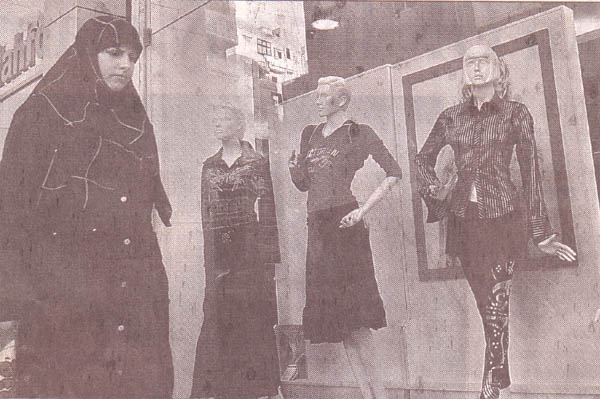
MUSLIM HATE FOR WOMEN
Report declares treatment of Christian minority women and girls a ‘human rights catastrophe’
By CNA Staff
London, England, Nov 24, 2021 / 12:00 pm
A
report issued on Wednesday declared the treatment of Christian minority
women and girls in parts of Africa, the Middle East, and South Asia a
“human rights catastrophe.”
The
study, “Hear Her Cries,” published by the charity Aid to the Church in
Need (ACN) on Nov. 24, said that, “at its most extreme,” forced
conversions could amount to “genocide.”
The
report, released on Red Wednesday, an annual commemoration raising
awareness of anti-Christian persecution, highlighted cases in countries
including Egypt and Pakistan.
It
also focused on Nigeria, which was controversially removed from this
year’s U.S. State Department watchlist of countries with the most
egregious violations of religious freedom.
The
study found numerous cases of forced kidnapping and exploitation in
Egypt, that Christians account for 95% of women and girls seized by
Islamists in Nigeria, and that 70% of those forcibly converted and
married in Pakistan are Christians.
ACN
described the report as “the first of its kind to focus on the
phenomenon of young women who are seized, because both their sex and
religion makes them vulnerable to abduction and assault.”
Michele
Clark, a human rights advocate who has studied the plight of Coptic
Christian women, told CNA on Nov. 24 that the report was significant
because it revealed the scope of the problem.
“I
think the report makes a very important contribution, because it
expands the focus on these abductions, forced conversions, forced
marriages, from just single country reports to a much broader, much
more global perspective,” said Clark, a retired adjunct professor of
international affairs at George Washington University, in a phone
interview.
“We
can pick this up and realize, ‘Wow, this is not just happening in one
place.’ This is happening in many, many places around the world. It’s
happening in the Middle East. It’s happening in Central Asia. It’s
happening in Africa. And so shedding a light on the scope of the
problems is a very important contribution.”
The
report was compiled by ACN’s U.K. branch, which has launched a petition
calling for action to stop the sexual enslavement of Christian women.
The
text was presented at an online event chaired by the human rights
campaigner Caroline Cox. Speakers included Michele Clark and Fiona
Bruce, the British Prime Minister’s Special Envoy for Freedom of
Religion or Belief.
The
report, which includes case studies from Egypt, Iraq, Syria,
Mozambique, Nigeria, and Pakistan, said that “evidence suggests that
the coronavirus pandemic has provided the perfect breeding ground for
acts of sexual violence.”
“Research
showed that vulnerable converts in lockdown with their families are at
a greater risk of general abuse, especially in the Middle East and
North Africa region,” it noted.
The
report argued that “instances of systemic abduction, sexual violence,
forced marriage and conversion of Christian women in countries such as
Nigeria, Iraq and Syria can be categorized as genocidal by nature.”
It
recalled that one element of the 1948 Convention on the Prevention and
Punishment of the Crime of Genocide is the existence of “measures
intended to prevent births within the group.”
“There
is thus a link between the girls and young women who are the focus of
this study and the convention, which categorizes genocide as ‘acts
committed with intent to destroy in whole or in part, a national,
ethnical, racial or religious group,’” the report said.
Clark
told CNA that her own experience of documenting abuses committed
against Coptic women in Egypt suggested that the problem was growing.
“There
is definitely an increase in reported caseload,” she said. “There’s
also an interesting increase in asylum applications outside of Egypt
for young women who are fleeing for fear of abductions, and forced
conversions, and forced marriages. And these asylum applications are
being accepted in host countries because it’s a recognized phenomenon.”
“So
I’m seeing that, very slowly, very gradually, there is a recognition
that this is an issue that needs to be treated seriously, and that it
needs to be addressed, because of the deep, deep personal tragedies
that are represented in every single case.”
Around
10% of Egypt’s estimated 104 million population is Christian, with
around 90% belonging to the Coptic Orthodox Church, which is part of
the Oriental Orthodox communion and traces its roots to St. Mark the
Evangelist.
The
country’s Christians suffer various forms of discrimination. A report
earlier this month said that teachers at a school in Minya Governorate,
Upper Egypt, ordered Christian students not to wear crosses, while
inflicting violence on the schoolchildren.
The
ACN study said the Egyptian authorities were “highly dismissive” of
cases of forced abduction and conversion of Christian women.
It
quoted a former member of a kidnapping gang that targetted Coptic
girls, who described how the abductions were “meticulously
orchestrated” and led to the girls being passed to Salafist groups that
forced them to convert.
“The
former gang member also stated that kidnappers are paid handsomely by
these groups, and that police officers have conspired to report these
young women as missing rather than abducted,” said the report, which
added that incidents were under-reported in the media.
Clark said she was hopeful that governments were beginning to take the problem seriously.
“The
acknowledgment of other governments is absolutely essential. We can’t
allow perpetrators to think that they can continue with impunity and
that nobody really cares what they’re doing,” she said.
Asked
how individual Christians could contribute to ending the exploitation
of women and girls, she said: “The power of prayer, first, is so
important in what we do. And then when you move beyond that, I would
suggest that you become informed [about the situation].”
“I know that in the United States, we have Coptic women who have been asylees. These are families and young women which can benefit from friendship and support. Find out what is going on in your own particular community. Are there families that can benefit from a friend? This is a very important step in any kind of recovery process and feeling whole again.”
Iranian guards
sexually assaulted female IAEA inspectors - report
Iranian
security guards allegedly sexually assaulted female IAEA inspectors at the
Natanz nuclear facility.
SEPTEMBER 14,
2021
Iranian
security guards made female International
Atomic Energy Agency(IAEA) inspectors remove clothing and then
inappropriately touched them at Iran's Natanz nuclear facility, according
to The Wall Street Journal.
At least four
separate incidents of harassment were reported since early June, one diplomat
told The Wall Street Journal, while another diplomat said that there had
been five to seven. The most recent incident was reported in the past few
weeks.
"What I
understand is that there was touching in different places, sensitive places and
so on," said one diplomat to the newspaper.
A paper
circulated by the US among IAEA members ahead of a board meeting of the
agency's member states this week demanded an end to the conduct.
"Harassment
of IAEA inspectors is absolutely unacceptable, and we strongly urge you to make
clear in your national statement at the Board meeting that such conduct is
deplorable and must end immediately, and that the Board should take appropriate
action if further incidents are reported," read the paper, according to
the report.
The IAEA
confirmed to The Wall Street Journal that incidents had occurred at
the facility, without providing details.
The UN nuclear
watchdog on Tuesday described as "unacceptable" incidents in Iran
involving its inspectors, in which diplomats say security staff subjected
female inspectors to inappropriate searches that the United States is calling
harassment.
"The
Agency immediately and firmly raised this issue with Iran to explain in very
clear and unequivocal terms that such security-related incidents involving
Agency staff are unacceptable and must not happen again," the IAEA said.
"Iran has
provided explanations related to reinforced security procedures following
events at one of their facilities. As a result of this exchange between the
Agency and Iran there have been no further incidents."
Iran's
ambassador to the IAEA, Kazem Gharibabadi, said on
Twitter: "Security measures at the nuclear facilities in Iran are,
reasonably, tightened. The IAEA inspectors have gradually come up with the new
rules and regulations."
“The Agency
immediately and firmly raised this issue with Iran to explain in very clear and
unequivocal terms that such security-related incidents involving Agency staff
are unacceptable and must not happen again. Iran has provided explanations
related to reinforced security procedures following events at one of their
facilities,” an IAEA spokesman told the newspaper. “As a result of this
exchange between the Agency and Iran there have been no further incidents.”
This isn't the
first time that Iran has faced allegations of harassment against IAEA
inspectors. In 2019, a female inspector was detained at the airport and Tehran
had her travel documents taken from her. Iran claimed at the time that she had
traces of explosives on her and later released her.
Other
incidents of alleged harassment took place before nuclear negotiations began in
2013 before the JCPOA nuclear deal was signed, according to The Wall
Street Journal.
In
April, Iran was elected to
the United Nation's Commission on the Status of Women for a four-year term
along with China, Japan, Lebanon and Pakistan.
The Commission
on the Status of Women is the "global champion for gender equality,"
according to the organization. It works to develop and uphold standards in
which all women can exercise their human rights. The commission focuses on
issues it deems fundamental to women's equality and attempts to promote the
progress of women worldwide.
Women's rights
are severely restricted in Iran, Human Rights Watch (HRW) reported, saying that
they face "serious discrimination" on
a variety of issues including marriage, divorce and child custody. Women have
been jailed for speaking out in favor of women's rights, HRW reported.
Domestic
violence, marital rape, early and forced marriage are all offenses that Iranian
authorities have failed to criminalize, according to Amnesty International.
These offenses and other gender-based violence against women remain widespread
in the country, according to Amnesty International.
Authorities
have also failed to take steps against men who kill their wives or daughters
and the legal age for marriage is 13, although men can obtain permission to
marry their daughters and granddaughters earlier, said Amnesty International.
“Electing the
Islamic Republic of Iran to protect women’s rights is like making an arsonist
into the town fire chief,” said Hillel Neuer,
executive director of UN Watch, at the time. “It’s absurd — and morally
reprehensible.”
58 Palestinian
women murdered in domestic violence in 2 years; PA blamed for not ratifying law
to protect them
Nan Jacques Zilberdik
Jul 8, 2021
Palestinian
Media Watch
“The women in our
society are still being subjected to murder and violence… A chronic illness” –
official PA daily
“In the
absence of the law to defend the family against violence, the men of the family
will continue to do as they please with the women” – Palestinian NGO
“The increase
in the murder of women in Palestinian society under different circumstances and
unjustified and illogical excuses indicates the exacerbation of fundamentalism
and social seclusion” – Palestinian NGO
Palestinian
women’s rights organizations blame PA inaction in passing a law to defend women
from domestic violence as the reason murder of Palestinian women in domestic
violence is increasing.
According to
the independent Palestinian NGO, the Women's Centre for Legal Aid and
Counselling (WCLAC), over a two-year period (2019-2020), 58 Palestinian women
and young women were murdered in the Gaza Strip and the West Bank, including
Jerusalem. In 2019, 21 cases were documented – a number that rose to 37 cases
in 2020.
Palestinian
NGOs fighting for women’s rights are calling on the PA to finally ratify the
laws that will protect women and limit domestic violence:
“Member of the
Board of Directors of the Palestinian NGOs Network (PNGO) and Secretary of the
Women’s Activity Committees Association in Nablus Sana’a Shbeita
emphasized that… ‘The laws… increase the consciousness in society regarding
rights, and also constitute a deterrent and bring about security and stability.
Therefore, ratifying the law to defend the family against violence will
limit the violence against women and will thus protect them from the danger of
murder.’”
“The absence
of a defense mechanism for the women” and “the patriarchal culture that gives
men custody over the women and young women” were cited by Tahrir Al-A’araj, Director-General of the Palestinian Initiative for
the Promotion of Global Dialogue and Democracy “Miftah,” as the main reasons
for continued violence against and murder of Palestinian women. She foresees
that “in the absence of the law to defend the family against violence, the men
of the family will continue to do as they please with the women.”
Another
representative from the same NGO interpreted the rise in murders of women as a
sign of the “exacerbation of fundamentalism,” and implied the moral failure of
the PA as a “state that aspires to lay the foundations for the rule of law and
proper governance”:
“The increase
in the murder of women in Palestinian society under different circumstances and
unjustified and illogical excuses indicates the exacerbation of fundamentalism and
social seclusion… The law is the legal tool to deal with an attacker or
abuser in a state that aspires to lay the foundations for the rule of law and
proper governance, and ratifying laws, including the law to defend the family
against violence, is what will strengthen the achievement of justice and
security for the weak sectors of society, including women and young
women.’”
Palestinian
Media Watch has previously reported on honor killings and domestic violence in the PA. Although
focus on these problems has increased in the PA over the last few years, the
one thing that could make a difference - tougher legislation – has not been
taken on by the PA. On the contrary, PMW has shown that it is the PA itself and
often its religious representatives who
keep things at a standstill by for example telling women not to submit
complaints over their spouses to Israeli police, and justify that men beat their wives.
Speaking in
2019 - during the period of the WCLAC survey - a lecturer at the Bir Zeit
University also cited “the social culture and the domination of a male-patriarchal culture” and the “lack of defined and
detailed deterrent laws” as some of the reasons for violence against women in
the PA. Other experts on the same program explained that the concept of
“marital rape” is not even recognized in Palestinian culture because women’s
bodies are “a right permitted to the man”:
The
Palestinian Human Rights and Democracy Center "SHAMS" also explained
in 2019 that the male culture grants men the status of moral guardians who can
do as they please:
"Women
remain the most prominent victims of the male culture and of the violence that
grows out of it, while this culture elevates men beyond the culture of shame,
appoints them the masters and guardians of morality - even when they act
immorally - and grants them complete immunity. Reducing a woman's honor to her
hymen indicates a superficial and uncivilized mentality that stems from viewing
women as bodies and private property."
It should be
noted that in the PA with a nonfunctioning government and parliament all that
would be necessary to enact the law protecting women which has been under
discussion for years would be a statement by PA chairman Mahmoud Abbas. His
refusal to do so may be an indication of the social pressures in Palestinian
society against changing the status quo of male dominance over women.
The following
is a longer excerpt of the article on the new report on murder of Palestinian
women cited above:
Headline:
“Violence leads to murder – 58 cases in two years
They treat the women’s lives as they please and spill their blood, and the
victims are entire families under the powerlessness of the law”
“Despite all
the efforts at all levels, and despite the ongoing work by institutions, figures,
and media and social influencers, the women in our society are still being
subjected to murder and violence. Every time a case of murder occurs whose
victim is a woman in her youth, the criminal remains free without giving an
accounting, and these cases indicate a chronic illness from which we are
suffering, which is accompanied by violence and ignorance.
Recently, the
[independent Palestinian] Women's Centre for Legal Aid and Counselling (WCLAC),
one of the institutions dealing with monitoring issues and affairs of the
Palestinian women, published a report that shed light on the phenomenon of
women being murdered between the years 2019-2020…
According to
the information presented by the WCLAC, 58 cases were documented of Palestinian
women and young women being murdered during the last two years of 2019-2020 in
the Gaza Strip and the West Bank, including Jerusalem, which were divided into
21 cases in 2019 as opposed to 37 cases in 2020…
The severity
of the phenomenon lies in the general trend of an increase in the rates of
murder of women and young women in all areas, as at the time when an increase
took place in the cases of murder of women and young women – 25 cases in the
Gaza Strip and 33 in the West Bank – a significant increase also took place in the
cases of murder in the West Bank and the Gaza Strip in 2020 as opposed to 2019…
Member of the
Civil Organizations Network’s Board of Directors and Secretary of the Women’s
Activity Committees Association in Nablus Sana’a Shbeita
emphasized that… ‘The laws play a central role in protecting the social
sectors, the individual, his possessions, and his beliefs, and particularly the
women. The laws also increase the consciousness in society regarding rights,
and also constitute a deterrent and bring about security and stability.
Therefore, ratifying the law to defend the family against violence will
limit the violence against women and will thus protect them from the danger of
murder.’ …
In the same
context, [Palestinian Initiative for the Promotion of Global Dialogue and
Democracy] Miftah institution Director-General Tahrir Al-A’araj
emphasized that ‘One of the main reasons for violence against women, which is
violence that leads to murder in most of the cases, is the absence of a defense
mechanism for the women that constitutes a continuation of the violence against
women in the private space, which is connected to the mechanism of the
patriarchal culture that gives men custody over the women and young
women in this space. Therefore, in the absence of the law to defend the
family against violence, the men of the family will continue to do as they
please with the women.’ …
Miftah
Director of Projects Najwa Sandouqa said that ‘The
increase in the murder of women in Palestinian society under different circumstances
and unjustified and illogical excuses indicates the exacerbation of
fundamentalism and social seclusion… The law is the legal tool to deal with an
attacker or abuser in a state that aspires to lay the foundations for the rule
of law and proper governance, and ratifying laws, including the law to defend
the family against violence, is what will strengthen the achievement of justice
and security for the weak sectors of society, including women and young
women.’”
4 women who ran
empowerment workshops killed in Pakistan
"Is this
the way to give back to someone for the hard work they were doing for the
poor?” their employer told NBC News.
Feb. 22, 2021,
7:55 AM PST
By Mushtaq
Yusufzai and Saphora Smith
PESHAWAR,
Pakistan — Four women who ran empowerment workshops were gunned down Monday in
a volatile area of Pakistan that was once a base for the Taliban,
local police and the women's employer said.
The team was
hired by Bravo College of
Technology in Peshawar to
help local women gain vocational skills such as sewing in North Waziristan,
said Fayaz Khan, the chief executive of the college.
“Is this the
way to give back to someone for the hard work they were doing for the poor?”
Khan said by telephone. “Their role was tremendous for the local community.”
The women were
shot in an apparent targeted attack as they passed through a deserted village
near the town of Mirali in North Waziristan tribal
district, police chief Shafiullah Gandapur told NBC
News.
North
Waziristan runs along Pakistan’s border with Afghanistan and served as a base
for the Pakistani Taliban and other militants, including Al Qaeda, until 2014,
when the army said it cleared the region of insurgents.
No group
immediately claimed responsibility for the attack.
The incident
comes amid an uptick in attacks claimed by the Pakistani Taliban in the deeply
conservative area in recent months and amid concern that the insurgents may be
regrouping.
“North
Waziristan tribal district has suffered badly from militancy for a long
time," Gandapur said also by telephone.
"The security situation has improved but still we face a lot of problems.”
Marchers
attacked on International Women’s Day in Kyrgyzstan, Pakistan and Turkey
In Bishkek,
police detained activists for breaking rally ban. In Islamabad, radical groups
pushed barriers aside to attack marchers, including many men.
03/09/2020
Islamabad
(AsiaNews/Agencies) – While the world yesterday celebrated International
Women's Day with joyful events and colourful
initiatives, women's marches were attacked in Muslim-majority Asian countries,
namely Kyrgyzstan, Pakistan and Turkey. In some cases, police dispersed assembled
crowds with tear gas; in others, groups of Islamic radicals armed with bars and
sticks attacked participants.
Yesterday people
took to the streets around the world to celebrate women, focusing on certain
issues, such as domestic violence, child marriage, and so-called honour killings. Marchers stressed the principle of equal
pay for equal work, women's solidarity, equality between men and women, and
respect and mutual understanding within couples.
In Bishkek,
the capital of Kyrgyzstan, a group of masked men attacked the 8 March rally
that had brought together scores of women to protest against domestic abuse and
“bride kidnapping," a
widespread but unspoken practice.
By the time
police arrived the assailants had fled, but the agents had the time to arrest
protesters, at least 70, for illegal gathering and breaking the ban on
assemblies purportedly to prevent the coronavirus from spreading. So far, no
case of the Covid-19 has been reported in the Central Asian country.
In Istanbul
(Turkey), police used tear gas to disperse a few hundred women protesting at
the edge of Taksim Square. Agents stopped women from
entering Istiklal Street, the district’s main
pedestrian avenue. Istanbul’s governor Ali Yerlikaya
also closed down Taksim metro station and parts of
nearby Sishane station.
The
authorities said that protesters did not have a permit to hold a protest at
their chosen location. This is not the first time that
women’s rallies are forcibly ended.
In Pakistan,
the day was marked by some peaceful events, but others that ended in violence.
In
Faisalabad’s Madina Town neighbourhood,
the Holy Rosary parish held a seminar to mark women’s achievements of and note
the abuses, like abductions and forced conversions to
Islam, that women still endured.
In the capital
Islamabad, Islamic groups attacked the Aurat Azadi
March (march for women's freedom) organised by
various groups.
Members of the
Jamiat Ulema-e Islam (F), Sunni Ittehad
and Jamia Hafsa pushed aside streets barriers and attacked marchers, including
many men, with sticks, stones and shoes. Several people were injured.
Iranian
human rights lawyer Sotoudeh sentenced to 38 years in prison, 148 lashes, says
family
WRITTEN
BY ANI
March
13, 2019
DNA
Iranian
human rights lawyer Nasrin Sotoudeh has been sentenced to serve 38 years in
prison and 148 lashes, according to her family.
Sotoudeh
was convicted of "gathering and colluding to commit crimes against
national security" and for "insulting the Supreme Leader,"
according to IRNA.
She
is renowned for representing human rights defenders, dissidents, and women who protested
against the compulsory wearing of a headscarf in the country.
Nasrin
Sotoudeh's husband, Reza Khandan, wrote in a Facebook
post that she has been sentenced to 33 years and 148 lashes. Stating that she
was awarded five years in prison in absentia, her punishment now amounts to a
total of 38 years in prison.
Contradicting
Khandan, the state media, citing the judge in the
case, Mohammad Moghiseh, stated that Sotoudeh has
been sentenced to seven years in prison.
However,
the reason for the discrepancy in the reports was not immediately clear.
Meanwhile,
Amnesty International condemned the decision of incarceration of the Iranian
Human Rights lawyer.
"Nasrin
Sotoudeh has dedicated her life to defending women's rights and speaking out
against the death penalty -- it is utterly outrageous that Iran's authorities
are punishing her for her human rights work," said Philip Luther, Amnesty
International's Middle East and North Africa research and advocacy director, in
a statement on Monday.
Last
June, Sotoudeh was arrested in Tehran and taken to Evin
prison.
A
winner of the European Parliament's Sakharov Prize for Freedom of Thought,
Sotoudeh, is serving a jail sentence for a second time.
According
to CNN, in 2010, she was sentenced to 11 years in prison on charges relating to
her work. She was defending detained Iranian demonstrators during the 2009
Green Movement, a protest movement sparked by widespread accusations of
electoral fraud. She was, however, granted an early release in 2013.
Outrage at Muslim preacher's 'repugnant' views that it's a 'major SIN' for a
wife to refuse her husband's demands for sex
• Muslim fundamentalist preacher in Sydney said husband could
demand sex
• Nassim Abdi described a wife's refusal to get intimate with
spouse as 'major sin'
• Feminists Eva Cox and Catharine Lumby condemned Sunni
religious sermon
• New South Wales Attorney-General Mark Speakman said his
views 'repugnant'
By STEPHEN JOHNSON FOR DAILY MAIL AUSTRALIA
PUBLISHED: 23:00 EDT, 10 September 2018
Feminists and the NSW Attorney General have expressed concern after a Sydney
Muslim preacher declared it was a 'major sin' for a wife to refuse sex with her
husband.
Nassim Abdi, a fundamentalist Sunni, told an Auburn mosque in the city's west a
woman would be 'cursed' by angels for withholding marital intimacy.
'If the husband calls the wife to be intimate and there's no legitimate reason
for the woman to say no, then she must answer the call of her husband,' he said
on Friday night.
'She must answer the call of her husband and if not
she has committed a major sin.
'If the man calls the wife to bed and she refuses, the angels curse this woman
and he sleeps with her whilst he's angry, the angels curse her until she wakes
up.'
Mr Abdi preaches a seventh-century fundamentalist
version of Salafist Islam from Saudi Arabia with the Ahlus
Sunnah Wal Jamaah Association, which also advocates
aspects of Sharia law.
Long-time feminist Eva Cox described him as a 'nutter',
while stressing Islam was not the only religion with fundamentalists who
disrespected women's rights.
'Somebody needs to inform the preacher that he's preaching something which is
illegal,' she told Daily Mail Australia.
'Preaching something which is illegal maybe should be banned.
'I'm sorry we've got these nutters.'
Macquarie University research professor Catharine Lumby, a gender adviser with
the National Rugby League, described the sermon as 'hate speech'.
'That kind of speech should be investigated. I believe in freedom of speech but
I believe in limits to freedom of speech where violence is being advocated,'
she said.
'It is absolutely against the law in this country what he's advocating.
'It's a form of hate speech.'
Both feminists from an academic background stressed that fundamentalist
Christians, too, had described women as the sexual property of men and said the
sermon was not a reflection on all Australian Muslims.
Mr Abdi has previously declared it sinful for Muslim
women to show their ears under their hijabs in public and for parents to allow
their children to listen to music in the car.
Professor Lumby said Mr Abdi's sermon could encourage
Muslim men to commit domestic violence.
'I would say it's incitement to commit a criminal offence: if your wife doesn't
submit, then you still have the right to take her. That is a crime under
Australian law,' she said.
'Shocking. The more I think about what this fundamentalist preacher said, in a
way he's advocating a form of domestic violence.'
New South Wales amended the Crimes Act this year to give three-year jail terms
for inciting violence based on race, religion or sexuality.
However, it didn't specifically target the comments of religious preachers.
Attorney-General Mark Speakman said Mr Abdi's remarks
were a matter for police.
'Non-consensual sex is a serious crime which should be reported to the police,'
he told Daily Mail Australia today.
'Respect for all women is a central value of Australian society.
'The views expressed by this preacher are repugnant to those values.'
Daily Mail Australia has sought a right of reply from the Ahlus
Sunnah Wal Jamaah Association at Auburn.
The group removed the video from YouTube after a series of questions were
emailed to them.
It was titled: 'Prohibitions regarding intimacy in marriage.'
Marital rape didn't become a crime across Australia until 1994, with South
Australia in 1976 becoming the first state to criminalise
sexual assault in a marriage.
“Haram” To Cast Votes For Women: Pakistan Ex Social Welfare
Minister
Addressing a rally in his
constituency in Muzaffargarh, Haroon Sultan said he will follow the directions
of religion and will abstain from casting a vote to any female candidates as it
is considered "haram" (forbidden in Islam), The News reported.
World | Press Trust of India | Updated: July 03, 2018
LAHORE:
Pakistan Muslim League-Nawaz (PML-N) candidate for the July 25 general election
and former Punjab province minister Haroon Sultan has sparked a controversy by
terming it "haram" to cast votes for women.
Haroon Sultan, who has served as minister for social welfare in the previous
tenure of the PML-N government in Punjab, is contesting elections from the
National Assembly constituency NA-184 against Pakistan Tehreek-e-Insaf's female candidate Zehra Basit Sultan Bukhari, who is
also reportedly his sister-in-law.
Addressing a rally in his constituency in Muzaffargarh, Haroon Sultan said he
will follow the directions of religion and will abstain from casting a vote to
any female candidates as it is considered "haram" (forbidden in
Islam), The News reported.
"I will work under the commands of Allah and His messenger...and will
desist from doing the contrary," he added.
Pakistan People's Party has fielded Nawaz Iftikhar Khan in this constituency.
PML-N is led by former prime minister Nawaz Sharif, who was disqualified by the
Supreme Court last year in the Panama Papers case.
Voting is a constitutional right in Pakistan, but millions of women have been
prevented from exercising their franchise by men using outdated customs.
16 Guards Are Needed to Protect a German Imam Who Fights for Gender Equality
MAY 15, 2018 BY TERRY FIRMA
PATHEOS
Berlin-based Imam Seyran Ateş, 55, has had to get
used to the hate mail and the death threats.
She hardly cut a popular figure among Germany’s Muslim population before 2017;
as a lawyer, she used to represent victims of domestic abuse and other violence
perpetrated by her clients’ conservative-Muslim husbands and brothers. Ateş has a scar on her neck from where a would-be
murderer’s bullet hit her years ago.
Then, last year, the Istanbul-born feminist really painted a bull’s-eye on
herself when she started the Ibn Rushd-Goethe mosque
in the German capital. It’s a place of worship where men and women pray in the
same space. Burqas and niqabs are strongly discouraged, headscarves are
optional, and women often lead in prayer. LGBT Muslims are welcome and can get
even get married at the mosque.
The Dutch daily Trouw, which published an interview
with Ateş on Friday, reports that she has a
security detail of 16 guards. Everywhere she goes, her armed protectors keep an
eye on her, scanning the surroundings for Islamist assassins.
With her liberal religious interpretations of the Qur’an and the Hadith, Ateş unleashed the anger of “millions of Muslims,”
according to Trouw. Religious authorities in Turkey
and at the Al-Azhar university in Cairo have excoriated her, and virtually
every day brings new threats of rape, or murder, or both — often from within
the free, secular country where Ateş has lived
since she was six.
The hatred she receives only strengthens her conviction that gender equality is
vitally important, and worth fighting for.
“It is so liberating to pray together, especially for women. Many feel for the first time what it is like to be fully human,
and experience what it is to be respected as such, instead of being reduced to
a female and a sex object that men can undress with their eyes, or ignore. By
praying together and making gender a non-issue, the focus finally shifts to
spirituality instead of sexuality.”
Ateş sees a strong connection between her
erstwhile career as an attorney and her current one as an imam, pointing out
that she defends constitutional principles in both capacities.
“What’s happening in our Dutch and German mosques is that Muslims pray against
principles of equality. The ideology that is bred within the mosque has an
effect outside of it. Mosques form the moral guide of the community. The gender
segregation, and women’s reduction to sex objects that is the cause of it,
influence the mindset of young Muslims. …
I realized that while I defended the constitution in the courts, that same
constitution was ignored and invalidated in every mosque. There isn’t a place
in Germany where, as a woman, I feel less welcome than in a mosque. So that’s
where I had to start.”
I was struck by how much Ateş has in common with
Ayaan Hirsi Ali (despite the latter having become an atheist). Both fled
patriarchal oppression and arranged marriages. Both settled in the West. Both
pulled themselves up by the bootstraps, integrated with keenness, fell in love
with enlightenment ideals, thrived academically, and became celebrated for
their tireless advocacy on behalf of women (Ateş
was named Germany’s Woman of the Year in 2005).
Moreover, both rail eloquently against the insane
iniquities that girls and women suffer under Islam even in the West. And both
like to point out the dangers posed by the rise of political Islam in Europe;
warn against unfettered multiculturalism and unrestricted immigration; and
condemn the bigotry of low expectations displayed especially by the regressive
Left, whose tolerance of intolerance helps keep Muslimas under the thumb of
medieval-minded Islamic men.
Just as meaningfully, both Ateş and Hirsi Ali
have fatwas and assorted murder threats hanging perennially over their heads —
hard proof, as if we needed it, that Allah doesn’t necessarily bestow morals or
actual virtue upon those serving him.
=-=-=-=-=-=-=-=-=-=-=-=-=
P.S.: On the same day that Trouw published its
interview with Ateş, a news report from France
24 revealed what is habitually preached in mosques in neighboring Belgium (but
not just there).
Teaching manuals in Gulf Arab-financed mosques in Belgium promote anti-semitic stereotypes of Jews and call for the
persecution of homosexuals, according to a leaked Belgian intelligence report.
The texts used in mosques including the Brussels Grand Mosque call for gays to
be stoned to death or thrown off buildings …, the report by the OCAM national
terrorism monitoring center said. …
The manuals call Jews a “corrupt, evil and treacherous people” and call for
“war” on all people who do not follow Sunni Islam.
Out of understandable concern over Islamic radicalism, the Belgian government
announced in March that it would not be renewing the lease on Brussels’ Grand
Mosque. For the past 50 years, that lease has been held by Saudi Arabia and its
controversial Muslim World League.
'Beat her in a way that doesn't turn her skin red': Visiting Islamic preacher
from Iran tells Sydney mosque audience it's OK for a husband to bash his wife
• Visiting Iranian Shia cleric Sheikh Taleb
al-Khozaei justified domestic violence
• He was a guest speaker at Hussainayet
Ale Yassin Mosque in western Sydney
• The imam said husbands could beat their wives as a 'last
resort' citing Koran
• Mosque founder and manager Ali Soorat
condemned the sermon's message
By Stephen Johnson For Daily Mail Australia
PUBLISHED: 22:19 EDT, 16 October 2017
A visiting Islamic preacher from Iran told a Sydney mosque it is okay for a
husband to beat his wife as long as he doesn't leave any red marks.
Sheikh Taleb al-Khozaei, a
Shia cleric aligned with the Iranian theocracy, was a guest lecturer at the Hussainayet Ale Yassin Mosque at Sefton, in Sydney's west.
In an Arabic language sermon, he said it was permissible for husbands to
lightly beat their wives 'as a last resort' if they had been disobedient.
The western Sydney mosque which organised the visit
has condemned that sermon promoting domestic violence and has vowed to bar him
from returning.
Citing verse 4.34 of the Koran, Sheikh al-Khozaei
said husbands could abandon their wives if they had been disobedient.
'He must beat her only enough to bring her back home if she leaves,' he said in
a June sermon that was live streamed.
'He must beat her in a way that doesn't turn the skin red or dark.'
He then proceeded to explain how husbands could abandon their wives in the
bedroom.
'The first method is through advice, the second method is by abandoning them in
the bedroom by turning his back towards her at night or sleeping in another
place,' he said.
'The woman has honour, therefore by abandoning her
you are humiliating her by making her feel that she has made a mistake by not
serving her husband's rights.'
Sheikh Taleb al-Khozaei's
fundamentalist sermon also described the method of beating 'as a last resort'.
'Here, beating takes place. But which type of beating? Don't get me wrong,' he
said.
'Islam is not a terrorist religion. The beating that doesn't cause an affect
and is not a beating for revenge.'
His sermon was based on section 4.34 of the Koran which advises husbands to
abandon their disobedient wives.
'Admonish them, and leave them alone in the sleeping-places and beat them,' it
says.
The Hussainayet Ale Yassin Mosque denounced the
sermon promoting domestic violence.
'We don't condone it and in our community we don't
accept hitting of any kind,' it told Daily Mail Australia in a statement on
Tuesday.
'I didn't know that he was going to say something like that and after he
finished his speech I did tell him that he shouldn't
have said it.
'Because of that we are not inviting him back anymore.
'I also was going to take that video of off website but I had forgotten about
it, thanks for the reminder.'
In February, Islamic Friendship Association of Australia founder Keysar Trad told Sky News presenter Andrew Bolt husbands
could lightly beat their wives after trying to reconcile with flowers or a box
of chocolates.
'This verse is saying really, is playing on the psychology of the man saying
violence is a last resort,' he said, before apologising
a few days later.
Two months later, Women of Hizb ut-Tahrir
made a video describing domestic violence as a 'beautiful blessing'.
Sydney primary school teacher Reem Allouche told the
women's arm of hardline Islamist political group Hizb
ut-Tahrir that men could hit women with sticks,
during a 30-minute discussion in Sydney's west with fellow panellist
Atika Latifi.
Survey finds deeply regressive views of women among large majorities of Muslim
men
03 May 2017
National
Secular Society
A large-scale survey of views in Egypt, Lebanon, Morocco and Palestine has
reported extensive anti-women views and widespread tolerance of domestic
violence.
The three countries and Palestine were selected to be broadly representative
and "to reflect the diversity of the region".
The report's authors said they wanted to "provide a more nuanced view of
men in the Middle East and North Africa" following gang rapes committed by
young Middle Eastern and North African men in Tahrir Square and Cologne.
Unsurprisingly their data found that clear majorities of men in these
overwhelmingly Muslim-majority countries held anti-women views, and had deeply
regressive opinions about the role of women in society.
The report, produced by International Men and Gender Equality Survey (IMAGES)
found that "The majority of Egyptian men consider it their duty to protect
the honour of women and girls in their family, and
nearly three-fifths agree with honour killing in some
circumstances. More than 90 per cent of men saw male honour
as directly contingent on their female relatives' dress and behaviour".
Just 45% of Egyptian men believed there should be laws "criminalizing
domestic violence, including marital rape." And only 70% of Egyptian women
agreed with this statement.
43% of Egyptian Muslim men said they would approve of their son having multiple
wives, though just 9.5% said they would approve of their daughter marrying a
man who already had other wives.
Only 6.6% of unmarried men said they "have no problem with marrying
someone of a different religion", and a tiny 2.3% of unmarried Egyptian
women said the same.
Just 39% of Egyptian men approved of women serving as leaders of political
parties, though 93% said they should be able to vote.
60% of Moroccan men said "if a woman is raped, she should marry her
rapist."
62% of Moroccan men said "a woman should tolerate violence to keep the
family together", and 38% agreed "there are times when a woman
deserves to be beaten". Shockingly, 20% of Moroccan women agreed with
this.
The report collected anecdotes and accounts from men and women across the four
countries surveyed, including many accounts of domestic violence.
One young woman living in Cairo said her husband apologised
for beating her and she went back to him, and now "The beating decreased,
and now he beats me slightly if we disagree. But before, he used to beat me
'till my face and body became blue. But now things are better."
The report's authors said, "While a majority of men surveyed in the four
countries support a wide array of inequitable, traditional attitudes; a sizable
minority of men in the four countries acknowledge and support women's equality
in many aspects of public and private life."
Sultan rejects bill proposing equality for men, women
•Says it’s un-Islamic
28th December 2016
By Adetutu Folasade-Koyi
The
Sun
The Sultan of Sokoto, Alhaji Sa’ad Abubakar lll, has rejected an equality bill being considered by the
Senate.
The bill seeks equality for male and female children in the sharing of
inherited family wealth or property.
It also proposes that a widow is entitled to the custody of her children unless
it is contrary to the interests and welfare of the children.
The bill also seeks that a widow shall have the right to remarry any man of her
choice and have the right to a fair share in the inheritance of her late
husband’s property and the right to live in her matrimonial house.
The Sultan, has, however said the bill is anti-Islamic and unacceptable to
Muslims.
Tthe Sultan said this in Gusau at the closing of the
20th Zamfara State Annual Qur’anic Recitation competition, yesterday.
Abubakar said at the occasion that the bill is against Islam and, therefore,
unacceptable to Muslims.
“Our religion is our total way of life; therefore, we will not accept any move
to change what Allah permitted us to do.
“Islam is a peaceful religion; we have been living peacefully with Christians
and followers of other religions in this country. Therefore, we should be
allowed to perform our religion effectively,” he said.
He urged the Senate not to consider the bill because of its religious
implications.
Calls to end Saudi male guardianship sweeping social media
By KATIE BEITER
The
Jerusalem Post
Wed,
07 Sep 2016
Saudi women are not allowed to travel, marry, study, or even have surgery
without permission from their guardians.
Reem, a 37-year-old Saudi nurse, who asked that her last name be withheld,
recalled when her family arranged her marriage. After graduating from nursing
school, she worked for 10 years until her cousin approached her father asking
for her hand in marriage.
“All of a sudden my father said to me, this is my nephew and you will marry
him,” Reem said. “We were complete opposites in character and I didn’t like
him, he wasn’t handsome. So, I refused, I cried, I did everything a Saudi girl
can do, but sadly, they forced me.”
“It broke my soul,” she added. After a year of being engaged, Reem broke it
off. Her parents then forced her to marry a man, who, according to Reem, was a
drug addict; so she divorced him.
“Now, I am divorced with one son. I am a nurse, but I stay with my family. I
have a good salary, but they refuse to let me live independently. I am 37 years
old and I still live with my parents,” Reem said.
Stories like these are not uncommon in Saudi Arabia, a conservative, Muslim
country, where male guardianship laws still reign. These laws require Saudi
women, regardless of age, to have a male guardian, usually a husband or a
father, who makes all legal decisions for them.
The hashtag, #StopEnslavingSaudiWomen, has taken the Twitter social networking
world by storm, calling for an end to these oppressive laws.
“Basically, from when they are born to when they die, Saudi women require male
guardians, who are given legal control over their lives,” Kristine Beckerle, a Human Rights Watch researcher recently
reported. According to Beckerle, the New York-based
human rights organization "has concluded that male guardianship is the
most significant impediment to women’s rights in Saudi Arabia today.”
Saudi women are not allowed to travel, marry, study, or even have surgery
without permission from their guardians. “If you go out against your guardian’s
will, he can go to the police and file a complaint that you are a fugitive and
the police will come after you and take you home,” Reem added.
There is a Twitter hashtag in Arabic
(#سعوديات_نطالب_باسقاط_الولاية51),
which updates the number of days the hashtag has been circulating. It has
reached 51.
“It's a unified effort by Saudi Women in attempt to voice their struggle in the
only legal way that they can in Saudi Arabia,” Isaac Cohen, Director of the
S.A.F.E. Movement, a non-profit organization dedicated to helping Saudi women
fight male guardianship, told The Media Line.
Women have chosen the social media platform to raise awareness because protest
rallies are illegal and can even carry prison sentences in Saudi Arabia. In the
past, Saudi women have feared publicizing their beliefs; however, women have
now become more willing to take a stand in the anti-guardianship campaign,
according to Beckerle.
These women have gone so far as to record videos of themselves to post on
social media, articulating the horrors of the repressive laws. Aside from the
hashtags, there have been many other instances of solidarity amongst Saudi
women.
Some of which include the distribution of “I am my own guardian” bracelets and
stickers; a petition to the king, which gathered over 3,000 signatures in 24
hours; and a wall in Riyadh with the hashtag written in graffiti.
“I am flabbergasted. The media is not free and Saudi women themselves face many
levels of difficulty. To see women take up the call
and demand their rights has been incredible,” Beckerle
said.
There have been movements in the past to change laws in Saudi Arabia. In
October 2013, there was a campaign to allow women the right to drive; however,
that was unsuccessful.
However, activists hope that this campaign may be different. Because the
guardianship laws affect a number of different aspects of women’s lives, Beckerle believes that this gives the government room to
initiate changes. Reem said that while she believes the government is gradually
making necessary changes, she does not believe that there will ever be complete
elimination of male guardianship laws.
“Un-Islamic” for women to seek divorce without husband’s permission
By Qaiser
Butt
Published:
February 18, 2016
The
Express Tribune, Pakistan
ISLAMABAD: The Council of Islamic Ideology (CII) has declared it un-Islamic for
courts to use ‘Khula’ (right of a woman to seek
divorce) without the consent of a husband to dissolve a marriage.
The powerful religious body observed on Thursday that courts were dissolving nikkahs in the name of ‘Khula’,
which is not correct since only the husband has the right to grant Khula after which courts can dissolve marriage contracts.
Urging civil courts to differentiate between ‘Khula’
and a unilateral dissolution of marriage through a court order, the CII said
several women who had dissolved their marriages using ‘Khula’
were still not certain if their marriage had actually been dissolved.
“While Shariah has explicitly defined the framework and procedure for Khula, it has not been defined in the country’s existing
marriage laws,” the CII observed.
Therefore, a civil court decreeing dissolution of marriage on a wife’s plea
without her husband’s consent, under the name of Khula,
would be in violation of the Holy Quran and Sunnah, the council observed.
The council also observed that denying a husband the right to appeal against
such a ‘unilateral’ court decision would also be unjust as per Islamic law.
According to a majority of ulemas, a wife has to
forfeit her financial rights when ‘Khula’ is used to
dissolve a marriage. However, the two can reach an agreement outside the law if
a mutual understanding is established.
As per the Dissolution of Muslim Marriage Act passed in 1939, “Judicial khula is allowed to be authorised
without the husband’s consent if the wife has agreed to forfeit her financial
rights. Marriage is not considered a sacrament among Muslims but rather a civil
contract with spiritual and moral undertones.”
“Therefore, legally, the marriage can be dissolved for a good cause. The wife
has the right to dissolve a marriage on grounds of Khula
if she decides she cannot live with her husband [any longer].”
Sunni leader says 'women only fit to deliver
children'; calls gender equality 'un-Islamic'
Saturday,
28 November 2015
Place:
Thiruvananthapuram
Agency:
PTI
Sunni leader Kanthapuram A P
Aboobacker Musliar, the chief of All India Sunni Jamiyyathul Ulama, said women have no mental strength and
the power to control the universe, "which lies in the hands of men."
In a
controversial remark, Sunni leader Kanthapuram A P Aboobacker Musliar on Saturday
described as "un-Islamic" the concept of gender equality and said
that women could never equal men as "they are fit only to deliver
children".
Musliar, the chief of All India Sunni Jamiyyathul Ulama, said women have no mental strength and
the power to control the universe, "which lies in the hands of
men.""
Gender equality is something which is never going to be a reality. It is
against Islam, humanity and was intellectually wrong," he said while
speaking at a camp of Muslim Students Federation (MSF) in Kozhikode."
Women can never equal men. They are fit only to deliver children. Women cannot
withstand crisis situations," he said. He wondered if there was even a
single woman among thousands of cardiac surgeons.
The 76-year-old Islamic scholar's remarks against reservation for women in
elections had set off another controversy recently.
He had said 50% reservation of seats for women in civic polls was "too
high" but retracted the statement later when it became controversial.
Referring to the ongoing debates over allowing girls and boys to share seats in
colleges, Musliar said it was "part of a
calculated move to destroy Islam and culture."
He also rubbished recent allegations regarding sexual exploitations at Madrasas
and asked those who raised allegations to bring evidence to prove it.
A controversy had erupted recently after a woman journalist wrote an account on
her Facebook wall about the alleged sexual abuse of young boys and girls in
Madrasas.
Saudi housewife could be put behind bars for
posting online video of her cheating husband
Footage
exposing partner as he tried to kiss maid could count as
"defamation", lawyers warn
By Colin Freeman
08 Oct 2015
The Telegraph
A Saudi woman who posted footage online of her
husband assaulting a family maid has been warned that she may face jail for
"defamation".
The housewife used her mobile phone to secretly
film her partner as he made advances to a female servant in the kitchen of the
family home.
The video shows a man, dressed in traditional
white robes of a Saudi male, apparently trying to kiss the maid as she attempts
to pull away from him.
The wife uploaded the footage to YouTube,
alongside the caption "the minimal punishment for this husband is to scandalise him".
The footage drew widespread support for the
unnamed housewife, but Saudi legal experts have warned that it could be the
wife who ends up in jail.
"She faces up to one year in prison or a
fine of SR500,000 (£87,214) for defaming her husband in line with the law on
information technology crimes," Majid Qaroob, a
lawyer in the ultraconservative kingdom, told a local newspaper.
"This law includes stiff punishment for
anyone using mobile phones with camera or other equipment to photograph others
and defame them."
The encounter takes places in full view of
another woman, also believed to be a houseservant,
who is also seen walking around the kitchen.
In a country where women are still not allowed
to drive, and must seek permission from a male next of kin to travel or get a
job, the housewife's actions have received warm applause from other women.
The case has also highlighted the plight of
house servants, usually migrant workers who have little in the way of
employment rights.
“I salute you warmly for your valiant courage,”
said Al Yamama, a blogger, in remarks reported by
Gulf News. “You did the best thing because there was an urgent need for revenge
and your revenge is the best."
‘Gang-rape victim’ faces public caning in Indonesia
Oman Tribune
May 6, 2014
BANDA ACEH A woman allegedly gang-raped in
Indonesia’s Aceh as a punishment for sleeping with a married man may still be
caned for the affair under the province’s Islamic laws, an official said on
Tuesday.
A group of eight men allegedly carried out the sex assault last week on the
25-year-old widow at her house in Langsa in East Aceh
district, and also beat up the man with whom she is accused of having an
affair.
After the attack, which also saw the couple doused with sewage, the pair were
handed over to Islamic sharia law officials.
Ibrahim Latif, head of Langsa’s Islamic sharia law
office, said both the man, 40, and woman still face up to nine lashes of the
cane in public over the affair.
“We want the couple to be caned for violating sharia law on adultery,” he
said.
He added that the rapists “will also be brought to justice”.
Police have arrested three suspected rapists including a 13-year
old boy, while the five others are still on the run.
Teungku Faisal Ali, the head of the NU’s Aceh
chapter, told the Jakarta Globe that “the punishment for the mob that raped the
victim must be much harsher because they have set back efforts to uphold
Shariah in Aceh.”
He also urged residents to leave Shariah enforcement up to the WH and not
enforce the regulations themselves.
“If anyone sees any violation of Shariah, they must report it to the Shariah
police, in accordance with the prevailing standards and procedures,” Faisal
said.
He also bemoaned what he called the increasing prevalence of mob violence in
Aceh, particularly against those accused of Shariah violations.
A 20-year-old university student was raped by three Shariah police officers in Langsa in January 2010 after being caught riding on a
motorcycle with her boyfriend.
The town’s Shariah police chief, Syahril, was
subsequently fired and two of the perpetrators were later sentenced to serve
eight years in prison each. The third perpetrator has not been caught.
Conservative Afghan lawmakers block legislation
protecting women’s rights
By Associated Press, Published: May 18, 2013
KABUL, Afghanistan — Conservative religious
lawmakers in Afghanistan blocked legislation on Saturday aimed at strengthening
provisions for women’s freedoms, arguing that parts of it violate Islamic
principles and encourage disobedience.
The fierce opposition highlights how tenuous
women’s rights remain a dozen years after the ouster of the hard-line
Taliban regime, whose strict interpretation of Islam once kept Afghan women
virtual prisoners in their homes.
Khalil Ahmad Shaheedzada, a conservative lawmaker for
Herat province, said the legislation was withdrawn shortly after being
introduced in parliament because of an uproar by religious parties who said
parts of the law are un-Islamic.
“Whatever is against Islamic law, we don’t even
need to speak about it,” Shaheedzada said.
The Law on Elimination of Violence Against Women
has been in effect since 2009, but only by presidential decree. It is being
brought before parliament now because lawmaker Fawzia
Kofi, a women’s rights activist, wants to cement it with a parliamentary vote
to prevent its potential reversal by any future president who might be tempted
to repeal it to satisfy hard-line religious parties.
The law criminalizes, among other things, child
marriage and forced marriage, and bans “baad,” the
traditional practice of exchanging girls and women to settle disputes. It makes
domestic violence a crime punishable by up to three years in prison and
specifies that rape victims should not face criminal charges for fornication or
adultery.
Kofi, who plans to run for president in next
year’s elections, said she was disappointed because among those who oppose
upgrading the law from presidential decree to legislation passed by parliament
are women.
Afghanistan’s parliament has more than 60
female lawmakers, mostly due to constitutional provisions reserving certain
seats for women.
There has been spotty enforcement of the law as
it stands. A United Nations analysis in late 2011 found only a small percentage
of reported crimes against women were pursued by the Afghan government. Between
March 2010 and March 2011 — the first full Afghan year the decree was in effect
— prosecutors filed criminal charges in only 155 cases, or 7 percent of the
total number of crimes reported.
The child marriage ban
and the idea of protecting female rape victims from prosecution were particularly
heated subjects in Saturday’s parliamentary debate, said Nasirullah
Sadiqizada Neli, a
conservative lawmaker from Daykundi province.
Neli suggested that
removing the custom — common in Afghanistan — of prosecuting raped women for
adultery would lead to social chaos, with women freely engaging in extramarital
sex safe in the knowledge they could claim rape if caught.
Another lawmaker, Mandavi
Abdul Rahmani of Barlkh
province, also opposed the law’s rape provision.
“Adultery itself is a crime in Islam, whether
it is by force or not,” Rahmani said.
He said the Quran also makes clear that a
husband has a right to beat a disobedient wife as a last resort, as long as she
is not permanently harmed. “But in this law,” he said, “It says if a man beats
his wife at all, he should be jailed for three months to three years.”
Sexual violence rises in Egypt's Tahrir
Increasing
number of women fall victim to gang assaults in square that was at the centre of last year's revolution.
Sally El-Sabbahy Last Modified: 05 Jul 2012
Cairo, Egypt - Nearly a year and a half after
Lara Logan was sexually assaulted by a mob of men in Tahrir Square, women have
increasingly been coming forward with disturbing personal testimonies of
similar attacks.
Natasha Smith, a British journalism student who
was in Cairo on a research internship, recently lit up the social media sphere
with a detailed blog account of an attack she suffered in Tahrir.
The posting recounts how a horde of men encircled
and quickly overpowered Smith, who was accompanied by two male friends, on the
outskirts of the Square on June 24.
"Hundreds of men pulled my limbs apart and
threw me around. They were scratching and clenching my breasts and forcing
their fingers inside me in every possible way," she wrote. "Although
a few men tried to form a human shield around me, offering me rags to cover my
bruised body, men were still able to touch me. There were just too many."
After being hidden in a tent, Smith only escaped
her attackers by donning a niqab and being smuggled out of Tahrir by a man who
ordered her not to cry for fear it would alert her assailants to her identity.
In another account, an anonymous victim, who
called herself "C", was also subjected to a vicious gang assault in
Tahrir on June 2 after being separated from her group of friends.
"Before I knew it, I was thrown up against
a wall where a motorcycle was parked," she recalled in her testimony to
the Egyptian centre, Nazra for Feminist Studies, a
feminist organisation that has been seeking to record
as many of these incidents as possible. "I was standing on top of the bike
while my friend and a few other men tried to make a half circle to protect me.
But there were more men trying to hurt me than protect me and I was grabbed all
over and my pants and shirt were ripped."
After being dragged into the foyer of a nearby
apartment building, "C" was continuously violated until she was
finally rescued by a group of men that hid her with a family living in one of
the flats. Much like Logan and Smith, the men attacking her not only forced
their fingers into her body repeatedly, but also brutally beat her throughout
the attack.
A surge in violence
The month of June ushered in a series of
startlingly volatile sexual assault cases across Tahrir.
In addition to recorded individual attacks like those above, an attempted
women's rally scheduled to take place in the Square on June 8 ended in terrorwhen the women participating in the demonstration
were beaten and violently groped, despite having male companions form a human
chain around them for protection.
While these are not the first such incidents - the women demonstrating in
commemoration of International Woman's Day in Tahrir on March 8, 2011 were also
groped and attacked until the intervention of an army soldier - private organisations like Nazra are saying that June witnessed a
sudden and alarming increase in their frequency.
Dalia Abd El Hameed, a researcher for the
Egyptian Initiative for Personal Rights (EIPR), confirmed a noticeable increase
in the violence.
"While sexual assault was also a case in
the first days of the revolution, it was less obvious and less harsh and wasn't
committed by gangs… what's remarkable about these [incidents] is that they are [all]
gangs," she explained. "There was the incident of Lara Logan and a
couple others, but other than that it was primarily harassment in the
frontlines in places like Mohamed Mahmoud Street where the violence was
highest."
According to Abd El Hameed, one possible cause
for the rise in violence is the general increase in violence throughout the
country since January 2011. "The process of militarisation
that the country is undergoing now is creating a parallel culture of normalised violence," she said. "In areas where
there is conflict or transition or clashes, there is always violence against
women."
A high-ranking police official, who spoke on
the condition of anonymity, also linked the increase in sexual violence to
"the overall instability in the country and the lack of law
enforcement".
He added that it was especially true in Tahrir,
where "the police are as helpless as anyone else. They fear the crowd
would turn on them."
No justice
In spite of growing sexual violence in the
Square, it is unclear how - or if - these cases are being investigated.
The anonymous police officer explained that
daily reports containing all of the crimes registered in police stations
throughout Cairo are sent on a daily basis to the Office of the Commissioner of
the Police in the city's Bab el Khalk district.
The reports are then supposed to be reviewed by
the commissioner, but when asked about how the department follows up, the
officer replied, "[only] God knows what happens".
In addition, the official also revealed his
suspicion that officers omit some incidents from the reports to give the
impression that they are managing crime effectively, and sometimes discourage
sexual assault victims to file cases by "mentioning how shameful the whole
process will be for the victims' families".
In a report published in 2008 by the Egyptian
Centre for Women's Rights (ECWR), only 2.4 per cent of Egyptian women and 7.5
per cent of foreign women in Egypt victimised by sexual
violence said they reported the incident to the police.
Among the reasons they gave were the beliefs
that the police would be ineffective, or that filing a report could negatively
impact their reputations.
Twitter response
A sense of frustration and helplessness about
the sexual violence in Tahrir has become increasingly evident across social
media platforms, which have been set ablaze with the subject since the
beginning of June.
One of the organisers of the doomed demonstration on
June 8 and a popular figure in the local women's rights movement, @sallyzohney,
tweeted that same day: "Stop calling it harassment, a march of over 100
was attacked in #tahrir and no one gives a [expletive]. I'm sick to my stomach.
It's assault. #EndSH."
Another popular Egyptian activist, @NoorNoor1,
tweeted on June 26 that Smith's account "nearly brought me to tears",
also ending his tweet with "#EndSH."
The hashtag #EndSH stands for "End Sexual
Harassment"; its recent predominant use in the Egyptian twitter scene is a
strong indication of how much attention the violence has drawn in social media
outlets.
But amidst online outrage, twitter has also
showcased varying degrees of denial among the Egyptian twitter community.
@RositaMexica, a friend of "C" who
was also assaulted on June 2, angrily tweeted: "I'm getting disgusted by
tweeps who don't find @natasha_journo story credible becuz
no1 else tweeted about it."
What next?
Despite the escalating violence, Abd El Hameed
said that women should not stop protesting in Tahrir.
"The right to protest and to peaceful
assembly is ensured for every person, this is what any person is entitled to
any place in the world. [We] don't have the agency to tell women to go or not
to go to a certain place," she said. "What we should call for is that
women must have the right to participate safely."
Rebecca Chiao, the Founder of HarassMap.org,
differed on this point, saying "that the solution lies in society rather
than in government. We waited years for the government to pass a [sexual
violence/harassment] law. They passed one in March/April 2011, and nothing
changed."
"I think we need to go back to community
pride in the safety and dignity of our streets, and I think the way to do this
is to ask everyone to stop ignoring or giving excuses and tell [offenders] to
stop," she added.
Following the attack on Smith, Ikhwanweb, the official English language website of the
Muslim Brotherhood, posted a message from MP Azza al-Garf, who condemned the incident and called for the
enforcement of law.
However, it still remains to be seen if the
Brotherhood's former party chairman and Egypt's newly appointed head of state,
Mohamed Morsi, will make sexual violence against women in Tahrir and the rest
of the country a priority on his domestic agenda.
If last month was any indication of what is to
come, Morsi should be acting fast.
Cairo mob brutally assaulted CBS reporter Lara
Logan
By Michael
Winter, USA TODAY
Feb 15, 2011
A mob in Tahrir Square brutally beat and
sexually assaulted CBS News' chief foreign correspondent, Lara Logan, who was
covering Friday's celebration of the departure of former president Hosni
Mubarak, the network says. She is in a U.S. hospital recovering.
CBS says Logan, who was reporting for 60 Minutes, was
surrounded by more than 200 people "whipped into frenzy." She then
became separated from her TV crew and security and then suffered a "brutal
and sustained sexual assault and beating." She was saved by a group of
women and about 20 Egyptian soldiers, and reconnected with her colleagues CBS
says. Saturday she flew back to the United States and
is now in a hospital. The network said it would have no further comment.
The Washington Post notes that
39-year-old Logan, who joined CBS in 2002, is the mother of two young children.
She met her husband, Joe Burkett, a defense contractor, in Baghdad while
covering the war.
The attack highlights the risks female
journalists face, The Atlantic's Garance
Franke-Ruta writes.
Most mainstream American news outlets have a
policy of not naming the survivors of sexual assault and it is hard to imagine
that CBS would have issued this statement, which landed like a thunderbolt in
the close-knit media world, without Logan's permission. That makes her one very
brave woman, as news of the attack ricocheted across Twitter and newspapers
with lightning speed.
Islam:
A Religion Custom Made For Men
26
Dec 2010
Muslims, by belief and practice, are the most blatant violators of human
rights. We hardly need to detail here Muslims’ systemic cruel treatment of the
unbelievers, women of all persuasions, and any and all minorities across the
board. To Muslims, human rights have a different meaning, and its protective
provisions are reserved strictly for Muslims—primarily for Muslim men. Just a
couple of examples should suffice for now.
Oppression of women, for one, is so systemic in Islam that to this day women
are, at best, second-class citizens under Islamic law. Saudi Arabia, the
custodian of Islamdom, denies women the right to drive, vote or hold elective
offices—the most basic rights of citizens in democratic societies. Arabs and
Muslims are masters of double-acts. They do all things in private, yet the
public display of morality, decorum, and even piety is something you wear as
you would your Keffiyeh even under the sizzling sun.
In model Islamic states such as Saudi Arabia and Iran, for instance, women do
not dare complain about their Allah-decreed chattel status. If they protest in
the least, they are beaten by their husbands. And if they dare to demonstrate
in public for equal family rights with men, they get severe beatings by the
police and are hauled to jails for additional indignities and violence.
One may wonder then why is it that millions of Muslim women meekly submit to
their subservient rank and thank Allah for it. These women are virtually
imprinted by their parents and the clergy from birth to adopt the gender
inequality as well as the entire pathological Islamic ethos.
Islam can be a “forgiving” religion, specifically for the male. If you neglect
to say your prayers or you simply don’t want to, you can hire someone,
preferably an imam or a mullah, to pray on your behalf. Going to the Hajj is
too onerous and takes you away from the pleasures and comforts of your life?
You can deputize someone else to go in your stead. You have a few drinks of the
forbidden brew and it is time to say your prayer? Simply rinse your mouth and
go ahead with praying. But, always remember the will of Allah and serve him. Do
your duties to vanquish the unbelievers, promote the rule of the Sharia, and
make the earth Allah’s.
In Islamic societies, freedom of expression, worship, and assembly are taken
away. Women are indeed treated as chattel. Young girls are subjected to
barbaric genital mutilation to make them sex slaves and birth channels without
the ability to enjoy intercourse. Minors are executed, adulterers are stoned to
death, thieves have their limbs amputated, and much much
more. Isn’t that everyone’s idea of paradise?
Women, by the very nature of their second-class status expressly stipulated in
the Quran, are occasionally allowed a token high position in government, while
non-Muslim minority citizens are virtually barred from securing any positions
at all.
“Men have authority over women because Allah has made the one superior to the
others and because they spend their wealth to maintain them. Good women are
obedient. They guard their unseen parts because Allah has guarded them. As for
those from whom you fear disobedience, admonish them and send them to beds
apart and beat them. Then if they obey you take no further action against them.
Allah is high, supreme.” Quran 4.34
This misogynist religion of Allah is custom-made for the savage male. A
faithful follower of Allah is allowed to have as many as four permanent
wives-and replace any of them at any time he wants-as well as an unlimited
number of one night or one-hour-stands that he can afford to rent. But, woe
unto a woman if she even has a single love affair with another man. Nothing
less than death by stoning is her just punishment.
In the Islamic Republic of Iran and under the Islamic Sharia that became the
unofficial law of the land, a religiously sanctioned ceremony immediately
filled the void. Many mosques provided the service of Seeghe—temporary
marriages—. Women interested or forced by circumstances beyond their control to
seek this type of ‘marriage’ would register with a local Mullah. Men seeking a
temporary wife would contact the Mullah and specify what kind of woman they
desired and for how long. Depending on the marketability of the candidate
woman, a fee is levied on the man and the Mullah pronounces them husband and
wife for a stipulated duration. Once the patron satisfies his urges, the same
Mullah simply annuls the marriage. Viola. No problems. The pair parts company
and the Mullah, a replacement for the former pimp or madam, pockets his fee.
Thanks to Western technology, the Seeghe business has
also joined the 21st century world. In some of the bigger cities and Tehran, a
man can pick up a woman and call in for a Seeghe
authorization which is granted over the phone and the fee is charged to the
patron’s credit card. Islam is a custom-made religion for men. Well, as long as
men rule and the rule serves them, the horrific plight of women plays out. It
is a great deal for men.
What is incredible is the gall and audacity of Muslims in demanding that Western
and other democracies legalize Sharia in their societies. Due to large
populations of Muslims, mostly recent arrivals, in countries such as Canada,
Great Britain, and Sweden, these countries are experiencing the insistent
demands by Muslims to have Sharia rule their Islamic communities. This is just
the beginning and it may seem relatively harmless to the simpletons in our
midst. Yet, once Sharia is recognized to any extent, it will reach out to rule
not only on matters that concern Muslims, but also those that may involve a
Muslim and non-Muslim. Under Sharia, a Muslim man married to a non-Muslim woman
is able to divorce the woman at will, automatically have custody of the
children, and literally toss the wife out of “his” home with practically no
compensation.
“Death to the Islamic Republic, Stop stoning women,
Death to the Criminal Mullahs and Democracy for Iran, are the banners read
almost routinely in most European countries by the Iranian ex-patriot
sympathizers condemning the Islamic Republic’s brutality against women. They
demand equal rights and treatments for the largest oppressed minority in the
world.
As the world turns, we become convinced that the Islamic system is custom-made
for men, by men and for the pleasure of men. And the men in power, the clergy,
the prime beneficiary of the system, do not intend to voluntarily relinquish
their privileged status.
There is a hope that Muslims themselves may leave this Bedouin slaveholder
religion. Yet, the hope is slim. Islam has a stranglehold on its slaves and
will neither let them go, nor do the Muslims seem to have the insight or the
will to leave it in large numbers. But hope, as slim as it is, keeps me
sounding the alarm before the fire of Islam engulfs us all.
Imani is the author of the riveting book “Obama Meets Ahmadinejad”.
Court in UAE says beating wife, child OK if no
marks are left
October 19, 2010
(CNN) -- A court in the United Arab Emirates
says a man is permitted under Islamic law to physically discipline his wife and
children as long as he leaves no marks and has tried other methods of
punishment, the country's top court ruled.
The ruling came in the case of a man who
slapped his wife and slapped and kicked his 23-year-old daughter, the document
said.
The daughter had bruises on her right hand and
right knee and the wife had injuries to her lower lip and teeth, the ruling
said.
The court ruled that a man has the right to
punish his wife and children. That includes beating them, after he has tried
other options, such as admonition and then abstaining from sleeping with his
wife.
However, the court ruled that in this case the
man exceeded his authority under sharia, or Islamic law. His wife was beaten too
severely and his daughter was too old to be disciplined, the ruling said.
"Although the [law] permits the husband to
use his right [to discipline], he has to abide by the limits of this
right," wrote Chief Justice Falah al Hajeri in a
ruling issued this month and released in a court document recently. It was
reported in the English-language publication The National.
"If the husband abuses this right to
discipline, he cannot be exempted from punishment," according to the
ruling.
Several experts said it is against Islamic law
to permit wife-beating.
Jihad Hashim Brown -- the head of research at Tabah Foundation, which specializes in the interpretation
of Islamic law -- couldn't comment specifically on what the courts did and
didn't say because he hadn't read the ruling.
However, he said he feels confident that the
UAE court didn't sanction injury or abuse. He said sharia law is complex and
has been open to interpretation.
But he argued that in Islamic law it is
"absolutely unlawful" to abuse a wife, injure her, or insult her
dignity.
"When a situation in a marriage reaches
the point where people feel like they need to hit someone, that is time for
divorce. Anyone who would abuse, injure or even insult the dignity of their
wife, this has now become a criminal offense which can be prosecuted in a court
of law."
Canadian-Egyptian scholar Dr. Jamal Badawi, who
has written about this topic, said "wife beating is not allowed in
Islam" and said the Quranic verses and sayings back "the prohibition
of any type of wife beating," especially on the face.
Summer Hathout, a
lawyer and an activist for women's rights in California, argued that the UAE
rulings are based on maintaning a patriarchal elite
power structure.
"To those of us who know Islam and the
Quran, violence against women is so antithetical to the teachings of
Islam," she said.
Iran
stoning woman 'tortured' to confess on TV
(AFP)
August 13, 2010
LONDON — A lawyer for an Iranian woman sentenced to death by stoning in the
Islamic republic told a British newspaper she was tortured before confessing on
state television to involvement in her husband's murder.
Sakineh Mohammadi-Ashtiani's
lawyer told The Guardian newspaper on Thursday that his client, a 43-year-old
mother of two, was forced to give the interview, recorded in Tabriz prison
where she has been held for the past four years.
"She was severely beaten up and tortured until she accepted to appear in
front of camera," lawyer Houtan Kian said on the
newspaper's website.
The lawyer said he feared the Iranian authorities would act quickly to carry
out the death sentence, which was reportedly commuted to hanging after an
international outcry against her sentencing last month.
The Guardian gave no details of where the lawyer was speaking.
Another of her lawyers, Mohammad Mostafaie, fled Iran
this month and is now in Norway after Iranian officials issued an arrest
warrant for him and detained his wife.
He said Thursday that the television programme Mohammadi-Ashtiani had appeared on was designed to
"justify the actions of those who abuse their power".
"In my opinion this programme is produced by the
security apparatus, particularly the ministry of information. They broadcast mostly
lies and misinformation," Mostafaie told BBC
television.
"I know that she said those things under duress."
The sentence against Mohammadi-Ashtiani was initially
for "having an illicit relationship outside marriage," which drew
condemnation from many countries.
But in the interview broadcast on state television, she said that a man with
whom she was acquainted had offered to kill her husband and she let him carry
out the crime.
In a separate interview with The Guardian last week, she said she had been
acquitted of murder, "but the man who actually killed my husband was
identified and imprisoned but he is not sentenced to death."
The television interview of the woman in Muslim face-covering was aired on
Wednesday during a political broadcast condemning Western
"propaganda" over her case as part of pressure on Tehran over its
nuclear programme.
The chief justice of East Azerbaijan province, where the alleged murder took
place in 2006, told the TV show that Mohammadi-Ashtiani
injected her husband with a substance that made him unconscious before the
killer electrocuted him.
Iranian officials have maintained the death sentence was for murder, although
initial reports said she was acquitted of that charge and convicted for
"having an illicit relationship outside marriage."
The stoning sentence has been temporarily suspended by Iranian judiciary chief Sadeq Larijani.
Iran's ambassador to Brazil said meanwhile that Mohammadi-Ashtiani
would not be transferred to the South American country, which had offered her
asylum.
"We have not received any official demand or offer that this woman be
transferred to Brazil. There is no written document or exchange of (diplomatic)
notes," Moshen Shaterzadeh
told Agencia Brasil news
service.
The British foreign ministry said it was "appalled" by the televised
confession and "deeply concerned by her lawyer's claim that the confession
was a result of torture."
Amnesty International criticised both the television
interview and the Iranian authorities.
"Televised 'confessions' have repeatedly been used by the authorities to
incriminate individuals in custody. Many have later retracted these
'confessions,' stating they were coerced to make them," it said in a
statement.
"Statements made in such televised exchanges should have no bearing on
Iran's legal system, or the call to review her case. This latest video shows
nothing more than the lack of evidence against Sakineh
Ashtiani."
The Guardian reported Friday that Iran was quietly changing the sentences of
Iranians awaiting death by stoning to hanging in the wake of the international
outcry.
Mariam Ghorbanzadeh, 25, was initially sentenced to
death by stoning for adultery but her sentence has been commuted to hanging,
said the paper, citing her lawyer Kian, who also represents Mohammadi-Ashtiani.
Palestinian says women's rights forgotten in Gaza
Activist
Naila Ayesh says political
and economic upheaval in the territory has forced women to give priority to
more immediate needs, such as finding work and providing for their families.
By Edmund Sanders, Los Angeles Times
June
27, 2010
Reporting from Ramallah, West Bank —
Naila Ayesh's path to
becoming a Muslim activist for women's rights began when she miscarried in an
Israeli detention center in 1987 after being arrested for belonging to a
Palestinian student union.
Today Ayesh, 49, founder of the Gaza Strip-based
Women's Affairs Center, has become one of the only feminist voices in the
seaside territory that was seized three years ago by Hamas, an armed
Palestinian group that aspires to impose Islamic law.
Besides being married to Jamal Zakout, a top advisor
to Prime Minister Salam Fayyad of the Fatah-led Palestinian Authority — Hamas'
political rival that rules the West Bank — Ayesh also
raises eyebrows in Gaza as she moves in public without covering her head and
sometimes even partakes of a shisha water pipe.
Speaking to The Times during a trip to Ramallah, Ayesh
said women's rights had been forgotten amid Gaza's political and economic
upheaval.
Q: Can you be a feminist in Gaza today?
A: We try. Things in Gaza now are not like before, when there were some
openings to express different ideas and to have more freedom. Hamas controls
everything, and they know everything that is going on. The situation in Gaza
may look normal, but it's not the real picture. Now, even speaking to
journalists makes us a little afraid.
Q: What has been Hamas' approach toward women's issues since it took over three
years ago?
A: The social agenda was always very important to Hamas, but they have not been
very public or formal about [imposing] it. There is no official statement, for
example, that women must cover their heads. But people know that's what Hamas
wants. So I can walk freely on the streets, like this,
without a cover. But often I use taxis whenever I can.
Covering is not something that is new, by the way. Since the first intifada [in
1987-1993], Hamas has pushed women to cover because they said they didn't want
Israeli soldiers to see Palestinian women without cover. So even back then,
women who didn't believe in it started covering. I was threatened several times
by people saying they would throw acid at me if I didn't cover. Gaza society
has always been perceived as a little more traditional and conservative, even
before Hamas took over.
Q: But haven't we seen cases recently of uncovered women being harassed at the
beach, being banned from riding motorcycles, female attorneys having to cover
in courtrooms and men being prohibited from working in beauty salons? Hamas
recently even put up posters in which a woman wearing
pants is labeled "satanic."
A: These are individual cases, to tell the truth. It's not a widespread
phenomenon. Hamas doesn't want to raise this issue in the society right now
because they know they will lose. They are very eager to have good relations
with Europe and the West. So they don't want to touch
this issue.
But sometimes they will put their ideas out there. For example, they will push
elementary school girls to cover their head. Then, after women's rights groups
voice concerns, they back off. So it's not an official
decision, really. They put things out there, and then ease off.
But the result is the same. Even if people don't really believe in the agenda
of Hamas, they comply. They get the message without being forced. So even
though women are not technically required to cover their heads in court, female
judges are now doing it.
Q: Violence against women in Gaza is rising. In one recent study, 52% of women
reported physical violence and 14% said they were victims of sexual violence.
Honor killings are also rising. What's driving this?
A: In the current environment in Gaza, it's not surprising to see an increase
in violence, especially after three years of [Israeli-imposed border
restrictions] and following the Israeli war on Gaza [in the winter of 2008-09].
Violence is related to poverty, which is at about 80%, according to a
Palestinian Human Rights Center study in 2008. Unemployment rates have reached
unprecedented levels. Unemployed men spend their time at home without doing
anything, and they take all this pressure, frustration and despair out on their
wives and children.
Gaza has very few entertainment venues, if at all. No cinemas, no clubs, no
parks, and therefore mosques became the main place where people meet, socialize
and even conduct activities such as collecting donations and so on. People do
not go to mosques just for praying. And, of course, in the mosque they hear
traditional views about the role of women. It's a kind of brainwashing.
It's not just the men. Women are also going more to the mosque. They didn't go
so much before. But now they go mainly to find support, such as money or food.
Men might be able to prevent them from going to one of our workshops about
raising awareness, but they can't stop women from going to the mosque.
Q: What sort of effect has that had on women and on your work?
A: It's made our work more difficult. Our purpose is to empower women's status
and involvement in the Palestinian society, through raising awareness and
advocating for human rights and women's rights. We focus on ordinary women from
different backgrounds.
But now sometimes we encounter resistance from women, who are becoming more
aware about religious matters, and when we discuss women's rights
they usually debate it from a religious point of view.
To give you an example, if we advocate that a man should have only one wife,
women might debate that religion allows for four, and that the prophet had more
than one wife. If we speak against underage marriage, women might note that one
of the prophet's wives is claimed to have been underage when he married her.
Some will even defend violence [against women] in the household.
Q: It sounds as if women's issues are not a priority to many in Gaza right now.
A: People are worried about the central needs. Ask people now about their
priority, and they will say food and work. They don't care about politics right
now. A lot of other issues are more important to women now than women's rights.
Q: How have women been affected by the economic collapse?
A: Women represent less than 11% of the working force in Gaza. Due to the
failure of the political process to change their reality, and the very difficult
economic situation and the increasing unemployment rate among men, women became
responsible for providing for their families through seeking support from
humanitarian agencies. This became the main purpose in their lives rather than
their rights as women or political participation. Women are trying to find
support wherever they can.
In our center, we try to find work for 250 women each year through our
job-creation projects. But it's a small number. It's the responsibility of
international donors and other aid groups to not just provide money and food,
but work on the long-term development of the society.
Because of this deterioration in the socioeconomic situation, there have been
some cases of women who provided sexual services for men in return for money.
Even married women. Even young women. It's not a lot of cases, but it's there.
Even Hamas is concerned now. Before they opposed us when we tried to open a
shelter for women. They thought it would encourage bad behavior of women. Now
they have a number of cases in which it would be dangerous to send a woman back
to her family [after a case of perceived sexual misconduct]. They can arrest
the man, but what do you do with the woman? The family might kill her. Last
year, there were more than 14 honor killings [in which male family members
killed a female family member who was perceived as bringing shame to the
family].
Q: What have been some of the biggest effects on women in Gaza during the last
three years?
A: In cases where wives have lost their husbands in the conflict, we are seeing
the husband's brother marrying the widow. If the woman doesn't agree, she is
thrown out of the house and the children are taken. She's just a piece of
furniture.
There is another phenomenon now, which is the collective weddings. We think
they are humiliating. Hamas is arranging for hundreds of men to marry at the
same time, paying for the wedding and giving the men money to encourage them to
marry widows. Thousands have been married like this, and who knows how many of these
marriages will last?
Also, families have been divided by the political split between Hamas and
Fatah. If a woman's father is Fatah and she's married someone from Hamas, the
woman might be prevented from visiting her family.
Q: Are there any female leaders within Hamas?
A: Women are represented in Hamas as … members of the party. However, from our
experience they have no influence and thus they are not decision-makers.
Pakistan edges closer to banning domestic violence
By
NAHAL TOOSI (AP)
April
8, 2010
RAWALPINDI, Pakistan — For seven years, her husband taunted, threatened and
thrashed her, she says. After she filed for divorce, he struck again, throwing enough
acid on her face to destroy her left eye.
Why didn't she leave sooner? Or turn to the police for help? Zakia Perveen's scarred lips are
quick to explain: She would have become a pariah in her conservative Pakistani
town of Jhelum.
"People don't appreciate women who go to police stations," the
38-year-old says. "I just thought it was my destiny, my fate."
Rights advocates hope a proposed law banning domestic violence will chip away
at such attitudes, giving women a more even playing field and bringing Pakistan
in line with a growing number of developing nations that have outlawed spousal
abuse.
But Islamist lawmakers in Parliament are objecting, claiming the law could tear
apart the social fabric by undermining families.
Violence against women is a widespread phenomenon in Pakistan, a
Muslim-majority nation of 175 million where most people are poor, only half the
adults can read and extremist ideologies, including the Taliban's, are gaining
traction.
In 2008, there were at least 7,571 incidents of acid attacks, rapes, spousal
beatings and other violence against women, according to The Aurat
Foundation, a women's rights group. Because the group relied mostly on media
reports, the figure is likely a vast undercount.
Other surveys have shown up to 80 percent of wives in rural parts of Pakistan
fear physical violence from their husbands, while 50 percent of women in urban
areas admit their husbands beat them, according to a 2009 U.S. State Department
report on Pakistan.
"It happens even in good families — wealthier families," says Yasmeen
Rehman, the sponsor of the bill now stuck in a committee in Parliament.
"In the rural areas, it's almost like a habit for the men."
The bill lays out a broad definition of domestic violence beyond assault,
including emotional abuse, stalking and wrongful confinement. Depriving a
spouse of money or other resources needed to survive is also considered a
violation.
The bill strives to cover everyone in a household, including elderly parents,
children and husbands. It also sets up local "protection committees,"
which are required to include women and empowered to file complaints on behalf
of victims.
Abusers can face months or years in prison and thousands of dollars in fines if
they violate court protection orders, the bill says.
Under current Pakistani law, women could turn to anti-assault statutes, but
unless they are severely beaten, such claims are hard to prove, activists say.
Police are rarely willing to interfere in domestic matters and often don't take
women seriously.
Most women are unwilling to report on a family member, especially if he's the
breadwinner, and they give in to societal pressure to just put up with the
abuse.
It's one of the many paradoxes in a country that has tried to blend Islamic
strictures with a more secular legal tradition inherited from the British, a
place where a woman has served as prime minister and yet militants regularly
torch girls' schools.
"Laws are very good, but unless and until you change the mindset of the
people, things won't change," said Nayyar Shabana Kiyani,
who has worked on the legislation as part of the The Aurat Foundation.
One person these women are working hard to persuade is a leading Islamist
lawmaker, Maulana Muhammad Khan Sherani.
In a lengthy interview with The Associated Press, Sherani
insisted domestic violence was not a big problem in Pakistan until advocacy
groups appeared and created the "issue" of women's rights.
Because of this, he explained, women became "contenders" to men in
the public realm, and were no longer content in the home. The new law led to
more divorce and disrupted family life by allowing police and other authorities
to interfere, he said.
"We oppose this law because it is not the solution — rather it is a
possible cause of more chaos in society," he said. The solution, he
suggested, was striving for a truer Islamic society.
Pakistan is behind many other countries when it comes to banning domestic
violence.
Among the growing number of developing nations that have passed laws against domestic
violence are Bangladesh, Indonesia and India, all of which have majority or
substantial Muslim populations.
Zakia Perveen is supportive
of the bill, even though no law will restore her face to what it once was. With
her husband on trial following the acid attack last year, Perveen
says she's focusing on her children.
"I will teach my son to look after his wife when he gets married,"
she said. "God forbid if something happens to my daughters. I will tell
them not to conceal the facts."
Uzbek filmmaker convicted of slander
By
MANSUR MIROVALEV (AP)
February
10, 2010
MOSCOW — An Uzbek film director was convicted of slander on Wednesday for
making a documentary on wedding rituals in the authoritarian ex-Soviet state,
but released on amnesty, the artist and her lawyer said.
Umida Akhmedova said the court in the Uzbek capital,
Tashkent, found her guilty of slander and "offense through mass
media."
Akhmedova's film, "The Burden of
Virginity," describes hardships young women face in the mostly Muslim nation
during and after the traditional nuptial ceremonies, including the public
demonstration of a bloodstained bedsheet after the first night.
The film has never been shown in Uzbekistan, but is available online.
Akhmedova's public trial before Judge Bekzod Irmatov used a conclusion
of government-appointed experts that found her film "offensive for the
Uzbek nation" and a media campaign that lambasted her films and
photographs.
Akhmedova also said the experts negatively evaluated
her photo album on the life of rural Uzbeks, concluding the pictures prompt
foreigners to think that Uzbekistan "lives in the Middle Ages."
Her lawyer, Sergei Mayorov, said the court
"completely ignored" his arguments and evidence proving Akhmedova's innocence. He said the judge could have used
the conviction to sentence the director to three years in jail, but instead
used an amnesty to release her.
Uzbek officials were not available for comment.
Since the 1980s, Akhmedova, 55, has filmed more than 20
documentaries. Her recent films cover topics tabooed in the official Uzbek
media such as ordeals of Uzbek women whose husbands earn a living abroad, the
life of ethnic Russians amid rising nationalism, and the official condemnation
of the country's Soviet past.
Uzbek President Islam Karimov, the nation's former
Communist boss, has ruled the Central Asian nation with an iron fist since
before the Soviet collapse, wiping out dissent and eliminating opposition.
Karimov's government censors the media, filters
unwanted Internet resources and bans "corrupting" films from Russia
or Hollywood.
In 2006, folk singer Dadakhon Khasanov
was given a three-year suspended sentence for writing a song about a bloody
government crackdown on the 2005 popular uprising in the eastern Uzbek city of
Andijan.
Rights groups and witnesses say hundreds of mostly unarmed protesters were
killed by government forces in Andijan. Authorities insist 187 died and blamed
Islamic radicals for instigating the violence.
Seven
women shot dead in Russian sauna
8
police officers killed in separate attacks in volatile region
August 14, 2009
MOSCOW (Reuters) - Seven women were shot dead in a sauna in Dagestan and, in
separate attacks, eight policemen and two separatists were also killed in Russia's
northern Caucasus region late Thursday, police and media said Friday.
Growing lawlessness and Islamist violence in Dagestan, Chechnya and neighboring
Ingushetia are undermining the Kremlin's control of its southern flank.The attacks are the latest
in a sharp upswing in violence against civilians across the region, where a
local minister was shot dead in his office earlier this week.
The seven women were shot by rebels at around the same time as separatists
attacked and killed four policemen manning a nearby checkpoint in Buinaksk, a town 25 miles from local capital Makhachkala.
"At least four died when they attacked the traffic police. Around the same
time they entered the sauna and shot seven
women," a spokesman for local police said Friday. He gave no further
details.
Shootout in Chechnya
Separately, four policemen and two separatists died in a shootout in Chechnya,
Russian news agencies reported on Friday. The Chechen deaths occurred in an
abandoned house near the capital Grozny, RIA news agency said. Five other
security force officers were also injured in a separate clash in the republic
on Thursday, Interfax reported.
On Wednesday, Ingushetia's construction minister was shot at close range in his
heavily guarded office. In Chechnya three human rights activists have been shot
and killed in the past month, two earlier this week and one in July.
Shooting prompts tighter security
Attack on Seattle Jewish group being treated as
hate crime
William Yardley, New York Times
Sunday, July 30, 2006
Seattle -- Jewish groups around Puget Sound moved to increase security Saturday as the police identified a Muslim man who they say shot six people, killing one, in the offices of the Jewish Federation of Greater Seattle on Friday.
The police identified the suspect as Naveed
Afzal Haq, 30, whose family lives in Pasco, in
southeast Washington about 180 miles from Seattle.
The police are treating the shooting as a hate
crime based on what they say Haq told a 911
dispatcher shortly before surrendering.
"He said he wanted the United States to
leave Iraq, that his people were being mistreated and that the United States
was harming his people," Chief R. Gil Kerlikowske of the Seattle police
said Saturday at a news conference. "And he pointedly blamed the Jewish
people for all of these problems. He stated he didn't care if he lived."
A judge on Saturday found probable cause to
hold Haq on one count of murder and five counts of
attempted murder. Bail was set at $50 million.
The police chief said Haq
apparently selected the federation as a target by randomly searching the
Internet for Jewish organizations in the area. The police confiscated at least
three computers, he said.
A neighbor of Haq's
family in Pasco said Haq had spoken of Jews as
recently as 10 days ago, sometimes using stereotypes about Jewish influence in
the United States.
"He was saying he wasn't trying to be
racial about it but how they had control over a lot of the newscasts and
things, ownership and stuff," said the neighbor, Caleb Hales, 21.
Colleagues of the victims said the gunman had
identified himself as "a Muslim American" who was "angry at
Israel."
Haq surrendered to police
at the federation offices near downtown 12 minutes after the shootings were
reported to 911.
The police have not released the names of the
victims, all women. Three of the survivors were in serious condition Saturday
and two were in satisfactory condition, according to the media relations office
at the Harborview Medical Center.
The survivors range in
age from early 20s to 40s and had gunshot wounds in the knee, groin, abdomen
and arm. Amy Wasser-Simpson, the federation's vice president, said the woman
who was killed was Pam Waechter, its director of annual giving.
Asked to describe her group's general relations
with area Muslim groups, Wasser-Simpson said, "We have had no negative
interactions with the Muslim community whatsoever."
Robert Jacobs, regional director for the
Pacific Northwest Region of the Anti-Defamation League, who knew several of the
victims, said the three with serious injuries are not Jewish, including Cheryl
Stumbo, the federation's marketing director.
"These were really good, hardworking
people who cared about the community," he said.
The gunman apparently hid behind a plant at the
federation's offices and waited for someone to enter the building, then forced
his way inside when a teenager opened a locked door, Kerlikowske said.
Hales, the neighbor of Haq's
family, said he spoke with Haq on July 20, in a
casual conversation near the Haq family's mailbox.
Hales, whose family is Mormon, said he had talked about his plans to attend a
business college in Salt Lake City and that Haq had
talked about finding a job, perhaps in engineering. The conversation wandered, Hales said, with Haq talking about
Jews and also expressing curiosity about Hales' religion. "He told me he
would stay up late up at night reading about people's religions and cultural
backgrounds," he said.
Officials stepped up security at synagogues and
mosques around Seattle and beyond on Saturday. The Jewish Community Center of
San Francisco enhanced security at its 3200 California St. building.
"We have fairly robust security as it is,
but we had a few extra people come in who were not scheduled to work,"
said Aaron Rosenthal, the center's communications manager. "Our head
security officer has been in touch with the police, but the upshot is that no
one really feels like there is a need for police presence and that doing that
would be taking things a step too far."
The Associated Press and Chronicle staff
contributed to this report.
Taliban kill top Afghan woman
Declan Walsh in Kandahar
Tuesday September 26, 2006
Suspected Taliban gunmen shot dead
a leading women's rights campaigner in Kandahar yesterday in the latest
assassination of a government official in the restive southern provinces.
Women's Affairs director, Safia Ama Jan, was killed on the city outskirts as she left
for work yesterday morning. The assailants shot her four times in the head,
through a burka, before fleeing.
Ms Ama Jan,
56, has been an advocate for women's rights in Kandahar, the former Taliban
headquarters, since the fundamentalists were ousted five years ago. Her murder
appeared to mark a return to a strategy of intimidation and assassination after
the defeat of Taliban fighters at the hands of a Nato
force in western Kandahar this month.
Relatives described Ms Ama Jan as religious and a champion of women's education
for more than three decades. She stayed in Afghanistan under the Taliban to
give secret classes to local girls at home.
Duchess Of Cornwall Accidentally Exposes Ankle In Pakistan Mosque
November 3, 2006
Maira Oliveira - All
Headline News Reporter
Islamabad, Pakistan (BANG) - Camilla, the
Duchess of Cornwall, caused a panic in Pakistan on Thursday. The duchess unwittingly
revealed her ankle inside a mosque.
Camilla visited the Lahore mosque with her
husband Prince Charles dressed in modest slacks. However, when Camilla replaced
her shoes - which she had removed for the tour in accordance with Muslim
tradition - she accidentally tucked her pants' leg into her sock and flashed
her ankle.
Her assistant private secretary, Amanda
McManus, was heard frantically whispering "Ma'am, ma'am" and then
rushed down the steps after her to rectify the wardrobe malfunction.
It is considered disrespectful to Islam for
women to show too much skin.
Charles' first wife, the late Princess Diana,
caused outrage when she visited the same mosque in 1991 wearing a green wrap
dress which stopped above the knee.
Charles and Camilla were shown around the
mosque by preacher Maulana Adbul Khabir
Azad, whose father was threatened with imprisonment over Diana's visit in 1991.
Fortunately, it is not believed Camilla's
mishap will cause the same controversy.
So far the tour has
not gone well for Camilla. Earlier this week she was accused of insulting the
memory of British servicemen after removing her Remembrance Day poppy pin,
claiming it kept catching on her Islamic-style dupatta scarf.
He was only quoting a scholar, says spokesman
Tom Allard and Alan
Mascarenhas
The Sidney Morning
Herald
October 28, 2006
THE defence
by Taj el-Din al Hilaly of his inflammatory remarks
on women and sex rests on three factors - his audience already knew he
condemned rape, he wasn't talking about rape and, like the Pope, was quoting a
religious scholar.
The remarks were made last
month to a group of men and women following one of his regular sermons at
Lakemba mosque.
While his speech begins with
a dissertation on adultery, it soon makes a thinly veiled reference to the gang
rape by Bilal Skaf that shocked Australia. "But when it comes to this
disaster, who started it?" he ponders.
It's then that he quotes
an Islamic scholar, al-Rafii, saying he would
discipline the man but arrest and jail a woman for life "if I came across
a rape crime".
The explicit reference to
rape seems to make a mockery of Sheik Hilaly's claim
that the talk was about "the causes that lead to fornication for both men
and women", not sexual assault.
It's when quoting the
Islamic scholar Rafii that he makes the incendiary
comparison between a scantily clad woman and "uncovered meat" and
it's the "uncovered meat that's the problem" in the event of sexual
assault.
Sheik Hilaly's
spokesman, Keysar Trad, did not dispute the content
of the translation yesterday, saying he had not heard the tape properly, but he
offered a new defence.
He likened the quoting of Rafii to Pope Benedict's recent citing of a Byzantine
religious scholar who said that Islam had been spread by the sword.
Quoting someone doesn't
automatically confer endorsement, Mr Trad said.
"It's a given that he doesn't support rape," he said. "When
something is a given, you don't have to say it."
The explanation did little
to placate Iktimal Hage
Ali, a prominent Muslim woman who has heard the sermon in Arabic and say it's
clearly about rape.
But Sheik Hilaly has his supporters, who offered another defence. His comments were only meant for Muslims and
understandable within the prism of Muslim culture.
Worshipper Barea Kamaledine, 39, from Greenacre, said: "The sermon that
everyone's chucking a big mental about was aimed at us and our men, our
community and our community only. He's just telling us to do the right thing. I
don't know why everybody's offended."
"You guys [the media]
never understand the things he says. We understand it because we know where
we're coming from. We understand our religion, whereas you don't. There are a
lot of problems in our community and he's just trying to stop them."
Muslim "fanatic" kills Pakistani
woman minister
Wed Feb 21, 2007
By Mubasher
Bukhari
LAHORE, Pakistan (Reuters) - A suspected
Islamist zealot shot dead a Pakistani woman provincial government minister on
Tuesday because he believed women should not be in politics, officials said.
Zil-e-Huma,
social welfare minister of the Punjab government, a women's activist and supporter
of President Pervez Musharraf, was about to give a speech to dozens of people
when the lone attacker shot her in the head. She died later in hospital.
The gunman, identified as Mohammad
Sarwar, was immediately arrested.
Punjab Law Minister Raja Basharat
told Reuters the gunman had been implicated in six previous murder cases but
had never been convicted because of a lack of evidence.
"He is basically a
fanatic," Basharat said. "He is against the involvement of women in
politics and government affairs."
The shooting occurred at Huma's
party office in the town of Gujranwala, 70 km (43 miles) north of the
provincial capital, Lahore.
"He considers it contrary to
the teachings of Allah for a woman to become a minister or a ruler. That's why
he committed this action," the police said in a statement.
Huma, 37, was married with two
sons. Her husband is a doctor. She also ran a small fashion design business in
Gujranwala.
Musharraf, a key ally in the
U.S.-led war on terrorism, promotes a vision of "enlightened
moderation" for the predominantly Muslim country of 160 million people and
has vowed to empower women.
Women make up just over 20 percent
of the lower house of parliament, according to the country's main human rights
group, and there are three women ministers in the cabinet of the federal
government.
But women still face widespread
violence and discrimination in a male-dominated society, particularly in the
countryside, where most Pakistanis live.
German Judge Cites Koran, Stirring
Up Cultural Storm
By MARK LANDLER
New York Times
March 23, 2007
FRANKFURT, March 22 — A German judge has
stirred a storm of protest by citing the Koran in turning down a German Muslim
woman’s request for a speedy divorce on the ground that her husband beat her.
In a ruling that underlines the tension between
Muslim customs and European laws, the judge, Christa Datz-Winter,
noted that the couple came from a Moroccan cultural milieu, in which it is
common for husbands to beat their wives. The Koran, she wrote in her decision,
sanctions such physical abuse.
News of the ruling brought swift and sharp
condemnation from politicians, legal experts and Muslim leaders in Germany,
many of whom said they were confounded that a German judge would put
seventh-century Islamic religious teaching ahead of German law in deciding a
case of domestic violence.
The court in Frankfurt abruptly removed Judge Datz-Winter from the case on Wednesday, saying it could not
justify her reasoning. The woman’s lawyer, Barbara Becker-Rojczyk,
said she decided to publicize the ruling, which was issued in January, after
the court refused her request for a new judge.
“It was terrible for my client,” Ms. Becker-Rojczyk said. “This man beat her seriously from the
beginning of their marriage. After they separated, he called her and threatened
to kill her.”
Muslim leaders agreed that Muslims living here
must be judged by the German legal code. But they were just as offended by what
they characterized as the judge’s misinterpretation of a much-debated passage
in the Koran.
While the verse cited by Judge Datz-Winter does say husbands may beat their wives for
being disobedient — an interpretation embraced by fundamentalists— mainstream
Muslims have long rejected wife-beating as a medieval relic.
“Our prophet never struck a woman, and he is
our example,” Ayyub Axel Köhler, the head of the Central Council of Muslims in
Germany, said in an interview.
While legal experts said the ruling was a
judicial misstep rather than evidence of a broader trend, it comes at a time of
rising tension in Europe as authorities in many fields struggle to reconcile
Western values with growing Muslim minorities.
Last fall, for example, a Berlin opera house
canceled performances of a Mozart
opera because of security fears stirred by a scene that depicts the severed
head of the Prophet Muhammad. Stung by charges that it had surrendered its
artistic freedom, the house staged the opera three months later without
incident.
To some here, the judge’s ruling reflected a
similar compromising of basic values.
“A judge in Germany has to refer to the
constitutional law, which says that human rights are not to be violated,” said
Günter Meyer, director of the Center for Research on the Arab World at the
University of Mainz. “It’s not her task to interpret the Koran. It was an
attempt at multicultural understanding, but in completely the wrong context.”
Reaction to the judge’s decision has been
almost as sulfurous as it was to the cancellation of the opera.
“When the Koran is put above the German
Constitution, I can only say, ‘Good night, Germany,’ ”
Ronald Pofalla, general secretary of the Christian
Democratic Union, said in the mass-market newspaper Bild.
The 26-year-old woman in this case was born in
Germany to a Moroccan family and married in Morocco in 2001, according to her
lawyer, Ms. Becker-Rojczyk. The couple settled in the
Frankfurt area and had two children.
In May 2006, the police were summoned after a
particularly violent incident. At that time, Judge Datz-Winter
ordered the husband to move out and stay at least 55 yards away from the
couple’s home. In the months that followed, her lawyer said, the man threatened
to kill his wife.
Terrified, the woman filed for divorce in
October and requested that it be granted without the usual year of separation
because her husband’s threats and beatings constituted an “unreasonable
hardship.”
“We worried that he might think he had the
right to kill her because she is still his wife,” Ms. Becker-Rojczyk said.
A lawyer for the husband, Gisela Hammes, did not reply to an e-mail message and a telephone
message left at her office in Mainz.