Avoid Muslim Lebanon
Lebanese President Aoun Lashes Out at Hezbollah
JUN 8, 2026 2:00 PM
BY HUGH FITZGERALD
To
listen to much of the world’s media, Israel invaded Lebanon with the
excuse of attacking Hezbollah, and the Lebanese are rallying around the
group, which they supposedly see as defending the country’s sovereignty
against the IDF’s seizure of territory south of the Litani River. This
is an inversion of the truth.
At
least three-quarters of the Lebanese — all of its Christians, both
Maronites and Orthodox, all of its Sunni Muslims, and even some of its
Shi’a — regard the terror group with rage and horror. Hezbollah has
dragged Lebanon into war after war with Israel, conflicts in which IDF
attacks on Hezbollah operatives and weapons have unavoidably caused
tens of billions of dollars in damage.
According
to the latest ceasefire agreement, which the U.S. brokered between
Israel and Lebanon, Hezbollah is required to completely halt its fire.
The agreement also calls for the dismantling and disarming of the group.
Hezbollah
has emphatically rejected the terms of the agreement, and the Lebanese
government still lacks the capability to disarm Hezbollah by force.
However, ever since Hezbollah attacked Israel on Oct. 8, 2023, the IDF
has managed to kill at least 5,000 of its combatants, injured another
4,000 with the “exploding pagers” so severely that they have been
rendered hors de combat, and it has reduced Hezbollah’s prewar
stockpile of 150,000 weapons — rockets, missiles, drones, and mortars —
by 90%.
The
Americans have in the last year sent several hundred million dollars in
weapons to the Lebanese National Army (LNA), and just now the EU has
announced it is sending $133 million worth of weapons to the LNA. As
Hezbollah continues to be ground down by the IDF, the LNA gets steadily
stronger. President Aoun is no longer afraid to speak out against
Hezbollah.
More
on what President Aoun had to say in an interview with Christiane
Amanpour on CNN can be found here: “‘It’s not your country’: Lebanese
President Aoun hits out at Hezbollah, Iran,” Jerusalem Post, June 5,
2026: Lebanese President Joseph Aoun slammed Hezbollah and Iran in an
interview with CNN on Friday, saying that his country’s people “are not
[Hezbollah leader] Naim Qassem’s people.”
Aoun
told CNN’s Christiane Amanpour that he spoke to a diverse number of
Lebanese civilians, who have told him that they are “fed up” with the
war between Hezbollah and Israel….
Regarding Iran, Aoun accused the Islamic Republic of using Lebanon “for the sake of your [Iran’s] own interest.”
“You are not trying to help us,” said Aoun. “The people of Lebanon are paying the price.”
He
then criticized statements by Iran’s Islamic Revolutionary Guard Corps
(IRGC) connecting Lebanon to a potential US-Iran ceasefire, saying the
regime is “using Lebanon as a bargaining chip in their negotiation.”
“It’s unacceptable,” he said. “It’s not your country, it’s our country.”
Lebanese
Prime Minister Nawaf Salam concurred with Aoun’s assessment of Iran,
further accusing the Islamic regime of bringing “destruction and ruin”
to Lebanon.
On
Friday, Salam spoke of Iran’s rejection of the recent ceasefire
framework, calling it “proof that this is not our war, but one that is
being waged on our land and at the expense of our residents.”…
When
polled, three-quarters of the Lebanese clearly reject Hezbollah. They
long for its defeat and disappearance. They don’t want to be dragged
into wars with Israel that end in so much damage to their buildings,
their villages, their cities. President Joseph Aoun and Prime Minister
Nawaf Salam are finally able — with Hezbollah weakened, and the LNA
strengthened — to stand up for Lebanese national interests, and to
denounce the terror group’s puppetmaster, Iran.
Iranian Foreign Minister Abbas Araghchi on Saturday rejected Aoun’s remark that Lebanon was a bargaining chip for Tehran.
“Had
Lebanon been a bargaining chip for Iran, we’d have a deal long ago,”
Araghchi posted on X/Twitter. “Save Lebanon from your real foe, Mr.
President.”
The
“real foe,” as President Joseph Aoun and Prime Minister Nawaf Salam and
most of the Lebanese know, is Hezbollah. Lebanon wants only to be free
from Iran’s proxy and its endless warmongering. And now Lebanese
leaders sense that with the arms they now possess, and with the IDF
still pounding Hezbollah with many dozens of sorties a day, the terror
group cannot continue to fight for very long.
Aoun
also discussed Israel with CNN, emphasizing that he believed that only
negotiations would bring safety and security to the region….
“We
are ready, we are willing; we are committed [to negotiations],” he
said. “If you [Israel] are not, you will never live in peace, safety,
and security.”…
Israel
is of course prepared to “live in peace” with Lebanon, but not with
Hezbollah. It always has been. Jerusalem and Beirut have the same
enemy, and together they can now destroy what is left of that terror
group.
On
Thursday, Hezbollah leader Qassem said that talks between Israel and
Lebanon were tantamount to “surrender,” rejected by “broad segments of
the Lebanese people.”
Qassem
rejected the US-backed ceasefire as “a roadmap for the annihilation of
a section of the Lebanese people and the enslavement of the rest.”…
That
is not what the people of Lebanon, or at least 75% of them, think.
Right now, they feel oppressed not by Israel, but by Hezbollah, that
for years has dominated the Lebanese landscape and used its territory,
as a proxy of Iran, to make intermittent war on the Jewish state.
Under
the framework discussed by parties in Washington, “pilot zones” would
be established in which the Lebanese army would have exclusive control,
with no non-state actors present.
In
other words, Hezbollah is to be systematically pushed out of each
“pilot zone” either voluntarily, or by the Lebanese army, which is now
ready assert, and maintain, its exclusive control over that same
territory. This effort will go on systematically. Hezbollah in some
places will remove itself without a fight, but in others will put up
resistance to the national army. With the delivery of new weaponry, and
the weakened state of Hezbollah, for the first time the LNA is ready to
take on Hezbollah. Lebanon will be regained for the Lebanese, and
Hezbollah, if it exists at all, will be reduced to being a political
party representing the interests of the Lebanese Shi’a. In this
scenario, Iran has no place.
Israel
and Lebanon are on the same side in wanting Hezbollah to be crushed.
Israel wants to stop Hezbollah from launching missiles and drones at
its civilians. Lebanon wants Hezbollah destroyed, so that Beirut will
no longer be dragged into destructive wars with Jerusalem. And now they
have the best chance to achieve it since Hezbollah was formed in 1982.
Hezbollah sites keep being bombed. Israel promised Trump that the IDF
would not bomb Beirut as long as Hezbollah refrained from attacks. And
it kept its promise. But within two days of Israel’s pledge not to
attack Beirut, Hezbollah resumed attacks on Israel and in response,
Israel has again been bombing Dahiyeh, the southern Beirut stronghold
of the terror group. The IDF says it has made a direct hit on Hezbollah
headquarters. In another strike the IDF hit a military vehicle
traveling in a combat zone near Nabatiyeh, killing three Lebanese army
soldiers, including a Brigadier General. President Aoun denounced that
killing, which the IDF recognizes was a mistake and is now
investigating. Aoun has also expressed a feigned anger with the IDF’s
renewed attacks in southern Beirut, for he must surely be quietly
pleased at what the IDF is doing in continuing to dismantle Hezbollah
as a fighting force.
The Demographic Lesson of Lebanon
DEC 9, 2025 10:00 AM
BY HUGH FITZGERALD
The
last official census in 1932 recorded 875,252 inhabitants, of whom
about 53% were Christians. Today we can estimate the population at
3,334,691 with 38.22% Christians and 61.62% Muslims. Between 1975 and
1984, 506,416 Lebanese fled the country, 78% of them Christians and 22%
Muslims.”
And from 2010 to 2020 alone, Muslims in Lebanon increased by 5%….
That
increase of 5% in the number of Muslims greatly undercounts the number
of Muslims in Lebanon. It includes only citizens. It does not include
the Muslim Palestinians in the refugee camps who by law cannot become
Lebanese citizen. Nor does it include the Syrian refugees who, like the
Palestinian refugees, are not accorded any civil rights by the
Lebanese, including the right to vote.
The
media and political elites in Lebanon tend to de-emphasize the Muslim
demographic threat, even though its effects have been felt for the last
half century. They are whistling in the dark, but dare not admit to
themselves, much less try to awaken fellow citizens, as to how the
country is being conquered demographically, without weapons.
The
parallels are disturbing: ghetto neighborhoods, the national language
becoming a minority language, informal Islamic courts, preachers openly
speaking of demographic conquest, ethnic and religious attacks.
When
Meotti refers to “the national language becoming a minority language,”
he is referring to French, always the language preferred by the
Christian Lebanese, who read Lebanese newspapers published in French,
such as L’Orient Le Jour, send their children to French-language
schools, and often, to universities in France.
“The
mass migrations represent an existential threat to Western civilization
and compromise the stability of key American allies,” the U.S. State
Department has just written….
The
only mass migration that is now a serious threat to Western
civilization is that undertaken by Muslims from North Africa and the
Middle East, and which does indeed threaten the civilization of the
West, its laws, itsvalues, its beliefs, its traditions.
We
should listen to Lebanese Cardinal Bechara Rai, Patriarch of Antioch,
who warned that “Islam will conquer Europe with faith and birthrate”….
This
calls to mind the prediction that Algeria’s leader Houari Boumediene
made at the United Nations in 1974. He said “they [the Muslims] will go
there to conquer it [Europe]… And they will conquer it with their sons.
The wombs of our women will give us victory.” And Muammar Qaddafi said
the same a few years later: “Islam will conquer Europe without firing a
shot.”
Our
ending is not written. But the Lebanese script lies before us, with the
final credits already prepared in the editing room. It is up to us to
decide whether we want to act out the last scene as well.
I
think Giulio Meotti is too melodramatic and gloomy in his predictions.
There is a new mood in the air. No one in Europe today would say, as
Angela Merkel did ten years ago, that “we can do this!” about Muslim
integration into European polities. I hope, and do believe, that within
the next five years a whole new set of political leaders in Europe,
people such as Jordan Bardella in France and Alice Weidel in Germany,
will be voted into office and will call a halt to all Muslim
immigration. Furthermore, they will undertake to deport — really deport
and not just issue orders for someone to be deported that are ignored —
many of those Muslims who are already in Europe, beginning with those
who are illegal migrants, and those who have committed crimes. In
addition, I hope European governments will mandate that welfare
benefits will no longer be available to migrants during the first five
years (or more) of their presence in their countries, and instead
governments will impose a work requirement during that time. If
migrants cannot find jobs on their own, governments should assign them
menial work. That should make Europe a good deal less attractive to
would-be migrants (especially Muslims) than has heretofore been the
case.
Lebanon declares it’s no longer under Iranian patronage or dictates, vows to disarm Hizballah
AUG 15, 2025 1:00 PM
BY CHRISTINE DOUGLASS-WILLIAMS
Hizballah
and Iran have been woes to the Lebanese people, and the Lebanese
government has had enough, as is reflected in the “unprecedented shift”
in firmly rejecting Iran and Hizballah. A Foreign Policy article
entitled “Why Hezbollah Is Rich and Lebanon Is Poor” tells part of the
story of how the people of Lebanon have suffered economic collapse
under Hizballah.
The leadership of Lebanon had a little help and nudging, as reported here at Jihad Watch by Hugh Fitzgerald:
The Trump Administration has for months been pressuring the Lebanese
government to demand that Hezbollah disarm. At a meeting of the Cabinet
in Beirut this past week, called by President Joseph Aoun, it was clear
that Hezbollah, so greatly weakened by the IDF, no longer intimidates
the Lebanese — Sunnis, Christians and many Shi’a too — who want
Hezbollah to give up its weapons and become a purely political movement.
The
people of Gaza have also been abused by Hamas, which is also propped up
by Iran. But at least Lebanon is recognizing that Hizballah and Iran’s
jihad against Israel are harming the country, and they are doing
something about it.
Israel
is to be thanked for liberating the people of Lebanon from Hizballah
and Iran, and likewise for liberating Gaza from Hamas.
Unfortunately,
rather than marginalize Hamas, the leftists of the Western world have
encouraged the jihad terror group by blaming Israel for the plight of
the Palestinians in Gaza, when that plight is the fault of Hamas.
“Unprecedented
Shift In Lebanon’s Attitude Towards Iran: Our Government’s Decision To
Disarm Hizbullah Stands; We Will Not Tolerate Your Intervention In Our
Internal Affairs; Relations With Lebanon Must Be Conducted Via State
Institutions, Not Via Hizbullah,” MEMRI, August 14, 2025:
On August 13, 2025, during his visit to Lebanon, the head of Iran’s
Supreme National Security Council, Ali Larijani, heard unequivocally
from Lebanese President Joseph Aoun and Prime Minister Nawaf Salam that
Lebanon is no longer under Iranian patronage and will not tolerate
Iranian dictates or interference in its internal affairs.
Larijani’s
visit came amid tension between the two countries that followed the
historic August 5 decision by the Lebanese government to disarm
Hizbullah by the end of the year[1] – a decision that sparked rage in
Hizbullah’s patron Iran. Iranian officials, among them Foreign Minister
Abbas Araghchi, as well as Ali Akbar Velayati, top advisor to Supreme
Leader Ali Khamenei, and Iraj Masjedi, deputy commander of Iran’s
Islamic Revolutionary Guards Corps (IRGC) Qods Force, expressed their
vehement opposition to the Lebanon’s sovereign decision, claiming that
it reflected not the will of the Lebanese people but only Israeli and
American aspirations. These senior Iranian officials voiced support for
Hizbullah’s refusal to comply with the demand to disarm,[2] and warned
that Hizbullah could thwart this plan because it had already rebuilt
itself following the war with Israel and is now “at the height of its
powers.” They added that Iran would support the organization in this
matter.
Lebanon
was quick to respond to these statements, perceiving them as direct and
blatant interference in its domestic affairs. In a notable response,
the Lebanese Foreign Ministry issued, unprecedentedly, not one but two
harsh condemnations of “the violation of Lebanon’s sovereignty, unity,
and stability.”
More
condemnation and criticism came from the anti-Hizbullah and anti-Iran
camp in Lebanon, which called on the Lebanese government to take
diplomatic measures against Iran, such as expelling the Iranian
ambassador and even severing relations with Iran, in addition to filing
a complaint with the UN Security Council.
During his visit to Lebanon, Larijani reiterated his country’s support for Hizbullah and its weapons, …..
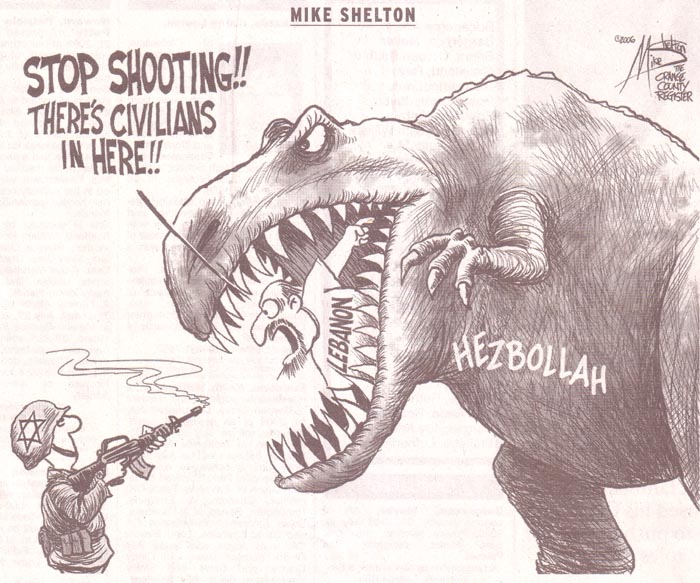
Hezbollah was in control of
Lebanon
Israel assassinates two Hamas terrorists in Lebanon as Hezbollah rockets damage homes in North
The Israel Air Force struck Hezbollah terrorists operating within a command center that was located inside a mosque.
By MAYA GUR ARIEH, DARCIE GRUNBLATT
OCTOBER 5, 2024
The Jerusalem Post
Israeli
Air Force fighter jets on Saturday morning killed Muhammad Hussein Ali
al-Mahmoud, who served as the operational arm of the Hamas terrorist
organization in Lebanon, the IDF announced later in the day.
He
was mainly responsible for directing terrorist activities in the West
Bank. However, Muhammad has also been involved in Hamas's efforts to
establish a foothold in Lebanon, which included supplying weapons for
rocket fire toward Israel. He has been involved in trying to
manufacture advanced weaponry as well.
In
another joint operation by the IDF and Shin Bet earlier Saturday
morning, in the Tripoli area of Lebanon, the terrorist Said Alaa Naif
Ali, from Hamas's military wing in Lebanon, was killed. He led attacks
against Israelis and worked to recruit operatives for Hamas in Lebanon.
The
military said on Saturday morning that the Israel Air Force (IAF)
struck Hezbollah terrorists operating within a command center that was
located inside a mosque adjacent to the Salah Ghandour Hospital in
southern Lebanon.
Hezbollah
terrorists used the command center to plan and execute terrorist
attacks against soldiers and Israeli citizens, the IDF added.
The IDF reportedly sent notices to residents and held discussions with key figures in the villages before the strike.
Hezbollah
utilizes hospitals in defiance of laws of armed conflict, the IDF said,
noting that any military activity carried out from hospitals should be
halted immediately.
"Since
the beginning of the war, and even more so since the beginning of the
limited ground activity in southern Lebanon, the IDF has been making
great efforts to prevent harming uninvolved civilians and civilian
infrastructure," the IDF stated.
The
military highlighted that these efforts stood in contrast to
Hezbollah's use of civilian structures, including critical
infrastructure, to shield its military activities.
Along
with IAF strikes, soldiers from the Commando Brigade destroyed
munitions warehouses and Hezbollah tunnel shafts in southern Lebanon as
part of the IDF's ground operation, the military reported on Saturday.
Soldiers
operated within villages in southern Lebanon, including large swathes
of villages converted to terrorist infrastructure and used by Hezbollah
for terror purposes. Soldiers, guided by IDF intelligence, raided
Hezbollah infrastructure both above and underground in mountainous and
thicketed areas.
IDF
soldiers found and destroyed weapons stockpiles, observation posts,
missiles, and launching positions that were aimed toward Israeli
territory, the military said.
Troops
also located and destroyed tunnel shafts used by Hezbollah terrorists
to approach the border with Israel. Commando soldiers worked in
coordination with the IAF, including the use of drones and advanced
weaponry, to eliminate dozens of terrorists.
Hezbollah Says Israel Orchestrated Pager Blasts in Lebanon
Dana Khraiche and Youssef Diab
Tue, September 17, 2024
(Bloomberg)
-- Iran-backed Hezbollah accused Israel of orchestrating an attack that
killed several people and left almost 3,000 wounded across Lebanon,
increasing fears of an all-out war.
Israel
didn’t comment on Tuesday’s events, which left hundreds of members of
the Hezbollah militant group injured. The two sides have exchanged fire
on a near-daily basis for much of the last year, with tensions rising
over the past several weeks.
A
string of medical emergencies were reported Tuesday afternoon following
the mysterious explosion of thousands of pagers used by Lebanese
people, including members of the militant group.
Hezbollah
and Lebanon’s government were both quick to describe the events as an
Israeli attack, with the former vowing to respond. Israel declined to
comment. American officials said Tuesday that the US was neither
involved nor informed in advance of the pagers incident.
The
United Nations Special Coordinator for Lebanon, Jeanine
Hennis-Plasschaert, said in a statement that nine people had been
killed, including children, calling the episode “an extremely
concerning escalation” and adding that under international humanitarian
law “civilians are not a target and must be protected at all times.”
The
wireless devices likely overheated before the blasts took place,
indicating “foul play,” Lebanon’s Telecommunications Minister Johnny
Corm told Bloomberg. Experts theorized the pagers had been modified
earlier in the supply chain before delivery, possibly including
planting explosives that could be triggered remotely.
Oil prices rose on traders’ concern the deadly blasts would reignite geopolitical tensions.
If
the blasts were carried out by Israel, it would mark one of the most
sophisticated attacks ever executed by either of the two parties, which
have been fighting in intermittent clashes for around four decades.
Pagers, which have been largely obsolete in the West for several years,
are popular among Hezbollah fighters, who believe they can avoid
interceptions by Israeli intelligence thanks to their low-tech nature.
Late
Tuesday the New York Times cited US and other officials it didn’t
identify as saying Israel was responsible for the operation and that it
had planted small amounts of explosives in the pagers, which had been
sourced from Taiwan.
Gold
Apollo Co., a small closely-held Taiwanese company identified in some
media reports as the manufacturer of the pagers that exploded, denied
that it made the devices.
“Those
devices aren’t ours,” said a company official, asking not to be named
before a formal statement. The person added that Gold Apollo licenses
its brand to at least one other company, without providing more
details. Such devices could be modified after being exported, Taiwan’s
economy ministry said in a statement, citing the company.
The
New York Times report said the pagers got a message at 3:30 pm local
time that appeared to be from Hezbollah leadership just before the
explosives detonated.
About
1,500 members of Hezbollah were wounded in the attacks, according to a
Lebanese military official with knowledge of the matter, who asked not
to be identified because of the sensitivity of the issue.
While
that’s probably one of the biggest single-day casualties for the group,
it would hardly make a dent in its fighting force, believed to be
around 100,000.
“These
pagers were detonated with high-tech by the Israeli enemy,” Hezbollah
lawmaker Ibrahim Mousawi told the group’s television channel. Lebanon
Information Minister Ziyad Makari called the attack “a serious
violation of Lebanese sovereignty and a crime by all standards.”
The
alleged attack adds to tensions that have been building since July when
Israel assassinated a key commander of the organization in Beirut.
Hezbollah has vowed to avenge the death, which was quickly followed by
the killing in Tehran of the political leader of Hamas, which carried
out last October’s assault on Israel and is also backed by the Islamic
Republic.
While
Israel hasn’t claimed or denied responsibility for the killing of the
Hamas figure, Iran’s promises of a retaliation raised the fears of a
widening war in the Middle East. Israeli politicians, including Prime
Minister Benjamin Netanyahu, are increasingly warning that a full-on
war against Hezbollah is inevitable.
Late
Monday, the Israeli cabinet said enabling residents displaced by
Hezbollah attacks to return home is now a formal war objective,
signaling the country is closer to a large-scale offensive.
Tens
of thousands of civilians have been evacuated in southern Lebanon and
northern Israel because of the skirmishes, which began after the
Israel-Hamas war erupted in Gaza.
US Push
The
US has been trying to calm tensions between Hezbollah and Israel. Amos
Hochstein, one of President Joe Biden’s senior Middle East advisers,
met Netanyahu and Defense Minister Yoav Gallant in Israel on Monday.
He
told Netanyahu the US doesn’t believe a broader conflict in Lebanon
will help northern Israelis return to their homes and, if anything,
will risk a wider regional war, according to an American official, who
asked not to be identified discussing sensitive matters.
White
House Press Secretary Karine Jean-Pierre said that the incident
underscored the urgency of a diplomatic solution to the conflict on
Israel’s northern border, which “has gone on for way too long,” as well
as the war in Gaza.
Secretary
of State Antony Blinken arrived in Cairo early Wednesday morning and is
scheduled to meet top Egyptian officials including President Abdel
Fattah el-Sisi. Egypt has been a key moderator in peace talks with
Israel and Hamas.
During
Tuesday’s blasts, 2,750 people were hurt and eight were confirmed dead,
according to Lebanese authorities. About 200 of those injured were in
critical condition. Hezbollah said two of its members were killed,
including the son of a lawmaker.
The explosions took place mainly in the southern suburbs of Beirut, where Hezbollah has a strong presence.
Blood Donations
Lebanese
authorities called for blood donations and asked hospital staffs across
the country to report to duty. One of Beirut’s main hospitals said it
was at full capacity and urged people to go elsewhere for treatment.
Television
footage from Beirut showed a man covered in blood sitting on the ground
as many others apparently wounded in the explosions were being carried
away. The Lebanese Red Cross said more than 50 ambulances were
dispatched.
Lebanese Christian leader says Hezbollah’s fighting with Israel has harmed Lebanon
May 8, 2024
MAARAB,
Lebanon (AP) — The leader of a main Christian political party in
Lebanon blasted the Shiite militant group Hezbollah for opening a front
with Israel to back up its ally Hamas, saying it has harmed Lebanon
without making a dent in Israel’s crushing offensive in the Gaza Strip.
In
an interview with The Associated Press on Tuesday night, Samir Geagea
of the Lebanese Forces Party said Hezbollah should withdraw from areas
along the border with Israel and the Lebanese army should deploy in all
points where militants of the Iran-backed group have taken positions.
His comments came as Western diplomats try to broker a de-escalation in the border conflict amid fears of a wider war.
Hezbollah
began launching rockets toward Israeli military posts on Oct. 8, the
day after Hamas-led militants stormed into southern Israel in a
surprise attack that sparked the crushing war in Gaza.
The
near-daily violence has mostly been confined to the area along the
border, and international mediators have been scrambling to prevent an
all-out war. The fighting has killed 12 soldiers and 10 civilians in
Israel. More than 350 people have been killed in Lebanon including 273
Hezbollah fighters and more than 50 civilians.
“No
one has the right to control the fate of a country and people on its
own,” Geagea said in his heavily guarded headquarters in the mountain
village of Maarab. “Hezbollah is not the government in Lebanon. There
is a government in Lebanon in which Hezbollah is represented.” In
addition to its military arm, Hezbollah is a political party.
Geagea,
whose party has the largest bloc in Lebanon’s 128-member parliament,
has angled to position himself as the leader of the opposition against
Hezbollah.
Hezbollah
officials have said that by opening the front along Israel’s northern
border, the militant group has reduced the pressure on Gaza by keeping
several Israeli army divisions on alert in the north rather than taking
part in the monthslong offensive in the enclave.
“All
the damage that could have happened in Gaza ... happened. What was the
benefit of military operations that were launched from south Lebanon?
Nothing,” Geagea said, pointing the the death toll and massive
destruction in Lebanon’s border villages.
Israel’s
war against Hamas in Gaza has killed more than 34,000 Palestinians,
caused wide destruction and displaced hundreds of thousands to the city
of Rafah along Egypt’s border. Israel’s Prime Minister Benjamin
Netanyahu vowed Tuesday to launch an offensive into the southern Gaza
city of Rafah despite international calls for restraint.
Geagea
said Hezbollah aims through the ongoing fighting to benefit its main
backer, Iran, by giving it a presence along Israel’s border and called
for the group to withdraw from border areas and Lebanese army deploy in
accordance with a U.N. Security Council resolution that ended the
34-day Israel-Hezbollah war in 2006.
Geagea also discussed the campaign by his party to repatriate Syrian refugees who fled war into Lebanon.
Those
calls intensified after a Syrian gang was blamed for last month’s
killing of Lebanese Forces official Pascal Suleiman, allegedly in a
carjacking gone wrong, although many initially suspected political
motives.
Lebanon,
with a total population of around 6 million, hosts what the U.N.
refugee agency says are nearly 785,000 U.N.-registered Syrian refugees,
of which 90% rely on aid to survive. Lebanese officials estimate there
may be 1.5 million or 2 million, of whom only around 300,000 have legal
residency.
Human
rights groups say that Syria is not safe for mass returns and that many
Syrians who have gone back — voluntarily or not — have been detained
and tortured.
Geagea,
whose party is adamantly opposed to the government of President Bashar
Assad in Syria, insisted that only a small percentage of Syrians in
Lebanon are true political refugees and that those who are could go to
opposition-controlled areas of Syria.
The
Lebanese politician suggested his country should follow in the steps of
Western countries like Britain, which passed controversial legislation
last week to deport some asylum seekers to Rwanda.
“In
Lebanon we should tell them, guys, go back to your country. Syria
exists,” said Geagea, who headed the largest Christian militia during
Lebanon’s 1975-90 civil war.
Hezbollah
stockpiled chemical behind Beirut blast in London and Germany
The Beirut
explosion took place at a warehouse that held 2,750 tons of ammonium nitrate
that had been confiscated from a ship.
By LAHAV HARKOV
AUGUST 5, 2020
The Jerusalem
Post
Hezbollah kept
three metric tons of ammonium nitrate, the explosive thought to be behind the
mega blast in Beirut this week, in a
storehouse in London, until MI5 and the London Metropolitan Police found it in
2015.
The Lebanese
terrorist group also stored hundreds of kilograms of ammonium nitrate in
southern Germany, which were uncovered earlier this year.
The Beirut
explosion took place at a warehouse that held 2,750 tons of ammonium nitrate
that had been confiscated from a ship.
The
Iran-backed terrorists kept the explosive in thousands of ice packs in four
properties in northwest London, according to a report in The Telegraphlast year. The ice pack deception tactic was used
in Germany, as well.
A source was
quoted in The Telegraph saying the ammonium nitrate was to be used
for “proper organized terrorism” and could have caused “a lot of damage.”
MI5 arrested a
man in his 40s for allegedly planning terrorist attacks, but did not find
evidence that the terrorists were planning an attack in the UK.
A foreign
government reportedly tipped off MI5 to the explosives stockpile. KAN reported
that the Mossad gave the UK the information.
“MI5 worked
independently and closely with international partners to disrupt the threat of
malign intent from Iran and its proxies in the UK,” an intelligence source
told The Telegraph.
The Prime
Minister’s Office did not respond to a question as to whether Israel helped the
UK nab the terrorists.
However,
Germany found the Hezbollah explosive stockpiles with help from the Mossad.
The operation
and raid on mosques and residents tied to Hezbollah throughout Germany in April
came in tandem with a ban on the terrorist group’s activities.
In 2019, the
UK banned Hezbollah, making it a criminal offense to support or be a member of
the group, carrying a sentence of up to 10 years in prison.
Then-home
secretary Savid Javid said the Lebanese terrorist
group “is continuing in its attempts to destabilize the fragile situation in
the Middle East – and we are no longer able to distinguish between their
already-banned military wing and the political party. Because of this, I have
taken the decision to proscribe the group in its entirety.”
Last week, a
cross-party group of UK parliamentarians expressed concern that the UK was not
effectively enforcing the ban on Hezbollah.
The letter
sent to UK Security Minister James Brokenshire came after he said, in a
Parliamentary answer, that the government did not collect data on the number of
people in the UK investigated or charged with supporting Hezbollah.
They called on
intelligence agencies and the Home Office to collect and regularly review
statistics on people who have displayed the Hezbollah flag or other symbols of
support, and update the House of Commons on those numbers, in order to assess
the effectiveness of the ban.
Marine Le Pen
in Lebanon row after refusing to wear headscarf
By Ghazi Balkiz and James Masters,
CNN
February 21,
2017
Beirut (CNN)France's Marine Le Pen canceled a meeting with Lebanon's Grand
Mufti Tuesday after refusing to wear a headscarf.
The far-right presidential candidate is on a two-day tour of Lebanon where she
is courting Franco-Lebanese votes ahead of the first round of French elections
on April 23.
Le Pen told reporters that she was surprised by the requirement. But a
spokesman for the Grand Mufti said Le Pen had been informed of the need to wear
a head covering before the meeting.
Le Pen said she had met the Grand Mufti of Al-Azhar during a visit to Egypt in
2015 without covering her head.
"I met the grand mufti of Al-Azhar," she told reporters. "The
highest Sunni authority didn't have this requirement, but it doesn't
matter."
"You can pass on my respects to the grand mufti, but I will not cover
myself up," she insisted.
Le Pen has been outspoken in her opposition to the headscarf and has stated
that she would ban all religious symbols in public places.
A spokesman for Lebanon's Sunni religious leader, Grand Mufti Abdel Latif Derian, told CNN that Le Pen had been informed of the need
to wear a head covering prior to the meeting.
Burqa, niqab banned in France
"I personally greeted her at the door of the Edict House and wanted to
hand her a white headscarf that was in my hand, she refused to take it," Khaldoun Awas explained.
"I urged her to put it on, she refused and said she would not put it on
and walked out without attending the previously agreed upon meeting with the
Mufti. The Edict House regrets such inappropriate behavior at such
meetings."
Shortly after the incident, Florian Philippot, the
vice president of Le Pen's Front National Party tweeted: "In Lebanon,
Marine refuses to wear the veil. A beautiful message of freedom and
emancipation sent to women in France and the world!"
The burqa and the niqab, a full face veil worn by some
Muslim women, have been prohibited in public areas in France since 2011.
Headscarves and other "conspicuous" religious symbols were banned
from French schools in 2004.
Mayors in some French towns sparked controversy and protests last summer when
they banned women from wearing burkinis on beaches in the wake of the Nice
terror attack. The ban was later overturned.
How Lebanon Is Threatened by Syria's Rebellion
By Rania Abouzeid / Beirut Monday,
May 21, 2012
Time
An uneasy, fragile calm returned to the Lebanese capital Beirut and the
northern city of Tripoli on Monday, a day after the worst clashes between pro-
and anti-Syrian Lebanese factions since 2008. The violence erupted after the
killing of a prominent anti-Syrian Sunni cleric, Sheikh Ahmad Abdel Wahed, and an associate. The pair were shot dead by
soldiers in the northern Lebanese region of Akkar
after their convoy allegedly failed to stop at a checkpoint. And while the
politics involved are local and sometimes impenetrable, the consequences are
much broader. They illustrate how this tiny country, wedged between Israel and
Syria, continues to be captive to its geography.
The sheikh's death was just the latest incident to tap into the deeply seated
frustrations of the largely anti-Syrian Lebanese Sunni community, and Sunni
reaction to the killings was immediate and predictable. Protests erupted and
roads, initially in the north but then later in other parts of the country,
were closed with burning tires. In an impoverished Sunni section of Beirut
heavy machine guns and rocket-propelled grenades were used in overnight
clashes.
Lebanon's vibrant, often violent domestic politics have been shaped by events
taking place in its larger neighbors, and it has been a stage for their proxy
wars, courtesy of sectarian leaders who have often been willing pawns to
foreign meddling. It is not surprising that elements of Syria's 15-month
conflict have come to Lebanon. But it is troubling nonetheless.
Lebanon has been divided along pro- and anti-Syrian lines since at least 2005,
when Sunni leader and former premier Rafik Hariri was assassinated in a blast
his supporters blamed on Syria and its local allies. The killing and the
domestic and international outrage it provoked propelled Damascus to withdraw
its military from Lebanon that year, ending a 29-year presence. In the years
since, the gulf between the two Lebanese camps has widened. Like so many things
here, it is sharply sectarian. On one side are the Shi'ite parties of Hizballah
and Amal, and their Christian allies who support Syrian President Bashar
al-Assad. On the other is an anti-Assad coalition of Sunnis, Druze and rival
Christians.
The stage has long been set for a conflagration. There was a brief flare-up in
May 2008, when Hizballah, enraged by a decision by the anti-Syrian government
of the day to uproot its independent military communications network, overran
parts of the Lebanese capital in a potent display of military prowess that left
its overpowered Sunni rivals seething and humiliated. For many Sunnis, the
scars of 2008 are still raw.
A little over a week ago, politics once again returned to the streets, when
running gunbattles erupted in parts of Tripoli
between residents of the conservative anti-Syrian Salafi neighborhood of Bab
al-Tebbane, and the adjacent pro-Syrian Alawite
neighborhood of Jabal Mohsen. (Fittingly, the street dividing them is called
Syria Street.) Such local enmities and conflicts are often unalarming in a
national sense, especially since there have often been deadly clashes between
the two Tripoli neighborhoods. But this time, things began to add up.
The trigger for the violence was the arrest of a little-known Sunni Islamist
called Shadi Mawlawi. Mawlawi, who was not a wanted man, was at a social services
center run by a local anti-Syrian politician, having been lured there by an
element of the security forces perceived as sympathetic to Hizballah. He has
now been charged with belonging to a terrorist organization, although his
supporters say he was nabbed because he helps Syrian refugees fleeing to
Lebanon. Mawlawi's arrest brought the Sunni community
to a near tipping point. It was the latest in a list of grievances and
perceived humiliations borne by the group, specifically its northern Salafists.
The charge of belonging to a terrorist organization was particularly bitter,
given that the community is still protesting the five-year detention of some
Islamists who have been held without charge on suspicion of belonging to
extremist groups. There are economic reasons for the anger as well. Northern
Lebanon in general, and Tripoli in particular, are impoverished, long-neglected
areas that have benefited little from economic development in the rest of the
country. The tipping point came with the sheikh's death on Sunday, when many
Sunnis around the country took up arms in protest.
Shocked by the rapid deterioration of the security situation in the past few
weeks, some Lebanese fear a replay of the chaos of the early 1970s that led to
the civil war. Back then, the country was similarly polarized over one of its
neighbors. It was split over the issue of Palestine, or more specifically, the
influx of guerrilla groups expelled from Jordan during the bloody 1970s Black
September crackdown. Leftist, pan-Arab, mainly Muslim parties in Lebanon
supported the Palestinian guerrillas in their fight against Israel. Right-wing,
mainly Christian nationalists did not. The ensuing conflicts contributed to a
civil war that took 15 years to end.
There's another worrying similarity. For the first time in a long time, the
neutrality of the Lebanese army has been questioned. The military, considered one
of the few state institutions which is at least superficially above the
sectarian fray, was accused by some Salafists of siding with the Alawites
during the fighting between Bab al-Tebbane and Jabal
Mohsen. That view was cemented by the death of Sheikh Abdel Wahed.
It's a serious charge, given that the institution's unity depends on its
neutrality.
The army was quick to offer its condolences for the "regrettable"
incident and promised a thorough investigation. Still, a group of clerics from Akkar ominously threatened to form a "Free Lebanese
Army," a sentiment recalling the dark days of the civil war when the army
split along sectarian lines. Some army units withdrew from Akkar
on Sunday following the shooting, in a bid to ease tensions.
Prominent anti-Syrians like Sunni leader Saad Hariri, son of the slain former
premier, warned against a confrontation between the army and the people.
"We do not blame the Lebanese army as a whole for the murder, because the
army is the national military institution by which the people of Akkar have always stood," he said in a statement.
"But it is clear that some people involved in this murder want to use the
institution and its symbol to import the crisis of the Syrian regime with its
people and the whole world, to Lebanon, in a desperate attempt to save it from
its unavoidable end."
Religious and political leaders from across the political divide have urged
calm. Still, questions remain about when and why the soldiers opened fire. Did
the sheikh's convoy fail to stop, or as one of his driver's said, was it
turning around after the sheikh had been humiliated by an officer?
The incident has increased pressure on Prime Minister Najib Mikati,
a Sunni from Tripoli, who must tread a fine line between his government (which
is dominated by Hizballah and its allies) and his hometown constituency. The
government's policy of "dissociation" from the Syrian crisis is
looking increasingly untenable. It survived Syrian infringements of Lebanese
sovereignty — the government barely blinked during a handful of incursions by
Syrian forces and incidents of gunfire into Lebanese territory despite the fact
that several Lebanese were killed — but this may be more difficult to contain.
It's a fragile, easily combustible situation, made more so by the influx of
Syrian refugees. The figure is at least 24,000 — and climbing. The first waves
of mainly Sunni Syrians crossed into the northern Lebanese, largely Sunni and
fiercely anti-Syrian region of Wadi Khaled. Many had blood ties to the region, and
were housed in relatives' homes, in schools and in mosques. In recent months, a
large number of Syrian refugees have entered the Bekaa,
which is more politically and religiously diverse. Parts of it, like the area
around Baalbek-Hermel, are Hizballah strongholds.
There are acute housing shortages for refugees in the region, the UNHCR says,
but neither the UN body nor other NGOs want to house Syrians in tents, for
humanitarian reasons.
Hizballah, too, does not want Lebanon to establish refugee camps like those in
Turkey, but theirs is a very different calculation: "We cannot accept
refugee camps for Syrians in Lebanon because any camp... will become a military
pocket that will be used as a launchpad against Syria and then against
Lebanon," Hizballah's deputy secretary-general Naim
Qassem said in March, according to the Beirut-based
Daily Star. In other words, Hizballah does not want a situation akin to that in
the early 1970s, when Palestinian guerrilla groups set up bases (not to be
confused with Palestinian refugee camps) in southern Lebanon and parts of the Bekaa to launch attacks against Israel from Lebanon. Still,
some aid workers say that the establishment of camps is inevitable, given the
rising number of refugees. The issue is already a domestic political football,
and risks further enflaming existing tensions.
As night fell Monday, there were reports of new roads being closed with burning
tires even as others were reopened. Nevertheless, the Lebanese are used to
volatility. They are remarkably adept at dusting off their weapons at the
slightest provocation, racing to the brink of what seems like a new civil
conflict, only to pull away from it just as suddenly. The next few days will
determine if recent events are just another spasm of violence, or something
more.
Lebanon's clerics attack domestic violence law
By DAVID E. MILLER / THE MEDIA LINE
06/27/2011
Jerusalem Post
Grand Mufti: Islam is enough to protect women from abuse; activists say
religious law doesn't deal with domestic violence, rape cases.
New legislation intended to combat domestic violence in Lebanon has run into
opposition by the country's religious establishment.
Dar Al-Fatwa, the country's highest Sunni religious authority, claimed that the
new law contradicted Islamic law (sharia) and would deprive Muslim women of the
ability to turn to religious courts for protection. It warned the legislators
against "religious innovations" such as the concept of rape within
the marital framework.
“[The draft law] was not introduced to improve women’s status, but rather to
break up the family similar to Western ways, which are foreign to our society
and values,” the statement from Dar al-Fatwa said following a meeting between
the Grand Mufti of the Republic Sheikh Mohammad Rashid Qabbani
and other leading Sunni sheikhs.
Lebanon, a patchwork of different religions and differing attitudes towards
modernity, has become a battleground for women's rights. Among Islamists, the
push for issues such as birth control and other feminist issues is often interpreted
as a Western assault on the Muslim faith.
Personal status issues are dealt with in Lebanon by the country's religious
sects, and womens’ rights advocates are treading
carefully in lobbying for the new law.
"We disagree with the decision of Dar Al-Fatwa, and urge them to
reconsider their position," Aman Kabara-Shaarani,
president of the Lebanese Council of Women (LCW), told The Media Line. "We
are engaged in ongoing dialogue with the religious authorities on this issue,
and were surprised by this announcement." LCW is an umbrella organization
representing 170 civil rights organizations nationwide.
The draft law, which would be added to Lebanon's penal code, was approved by
the caretaker government of Saad Hariri in April 2010 and was sent to parliament
for further debate. The bill criminalizes marital rape and forces police to
intervene when a woman files a domestic violence complaint against a family
member.
Rasha Moumneh, a
Beirut-based researcher at Human Rights Watch, said Lebanese women suffered no
more domestic violence than women in other countries, but they have no law to
protect them. She said the Sunni religious establishment, led by Qabbani, was less concerned about the encroachment of
Western ideas than of losing power.
"The religious establishment fears loss of power," Moumneh told The Media Line. "This is because
according to the law, domestic violence issues will be discussed in civil
courts rather than religious courts."
Moumneh said that religious opposition to the draft
law was part of a larger campaign against the push for women's rights in
Lebanon. She contended that women's legislation in Lebanon was based on the
United Nations Convention on the Elimination of All Forms of Discrimination
against Women (CEDAW), which extremist Sunni organizations had recently decided
to attack.
"In the north, Salafists [Sunni fundamentalists] have been handing out
leaflets against the UN convention, which Lebanon had ratified back in
1997," Moumneh said.
Lebanon's Islamists claim that the draft law contradicts the current law on
personal status, but Moumneh said this was false,
saying the current law doesn’t treat domestic-violence issues at all. The only
legislation protecting women is of a general nature covering any kind of
violence. Women's rights activists say it’s insufficient because police usually
claim it doesn’t authorize them to intervene in cases of violence within the
home and family.
Rima Abi-Nader, a social worker at Kafa, a Lebanese
organization tackling domestic violence and the initiator of the new
legislation, said social attitudes allowed Lebanese men to practice almost
unlimited domination over their wives.
"Some religions give men the right to beat their wives, and act as a
dictator at home," Abi-Nader, who operates a hotline for domestic
violence, told The Media Line. She said one of the most important components of
the new law is psychological and behavioral training, which will allow the
husband to return to the family.
Moumneh of Human Rights Watch said that although the
Sunni establishment is the most vociferous in opposing progressive legislation,
it is by no means alone. Hezbollah, the country's leading Shiite group, also
opposes universal legislation that would harm its absolute authority to decide
in personal matters within the Shiite community.
"Naim Qasem, the
deputy secretary-general of Hezbollah, has spoken out against a universal civil
status law in Lebanon," Moumneh said. "A
new nationality law, which will allow women to pass on their Lebanese
nationality to husbands and children, was opposed across the board by all
religious groups."
Moumneh said that the religious establishment in
Lebanon was not independent, but tightly linked to the political leadership of
Lebanon's sects. In the case of Dar Al-Fatwa, that would mean a link to Saad
Hariri's March 14 movement.
"There is a common perception that March 14 is more moderate than other
groups on these issues, but in reality that's not the
case," Moumneh said.
Thousands in Lebanon honor bodies of Hezbollah fighters
Unusually quick return of corpses by Israel was intended
to restore calm.
Saturday, November 26, 2005
By ZEINA KARAM The Associated Press
BEIRUT, LEBANON – Israel returned to Lebanon on Friday
the corpses of three Hezbollah guerrillas killed this week in fierce fighting
in a disputed border area - an unusually quick return intended to restore calm.
Hezbollah's leader told supporters the group would nonetheless continue to try
to kidnap Israeli soldiers.
"It is our natural right to capture Israel
soldiers," Sheik Hassan Nasrallah told a rally in the Hezbollah stronghold
of south Beirut. "Indeed, it is our duty to do that."
Hezbollah's show of force - attacks on the
Lebanese-Israeli border and Friday's mass rally - aimed to affirm the group's
significance as a main player in Lebanese politics and as a key to stability
with Israel.
Lebanese Prime Minister Fuad Saniora
had demanded Wednesday that Israel return the bodies, saying it was necessary
to restore calm after the clashes Monday, the heaviest in years.
Israel handed the bodies to the International Red Cross,
which drove them through the Naqoura crossing on the Lebanese-Israeli border
Friday.
Israel has previously kept the bodies of Hezbollah
fighters for long periods - sometimes years at a time - eventually returning
them in negotiated swaps for the remains of Israeli soldiers or prisoners. Its
quick delivery this week indicates a desire to defuse tension on the border and
to deny Hezbollah a pretext to launch further attacks.
Further, Israel knows that an escalation in border
fighting would turn Lebanon's attention away from the country's main
preoccupation - the U.N. investigation into the assassination of former Prime
Minister Rafik Hariri and relations with Syria. The investigation has
implicated top officials in Syria, a longtime enemy of Israel.
Sheik Nasrallah was on hand to welcome the guerrillas'
coffins when they arrived in Lebanese ambulances at a complex south of Beirut.
Families of the guerrillas were among several hundred mourners. Some threw
flower petals at the caskets, which were wrapped in Hezbollah's yellow flag.
"We are used to martyrdom. I have five more (sons)
and I am ready to offer them," Ibrahim Mousawi,
the father of slain guerrilla Mohammed Mousawi, told
Hezbollah's Al-Manar television.
In his speech, Hezbollah leader Nasrallah said he did
not consider the kidnapping of Israeli soldiers to be a crime, and Hezbollah's
attacks this week had sent a message that the group is still ready to defend
Lebanon.
"We are not weak and we will not be weakened ... we
are not afraid and we will not be frightened," he said in a speech to
thousands of supporters that was interrupted several times by their roars of
"Death to Israel!" and "Death to America!"
After his speech, Hezbollah pall bearers carried the
three coffins to a podium where Nasrallah, a medium-ranking cleric, prayed for
their souls.
The U.N. Security Council accused Hezbollah of starting
Monday's fighting - something Hezbollah denies. It is thought the group may
have been trying both to capture Israeli soldiers for a future exchange of
prisoners and to take the pressure off Syria stemming from the U.N.
investigation into Hariri's assassination.
In the fighting, Hezbollah guerrillas fired rockets at
Israeli military posts, and Israel retaliated with airstrikes and an artillery
bombardment. Eleven Israeli soldiers were wounded and four guerrillas were
killed. The fourth guerrilla was carried back into Lebanon by his comrades and
buried on Tuesday.
Fighting briefly resumed Wednesday when an Israeli
civilian in a hang glider drifted across the border and landed inside Lebanon.
Israeli troops shot at Hezbollah guerrillas to prevent them capturing the
civilian as he ran back to Israel.
Last year, Hezbollah swapped an Israeli businessman and
the bodies of three Israeli soldiers for about 400 Palestinian and Lebanese
prisoners.
Inside Hezbollah's Lebanon
The Washington Times
By Barbara Newman
July 20, 2006
As the Israeli military and the
Lebanese Hezbollah exchange blows and Middle East violence escalates, the
chattering class moves to center stage on the pundit circuit. My conclusion
after listening to hours of this is to question how little is known by so many
about something so important.
In the late 1980s, I was
commissioned by Central Television in London -- one of the important
independent stations in the United Kingdom -- to produce a documentary program
about hostages being held in Lebanon by Hezbollah. I had access to the material
through many old contacts from Lebanon, especially Elie Hobeika.
Mr. Hobeika had been chief of security for the
Christian Lebanese Forces, but was forced out of the country after heading the
operation that killed about 1,200 Palestinians in the Sabra and Shatilla refugee camps in 1982, following the assassination
of Christian President-elect Bashir Gemayel. Mr. Hobeika
had taken his wing of the Lebanese forces to Syria.
Timing is everything. And my
request to Mr. Hobeika arrived at about the same time
that Syria wanted to clip Hezbollah's wings -- not directly but through a
critical TV documentary. Obviously, any TV investigation about the hostages
would not be friendly to Hezbollah. Mr. Hobeika
explained to me that Hezbollah's success in taking hostages had begun to turn
around. It wasn't the terrorist activities of Hezbollah that irritated the
Syrians but the lack of coordination. For example, the Syrians were furious
when ABC producer Charles Glass was seized and held in the Hezbollah-controlled
south Beirut suburbs, and they eventually arranged for him to be freed.
I flew with a Lebanese friend who
worked for Mr. Hobeika from Paris to Damascus. Mr. Hobeika met us at the airport, took us to the VIP lounge
and phoned Vice President Abdel Halim Khaddam,
actually waking him up. We got visas immediately and then drove with Mr. Hobeika and his security detail to his militia's
headquarters in Zahle, a Christian city in Lebanon,
in the Bekaa Valley, which borders Syria.
Early the next day, three trucks
filled with Syrian commandos dressed in their pink-and-brown camouflage gear
showed up to be our security as we filmed in Baalbek, probably the most
dangerous place in the world at the time. They surrounded me in a circle, guns
pointed out, as I filmed the Sheik Abdullah Barracks. It was the headquarters
of the Iranian Revolutionary Guards as well as Hezbollah. Several hostages were
being held there. After the filming, Sheikh Hussein Mussawi,
the head of Hezbollah, sent me a message inviting me to interview him at his
headquarters in Baalbek. Talk about deja vu. He
excoriated the West for its degeneracy and called the Israelis and Jews
"microbes who need to be exterminated."
Hassan Nasrallah, the current head
of Hezbollah, is Mussawi's direct successor. Before
his recent operation -- abducting two Israeli soldiers and allowing Israel the
opportunity to destroy his military wing -- Mr. Nasrallah was thought to be
almost infallible. He had acquired the charisma of a winner, which is so
important in the Arab world, by claiming to head the only Arab army that ever defeated Israel. This is his own twist on Israel's 2000
evacuation from Lebanon.
Mr. Nasrallah's esteem in the Arab
world cannot be overstated. He is especially close to Syrian President Bashar
Assad and his British-born wife, who look at him as a spiritual being.
It is not widely known that one of
Mr. Nasrallah's sons was killed in a Hezbollah-Israel border attack a few years
ago, but this adds to his aura on the street where he lives.
The sweet, fragile Lebanese
democracy that some commentators poetically invoke is a hoax. Mr. Nasrallah was
the winner of the so-called democratic elections, picking up 14 seats, getting
two ministries with a third -- Foreign Affairs -- in his pocket and making an
alliance with the most popular Christian there, Gen. Michel Aoun. This
effectively gives him a headlock on state politics.
The Lebanese parliament, under Mr.
Nasrallah's thumb, says that implementation of U.N. Security Council Resolution
1559, calling for the disarmament of Hezbollah, is an "internal
affair." Mr. Nasrallah says it will never happen.
Aside from the $100 million
Hezbollah gets from Iran, it gets additional millions from criminal activities
in the United States and elsewhere. In one instance, money from a Hezbollah
cell in Charlotte, N.C., was used to purchase the most sensitive weapons of war
in Canada.
We'd be a lot safer with the
destruction of Hezbollah. It would be a good lesson to like-minded extremists
that what wins is pragma and not dogma.
Barbara Newman is a TV producer, senior fellow at the Foundation for the
Defense of Democracies and co-author of "Lightning out of Lebanon:
Hezbollah Terrorists on American Soil."
Israel strikes Lebanon religious building
July 22, 2006
The Associated
Press
BEIRUT, Lebanon — Israeli warplanes struck Sidon early Sunday, targeting a
religious building run by a Shiite Muslim cleric close to Hezbollah in their
first hit inside the southern port city, currently swollen with refugees from
fighting further south.
Also early Sunday, a huge explosion reverberated
across Beirut, apparently caused by an Israeli air raid on the capital's
southern suburbs.
At least four people were wounded in the airstrike that targeted Sidon for the
first time since Israel launched its massive military offensive against Lebanon
and Hezbollah guerrillas July 12, hospital officials said.
Strikes early in Israel's campaign hit bridges outside the city of 100,000,
where 35,000 refugees are also now residing.
Witnesses said the Israeli jets fired two missiles that directly hit the
four-story Sayyed al-Zahraa compound in Sidon. The
compound, which contains a mosque, a religious library and a seminary, was
entirely destroyed but was believed to be empty at the time of the strike, they
said.
A man and his wife in a nearby house were lightly wounded from broken glass,
while two other people strolling near the compound were also hit by shrapnel,
hospital officials said.
The compound is run by Sheik Afif Naboulsi,
a Shiite Muslim cleric close to Iran and the militant Hezbollah group.
Minutes earlier, two other blasts also shook Beirut also caused by an Israeli
airstrike on the southern suburbs where Hezbollah headquarters, including the
residence of Hezbollah leader Sheik Hassan Nasrallah have been flattened by
repeated Israeli bombing.
Israeli warplanes also hit targets in eastern Lebanon's Bekaa
Valley firing missiles in the cities of Hermel and
Baalbek at around 11 p.m. Saturday, witnesses said. There was no immediate word
on casualties in either strike.
Returning Home to Ruins: Shock Is Mixed With Outrage
Published: August 15, 2006
BEIRUT, Lebanon, Aug. 14 — Four
hours after the cease-fire with Israel
started Monday morning, Dr. Abdel Munaim Mansour
stood staring in disbelief at the mountainous of rubble that was once the
apartment building where his family lived.
“We will kill every American for this!” Dr. Mansour
shouted, his voice cracking with rage. “Every Shiite Muslim will kill
Americans! We will grind them under our shoes!”
Dr. Mansour and his wife, Seneen,
an elegantly dressed couple who work at a nearby hospital, stumbled on through
their old neighborhood in a state of shock, seeming almost not to recognize the
charred and shredded landscape around them. They had returned, after weeks of
exile in the relative safety of the mountains, to the capital’s southern Shiite
district, which has been largely deserted during a month of heavy Israeli bombardment.
Around the couple, thousands of others streamed back on
Monday into the ruined streets, where smoke and the smell of rotting flesh rose
from the rubble. Some cursed America and Israel and swore revenge; others
simply wept. Most said that before they returned, they had no idea of the scale
of the destruction in this area, which includes many Hezbollah
offices.
“Why did they bomb here?” asked a 60-year-old woman in a
black-and-white head scarf who gave her name only as Umm Abdullah. “So that
people would turn against Nasrallah and the resistance?” referring to Sheik Hassan
Nasrallah, the Hezbollah leader. “But that will never happen.
Whatever happens, we could never hate the resistance. They’re part of our
blood, they’re our children.”
She gazed around sadly at the ruins. “If I only had a
thousand livres for bread,” she said, about 75 cents, “I would give it to the
resistance.”
A tall man in a blue shirt stepped eagerly past her,
seemingly glimpsing the vista of ruins for the first time. “All of us are
Hassan Nasrallah!” he bellowed. “Every man, every woman, every stone is Hassan
Nasrallah!”
The tall man, as it happens, was Hassan Nasrallah. Not
the Hezbollah leader, he quickly explained; he simply had the same name. He
works at a bank nearby and is a distant relative of the revered cleric, he
said.
After he had finished yelling, Mr. Nasrallah became
polite and quiet. “We are not against the American people, we are against American
foreign policy,” he said, switching from Arabic to French to talk to a
reporter.
Not far away, Nurredin Asya, a soft-voiced 52-year-old shopkeeper in a black gown
and wire-frame glasses, was gazing up sadly at her own apartment, on the top
floor of a six-story building. It had been smashed from above, as if a giant
thumb had crushed the top layer of a birthday cake. On the bottom floor of the
same building is her minimarket — named Hasanain,
after one of her four children. Its entryway was filled with rubble and broken
glass piled high, its metal door smashed. She had
another store a few blocks away. It is now a large crater.
“Everything is gone,” she said.
It was not the first time for Ms. Asya.
She is Lebanese but grew up in Liberia, she said, and had three food markets
there until 1993, when war engulfed that country, too, and she was forced to
flee. She lost $350,000, she said.
“I am thinking to take my visa and go,” she said. Her
husband is in Virginia, where he was visiting one of their daughters when the
bombing began, and has not been able to return. But Ms. Asya
said she would rather go to Britain.
As she spoke, a young girl dressed in black walked past,
her cheeks wet with tears. She was holding a yellow Hezbollah flag. Elsewhere,
people had planted the flag on the mounds of ruin alongside the Lebanese flag.
Several Hezbollah security guards stood on street corners carrying AK-47
rifles; it was the first time they had moved openly in the area for weeks.
Ms. Asya said quietly that
Hezbollah would never give up its weapons.
“You know why Hezbollah succeeds?” she said. “Because
you can’t see them. The army you can see, so Israel knows where they are and
can get them.”
“Who is Hezbollah?” Ms. Asya
went on, gesturing at the residents and aid workers in the streets all around
her. “They are the sons and daughters and parents of Hezbollah.”
A few blocks away, earthmovers and bulldozers were digging
away at the smoking ruins of a vast open area where eight apartment buildings
had been destroyed Sunday afternoon in an Israeli airstrike. The construction
crews had begun working within an hour after the cease-fire took effect Monday.
The same blast had sheared off the walls of neighboring buildings; one woman
pointed anxiously to her fourth-floor apartment, where a red outfit belonging
to her baby girl could be seen hanging from the exposed bedroom.
At the edge of the open lot, a heavyset man in a white
T-shirt caught sight of a skinny boy and called to him, spreading his arms. The
boy ran to him, and soon they were locked in an embrace, tears streaming down
their cheeks.
Later, the man, who gave his name as Abu Ahmed Bazi, said the boy, Ahmed, 9, had lost his parents and
several siblings in the bombing on Sunday. The boy survived only because he
happened to cross the street to buy an ice cream in Mr. Bazi’s
candy shop just beforehand, he said.
“I held the boy and told him to pray to Imam Ali to save
us,” said Mr. Bazi, his face red and sweaty. “When
the bombing stopped I couldn’t believe it — he wasn’t
even scratched.”
Sectarian violence erupts in Lebanon
Iranian-backed protesters want government out
The Associated Press
Published: 1-24-2007
BEIRUT, Lebanon — Hezbollah-led protesters burned tires
and cars and clashed with government supporters Tuesday, paralyzing Beirut and
areas across Lebanon in the worst violence yet in the pro-Iranian group's
campaign to topple U.S.-backed Prime Minister Fuad Saniora.
At least three people were killed and dozens injured as
the two camps battled each other around street barricades with stone-throwing
and in some cases gunfire.
The fighting quickly took on a dangerous sectarian tone
in a country whose divided communities fought a bloody 1975-1990 civil war.
Gunmen from neighboring districts in the northern city of Tripoli — one largely
Sunni Muslim, the other largely Alawites, a Shiite Muslim offshoot — fought
each other, causing two of the fatalities.
The day gave a frightening glimpse of how quickly the
confrontation between Saniora's government and the
Iranian-backed Hezbollah and its allies could spiral out of control, inflame
tensions among Sunnis, Shiites and Christians and throw Lebanon into deeper
turmoil.
In the evening, the opposition announced it would call
off the roadblocks and the nationwide general strike that sparked the unrest,
saying it had delivered a warning to the government. But it threatened more
protests.
Opposition supporters began withdrawing from their
street blockades, leaving behind burning tires, concrete blocks and debris. At
one abandoned roadblock in the north of Beirut, a fire engine extinguished the
burning tires.
Suleiman Franjieh, a Christian
opposition leader, told Hezbollah's Al-Manar TV the
next steps "will be nothing compared to what we saw today" if the government
does not respond to the opposition's demands.
The Hezbollah-led opposition is growing increasingly
frustrated after two months of sit-in protests outside Saniora's
offices in downtown Beirut failed to force him to step down or form a new
government giving the opposition more power.
Saniora vowed not to give in, saying in
a televised address: "We will stand together against intimidation and to
confront sedition."
He repeated his willingness to discuss a political
solution to the impasse and called for a special session of Parliament.
Hezbollah gunmen seize control of Beirut neighborhoods
By BASSEM MROUE
May 9, 2008
BEIRUT, Lebanon (AP) — Shiite Hezbollah gunmen seized
control of key parts of Beirut from Sunnis loyal to the U.S.-backed government Friday,
a dramatic show-of-force certain to strengthen the Iranian-allied group's hand
as it fights for dominance in Lebanon's political deadlock.
An ally of Hezbollah said the group intended to pull
back, at least partially, from the areas its gunmen occupied overnight and
Friday morning — signaling Hezbollah likely does not intend a full-scale,
permanent takeover of Sunni Muslim parts of Beirut, similar to the Hamas
takeover of Gaza a year ago.
The clashes eased by Friday evening as Lebanon's army
began peacefully moving into some areas where Hezbollah gunmen had a presence.
But as Hezbollah gunmen celebrated in the capital's
empty streets — including marching down Hamra Street,
one of its glitziest shopping lanes — it was clear that the show-of-force would
have wide implications for Lebanon and the entire Mideast.
Lebanon's army largely stood aside as the Shiite
militiamen scattered their opponents and occupied large swaths of the capital's
Muslim sector early Friday — a sign of how tricky Lebanon's politics have
become.
In one instance, the army stood aside as Shiite
militiamen burned the building of the newspaper of their main Sunni rival —
acting only to evacuate people and then allow firefighters later to put out the
blaze.
The army has pledged to keep the peace but not take
sides in the long political deadlock — which pits Shiite Hezbollah and a
handful of allies including some Christian groups, against the U.S.-backed
government, which includes Christian and Sunni Muslims.
Three days of street battles and gunfights capped by
Friday's Hezbollah move have killed at least 14 people and wounded 20 — the
country's worst sectarian fighting since the 1975-1990 civil war.
Three more people were killed in two separate incidents
on Friday after the Hezbollah takeover. Two of them were Druse allies of
Hezbollah who died in a shooting in a hilly suburb southeast of the capital
late Friday, security officials said.
For Beirut residents and those across the Mideast, it
was a grim reminder of that troubled time when Beirut was carved into enclaves
ruled by rival factions and car bombs and snipers devastated the capital.
The takeover by the Iranian- and Syrian-backed Hezbollah
was a blow to U.S. policy as President Bush's administration has been a staunch
supporter of the government in Beirut over the last three years.
"We are very troubled by the recent actions of
Hezbollah," White House spokesman Gordon Johndroe
said Friday.
"We urge Hezbollah to stop their attempt to defy
the lawful decisions taken by the democratically elected Lebanese government.
We also urge Iran and Syria to stop their support of Hezbollah and its
destabilizing effects on Lebanon," he added.
The fighting also was certain to have implications for
the entire Middle East at a time when Sunni-Shiite tensions are high. The
tensions are fueled in part by the rivalry between predominantly Shiite Iran,
which sponsors Hezbollah, and Sunni Arab powers in the region such as Saudi
Arabia and Egypt.
The leaders of Qatar and Syria held talks on Lebanon in
Damascus, which wields influence with Hezbollah and has close relations with
Iran. Syria's official news agency said the two sides agreed the conflict in
Lebanon was an internal affair and expressed hope the feuding parties would
find a solution through dialogue.
About 100 Shiite Hezbollah militants wearing matching
camouflage uniforms and carrying assault rifles marched down Hamra Street, a normally vibrant commercial strip in a
mainly Sunni area of Beirut. They took up positions in corners and sidewalks
and stopped the few cars braving the empty streets to search their trunks.
On nearby streets, dozens of fighters from another
Hezbollah-allied party appeared, some wearing masks and carrying
rocket-propelled grenade launchers.
The Hezbollah takeover was peaceful in some
neighborhoods as the militants fanned out across the Muslim sector of the city.
Later in the day, Lebanese troops began taking up
positions in some Sunni neighborhoods abandoned by the pro-government groups,
but did not intervene in the clashes, which had largely tapered off into
sporadic gunfire by early afternoon. Some of the gunfire was celebratory in the
air by the militants.
A senior security official said the army began deploying
on some streets with the end of the clashes and would soon take over the
Sunnis' last stronghold of Tarik Jadideh. The
official spoke on condition of anonymity because he was not authorized to speak
to the media.
In some cases Hezbollah handed
over newly won positions to Lebanese troops, presumably after having made clear
to everyone its strength ahead of the next round of negotiations with opponents
over the country's political future.
Hezbollah's power was demonstrated dramatically Friday
morning when it forced the TV station affiliated to the party of Lebanon's top
Sunni lawmaker, Saad Hariri, off the air. Gunmen also set the offices of the
party's newspaper, Al-Mustaqbal, on fire in the coastal
neighborhood of Ramlet el-Bayda.
Later in the afternoon, anti-government gunmen loyal to
a pro-Syrian group attacked and set on fire a two-story building where Hariri's
Future TV have their archives. The building, in the western neighborhood of Rawche, is about 100 yards from the Saudi embassy.
With top leaders Hariri of the Sunnis and Druse leader
Walid Jumblatt besieged in their residences in Muslim western Beirut, officials
of the pro-government majority held an emergency meeting in a mountain town in
the Christian heartland northeast of Beirut
After the meeting, they issued a statement calling on
the army to take control of the streets and urging Arab and international
intervention to pressure the countries that support Hezbollah — meaning Iran
and Syria.
"The bloody coup d'etat
aims at returning Syria to Lebanon and placing Iran on the Mediterranean,"
said the statement read by Christian pro-government leader Samir Geagea. "Violence will not terrorize us, but it will
increase our resolve," he said.
He said the Hezbollah takeover violated the constitution
which governs Christian-Muslim coexistence in Lebanon.
Late Friday, a group of gunmen fired about a dozen
bullets at a statue of Rafik Hariri next to the seafront road where he was
killed in a massive 2005 truck bombing. The statue was raised in February on
the anniversary of the assassination.
Prime Minister Fuad Saniora
and several ministers were holed up in Saniora's
downtown office surrounded by troops and police.
An emergency meeting of Arab foreign ministers in Cairo
to discuss the crisis will be held in two days, said Egyptian Foreign Ministry
spokesman Hossam Zaki.
The unrest has virtually shut down Lebanon's
international airport and barricades closed major highways. The seaport also
was closed, leaving one land route to Syria as Lebanon's only link to the
outside world.
Associated Press writer Scheherezade
Faramarzi contributed to this report.