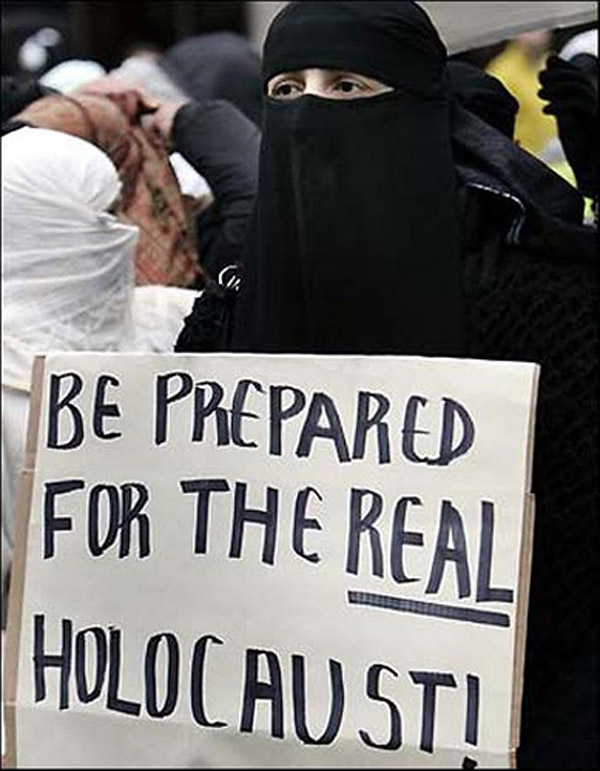
MUSLIM MOTHERS WANT TO MURDER YOU!
Alarmed by suicide attack, China and Pakistan work together on probe
Sun, October 30, 2022
By Asif Shahzad and Syed Raza Hassan
KARACHI, Pakistan (Reuters) - It was the kind of attack Pakistani authorities had dreaded.
A highly educated female suicide bomber killed three Chinese teachers
in Karachi in April along with their local driver, targeting nationals
from Pakistan's most important partner and seeking to undermine a
relationship on which Islamabad's financial survival largely depends.
The blow threatened a major segment of Beijing's Belt and Road
infrastructure initiative, a $65 billion network of roads, railways,
pipelines and ports in Pakistan that will connect China to the Arabian
Sea and help Islamabad expand and modernise its economy.
Separatists from the vast, impoverished Pakistani province of
Balochistan claimed responsibility for the attack after a young,
educated mother from a well-to-do family blew herself up in an assault
captured on CCTV and broadcast on local news channels.
In a video on social media, the separatists warned China to leave Pakistan or face further carnage.
Even though months have passed since the attack, Pakistani authorities remain deeply worried.
"Attacks on the Chinese nationals and projects in Pakistan are of grave
concern for the government," the interior ministry said in a statement
to Reuters last week, adding that the government was in active pursuit
of such militant outfits.
The Baloch National Army (BLA), the banned group that issued the video,
is part of a decades-old insurgency that usually targets Pakistani
security forces.
But in recent years the BLA has attacked Chinese nationals, because, it
says, Beijing has ignored warnings not to enter deals and agreements
regarding Balochistan.
China is involved in major mining and infrastructure projects in the
resource-rich province, including the deep-water Gwadar port, all part
of the China-Pakistan Economic Corridor (CPEC).
At the start of the video, a masked gunman addresses China. Speaking in
English he says: "President of China ... you still have time to get out
of Balochistan, otherwise you will be taken out of Balochistan in such
a way that you will never forget."
Shortly afterwards, schoolteacher Shari Hayat Baloch, 30, is filmed
walking in a park with her young son and daughter and later addressing
the camera in combat fatigues.
Smiling and calm, the 30-year-old thanks fellow Baloch separatist
fighters for giving her the "opportunity" to become the movement's
first female suicide bomber.
CONCERNS IN BEIJING
A team of Chinese officials travelled to Pakistan to assist in
investigations, the interior ministry said, a sign of the seriousness
Beijing attaches to the attack. The visit has not been previously
reported.
The Chinese officials supported Pakistan's counter-terrorism forces in
areas such as CCTV footage enhancement and data retrieval from cell
phones, the ministry said.
The team left in late August after spending nearly two months trawling
through tens of thousands of data files, according to four Pakistani
sources directly involved in the probe. The leads they found helped
Pakistani authorities zero in on the main suspect in the university
attack, who was arrested in July.
China's foreign ministry did not reply to queries from Reuters. It has
previously condemned the April 26 attack and demanded that Pakistan
punish the perpetrators, protect Chinese citizens and prevent such
incidents from happening again.
Security for Beijing's interests in Pakistan will be on the agenda
during a visit by Pakistan Prime Minister Shehbaz Sharif to China this
week, where he will be one of the first leaders to meet President Xi
Jinping after he secured a third term in office.
PATH TO SUICIDE
Hayat - a science teacher who had a masters degree in Zoology - was
planning to enrol in a second masters degree at the time she detonated
explosives in her rucksack as a minivan carrying the three Chinese
teachers drove by, police said.
The four officials involved in the probe said interviews with dozens of
students, friends and relatives indicated that her path to
radicalisation began at the university in the Balochistan capital
Quetta through the Baloch Students Organization (BSO).
"It may be difficult to know exactly what provoked her to join the
Baloch armed struggle," said an undated counter-terrorism department
report on Hayat seen by Reuters.
"However, she remained a member of the Baloch Students Organization Azad in her student life," it said.
Unlike the broader BSO, its breakaway faction BSO Azad is banned by
authorities who see it as an extreme wing of the Baloch campus movement.
Two BSO officials contacted by Reuters declined comment.
BSO Azad remains underground, and Reuters was unable to contact any of
its senior leaders for comment. The BLA, also a banned organisation,
did not respond to e-mailed requests for comment.
Two members of staff at Quetta University confirmed to Reuters that
Hayat had been active in the BSO Azad when she studied Zoology there
from 2011 to 2014. They declined to be named due to the sensitivity of
the subject.
One of them recalled that the man Hayat later married, Habitan Baloch, was a leading figure in BSO Azad at the time.
BRAINWASHING
The four officials said another influential figure in Hayat's life
appeared to be Karima Baloch, a leading Baloch activist who featured in
the BBC's list of 100 inspirational and influential women in 2016.
Karima moved to Canada that year after saying she had received threats
in Pakistan. Her body was found in the waters off Toronto in late 2020,
an event that the officials believe prompted Hayat to join the BLA
militants.
Toronto police have said they believed Karima's death to be a non-criminal matter.
According to two of the Pakistani investigators, as part of
brainwashing, the wife of a slain former leader of the BLA spent time
with Hayat and introduced her to families of people who had disappeared
or whose bodies were found after they had gone missing.
On the day of the Karachi attack, Habitan, a dentist, tweeted that he was "beaming with pride" at what his wife had done.
The post has since been removed and Pakistani authorities say they do
not know the whereabouts of Habitan or the couple's children. Reuters
could not reach him via his social media profiles or relatives.
Hayat's father, Mohammed Hayat, a retired civil servant, told Reuters:
"In our families, everyone talks about the resistance, that's a normal
thing. I never knew that she could ever have extremist inclinations."
Following the bombing, Pakistani law enforcement agencies detained at
least seven Baloch students across the country who were suspected of
being involved.
All have since been released, a top counter-terrorism official said.
Pakistan has long blamed old enemy India for supporting the Balochistan
insurgency. India, which has fought wars with both Pakistan and China,
denies the charge.
KEY SUSPECT
The four officials said China's data analysis helped lead investigators
to a man they say played a key role in coordinating the Karachi attack.
Dad Bukhsh, a 26-year-old Baloch separatist wanted by authorities for
suspected involvement in previous attacks on Chinese targets, travelled
from Karachi to the Afghan city of Kandahar in December, 2020,
according to the officials.
There he received training in bomb making and armed combat and met
several leaders of the Baloch insurgency who were in neighbouring
Afghanistan at the time, the officials added.
Afghanistan's ruling Taliban, who were fighting their own insurgency
against Western forces at that time, declined to comment on Bukhsh's
activities. Reuters could not independently verify his alleged role in
the April bombing.
According to two of the sources, Bukhsh returned to Karachi in July,
2021, and began to scope out the KANUPP nuclear plant, which is being
expanded with Chinese technology and manpower and was considered a
potential target for attack.
The interior ministry did not respond to a question on any potential KANUPP attack.
When the facility proved inaccessible, Bukhsh was invited by a BLA
operative to meet Habitan, who communicated to him that the new target
was to be Chinese teachers at Karachi University, the sources involved
in the probe said.
Bukhsh enrolled in an English language course in a campus adjacent to the university in order to trace their daily movements.
In January, Hayat arrived in Karachi from Balochistan, and she and her
husband moved from property to property over the following weeks as
they prepared for the attack.
On April 24, two days before the bombing, Habitan and Bukhsh left the
city and went to Balochistan, according to the officials. Bukhsh
returned to Karachi soon after making an alibi that he wasn't in the
city on the day of the attack.
Murtaza Wahab, an adviser to the provincial government in Sindh of
which Karachi is the capital, said a joint team of counter-terrorism
and intelligence agencies worked on different leads that resulted in
Bukhsh's arrest in the city in July.
Police have filed charges against Bukhsh in an anti-terrorism court,
government prosecutor Zulfikar Ali Mahar told Reuters. He is in
custody, and does not yet have a lawyer. Reuters was not able to
contact him.
Bukhsh will be tried on terrorism charges for killing Chinese nationals
and launching an attack against the state's interests, Mahar said,
adding, "We are waiting for the court to give us a date to start his
trial."
White Widow Samantha Lewthwaite 'has killed 400 people in reign of terror against the west'
17 MAY 2015
BY STEWART WHITTINGHAM
The Mirror
Spy
chief says the British mum of four is believed to have directed terror
raids, suicide attacks and car bombings in Somalia and Kenya
White Widow Samantha Lewthwaite has murdered 400 people after becoming a key figure in jihadist terror group al Shabaab.
The 32-year-old
mother of four’s atrocities include last month’s slaughter of 148 by
gunmen at a university in Kenya, say security chiefs.
One told the
Mirror in the Somalian capital, frequently bombed by al Shabaab: “This
lady sits at the right hand of the leader directing attacks.”
She has been rapidly promoted through the ranks of al Shabaab after many of its leaders died in drone attacks.
The London
University graduate was quickly recognised as intelligent and
evil-minded enough by jihadi terror bosses to be trusted with the most
horrific atrocities.
A senior Somali
anti-terror officer says Lewthwaite is now at the right hand of al
Shabaab leader Ahmad Umar and is suspected of ordering the deaths of
more than 400 innocent people.
He said: “She is an evil person but a very clever operator.”
Lewthwaite, of
Aylesbury, Bucks, is believed to have directed terror raids, suicide
attacks and car bombings in Somalia and Kenya, as well as masterminding
last month’s slaughter of 148 people, by gunmen at a university in
Garissa, northern Kenya.
She has also
launched a recruitment drive of teenagers and women as suicide bombers
after bribing their desperate families with as little as £300.
One London resident blew herself up at a hotel in the Somali capital Mogadishu in February killing 25.
And Lewthwaite
is believed to have sent brain-washed boys as young as 15 to their
deaths as suicide bombers – after they were pumped full of heroin.
The top officer
at Somalia’s National Intelligence and Security Agency – who we are not
naming to protect his identity – added: “The lady has moved up the
ranks. She is one of the most important figures in the terror group.
“We think this lady is sitting at the right hand of the leader directing attacks.
“She does not carry out attacks herself as she is too important but is responsible for many, many deaths - hundreds.
“She uses children to kill for her after giving money to their families.”
But he says the
world’s most wanted woman is now facing the same fate as her dead
former jihadist leaders. NISA operatives are working with MI6 to
capture her, dead or alive.
The Somali spy
chief added: “We share all our information with British agents here in
Mogadishu. They are here to keep an eye on the lady and other Britons
in Somalia.
“The SAS are ready to get her or we are ready to call in a drone strike against her. We will get her eventually.
“We know she has
surrounded herself with other Britons, her own people as her Somali
language is not so good. They are her lieutenants and bodyguards.”
Lewthwaite,
whose dad is a former soldier who served in Northern Ireland, is the
widow of Germaine Lindsay – one of the London 7/7 suicide bombers.
She fled Britain
in the wake of the 2005 attacks that killed 52 and has been on the run
for nearly four years after she and British terror suspect Jermaine
Grant, 30, plotted to blow up tourists in Mombasa.
The fanatic has
been accused of being one of the masterminds behind the Westgate mall
attack in Nairobi where 67 people, including five Brits, were murdered
by al-Shabaab in 2013.
Interpol issued a Red Notice warrant for Lewthwaite and security services in 200 countries are hunting for her.
It is thought she has changed her appearance through plastic surgery, dying her hair and loing two stone.
She narrowly escaped death in March when she had just left a terrorist camp that was bombed by a US drone attack in March.
Kenyan jets have also bombed camps in Somalia where she was hiding.
The Somali officer added: “The lady does not sleep in the same place twice. She moves around all the time.”
It is thought
she is hiding out near the town of Haaway in southern Somalia which is
an al-Shabaab stronghold. Local villagers have been warned not to
approach the area by the Islamic extremists.
Last summer The
Mirror revealed that the White Widow married again to al Shabaab
warlord called Hassan Maalim Ibrahim, aka Sheikh Hassan.
Al Shabaab is an
Al Qaeda offshoot based in Somalia which still controls a fifth of the
lawless country despite military setbacks against 10,000 African Union
peacekeepers known as Amisom.
The extremists
are fighting to impose strict Islamic law in Somalia and have banned
football, dancing, music and even mobile phone ring tones.
Amisom have driven them out of towns and cities and obliterated much of their leadership with drone attacks and bombing raids.
An Amisom source
revealed: “Lewthwaite comes to Hassan when she wants to hide out. She
is protected in no-go areas by his clan and she often poses as a camel
herder. She is dressed all in black robes and gloves so her white skin
does not give her away.”
It is thought she only sees her children rarely and does not take them with her on the run.”
Captured terror boss Zakariye Ismail Hersi offered to betray the White Widow in January after he was captured.
He revealed she had been hiding out in the jungles of Ras Kiyamboni near the Kenyan border.
A suicide squad
of up to 15 fighters often guard her. Two months she ago was seen with
25 women recruits in the city of Harardhere in northern Somalia after
crossing the sea by dhow from the Yemen.
Lewthwaite is
also feared to have helped plan last month’s attack on a university in
Garissa, Kenya. Gunmen stormed the university and shot 148 Christian
students dead.
If they could not recite the Koran they were executed.
Cynthia Charotich, 19, told how she drank body lotion and hid in a cupboard for two days to escape the bloodbath.
Another student
Eric Wekesa said: “What I managed to hear from them is ‘We came to kill
or finally be killed.’ That’s what they said. “It was horrible, there
was shooting everywhere.”
Kenya’s security
forces fear twisted Lewthwaite is on a revenge missionagainst Kenya
after they killed her mentor - Sheikh Abubakar Shariff was killed in
the Kenyan coastal city of Mombasa.
She had lived in a safe house there where The Mirror found her terrorist manifesto.
The hand-written
‘Diary of Death’ revealed she had brainwashed young radicals for a Holy
War against the West.Itis thought brutal Islamic State executioner
Jihadi John was on his way to meet the White Widow when he was arrested
at an airport in Tanzania in 2009.
Mohammed Emwazi Al-Shabaab gunmen also ambushed a bus in November in Kenya and murdered 28 non-Muslims.
Kenya is now planning to build a wall across its border with Somalia to try and stop attacks.
William Ruto,
the Kenyan deputy president, said: “The way America changed after 9/11
is the way Kenya will change after Garissa.”
In February
al-Shabaab released a video featuring an extremist with an English
accent calling for terror attacks against London’s Oxford Street and
Westfield shopping centre.
He called on followers to “hasten to heaven” with a suicide attack similar to the Westgate massacre.
It is also
thought brutal Islamic State executioner Jihadi John was on his way to
meet the White Widow when he was arrested at an airport in Tanzania in
2009.
Security
services think Mohammed Emwazi had been due to travel to Kenya to
become a disciple of Lewthwaite before he then travelled to Syria to
unlease his reign of terror.
Indiana Grandmother, a Muslim Convert, Being Investigated for Possible Terror Link
By Jana Winter
Published December 28, 2010
FoxNews.com
A 46-year-old Indiana grandmother is under
investigation for her possible ties to suspected and convicted international
terrorists, FoxNews.com has learned.
Muslim-convert Kathie Smith, 46, a U.S. citizen living in Indianapolis who has
blogged about her granddaughter, last year married a suspected German jihadist,
and has been flying back and forth between the U.S. and Germany as recently as
two weeks ago.
A pro-jihadist video featuring Smith and her
husband – alongside photos of members of the Islamic Jihad Union charged with
plotting failed terror attacks against U.S. targets in Germany -- is being
investigated by the Indiana Intelligence Fusion Center. The center is a
counterterror intelligence clearinghouse staffed by law enforcement officers
from local and federal agencies, including the
FBI
and Department of
Homeland Security.
“Certainly, it’s being looked at and evaluated by Indiana State Police, which
runs Indiana Intelligence Fusion Center, ” Indiana Department of Homeland
Security spokeswoman Emily Norcross told FoxNews.com, adding that the video
would be passed along to appropriate law enforcement for further investigation.
FBI spokeswoman Jenny Shearer said: “As you’re aware, FBI and DOJ policy
precludes us from confirming or denying the existence of an investigation.”
The Department of Homeland Security (DHS) Washington office did not respond to a
request for comment.
Interpol,
which helps government law enforcement agencies track crime suspects around the
world, declined to comment, citing policy.
The FBI also did not respond to an e-mail from FoxNews.com asking why Smith is
not on the federal government’s no-fly list. Smith, meanwhile, said she believes
her name is on some kind of government “watch list.”
In lengthy e-mail exchanges with FoxNews.com, Smith claimed that she has been
repeatedly subjected to hours-long interrogations by Homeland Security every
time she travels. She said her luggage has been subjected to bomb residue tests,
and that officials asked her numerous detailed questions about her husband. She
also claims DHS officials on more than one occasion escorted her onto a
departing airplane.
DHS did not respond to FoxNews.com’s request for comment on Smith’s allegations.
Smith — who now calls herself Zubaida — added that she and her husband were met
and interrogated by German police while in a taxi in October 2009.
German police, however, said they were not currently investigating an American
woman, but declined to say whether they were aware of Smith.
In lengthy e-mail exchanges with FoxNews.com, Smith alternatively defended her
online postings, denied being anti-American, called the Sept. 11 attacks an
inside job, the U.S. a terrorist organization and praised the American-born
radical Muslim cleric Anwar al Awlaki -- architect, trainer and inspiration for
many of the recent terrorist attacks attempted or committed against the U.S.
President Obama
last April approved Awlaki's inclusion on the CIA's targeted killing list.
In one e-mail to FoxNews.com, Smith wrote:
“If your neighbor was being attacked by a perpetrator, would you just stand
there and say, 'Oh I will let someone come who has a gun to help them'? No, you
would rush to their defense. And use any type of "weapon" to help that person...
this is what I am doing. I am defending the defenseless. I am defending my home
and family and their right to safety. No matter who it is at my door. These are
the rights the Constitution gives me. The very right this Communistic government
is trying to take away from me and the rest of the Americans.”
In the nearly six-minute video under investigation, Smith and her husband, known
online as Salahudin Ibn Ja'far, 28, appear posing and hugging and holding
weapons interspersed with photos of known and suspected terrorists and assorted
jihadist propaganda, like an Awlaki sermon album cover.
There also are photos of German
Taliban
Mujahideen -- German nationals who have formed their own splinter group within
the Taliban -- and mug shots of members of the Saarland cell of Islamic Jihad
Union charged with plotting failed terror attacks against U.S. targets in
Germany, including a 2007 plot to bomb the U.S. Air Force base at Ramstein.
Smith said of the Ramstein plotters featured in her video:
“The so-called 'jihadists' you have mentioned are actually personal friends of
my husband from childhood. In the video he was expressing his love and gratitude
to his friends, who have died fighting for freedom. Just like any other American
or European citizen who displays pictures of soldiers who have died on their
videos. There is no difference in gratitude and love. It is just that your
government has deemed these noble men as 'terrorists' because they are not on
the same side. Least us not forget the Mujahideen who fought the Russians for
the U.S. They were deemed 'heroes' and lead by
Osama Bin Laden
at that time, and now because the government says so... they are "terrorists.””
(In a no-longer-active Facebook profile, Smith's husband, Salahudin, listed his
current city as Saarbrucken, the capital of the state of Saarland in Germany.)
In addition to being close childhood friends of convicted terrorists, Salahudin
has posted content from the German Taliban’s media outfit and the Islamic Jihad
Union on forums and social networking sites. He's also written in support of his
“noble leaders” -- bin Laden, Awlaki, the Sept. 11 hijackers and other terrorist
leaders.
Salahudin appeared to maintain forums devoted to
hosting Awlaki’s sermons. Earlier this month he uploaded videos to his
since-deleted YouTube account that included German muhajideen training at
jihadist camps in
Pakistan,
and another featuring the widow of a German Taliban jihadist directing the wives
of jihadists to fulfill their obligations while their husbands are off fighting.
In other English-language posts, he suggests he himself has trained in these
same jihadist camps.
On Facebook, he is "friends" with the notorious
Al Qaeda
English-language online magazine Inspire, thought to be principally authored by
American-turned-Muslim radical Samir Khan. Salahudin also has used his online
posts to call for the deaths of U.S. citizens, military and government leaders,
and recently joined in on another user’s thinly veiled threats against
Condoleezza Rice,
according to postings discovered by FoxNews.com and screen shots provided by the
Jawa Report, a watchdog blog that has been following the online activities of
Smith and her husband.
His Facebook "friends" make up a who’s who of terror groups, many of which his
wife is also associated with online. He and Smith have been kicked off of
Facebook repeatedly over the past month, but both continue to open up new
accounts and remain on the social networking site today.
On Facebook, Smith "likes" Awlaki, has belonged to a Facebook group called “Al
Qaeda in Islamic Maghreb to answer your questions,” referring to the North
African branch of Al Qaeda. Smith also is Facebook "friends" with pages claiming
to be the terrorist groups Al Shabaab and Ansar al Jundullah, in addition to
"friends" Sheikh Faisal and Youself al-Khatb, the reported spiritual leader and
co-founder of Revolution Muslim, respectively. Her “Likes” and “Groups” are
visible to the public; a friend request from this reporter to Smith was not
accepted.
A Facebook Page provided by Jawa Report shows that Smith warned her husband via
Facebook post not to accept FoxNews.com’s friend request either.
On her
MySpace
page, currently available for viewing via Google cache, Smith wrote: “As salamu
alaikum akhi.. it is time for Jihad and it is now Fard ayn for ALL Muslims
whether their in the United Snakes or else where...Insha'Allah!!!!”
Smith has lauded Awlaki, celebrated the deaths of U.S. soldiers -- who she
called “terrorists” -- at the hands of the Taliban in
Afghanistan,
and applauded another user’s posting of a rendering of the two planes hitting
the World Trade Center towers on Sept. 11, 2001.
And while she has repeatedly called for jihad against the West, Smith told
FoxNews.com: “I am exercising my right, as an American citizen to freedom of
speech, religion, and the right to bare arms. I have the right in America to say
what ever I want. That is what makes America so great, right?”
But a paid government consultant aware of Smith’s movements said there’s concern
that Smith could follow the path of Colleen LaRose, a suburban Philadelphian
dubbed “Jihad
Jane,” who pleaded
not guilty in March to conspiracy charges involving a plot to kill a Swedish
artist and providing material support to terrorists.
“As we saw in the case earlier this year with the arrests of "Jihad Janes"
Colleen LaRose and [co-conspirator] Jamie Paulin-Ramirez, Kathie Smith has been
exhibiting classic signs of extremism possibly transitioning into violence," the
consultant told FoxNews.com, asking not to be identified due to the sensitive
nature of his work. "Her online postings on Facebook have been increasingly
promoted acts of terrorism and statements by terrorist leaders, such as Anwar
Al-Aulaqi,” the contractor said.
“When her husband released the video earlier this month of the two of them
holding weapons and included standard jihad imagery, such as pictures of German
jihadists that have left to join terrorist groups in Pakistan and Afghanistan or
have been arrested for plotting terror attacks, we were concerned that they
might be escalating to an attack themselves,” the consultant said.
To that concern, Smith replied by e-mail to FoxNews.com:
“I live a simple life, a life where I fear Allah first and try hard to do what
is right for mankind. I am not some "horribly misguided, or brainwashed"
individual. I have lived a long life and have seen many things. And I will
always stand up for what is right, no matter who is trying to say the contrary.”
Female suicide bomber kills 38 in Baghdad
The explosion was at a crowded checkpoint where Shiite Muslim pilgrims were on their way to a shrine.
By Usama Redha and Kimi
Yoshino
January 5, 2009
Reporting from Baghdad --
As Shiite Muslim pilgrims made their way to a shrine in Baghdad on Sunday to
mark one of the sect's most important holidays, a female suicide bomber
detonated her explosives at a crowded checkpoint, killing as many as 38 people
and wounding 72, police said.
It was one of the capital's worst attacks in months and the second major bombing
in the predominantly Shiite neighborhood of Kadhimiya in nine days. On Dec. 27,
a minibus exploded, killing 24 people.
Violence in Iraq has
declined significantly, but suicide attacks remain a threat. U.S. military
officials have warned that January could be particularly violent, with
provincial elections Jan. 31. Insurgents also might try to assert themselves as
the U.S. hands over military control to Iraqis. Withdrawal of all American
troops is planned by the end of 2011.
On Sunday, witnesses described a chaotic scene of dozens of dead and injured
men, women and children, most of them on a pilgrimage to the shrine of Musa al
Kadhim, considered the seventh imam of the Shiite sect. Thousands of pilgrims
are visiting the holy site to mark Ashura, the anniversary of the battlefield
death in 680 of Imam Hussein, a grandson of the prophet Muhammad.
Ashura, which falls on Wednesday this year, is a defining event in the Shiite
faith. Militants have targeted Kadhimiya repeatedly because of its significance
to Iraq's Shiite majority.
At least 17 pilgrims from
Iran, which also has a Shiite majority, were among the victims Sunday, police
said.
"I saw the people lying on the ground," said Assad, who declined to give his
last name. "They were like sheep more than human. Is that acceptable? Oh, my
God."
Heider abu Hussein, 32, who owns a bookstore near the site, said the bomber
exploded from the middle of a crowd, sending people and body parts flying
everywhere.
"Can anyone help us? Can anyone help us?" Hussein's friend Mohammed yelled into
the crowd. "We need help here!"
The friends began carrying people to safety. Hussein spotted an infant, maybe 2
months old, lying on the ground and crying.
"Then I saw his mother," Hussein said. "She was moving in pain. She started to
point at me. She couldn't speak. In her gesture, she was telling me to give her
baby back. Then she collapsed. I thought she was dead."
The baby began vomiting blood and was bleeding from the stomach, where he had
been struck by shrapnel. At a hospital, the friends learned that the baby's
mother was alive but seriously injured.
Relatives were able to take care of the baby, Hussein said.
As police quickly cleared the scene and washed away the blood, angry residents
criticized officials.
"The security procedures absolutely are not good," said Abu Zainab, 61, who
carried injured people from the scene in handcarts. "The narrow streets of
Kadhimiya are not secured. Anyone can enter the city easily."
Abu Zainab said he tried to get a police officer to help him immediately after
the bombing but the officer refused, saying he had not been given such orders.
"I took off my shoes and I hit him with it," Abu Zainab said.
Some blamed lax checkpoints, reporting that they had seen officers and soldiers
playing with their cellphones. Residents said the military had set up a couple
of main checkpoints but several other entrances were easy to pass through.
"Every year, the people of Kadhimiya take the responsibility of protecting the
holy city," said Heider Fahad, 22, owner of a nearby cellphone shop. "But this
year, the army and the police did not let the civilians participate in this
searching. There are a lot of entrances, and someone who wants to commit such
activities can enter the holy city. It was a breach."
Qassim Atta, an army spokesman in Baghdad, said in a statement that security
procedures in Kadhimiya were being followed. The senior U.S. military commander
in Iraq, Gen. Ray Odierno, and U.S. Ambassador Ryan Crocker issued a statement
blaming the insurgent group Al Qaeda in Iraq for the attack and warning that the
group remained a threat.
Ali Adeeb, a Shiite lawmaker with Prime Minister Nouri Maliki's Islamic Dawa
Party, called for tighter security in Baghdad but denied that hard-line Sunni
groups were making a comeback.
"Security has improved, but there was some negligence and carelessness by the
security leadership," Adeeb said.
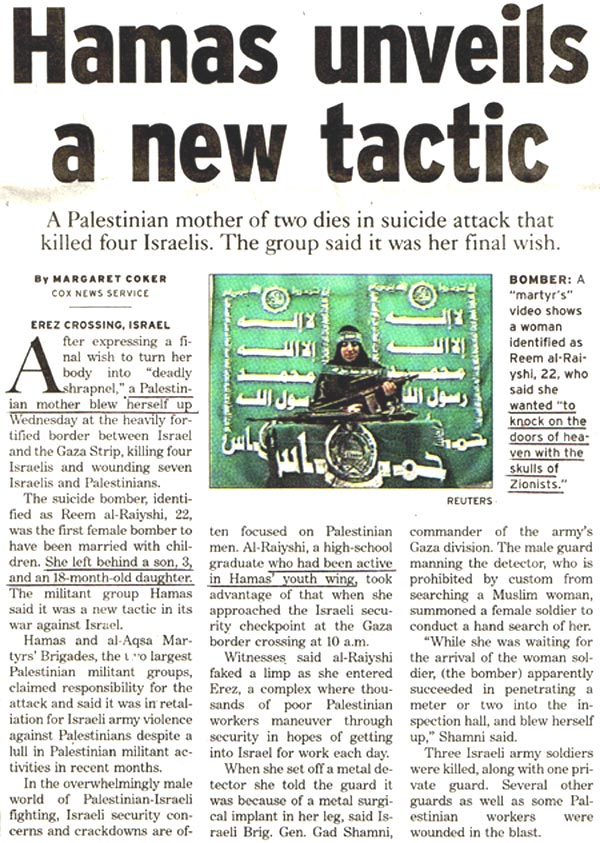
Hamas is using women to murder innocent civilians!
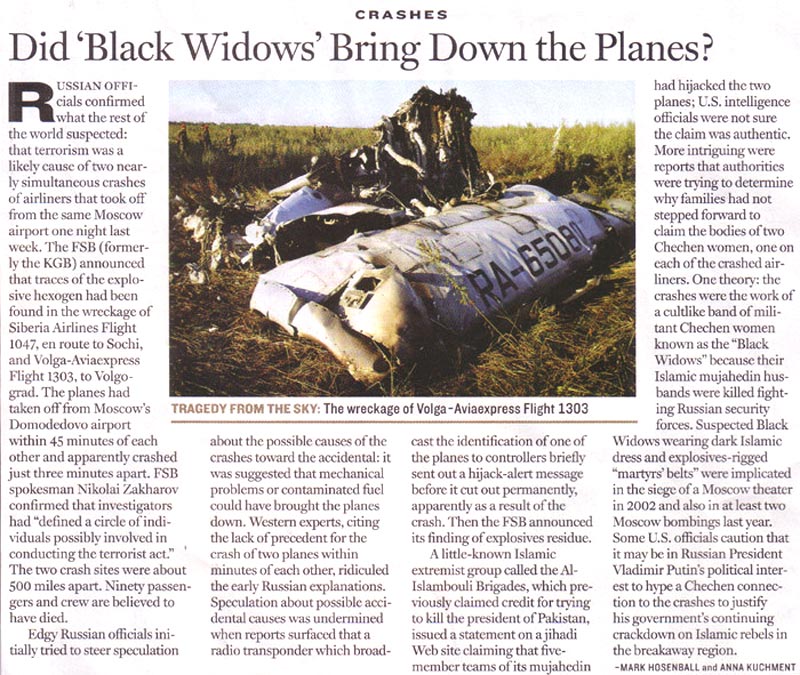
Muslim women are murdering innocent civilians!
By GARETH HARDING
UPI Chief European Correspondent
BRUSSELS, Dec. 7 (UPI) -- What drives a white, middle-class woman from provincial Belgium to strap explosives around her waist and blow herself up in front of a U.S. troop convoy in central Iraq? The question has dominated Belgian newspapers -- and disturbed security officials -- since the identity of Europe's first female suicide bomber was revealed last week.
"This is our Belgian kamikaze killed in Iraq," screamed a headline on the front-page of La Derniere Heure newspaper, above a picture of an attractive, long-haired woman in her late 30s.
"This is very shocking for Belgians," says Claude Moniquet, a Brussels-based terrorism expert. "It took several days for the news to sink in. They simply don't understand how this could happen."
Belgians are used to reading stories about jihadist groups -- 13 Islamist terrorists are currently on trial in Brussels for being members of an organization linked to the recent Madrid and London bombings -- but what particularly horrifies locals about their homegrown jihadist fighter is that she came from such a "normal" background.
Muriel Degauque was born 38 years ago in Monceau-sur-Sambre, a small town near Charleroi in a coal-mining area known as the black country. Her mother, a hospital secretary, and her father, a retired factory worker, still live in the small red-brick house where Degauque was brought up a good Catholic girl. According to reports in the Belgian media, she had an "absolutely normal childhood -- she was well-dressed, well-behaved and went to Mass."
Then, in her late teens, things started to go pear-shaped. She fell in with a gang of bikers, dabbled in drugs and saw her brother killed in a motorbike accident when she was 20. "She has the classic profile of a convert to Islamic jihadism," Moniquet told United Press International. "She had a drink or drug problem when she was young, had several run-ins with the law, was not close to her family and was often unemployed. People like Degauque use Islam to sort out their own problems. They always say that with Islam they find a real family for the first time in their lives."
According to Edwin Bakker, a Dutch terrorism expert at the Clingendael Institute in The Hague, it is hardly surprising that Degauque turned to radical Islam after meeting an Algerian man. "All the studies show that suicide bombers are people who are seeking a new purpose in life."
When the former bakery salesgirl met and married Issam Goris, a Belgian man with a Moroccan mother, she began to immerse herself in Islam, learning Arabic, reading the Koran and moving to Morocco for a brief spell. Friends and family became worried when she appeared at her parents' house wearing a head-to-toe robe and refusing to sit in the same room as her father at mealtimes. "The religion was totally ingrained in her. She only lived for that," her mother Liliane told France's Le Parisien newspaper, describing her daughter as "more Muslim than Muslim."
Bakker says that many Islam converts' sense of estrangement becomes a self-fulfilling prophecy because of their decision to reject their past lives and beliefs. "Converting to a religion which is perceived by many as 'evil' or an 'enemy religion' can lead to social isolation and the loss of friends and family."
Cut off from her family, living in a run-down part of Brussels near the city's main train station and exposed to radical jihadist thinking through her husband, Degauque set off for Iraq by car with Issam in August. On Nov. 9, she detonated a bomb belt in an attempt to blow up a convoy of American troops on a road 30 miles north of Baghdad. One American soldier was wounded and the Belgian was fatally injured in the attack. On the same day, her husband Issam was shot in the head by American troops in another botched attack.
There have been European suicide bombers before -- most notably in the July 7 terrorist attacks on London -- but never a female kamikaze. Security officers and experts fear there will be more deadly strikes as the number of converts to Islam increases. A recent report drawn up for the Dutch parliament revealed that 10,000 Dutch citizens have converted to Islam and that 10 percent of radical Muslims switched to the religion. Another study drawn up by French intelligence services shows that one third of converts to Islam have criminal records.
"Islamist terror organizations particularly prize converts," wrote Middle East expert Daniel Pipes in the New York Sun Tuesday. "They know the local culture and blend in. They cannot be deported. They can hide their religious affiliation by avoiding mosques, lying low, even drinking alcohol and taking drugs to maintain their cover. One guide counsels would-be suicide bombers going to Iraq to 'wear jeans, eat doughnuts, and always carry your Walkman.'"
Moniquet says there is another reason converts are so valuable to jihadist groupings: "The fact that people from Christian backgrounds join the jihadist cause proves to them that the Jihad is the right way."
Muriel Degauque may have the dubious distinction of being Europe's first female suicide bomber, but she will probably not be the last.
3 women held in Iraq suicide bomb plots
August 6, 2008
BAGHDAD, Iraq (CNN) -- Iraqi security forces arrested three women, accusing them of plotting suicide bombings against the country's armed forces, the Interior Ministry spokesman told CNN on Wednesday.
Iraqi Interior Ministry spokesman Gen. Abdul Karim Khalaf said the women were arrested last week as part of the military offensive in Diyala province, the territory that sprawls north and east of Baghdad.
Khalaf said two of the women "tested positive for explosives residue" and explosives were found in another's house. He did not say precisely where or when they were seized. He said the women confessed to planning attacks.
Women are increasingly carrying out suicide attacks in Iraq. Male security forces will not search women and few women have been trained to conduct searches.
Up to 24 suicide attacks in Iraq have been commited by female bombers in 2008 -- up from eight in 2007 -- according to U.S. military figures.
The military offensive in Diyala, called "Omens of Prosperity," began in the provincial capital, Baquba, where security forces have imposed a curfew and are encircling the city.
In addition to recent suicide bombings in Diyala, two central Baghdad roadside bombings on Wednesday wounded six people, according to the Interior Ministry.
The U.S. military said troops targeting al Qaeda in Iraq in the central and northern parts of the country on Wednesday detained three wanted men and several other people.