AVOID MUSLIM PALESTINE
Palestinian Authority Admits to ‘Pay for Slay’
JUN 17, 2026 4:00 PM
BY HUGH FITZGERALD
As
is well known, the Palestinian Authority provides generous monthly
stipends to imprisoned terrorists and to the families of terrorists who
died during their attacks. This is known as the PA’s “Pay For Slay”
program. The PA has tried to hide it, by providing the payments under
other names and for other, fabricated reasons (such as describing them
as payments to the poor) and by urging members not to discuss it lest
the cursed Israelis eavesdrop and record the remarks. The PA fears that
evidence of the Pay-For-Slay program’s continuance could convince
Western donors to cease their support. More on how one Palestinian
commentator, while warning his audience not to discuss the program by
name, nonetheless did exactly what he warned against. More on his
comical slip-up is here: “Palestinian radio: Shh… Don’t admit
Pay-for-Slay continues because PMW is listening,” by Ephraim D. Tepler
and Itamar Marcus, Palestinian Media Watch, June 14, 2026: …Since 2011,
when Palestinian Media Watch exposed Pay-for-Slay—the PA policy of
paying salaries to imprisoned terrorists and families of dead
terrorists, PMW has been the world’s source for “gathering all the
information” about the PA’s terror-reward program.
In
other words, the PA is very concerned that PMW is watching, recording,
and exposing it, as PA TV’s Israel Affairs expert Fayed Abbas said: “An
extremist right-wing organization Palestinian Media Watch… is watching
me now, recording me, and preparing reports.”
And
yet, having just warned that it would be better not to say too much
live on air, the radio host went ahead and said it anyway: A large part
of the terrorists’ salaries has already been paid.
So much for the PA’s claims to donor countries that it has canceled or reformed Pay-for-Slay.
Al-Hurriyah Radio host: “Suhaila Al-Najjar asks: Is there no news about the prisoners’ (i.e., terrorists’) salaries?
Actually,
there is. A large part [of the prisoners’ salaries] was paid through
the banks. You can contact the relevant and responsible bodies. We
don’t want to talk much about the subject live, because you know the
Israelis (i.e., PMW) are trying to gather all the information. But I
think that – it has already been published. There are reports that have
reported on the prisoners’ salaries, and the relatives of the Martyrs
and the families of the wounded – and I believe that a large part of it
has already been paid.”
[Al-Hurriyah Radio, Facebook page, June 3, 2026]
This short exchange tells the whole story.
The PA has not stopped its terror salary program. It has simply become more careful, coded, and nervous about being exposed….
The
same radio host on Al-Hurriyah who warned his audience not to talk
about you-know-what because those damned Israelis are listening in,
trying to get the goods on us about it, nonetheless spilled the beans
himself just before he gave that warning.
Oopsy-daisy.
The radio host made a frank admission that Pay-For-Slay is still going
on, that much of what is due — those “salaries” — has now been paid,
and you need only go to the relevant bank to collect. What was it those
Palestinians keep forgetting? Loose lips sink ships. Or in their case,
battleships.
Palestinian Authority Insists Israel Is ‘Doomed to Perish’
Jan 22, 2026 2:00 pm
By Hugh Fitzgerald
Many
people in the Western world, including the United States, have
convinced themselves that the Palestinian Authority is “moderate” and,
unlike Hamas, a “partner for peace” with Israel. They are deluded. The
PA has no intention of ever accepting the existence of the Jewish
state; it is convinced that Israel will not survive, but is “doomed to
perish.” More on the PA’s genocidal wish-cum-prediction can be found
here: “‘Israel is doomed to perish’ – Palestinian Authority admits its
goal,” by Ephraim D. Tepler and Itamar Marcus, Palestinian Media Watch,
January 18, 2026: The Palestinian Authority consistently indoctrinates
Palestinians to believe that Israel’s demise is inevitable and is an
inherent form of justice. This message is delivered by senior PA
leaders and is reinforced repeatedly across official PA media,
including news programs, children’s education, political commentary,
poetry, and international forums broadcast to the Palestinian public.
This
doctrine has been articulated again recently by Abbas Zaki, a senior
Fatah leader and member of the Central Committee, the PA’s ruling
party: Fatah Central Committee member Abbas Zaki: “In the end, the
winner is the one who remains on the land… and those who will remain
are the ones with the idea, the idea that says there is no escaping the
fact that this land will be liberated, and that the land of peace
cannot be based on revenge. Israel is doomed to perish.” [Arabi 21,
London-based Arab news website, Jan. 9, 2026]
Zaki’s
statement presents Israel as a temporary presence and Palestinians as
the enduring owners of Israel’s land, so that justice will ensure
Israel’s disappearance. This is a foundational belief promoted
systematically by the PA.
PA/Fatah
education teaches children to see Israel as temporary: “Palestine fell
under the Zionist occupation [in 1948], which continues today… The
occupation will cease to exist just as what was before it ceased to
exist…”
No
mention, in Abbas Zaki’s telling, of the Mandate for Palestine. No
mention, either, of the five Arab armies that invaded Israel in May
1948, in an effort to destroy it that ended in a total defeat, what the
Arabs call the “Nakba” or “catastrophe.” No mention by Abbas Zaki of
how Israel has gone from strength to strength. Its Jewish population
has increased from 670,000 in 1948 to more than 7.2 million today.
Israel’s regular army has 170,000 active personnel and a massive
reserve of about 465,000 reservists, making a total of over 600,000
when mobilized.
In
1948, the Israeli Air Force consisted of a dozen used and decrepit Avia
airplanes bought from Czechoslovakia; today it has 650 aircraft,
including fighters, attack helicopters, transports, and trainers. Among
them are 48 F-35s, the largest fleet outside the United States of the
most advanced aircraft in the world. Israel has the second largest
number of companies manufacturing drones. It is a global leader in
drone technology, production, and exports. In defensive weapons,
Israel’s layered anti-missile defense, including Arrow 3, David’s
Sling, Iron Dome, and now, the laser-based Iron Beam, has kept the
country safe despite the thousands of missiles and rockets launched at
it by Hamas, Hezbollah, the Houthis, and Iran. But Abbas Zaki thinks
Israel is on its way out.
Here
is more of his triumphalist drivel: “Algeria’s experience [of the
French leaving] assures that the Jewish settlers in Palestine will
disappear in the end.” [Fatah’s Waed Magazine for children ages 6-15]
The
pieds-noirs left Algeria in 1962 to return to France, the land from
which their ancestors had come to settle in Algeria. The Jews of Israel
are not colonists; Jews have lived in the Land of Israel for 3500
years. Many of the Jews now in Israel, or their parents and
grandparents, came from Arab lands, which they fled — 850,000 of them —
during the half-dozen years following the 1948 war. In that war,
600,000 Jews in Israel fought off a simultaneous invasion by five Arab
armies.
In
1967, Israel again won overwhelmingly, defeating in six days the
combined armies of Egypt, Syria, and Jordan, and taking possession of
the entire Sinai, the Golan Heights, and East Jerusalem.
In
1973, Israel was initially knocked off-balance by a surprise attack
launched byEgypt and Syria on Yom Kippur, but quickly recovered, and
went on to again defeat both countries.
Yet Abbas Zaki claims that Israel will soon fall.
Meanwhile,
in the real world and not the fantasy world of Abbas Zaki and his ilk
in the Palestinian Authority, Israel goes from strength to strength.
Its military has just finished battering Hamas in Gaza, Hezbollah in
Lebanon, and the Houthis in Yemen; it destroyed much of Iran’s nuclear
program and its store of ballistic missiles in the 12-Day War; it also
managed to destroy, just as soon as Bashar Assad fled to Moscow, the
arsenal of weapons in the Syrian army, while Ahmed Al-Sharaa’s men were
still unpacking their bags in Damascus.
While
Israel builds many of the most advanced weapons in the world, and is
now a leading exporter of weapons, while it has become known as the
“Start-Up Nation” for the number of new companies, many of them
unicorns, that its deep bench talented scientists have founded, while
its GDP of $610 billion is second in the region only to that of Saudi
Arabia, it is the Arab oil states that have so far been unable to
diversify their economies, and are still completely dependent on their
revenues from the sale of oil and natural gas, a source of wealth that
steadily diminishes as the world moves away from fossil fuels.
But
Abbas Zaki, like so many other Palestinian Authority officials,
journalists, and teachers, insists that “Israel is doomed to perish.”
Palestinian Authority columnist: Christian traditions are ‘nonsense,’ ‘Jesus belongs to the Palestinians’
AUG 12, 2025 12:00 PM
BY CHRISTINE DOUGLASS-WILLIAMS
The
Palestinian leadership is again referencing Jesus as a Palestinian.
This time around, they’re insulting Christianity as well. “‘Christians,
forget Jesus!’ ‘He is one of us’. Christian traditions are ‘nonsense,'”
by Itamar Marcus and Nan Jacques Zilberdik, Palestinian Media Watch,
August 11, 2025: Now it’s Christianity’s turn to be mocked by the
Palestinian Authority.
While
it’s PA policy to insult, mock and misrepresent Jewish tradition and
Jewish history in the land of Israel whenever possible, this week it
was Christian traditions’ turn to be insulted and denied by the PA.
In
the words of the official PA daily columnist, Christian traditions of
the Holy Sepulcher and the Holy Grail are “nonsense,” because Jesus
doesn’t belong to Christian tradition but belongs to the Palestinians.
In his words: Official PA daily columnist Hassan Hmeid: “During the
Crusades, when kings, princes, robbers, and the poor marched, they came
to – of course, it was a lie and nonsense – “save the Holy Sepulchre”
[from the Muslims]. They wanted to search for the Holy Grail, and so
on. They forgot that Jesus is our son, he is a Palestinian and one of
us.
[Official PA TV, Capital of Capitals – Damascus, Aug. 10, 2025]
The
Palestinian leaders, as part of their need to invent a Palestinian
history, claim that Jesus was a Muslim and a Palestinian, even though
neither Palestinians nor Muslims existed in the world in the time of
Jesus. According to historical accounts and the Christian Bible, Jesus
was a Jew from Judea….
It
isn’t new for the Palestinians to depict Jesus as one of them, despite
the nonsensical reasoning that this requires. Indeed, Jesus was born in
Bethlehem, a city in Judea and Samaria, over 100 years before the
Romans renamed Judea and Samaria “Palestine.” Palestinians are not an
ancient people. They are Arabs who are identical culturally,
linguistically, ethnically and religiously with the Arabs of Syria,
Jordan and other parts of the Levant.
Since
it’s undeniable that Jesus was from the House of David, Hamid Dabashi,
Professor of Iranian Studies and Comparative Literature at Columbia
University, describes Jesus in the Qatari-owned publication Al Jazeera
as “a Jewish Palestinian refugee child who grew up to become a towering
revolutionary figure.”
The
idea that Jesus was a Palestinian first came from Yasser Arafat, the
infamous head of the Palestinian Liberation Organization, which was
created by the Arab League for the purpose of destroying Israel in
1964. Arafat was a jihadist, a propagandist trained by the KGB and
bankrolled by the Soviet Union. It isn’t surprising that Jesus would be
presented as the poor Palestinian, a Bedouin; this idea was a creation
of Arafat that is accepted by far too many leftists today. Who could
forget the late Pope Francis’ unveiling of a nativity scene of Jesus in
a crib lined with a Palestinian keffiyeh last December.
The
falsification of Jesus presented as a Palestinian Bedouin escalates
into an abomination regarding the Holy Trinity. In 2012 senior
Palestinian Authority leader Jibril Rajoub said: “The greatest
Palestinian in history since Jesus is Yasser Arafat,” while an
editorial in the same Palestinian Authority official daily once
referred to Arafat, Jesus and Abbas as the Palestinian “holy Trinity”:
“Jesus is a Palestinian; the self-sacrificing Yasser Arafat is a
Palestinian; Mahmoud Abbas, the messenger of peace on earth, is a
Palestinian. How great is this nation of the holy Trinity!”
From
a Jerusalem Post article: The fabrication of a Palestinian Jesus has
been a core part of the lexicon of Palestinian nationalism since at
least the 1960s, as evidenced by news archive photos of a press
conference held by PLO chief Yasser Arafat in Amman in June 1970. Over
his shoulder hangs a poster of a gaunt, near-naked Palestinian nailed
to a Star of David. The message is clear: the Palestinians are
suffering at the hands of the Jews, just like Jesus did.
A
Fox News article stated in 2020: Tawfiq Tirawi, a senior Palestinian
leader and Fatah Central Committee member, made the claim that Islamic
tradition would mean Jesus is rewarded in heaven with 72 virgins…an
argument many Christians would consider blasphemous….
“This
is blessed Christmas, The birthday of our lord Jesus the Messiah, the
first Palestinian and the first Shahid [Islamic Martyr],” Tirawi wrote
on social media
According to The Algemeiner, “Rep. Ilhan Omar, Omar Suleiman, and Linda Sarsour have advanced this ahistorical narrative.”
Palestinian
propaganda, which has fit well into the DEI Marxist narrative, plays
the card that Jesus was not a blue-eyed blonde as depicted by many
artists in the West, which is likely true, and then claims that he was
instead a Palestinian. An Algemeiner article by Hen Mazzig notes that
in reality, “Jesus was a Mizrahi Jew,” Mizrahi Jews are “the largest
ethnic group of Jews in Israel,” and “share the same skin tone,
heritage, and birthplace as Jesus. Yet we would never be accepted as
Palestinian or identify ourselves as such.”
Mazzig
further notes that “the goal of the argument that ‘Jesus was a
Palestinian from Nazareth’ is not only to erase Jewish ties to the land
of Israel, but also to depict all Jews as ‘white,’ and in consequence,
less sympathetic to intersectional social justice movements.” Mizrahis
make up about 40% to 45% of the country’s total population; Ashkenazis
make up 32%
It
is no coincidence that ongoing insults to Christians, Jews and, in
fact, to Judeo-Christian tradition are perpetuated by exponents of the
leftist-Islamic alliance. And the Palestinian “resistance” is a core
Islamic issue, as stated repeatedly by the Organization of Islamic
Cooperation. See also HERE.
Palestinians
seek a one-state solution, that is, the total destruction of Israel,
and also declare Jesus as a Palestinian, which constitutes grand theft
of what belongs to both Jews and Christians.Palestinian Authority
columnist: Christian traditions are ‘nonsense,’ ‘Jesus belongs to the
Palestinians’
AUG 12, 2025 12:00 PM
BY CHRISTINE DOUGLASS-WILLIAMS
The Palestinian leadership is again referencing Jesus as a Palestinian.
This time around, they’re insulting Christianity as well. “‘Christians,
forget Jesus!’ ‘He is one of us’. Christian traditions are ‘nonsense,'”
by Itamar Marcus and Nan Jacques Zilberdik, Palestinian Media Watch,
August 11, 2025: Now it’s Christianity’s turn to be mocked by the
Palestinian Authority.
While it’s PA policy to insult, mock and misrepresent Jewish tradition
and Jewish history in the land of Israel whenever possible, this week
it was Christian traditions’ turn to be insulted and denied by the PA.
In the words of the official PA daily columnist, Christian traditions
of the Holy Sepulcher and the Holy Grail are “nonsense,” because Jesus
doesn’t belong to Christian tradition but belongs to the Palestinians.
In his words: Official PA daily columnist Hassan Hmeid: “During the
Crusades, when kings, princes, robbers, and the poor marched, they came
to – of course, it was a lie and nonsense – “save the Holy Sepulchre”
[from the Muslims]. They wanted to search for the Holy Grail, and so
on. They forgot that Jesus is our son, he is a Palestinian and one of
us.
[Official PA TV, Capital of Capitals – Damascus, Aug. 10, 2025]
The Palestinian leaders, as part of their need to invent a Palestinian
history, claim that Jesus was a Muslim and a Palestinian, even though
neither Palestinians nor Muslims existed in the world in the time of
Jesus. According to historical accounts and the Christian Bible, Jesus
was a Jew from Judea….
It isn’t new for the Palestinians to depict Jesus as one of them,
despite the nonsensical reasoning that this requires. Indeed, Jesus was
born in Bethlehem, a city in Judea and Samaria, over 100 years before
the Romans renamed Judea and Samaria “Palestine.” Palestinians are not
an ancient people. They are Arabs who are identical culturally,
linguistically, ethnically and religiously with the Arabs of Syria,
Jordan and other parts of the Levant.
Since it’s undeniable that Jesus was from the House of David, Hamid
Dabashi, Professor of Iranian Studies and Comparative Literature at
Columbia University, describes Jesus in the Qatari-owned publication Al
Jazeera as “a Jewish Palestinian refugee child who grew up to become a
towering revolutionary figure.”
The idea that Jesus was a Palestinian first came from Yasser Arafat,
the infamous head of the Palestinian Liberation Organization, which was
created by the Arab League for the purpose of destroying Israel in
1964. Arafat was a jihadist, a propagandist trained by the KGB and
bankrolled by the Soviet Union. It isn’t surprising that Jesus would be
presented as the poor Palestinian, a Bedouin; this idea was a creation
of Arafat that is accepted by far too many leftists today. Who could
forget the late Pope Francis’ unveiling of a nativity scene of Jesus in
a crib lined with a Palestinian keffiyeh last December.
The falsification of Jesus presented as a Palestinian Bedouin escalates
into an abomination regarding the Holy Trinity. In 2012 senior
Palestinian Authority leader Jibril Rajoub said: “The greatest
Palestinian in history since Jesus is Yasser Arafat,” while an
editorial in the same Palestinian Authority official daily once
referred to Arafat, Jesus and Abbas as the Palestinian “holy Trinity”:
“Jesus is a Palestinian; the self-sacrificing Yasser Arafat is a
Palestinian; Mahmoud Abbas, the messenger of peace on earth, is a
Palestinian. How great is this nation of the holy Trinity!”
From a Jerusalem Post article: The fabrication of a Palestinian Jesus
has been a core part of the lexicon of Palestinian nationalism since at
least the 1960s, as evidenced by news archive photos of a press
conference held by PLO chief Yasser Arafat in Amman in June 1970. Over
his shoulder hangs a poster of a gaunt, near-naked Palestinian nailed
to a Star of David. The message is clear: the Palestinians are
suffering at the hands of the Jews, just like Jesus did.
A Fox News article stated in 2020: Tawfiq Tirawi, a senior Palestinian
leader and Fatah Central Committee member, made the claim that Islamic
tradition would mean Jesus is rewarded in heaven with 72 virgins…an
argument many Christians would consider blasphemous….
“This is blessed Christmas, The birthday of our lord Jesus the Messiah,
the first Palestinian and the first Shahid [Islamic Martyr],” Tirawi
wrote on social media
According to The Algemeiner, “Rep. Ilhan Omar, Omar Suleiman, and Linda Sarsour have advanced this ahistorical narrative.”
Palestinian propaganda, which has fit well into the DEI Marxist
narrative, plays the card that Jesus was not a blue-eyed blonde as
depicted by many artists in the West, which is likely true, and then
claims that he was instead a Palestinian. An Algemeiner article by Hen
Mazzig notes that in reality, “Jesus was a Mizrahi Jew,” Mizrahi Jews
are “the largest ethnic group of Jews in Israel,” and “share the same
skin tone, heritage, and birthplace as Jesus. Yet we would never be
accepted as Palestinian or identify ourselves as such.”
Mazzig further notes that “the goal of the argument that ‘Jesus was a
Palestinian from Nazareth’ is not only to erase Jewish ties to the land
of Israel, but also to depict all Jews as ‘white,’ and in consequence,
less sympathetic to intersectional social justice movements.” Mizrahis
make up about 40% to 45% of the country’s total population; Ashkenazis
make up 32%
It is no coincidence that ongoing insults to Christians, Jews and, in
fact, to Judeo-Christian tradition are perpetuated by exponents of the
leftist-Islamic alliance. And the Palestinian “resistance” is a core
Islamic issue, as stated repeatedly by the Organization of Islamic
Cooperation. See also HERE.
Palestinians seek a one-state solution, that is, the total destruction
of Israel, and also declare Jesus as a Palestinian, which constitutes
grand theft of what belongs to both Jews and Christians.
Gangsters block aid distribution in south Gaza
Yolande Knell - BBC Middle East correspondent and Rushdi Abualouf - BBC Gaza correspondent
Mon, November 25, 2024
Amid
severe food shortages in Gaza, increasingly violent thefts by criminal
gangs are now the main obstacle to distributing supplies in the south,
aid workers and locals say.
They allege that armed men operate within plain sight of the Israel Defense Forces (IDF) in a restricted zone by the border.
The
BBC has learnt that Hamas - sensing an opportunity to regain its
faltering control - has reactivated a special security force to combat
theft and banditry.
After
gangsters robbed nearly 100 UN lorries, injuring many of the
Palestinian drivers, on 16 November - one of the worst single losses of
aid during the war - a number of alleged looters were then killed in an
ambush.
A
notorious Gazan criminal family then blocked the main Salah al-Din Road
leading from Israel’s Kerem Shalom crossing point for two days last
week.
Witnesses said iron barriers were erected and lorries trying to access the aid distribution point were fired at.
“Law
and order have broken down in the area around the Kerem Shalom
crossing, which remains the main entry point of goods, and gangs are
filling the power vacuum,” says Sam Rose, deputy director of Unrwa, the
UN agency for Palestinian refugees, in Gaza.
“It’s inevitable after 13 months of intense conflict - things fall apart.”
As
the rainy winter weather begins, humanitarian officials say solving the
worsening situation is critical to meet the huge, deepening needs of
most of Gaza’s 2.3 million population - now displaced to the centre and
south.
“It is tactical, systematic, criminal looting,” says Georgios Petropoulos, head of the UN’s humanitarian office, Ocha, in Gaza.
He
says this is leading to “ultra-violence” in all directions - “from the
looters towards the truckers, from the IDF towards the police, and from
the police towards the looters”.
There
has been increased lawlessness in Gaza since Israel began targeting
police officers early this year, citing their role in Hamas governance.
“Hamas’s
security control dropped to under 20%,” the former head of Hamas police
investigations told the BBC, adding: “We are working on a plan to
restore control to 60% within a month.”
Some displaced Gazans in the south welcome the new Hamas efforts against criminal gangs.
“Killing the thieves who stole aid is a step in the right direction,” exclaims one man, Mohammed Abu Jared.
However, others see them as a cynical attempt to take control of lucrative black markets.
“Hamas
is killing its competitors in stealing aid,” says Mohammed Diab, an
activist in Deir al-Balah. “A big mafia has finished off a small mafia.”
Many
see Hamas’s attempts to take a lead against the criminality as the
direct consequence of Israels’ failure to agree on a post-war plan in
Gaza.
There
are currently no alternatives to replace the Islamist movement and
armed group which Israeli leaders pledged to destroy after last year’s
deadly 7 October attacks.
The
chaos comes at a time when aid entering the Palestinian territory has
dropped to some of the lowest levels since the start of the war.
While
the threat of famine is greatest in besieged parts of the north where
Israel is conducting a new, intense military offensive, in the south
there are also major shortages of food, medicines and other goods.
“Prices
of basic commodities are sky-rocketing - a bag of flour costs more than
$200 (£160), a single egg $15 - or else goods are simply not
available,” Sam Rose of Unrwa says.
Every
day in the past week, Umm Ahmed has stood with her children in a huge
queue outside a bakery in Khan Younis in southern Gaza, where
ultimately some loaves are given out.
“My
children are very hungry every day. We can’t afford the basics. It’s
constant suffering. No food, no water, no cleaning products, nothing,”
she says.
“We
don’t want much, just to live a decent life. We need food. We need
goods to come in and be distributed fairly. That’s all we’re asking
for.”
The US has been pressing for Israel to allow more aid lorries into Gaza.
However,
Israeli officials say that the main reason that their goal of 350 a day
has not been reached is the inability of the UN and other international
aid agencies to bring enough lorries to the crossings.
Aid
workers reject that. They are urgently calling for many entry
restrictions imposed by the Israeli authorities to be lifted, and for
more crossing points to be opened and secured so they can collect and
distribute supplies.
They
say the breakdown in public order needs to be addressed and that
Israel, as an occupying power, is obliged to provide protection and
security.
The
BBC was told that thefts often happen in clear sight of Israeli
soldiers or surveillance drones - but that the army fails to intervene.
Stolen goods are apparently being stored outside or in warehouses in areas under Israeli military control.
The
IDF did not respond to BBC requests for comment on how it combats
organised looting and smuggling. It has previously insisted that it
takes countermeasures and works to facilitate the entry of aid.
Early in the war, as food became increasingly scarce, desperate Gazans were sometimes seen stealing from incoming aid lorries.
Soon,
cigarette smuggling became a huge business with gangs holding up
convoys at gunpoint after they arrived from Egypt’s Rafah crossing and,
after this shut in May, Kerem Shalom.
A
cigarette packet can sell for exorbitant amounts in Gaza: while a
packet of 20 cost about 20 shekels ($5.40) before the war, now a single
cigarette can cost 180 shekels ($48.60).
Cigarettes
are being found within the frames of wooden aid pallets and inside
closed food cans, indicating that there is a regional racket involved
in smuggling.
For the past six weeks, the Israeli authorities have banned commercial imports, arguing that these benefit Hamas.
This has added to the decrease in the supply of food, which is in turn driving the rise in armed looting.
Stolen
goods, from flour to winter shelters, sent as international donations
and meant to be given as free handouts to needy people can only be
bought at extortionate prices on Gaza’s black market.
Meanwhile, months’ worth of donated supplies are being held back in Egypt due to hold-ups in aid delivery.
In
recent days, local media reports are suggesting that Israel is now
studying the option of delivering aid to Gaza by means of a private,
armed American security contractor.
While nothing has yet been officially announced, aid workers are worried.
Georgios Petropoulos of Ocha questions which donor countries would want supplies distributed this way.
“How safe is it really going to be?” he asks: “I think it will be a vector for more bloodshed and violence.”
The Gaza neighborhood shocked to find Israeli hostages in their midst
By Florence Davey-Attlee, Ibrahim Dahman, Eyad Kourdi, Jeremy Diamond and Avery Schmitz
July 19, 2024
CNN
The
Aljamal family was widely respected in Gaza’s Nuseirat camp. They were
known as pious and prominent members of the community. While people
knew they had connections to Hamas, neighbors say no one could have
guessed how deep those links truly went.
When
Israeli forces stormed the Aljamals’ building on June 8 they found
Almog Meir Jan, Andrey Kozlov and Shlomi Ziv, hostages who had been
captured from the Nova music festival on October 7, cowering in a
darkened room.
The
experience of the three men – alongside that of Noa Argamani who was
held in another house nearby, belonging to the Abu Nar family – echoes
testimony from previously released hostages. They describe being
confined among the civilian population, rather than in Hamas’ vast
tunnel network under Gaza.
In
the aftermath of last month’s rescue, neighbors in Nuseirat, a refugee
camp in central Gaza, told CNN they were shocked to learn that Ahmed
Aljamal, a physician, and his family had kept hostages in their midst.
“Had
we known, had he told us, we would have taken safety precautions, hide
or move to somewhere else,” one neighbor, Abu Muhammad El Tahrawi, said.
Dr.
Aljamal, 74, was a general practitioner and also led the call to prayer
at the local mosque, waking early every day to get there before dawn.
“He
was a pious man,” neighbor Abdelrahman El Tahrawi said. “He leads the
prayer, then he goes back to his home. He didn’t mix with people,
didn’t complain about other people, and no one complained about him. He
was a man who minded his own business.”
Dr.
Aljamal’s son Abdallah, 36, was a freelance journalist who most
recently wrote for the US-based Palestine Chronicle, for which he filed
regular dispatches on the war in Gaza.
Neighbors
told CNN it was no secret that the family had links to Hamas. “We were
worried about the Aljamal house. They are with Hamas,” said a neighbor
and family acquaintance.
Abdallah
had served as a spokesman for Gaza’s Ministry of Labor as recently as
2022, a position entrusted only to Hamas members, according to
political analysts. He also showed his support for the group on social
media. On Facebook, he posted pictures of his young son dressed in the
fatigues of Hamas’ armed wing, the Qassam Brigades, and on October 7
openly praised the group’s attack on Israel. In a 2022 video post,
Abdallah commended the Hamas operation to kidnap Israeli soldier Gilad
Shalit, who was held in Gaza between 2006 and 2011, and proclaimed:
“Brothers, all of us are prepared to die for the resistance.”
Public
support for Hamas as a political movement in Gaza has ranged from 34 to
42% over the past seven months, according to polls by the Palestinian
Center for Policy and Survey Research. Polling in Gaza faces multiple
challenges, including population displacement, people’s reluctance to
criticize Hamas publicly and the risks to personal safety in war time.
The true level of support for Hamas may be lower, according to Dr.
Mkhaimar Abusada, associate professor of Political Science at Al-Azhar
University in Gaza, who is now based in the Egyptian capital of Cairo.
A
higher proportion of Gazans are more broadly supportive of armed
resistance, the polling suggests, despite more than nine months of war
that has obliterated the strip.
Some
people who were not affiliated with Hamas or other Palestinian militant
groups took part in the October 7 incursion into southern Israel,
streaming through the border fence after it was breached by fighters –
some stealing from Israeli communities and others taking hostages back
into Gaza. At least 1,200 people were killed and some 250 people in
total were taken from Israel into the strip, according to Israeli
authorities.
A
senior Hamas official last month told CNN the group does not know how
many hostages are still alive, suggesting it may not have full
oversight of their whereabouts. Israeli opposition leader Benny Gantz
told an Israeli TV channel that Israel knows to a “very close number”
how many hostages remain alive.
Despite
the level of support in Gaza for Hamas, which has governed the
territory since 2007, far fewer people would be accepted into the
trusted inner circles of the Islamist movement.
Hostages
being held by civilians under the direction of Hamas is unlikely unless
they have very strong ties to and are well trusted by the group,
according to Abusada.
“Hamas only trusts Hamas when it comes to those very sensitive issues such as Israeli hostages,” he said.
There may be other reasons why Hamas chose to house hostages in civilian homes, however.
Hussein
Ibish, senior resident scholar at the Arab Gulf States Institute in
Washington, said that approach fits Hamas’ strategy to get Israel
“bogged down in the urban centers of Gaza and push them into a
counterinsurgency that cannot end, which is the perpetual war Hamas
says it wants.”
The
three hostages who were held in the Aljamal family building were kept
there for around six months, according to Andrey Kozlov, who spoke last
week to CNN.
Kozlov
described physical and psychological abuse he received at the hands of
his guards. One in particular, he said, “was a big fan of creative
punishment” who on one occasion forced him to spend two days on a
mattress without moving or talking as a penalty for standing near an
open window, and on another occasion covered him with blankets in the
summer heat for washing his hands with drinking water.
“I was trying to breathe through the space between the mattress and blankets,” he said.
During
that time the hostages could hear the family, including children, going
about their daily lives on the floor below, according to Aviram Meir,
the uncle of Almog Meir Jan. In the weeks before Israel’s hostage raid,
the Aljamal family had been continuing as usual, outwardly at least,
and Abdallah’s most recent article for the Palestine Chronicle was
published just the day before.
Then, on the morning of June 8, Israeli forces stormed Nuseirat.
Zainab
Aljamal, Abdallah’s sister, who was in the family house at the time of
the raid, wrote a Facebook post that day describing what happened. The
Israeli soldiers entered and shot Abdallah’s wife Fatima first, before
killing Ahmed and Abdallah, she wrote. Zainab hid with Abdallah’s
children under a bed, according to the now-deleted Facebook post which
was shared with CNN by independent open-source researcher Thomas
Bordeaux.
Zainab
said in the post that the family had been waiting for the moment they
would be killed by Israeli forces. “Since the start of the war, we have
been waiting for this moment. We did not know how it would come and in
what horrific way it would happen, but we were aware that it would
inevitably come.”
As
the three hostages were rescued from the Aljamal house, around 200
meters (650 feet) away Israeli forces carried out a simultaneous raid
on a second apartment block – which was home to the Abu Nar family,
according to Israeli officials – to retrieve Argamani.
Argamani
had become one of the most recognized Israeli hostages when widely
circulated footage showed her being hoisted onto the back of a
motorcycle and driven away from the Nova music festival on October 7 as
her partner was seized and made to walk with his hands behind his back.
Less
is known about Argamani’s captors. Her family members told Israeli
media she had been held by a relatively well-off family who made
Argamani wash dishes for the household, reportedly telling her she was
lucky to be held by them as other hostages were experiencing much worse.
In
a video released by the Israel Defense Forces (IDF) that shows
Argamani’s rescue, troops are seen inside an apartment on the upper
floor of a building, passing a small kitchen.
The Israeli Prime Minister’s Office told CNN she was held by the Abu Nar family but did not provide further details.
According
to unofficial lists of those killed circulated on Arabic-language media
and social media, Mohamed Ahmad Abu Nar died alongside his wife and
child in Israel’s Nuseirat operation last month. Three relatives
of Abu Nar also posted on social media announcing he had been killed by
Israeli forces that day.
CNN
cannot independently confirm whether Abu Nar was involved in holding
Argamani and his relatives have not responded to requests for comment.
Neighbors
of the Abu Nar house in Nuseirat told CNN they saw Israeli special
forces enter and leave the building without much of a fight.
Bilal
Mazhar, a 16-year-old student, said his window was opposite the window
of the apartment in which Argamani was being held, just half a meter
away, but he never saw any sign of her presence until Israeli forces
brought her out.
“They pulled her out normally and no one intervened, and there was no shooting at them,” Mazhar said.
Mohamed
Ahmad Abu Nar seemed to share very little online about his life, and
local people were reluctant to share many details about the Abu Nar
family, but they did express surprise and concern that a hostage had
been held in their midst.
“He
had young children at home,” said Khalil Al-Kahlot, a civil servant in
Gaza. “No one would expect him to hold a hostage like this, in homes
and among people.”
Al-Kahlot,
who told CNN he’d been in Nuseirat for the past four months, said
Mohamed Ahmed was “ordinary” and “a normal man,” adding that he had
never suspected he was affiliated with Hamas.
“They
are people in Hamas, but we did not know that,” said another neighbor
of the Abu Nar family. “If we had known there was something there, no
one would have stayed in the area.”
After
Israeli forces evacuated the hostages, airstrikes hit both of the
buildings they were rescued from and now only rubble remains at each
site.
More
than 270 Palestinians were killed in Nuseirat on June 8, according to
Gaza health ministry officials, which doesn’t distinguish between
militants and civilians, and hundreds more were injured. Israel puts
the number of deaths at under 100. CNN cannot independently confirm the
figures.
Many locals questioned why so many Palestinians had to die for the Israeli forces to rescue just four hostages.
Al-Kahlot said: “People died because they were freeing her, and no one was looking at us.”
Nablus residents worried about minors joining clashes with IDF
By KHALED ABU TOAMEH
Published: DECEMBER 17, 2022
Jerusalem Post
Some
Palestinians in Nablus have expressed concern over the recruitment of
minors by armed groups in the city and the nearby Balata Refugee Camp.
Some
of them have been tasked by the Lions’ Den and Balata Battalion with
preparing explosive devices that are being used against soldiers,
Palestinian sources said. Others have been armed with rifles.
The recruitment of minors by Palestinian armed groups is not a new phenomenon, but has been ongoing for decades.
In
recent weeks, however, some Nablus residents have criticized the armed
groups for allowing boys aged 15-17 to take part in clashes with the
IDF. The residents also attacked the groups for using the boys to
prepare explosive devices and monitor the movements of IDF troops.
“This
is very bad and worrying,” said a prominent businessman from Nablus. “I
appeal to the armed groups to stop using children.”
A
school headmaster from the city said he received complaints from many
parents about the “exploitation” of their children by the armed groups.
“We are working closely with the families and the Palestinian security
services to solve this problem,” he said. “We don’t want to endanger
the lives of our children.”
Nasser wants to be a martyr
A 15-year-old boy, who identified himself as Nasser, told The Jerusalem
Post that he “works for” the Balata Battalion, which consists of dozens
of gunmen from the refugee camp.
Interviewed
in the Old City of Nablus last week, Nasser said he and one of his
friends, 16-year-old Mohammed, were involved in preparing improvised
explosive devices for the group.
He said he and other children have quit school to join the Balata Battalion.
“My
role model is Ibrahim al-Nabulsi,” Nasser said, referring to the gunman
killed by the IDF in the Old City of Nablus last August. “I want to be
a martyr like Ibrahim.”
According to Nasser, his father is aware of his activities on behalf of the battalion.
“I
told my father, ‘You love me and want me to be with you, but God also
loves me and wants me to be with Him. I have chosen to be with God.’”
Nasser
said he and his friends have lost confidence in the Palestinian
Authority. “Our leader is [Hamas military commander] Mohammed Deif,” he
said. “He represents us and the Palestinian resistance.”
Although
he lives in Balata Refugee Camp, Nasser visits the site where Nabulsi
was killed in the Old City of Nablus almost every day. When he returns
to the camp, he joins other teenagers in preparing explosive devices.
Mahdi Hashash killed by bomb he was carrying
Last month, Mahdi Hashash, 15, was killed when an explosive device he was carrying exploded.
The
incident took place during clashes between gunmen and IDF soldiers
accompanying Jewish worshippers to Joseph’s Tomb near the Balata camp.
The
Balata Battalion later endorsed Hashash as one of its “martyrs.” The
group, however, did not publicly admit that Hashash, nicknamed
Shaimoun, was carrying an explosive device.
Hashash’s
friends told the Post that, like many teenagers, one of his missions
was also to monitor the movements of the IDF when they enter Nablus.
After his death, the Balata Battalion praised Hashash as a “hero” describing him as a “Lion of the Battalion.”
Waseem Khalfeh killed in clashes with IDF
Last
August, 18-year-old Waseem Khalifeh, also of Balata Refugee Camp, was
killed by the IDF while fighting alongside Balata Battalion gunmen. A
year earlier, he was shot and seriously injured by the IDF during armed
clashes in the camp.
Sources in the camp confirmed that Khalifeh had joined the Balata Battalion at the age of 16.
Ahmed Shehadeh, also 16, was killed during armed clashes with the IDF in Nablus in late November.
A
resident of the Old City, he was a close friend of Hashash. Days before
he was killed, Shehadeh posted a video of himself standing next to his
friend’s grave.
A
leaflet issued by the ruling Fatah faction in Nablus mourned Shehadeh
as a “martyr,” describing him as the “boy of rocks,” a reference to his
involvement in throwing rocks at IDF soldiers. Some residents claimed
that he had been recruited by the Lions’ Den.
A
23-year-old gunman from the Old City of Nablus told the Post that there
was full cooperation between the various armed groups in the Nablus
area, including the Lions’ Den and Balata Battalion.
The
gunman confirmed that the groups have been recruiting teenagers. “Many
young people want to join the resistance,” he said. “Anyone who has the
ability to carry a rifle is welcome.”
Wanted by both Israel and the Palestinian security forces, he said the armed groups in the Nablus area were now more cautious.
“We
believe that Israel and the Palestinian Authority have infiltrated the
armed groups,” he said. “There are many spies here and we have learned
from the mistakes of the past.”
Palestinians vandalize, set fire to Joseph’s Tomb; PM decries ‘shocking destruction’
Bennett
vows rioters responsible for ‘violating a holy place’ will be caught;
Gantz says shrine, near Nablus in West Bank, will be quickly repaired
The Times of Israel
April 10, 2022
Prime
Minister Naftali Bennett joined the condemnation on Sunday of the
overnight arson and vandalism of Joseph’s Tomb near the West Bank city
of Nablus, saying he was appalled by the images of the damage to the
shrine.
“During
the night Palestinians destroyed Joseph’s Tomb. Dozens of Palestinian
rioters in a campaign of destruction simply violated a holy place for
us, the Jews,” Bennett said at the start of the cabinet meeting.
“They broke the tombstone on the grave, set fire to rooms in the compound — I saw the pictures and was shocked,” he said.
“We
will not abide such an assault on a place that is holy to us — on the
eve of Passover — and we will get to the rioters,” he said. “And of
course we will make sure to rebuild what they destroyed, as we always
do.”
Around
100 Palestinians broke into the site overnight, rioted and set it
ablaze, before they were dispersed by Palestinian security forces and
smashed objects inside, Israel Defense Forces spokesman Brig. Gen. Ran
Kochav said.
Images on social media showed parts of the tomb inside the shrine smashed and charred.
The rioting came amid clashes between Palestinian gunmen and IDF soldiers in the nearby Balata refugee camp in the Jenin area.
The
IDF confirmed that special forces — including troops from the elite
Shayetet 13 navy unit — carried out searches for weapons in the area,
and arrested eight Palestinians suspected of terror activity.
Footage
showed dozens of Palestinians entering the site and smashing objects
inside. The tomb is venerated by Jews, Christians and Muslims, and has
often been a flashpoint for violence.
Some
Jews believe the biblical Joseph is buried in the tomb, while Muslims
say a sheikh is buried there. The army escorts Jewish worshippers to
the site several times a year, in coordination with Palestinian
security forces.
Earlier,
Defense Minister Benny Gantz said the vandalism was a “grave event,”
and said he had sent a “strong message” to the Palestinian Authority
about the attack on the shrine.
“The
vandalism of Joseph’s Tomb is a grave event and a serious violation of
freedom of worship in one of the holiest places for every Jew. It
violates the feelings of the entire Jewish nation, especially when it
occurs during the Muslim holy month,” Gantz said in a statement, which
he released in Hebrew, Arabic and English.
Gantz
said that Israel will work quickly to “ensure that the site is
refurbished and quickly returned to its original condition.”
The minister added that “all necessary measures” will be taken to prevent a repeat of such an attack.
Gantz
concluded by saying that he told the Palestinian Authority that it must
increase security and take action against the rioters.
“This
morning, I delivered a strong message to the Palestinian Authority,
demanding the immediate reinforcement of their officials on-site and
decisive action against rioters and terrorists that harm stability and
security in holy places,” Gantz said.
Foreign Minister Yair Lapid, in a statement, deplored the attack while urging calm.
“Attacking
holy sites is attacking the heart of a people. The Palestinians who
laid waste to Joseph’s Tomb seek to sow destruction and devastation
during a holy festival. This is serious damage not only to the tomb
itself, but to the deeply-held feelings of the Jewish people,” Lapid
tweeted.
“We will bring the perpetrators to justice and repair Joseph’s Tomb. I call on everyone to promote calm and quiet.”
58 Palestinian
women murdered in domestic violence in 2 years; PA blamed for not ratifying law
to protect them
Nan Jacques Zilberdik
Jul 8, 2021
Palestinian
Media Watch
“The women in
our society are still being subjected to murder and violence… A chronic
illness” – official PA daily
“In the
absence of the law to defend the family against violence, the men of the family
will continue to do as they please with the women” – Palestinian NGO
“The increase
in the murder of women in Palestinian society under different circumstances and
unjustified and illogical excuses indicates the exacerbation of fundamentalism
and social seclusion” – Palestinian NGO
Palestinian
women’s rights organizations blame PA inaction in passing a law to defend women
from domestic violence as the reason murder of Palestinian women in domestic
violence is increasing.
According to
the independent Palestinian NGO, the Women's Centre for Legal Aid and Counselling
(WCLAC), over a two-year period (2019-2020), 58 Palestinian women and young
women were murdered in the Gaza Strip and the West Bank, including Jerusalem.
In 2019, 21 cases were documented – a number that rose to 37 cases in 2020.
Palestinian
NGOs fighting for women’s rights are calling on the PA to finally ratify the
laws that will protect women and limit domestic violence:
“Member of the
Board of Directors of the Palestinian NGOs Network (PNGO) and Secretary of the
Women’s Activity Committees Association in Nablus Sana’a Shbeita
emphasized that… ‘The laws… increase the consciousness in society regarding
rights, and also constitute a deterrent and bring about security and stability.
Therefore, ratifying the law to defend the family against violence will
limit the violence against women and will thus protect them from the danger of
murder.’”
“The absence
of a defense mechanism for the women” and “the patriarchal culture that gives
men custody over the women and young women” were cited by Tahrir Al-A’araj, Director-General of the Palestinian Initiative for
the Promotion of Global Dialogue and Democracy “Miftah,” as the main reasons
for continued violence against and murder of Palestinian women. She foresees
that “in the absence of the law to defend the family against violence, the men
of the family will continue to do as they please with the women.”
Another
representative from the same NGO interpreted the rise in murders of women as a
sign of the “exacerbation of fundamentalism,” and implied the moral failure of
the PA as a “state that aspires to lay the foundations for the rule of law and
proper governance”:
“The increase
in the murder of women in Palestinian society under different circumstances and
unjustified and illogical excuses indicates the exacerbation of
fundamentalism and social seclusion… The law is the legal tool to
deal with an attacker or abuser in a state that aspires to lay the foundations
for the rule of law and proper governance, and ratifying laws, including the
law to defend the family against violence, is what will strengthen the
achievement of justice and security for the weak sectors of society,
including women and young women.’”
Palestinian
Media Watch has previously reported on honor killings and domestic violence in the PA. Although
focus on these problems has increased in the PA over the last few years, the
one thing that could make a difference - tougher legislation – has not been
taken on by the PA. On the contrary, PMW has shown that it is the PA itself and
often its religious representatives who
keep things at a standstill by for example telling women not to submit
complaints over their spouses to Israeli police, and justify that men beat their wives.
Speaking in
2019 - during the period of the WCLAC survey - a lecturer at the Bir Zeit
University also cited “the social culture and the domination of a male-patriarchal culture” and the “lack of defined and
detailed deterrent laws” as some of the reasons for violence against women in
the PA. Other experts on the same program explained that the concept of
“marital rape” is not even recognized in Palestinian culture because women’s
bodies are “a right permitted to the man”:
The
Palestinian Human Rights and Democracy Center "SHAMS" also explained
in 2019 that the male culture grants men the status of moral guardians who can
do as they please:
"Women
remain the most prominent victims of the male culture and of the violence that
grows out of it, while this culture elevates men beyond the culture of shame,
appoints them the masters and guardians of morality - even when they act
immorally - and grants them complete immunity. Reducing a woman's honor to her
hymen indicates a superficial and uncivilized mentality that stems from viewing
women as bodies and private property."
It should be
noted that in the PA with a nonfunctioning government and parliament all that
would be necessary to enact the law protecting women which has been under
discussion for years would be a statement by PA chairman Mahmoud Abbas. His
refusal to do so may be an indication of the social pressures in Palestinian
society against changing the status quo of male dominance over women.
The following
is a longer excerpt of the article on the new report on murder of Palestinian
women cited above:
Headline:
“Violence leads to murder – 58 cases in two years
They treat the women’s lives as they please and spill their blood, and the
victims are entire families under the powerlessness of the law”
“Despite all
the efforts at all levels, and despite the ongoing work by institutions,
figures, and media and social influencers, the women in our society are
still being subjected to murder and violence. Every time a case of murder
occurs whose victim is a woman in her youth, the criminal remains free without
giving an accounting, and these cases indicate a chronic illness from which we
are suffering, which is accompanied by violence and ignorance.
Recently, the
[independent Palestinian] Women's Centre for Legal Aid and Counselling (WCLAC),
one of the institutions dealing with monitoring issues and affairs of the
Palestinian women, published a report that shed light on the phenomenon of
women being murdered between the years 2019-2020…
According to
the information presented by the WCLAC, 58 cases were documented of Palestinian
women and young women being murdered during the last two years of 2019-2020 in
the Gaza Strip and the West Bank, including Jerusalem, which were divided into
21 cases in 2019 as opposed to 37 cases in 2020…
The severity
of the phenomenon lies in the general trend of an increase in the rates of
murder of women and young women in all areas, as at the time when an increase
took place in the cases of murder of women and young women – 25 cases in the
Gaza Strip and 33 in the West Bank – a significant increase also took place in
the cases of murder in the West Bank and the Gaza Strip in 2020 as opposed to
2019…
Member of the
Civil Organizations Network’s Board of Directors and Secretary of the Women’s
Activity Committees Association in Nablus Sana’a Shbeita
emphasized that… ‘The laws play a central role in protecting the social
sectors, the individual, his possessions, and his beliefs, and particularly the
women. The laws also increase the consciousness in society regarding rights,
and also constitute a deterrent and bring about security and stability.
Therefore, ratifying the law to defend the family against violence will
limit the violence against women and will thus protect them from the danger of
murder.’ …
In the same
context, [Palestinian Initiative for the Promotion of Global Dialogue and
Democracy] Miftah institution Director-General Tahrir Al-A’araj
emphasized that ‘One of the main reasons for violence against women, which is
violence that leads to murder in most of the cases, is the absence of a defense
mechanism for the women that constitutes a continuation of the violence against
women in the private space, which is connected to the mechanism of the
patriarchal culture that gives men custody over the women and young
women in this space. Therefore, in the absence of the law to defend the
family against violence, the men of the family will continue to do as they
please with the women.’ …
Miftah
Director of Projects Najwa Sandouqa said that ‘The
increase in the murder of women in Palestinian society under different
circumstances and unjustified and illogical excuses indicates the exacerbation
of fundamentalism and social seclusion… The law is the legal tool to deal with
an attacker or abuser in a state that aspires to lay the foundations for the rule
of law and proper governance, and ratifying laws, including the law to defend
the family against violence, is what will strengthen the achievement of justice
and security for the weak sectors of society, including women and young
women.’”
Defiant
Abbas says he won’t halt stipends to terrorists
Palestinian leader says PA will not allow anyone to 'interfere' with who it
disburses money to; claims Arab states oppose Trump peace plan
9 July 2018
The
Times of Israel
Palestinian Authority President Mahmoud Abbas said Sunday that he will continue
paying stipends to Palestinian attackers and their families despite the Israeli
parliament’s decision last week to withhold hundreds of millions in funds from
taxes collected on the Palestinian Authority’s behalf.
Abbas defiantly told a meeting of Fatah party leaders that the Palestinian
government would pay “our martyrs and prisoners and wounded people” as it had
since 1965.
“We will not allow anyone to interfere with the money that Israel is against us
paying to the families of martyrs and prisoners,” he said, according to an
official transcript released by state-run news agency Wafa.
Israel has called on Palestinians for years to halt the stipends, which benefit
roughly 35,000 families of Palestinians killed, wounded or jailed in the
conflict with Israel, many of them accused of involvement in terror. Israel
says the stipends encourage violence.
Among the beneficiaries are families of suicide bombers and others involved in
deadly terrorist attacks on Israelis.
The Palestinians contend the number of stipend recipients involved in deadly
attacks is a small fraction of those aided by the fund. They say that the tax
revenue collected by Israel for them under past peace agreements is their money
and that the Palestinian Authority has a responsibility to all of its citizens
like any other government.
The stipends amount to approximately $330 million, or about 7 percent of the
Palestinian Authority’s $5 billion budget in 2018.
‘Arabs against Trump peace plan’
Abbas also said that the Trump administration’s efforts to restart the
Israeli-Palestinian peace process are doomed to fail.
Jared Kushner, President Donald Trump’s son-in-law and senior adviser, said
last month that the administration would soon present its Israeli-Palestinian
peace plan whether or not it had Abbas’s support.
Abbas said the Palestinians would “will not let the ‘Deal of the Century’
work,” referring to Trump’s term for his administration’s peace efforts.
“We have assured the world that we are against it, that we will not accept it
and we will not allow it to pass,” he said, according to Wafa.
Abbas said other Arab countries also have rejected the US plan, but didn’t say
which countries opposed the plan.
Police seize thousands in Hamas cash from family of dead terrorist who killed 8
Cops confiscate money from East
Jerusalem home of Alaa Abu Dheim, who killed students
in a terror attack at Jerusalem's Mercaz Harav yeshiva in 2008
Times of Israel
27
June 2018
Police seized tens of thousands of shekels from the family of an East Jerusalem
terrorist on Wednesday, which cops said was paid as a stipend by the Hamas
terror group.
The NIS 43,000 ($11,800) in Israeli and foreign currency had been given to the
family of Alaa Abu Dheim, who in 2008 shot dead eight
Israeli students, aged 15-26, in Jerusalem’s Mercaz Harav yeshiva and wounded 11 more.
Abu Dheim, from the East Jerusalem neighborhood of Jabel Mukaber, was killed during the attack by an off-duty
IDF captain and a student in the yeshiva.
“The activities carried out this morning were another step in the general
actions of the Israel Police and security forces to prevent, thwart and stop
those directly involved in riots or terror activities in Jerusalem, and also
against those who encourage and support terrorists,” police said in a
statement.
“The operation was the result of covert activity and targeted intelligence
gathering by the Israeli Police and security forces which found that the family
of the terrorist who live in East Jerusalem received cash and funding from
Hamas in support for the murderous terror attack,” police said.
“We will not permit financial support from a terror organization for the
families of terrorists who carry out murderous attacks,” they added.
Security forces and lawmakers have worked to end payments from the Palestinian
Authority and from Palestinian terror groups to families of terrorists which
they say encourage further attacks.
On Wednesday lawmakers gave the final go-ahead for a decisive vote on a bill
that would slash funds to the PA by the amount Ramallah pays out to convicted
terrorists.
The bill, proposed by Yesh Atid
MK Elazar Stern and Likud MK Avi Dichter,
says that welfare payments paid out by the PA to Palestinian prisoners and
their relatives must be deducted from tax revenues Israel transfers annually to
the administrative body. The money withheld in this way would instead go into a
fund designated to help victims of terror attacks.
Under the current law, based on the 1994 Oslo Accords that established the PA
and the mechanism for Israeli funding, the finance minister already has the
ability to freeze funds.
The measure, which would cut hundreds of millions of shekels from tax revenues
transferred to the PA, is similar to a measure recently passed in the US, known
as the Taylor Force Act, withholding funding to the PA over stipends to
terrorists and their families.
According to the Defense Ministry, the PA in 2017 paid NIS 687 million ($198
million) to the so-called “martyrs’ families fund” and NIS 550 million ($160
million) to the Palestinian Prisoners’ Club — some 7 percent of its overall
budget.
Palestinian prisoners serving 20- to 30-year sentences for carrying out terror
attacks are eligible for a lifetime NIS 10,000 ($2,772) monthly stipend, the
Defense Ministry said, citing PA figures. Those prisoners who receive a three-
to five-year sentence get a monthly wage of NIS 2,000 ($554). Palestinian
prisoners who are married, have children, live in Jerusalem, or hold Israeli
citizenship receive additional payments.
The Defense Ministry last month released figures alleging that some terrorists
who killed Israelis will be paid more than NIS 10 million ($2.78 million) each
throughout their lifetimes by the PA.
Terrorists will get NIS 10 million each from PA
The Times of Israel
6 May
2018
Ahead of vote on cutting funding to Ramallah, state estimates sum of future
payments to murderers of Henkin, Salomon, Ben-Gal and
Shevach
The Defense Ministry released figures Sunday alleging that some terrorists who
killed Israelis will be paid more than NIS 10 million ($2.78 million) each
throughout their lifetimes by the Palestinian Authority.
Ahead of a Knesset vote on a measure to cut some payments to the PA until it
stops paying stipends to terrorists and their families, the ministry gave
estimates of the total payments made to several jailed murderers.
In each case the ministry said the terrorist would receive NIS 1,400 ($390) per
month for their first three years in prison. But the ministry did not say how
much it estimated each terrorist would be paid after the first three years, or
how it arrived at its estimates of what each terrorist or his family would
receive by the age of 80.
The PA provides the monthly payments, usually via an intermediary organization,
to the families of those convicted of carrying out terror attacks on Israelis
or those killed perpetrating such attacks. Israeli officials have repeatedly
demanded that the payments be stopped, saying they incentivize terror.
“I call on all Knesset members to join us, vote for the law and put an end to
this theater of the absurd,” Defense Minister Avigdor Liberman said in a
statement ahead of Monday’s vote on the measure. “Every shekel that would have
been transferred to the murderers will be deducted from the PA’s tax revenues.
We will stop financing terrorism.”
Among the terrorists cited in the Defense Ministry report were the killers of Eitam and Naama Henkin in October 2015.
The Henkins were murdered in a drive-by shooting, and
the four killers were each sentenced to two life sentences and an additional 30
years in jail.
The four, all Hamas members, were named as Yahia Muhammad Naif
Abdullah Hajj Hamad, who carried out the shooting itself; Samir Zahir Ibrahim Kusah, the driver
of the car, who was also linked to previous terror attacks; gunman Karem Lufti Fatahi
Razek, who was wounded by gunfire from one of his
fellow cell members during the attack; and Zir Ziad
Jamal Amar.
By the time they turn 80, Razek will have been paid
NIS 11,232,000 ($3.1 million); Amar NIS 10,056,000 ($2.8 million) and Hamad NIS
10,080,080 ($2.77 million), the ministry claimed. No numbers were given for Kusah.
Another terrorist cited in the report was Omar al-Abed, who stabbed to death
three members of an Israeli family in their home.
Al-Abed knocked on the door of the Salomons family in
the West Bank settlement of Halamish in July 2017,
just minutes before festivities to celebrate the birth of a new grandson in the
family. He murdered Elad, Yosef, and Chaya Salomon.
He has already been paid NIS 12,200 ($3,370), the Defense Ministry said, and is
expected to receive at least NIS 12,604,000 ($3.5 million) by the time he turns
80.
The ministry also estimated the payments to an alleged terrorist who was not
yet convicted, and the payments to the family of another suspect killed in a
shootout with the IDF.
Abed al-Karim Assi has been charged with stabbing to
death Rabbi Itamar Ben-Gal, 29, at a bus stop outside
the West Bank settlement of Ariel February 5, 2018. So far
he has been paid NIS 1,400. However, if, as expected, he is sentenced to life
imprisonment, he will receive a total of NIS 12,604,800 ($3.5 million) by the
time he reaches the age of 80, the Defense Ministry said.
Similar payments are made to the families of Palestinians who allegedly
attacked Israelis and were subsequently killed by Israeli security forces.
Ahmad Nassar Jarrar, believed to have been behind the
January terror attack that killed Rabbi Raziel Shevach,
was killed in a shootout with the IDF. Because he would have received a lengthy
sentence, his family are receiving a monthly payment of NIS 1,400, and so far have received NIS 5,600 ($1,500), according to the
ministry.
Due to their lengthy imprisonment, if any of the terrorists are released from prison they are automatically entitled to a job with the PA
equivalent to a minister or a general, the Defense Ministry said. If they die
their family will be entitled to continue receiving the payments.
Under an economic agreement signed in 1994, Israel transfers to the PA tens of
millions of dollars each year in customs duties levied on goods destined for Palestinian
markets that transit through Israeli ports.
The bill to be voted on Monday would allow the government to either permanently
deduct the funds paid out to terrorists, or “freeze” the payments, leaving the
security cabinet with the final say.
Liberman said last month that withheld tax revenues would go toward
compensating Israeli terror victims who cannot sue their attackers.
“Soon, this theater of the absurd will come to an end, and the salaries of the
terrorists that we will withhold from [PA President Mahmoud] Abbas will be used
to prevent terrorism and compensate victims,” he said.
The PLO gives monthly payments to all Palestinian prisoners jailed in Israel,
no matter the reason for their incarceration, and also to families of so-called
“martyrs” — a term used by the PLO to refer to anyone killed by an Israeli,
including in the act of carrying out an attack.
A recent report published by the Coordinator of Government Activities in the
Territories, the Israeli Defense Ministry agency responsible for administering
civilian affairs in the West Bank and the crossings with Gaza, said that around
one-third of Palestinian prisoners were “directly responsible for the murder of
Israelis.”
The bill is similar to the Taylor Force Act, which was recently passed by the
US government.
Last May, a former senior defense official told a top Knesset panel that the PA
had paid out some NIS 4 billion — or $1.12 billion — over the previous four
years to terrorists and their families.
Setting out the figures, Brig.-Gen (res.) Yossi Kuperwasser, a former director
general of the Ministry of Strategic Affairs and ex-head of the army’s
intelligence and research division, told the Foreign Affairs and Defense
Committee that the longer the period for which a Palestinian security prisoner
is jailed, “the higher the salary… Anyone who has sat in prison for more than
30 years gets NIS 12,000 ($3,360) per month.”
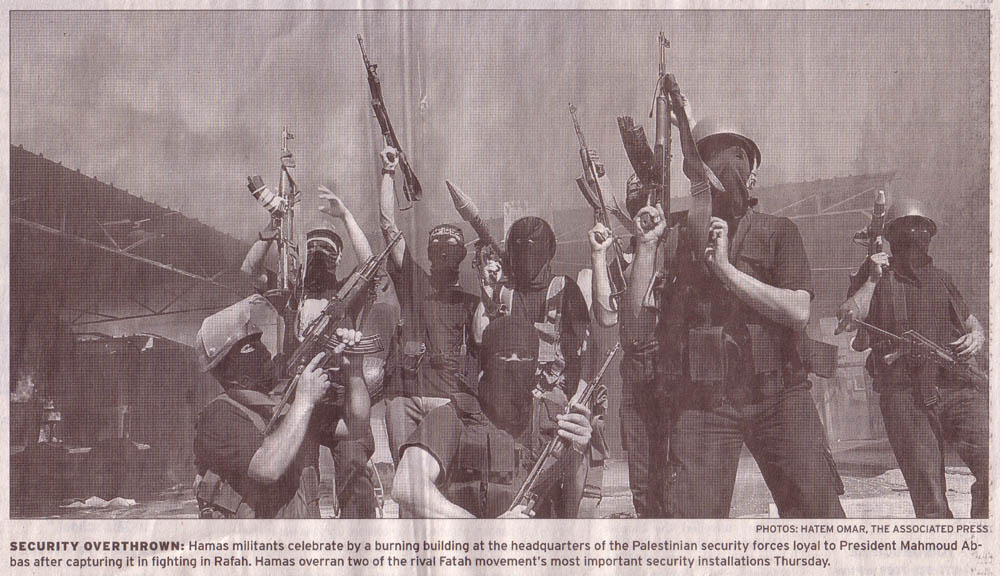
Hamas
Militants Fighting Alongside ISIS in Sinai
by TheTower.org Staff
03.14.16
Militants from the Palestinian terrorist group Hamas are fighting alongside the
Islamic State in the Sinai Peninsula, while ISIS fighters are continuing to
receive treatment in Gaza hospitals, a senior IDF official told Palestinian
media.
Maj.-Gen. Yoav Mordechai, the coordinator of government activities in the
territories, specifically cited a Salafi militant named Mahmoud Z. who has
allegedly been coordinating between the two Islamist groups, as well as Ibrahim
Abu Qureia, an ISIS fighter who recently received medical care in Gaza.
Mordechai added that Hamas has been seeking to exploit the Erez
crossing on the Israeli border for terrorist activities, and warned that
continuing those attempts would negatively impact Israel’s good-faith efforts
to help with Gaza’s reconstruction.
Israeli security officials told Ynet on Saturday that
Hamas had permitted Salafi leaders from Gaza to travel to Sinai, where the
local ISIS affiliate is fighting against the Egyptian military. At least two
men—Hamas militant Mohammed Sami Gint and Mahmoud Nimr Abdel Latif Zagrah—left Gaza
to fight with ISIS, they claimed. Their comments were made the same day Hamas
leaders traveled to Egypt in an effort to repair ties with Cairo, which have
deteriorated in recent years.
Egyptian security officials were quoted on Thursday by the Israeli daily
Yedioth Ahronot as saying that Hamas was building
3-mile-long “mega-tunnels” into the Sinai. Egypt has been aggressively
destroying Hamas tunnels that breach into its territory, and its intelligence
service has echoed the Israeli assessment that Hamas is involved in arms
smuggling with ISIS-Sinai Province.
Mordechai told the Arabic news site Elaph in February
that the same tunnel network that Hamas uses to smuggle arms and explosives
into Gaza serves as a crossing for ISIS fighters, which Hamas is treating in
exchange for money and weapons. Israeli sources familiar with the situation
told Elaph that Israel is keeping Egypt informed of
ISIS’s movements in the Sinai and of the group’s relationship with Hamas, and
has provided the Egyptian military with aerial photographs of tunnel openings
along the Sinai-Gaza border.
Ynet reported in December that Hamas has been funding
ISIS-Sinai Province with tens of thousands of dollars per month in weapons sales,
and that the IDF was intensifying efforts to collect information on the group
after it issued several threats against Israel. ISIS-Sinai Province is believed
to have thousands of jihadists in its ranks and receive millions of dollars in
aid from funders abroad, giving it the capacity to attack Egyptian targets on a
daily basis.
According to Egyptian authorities, Hamas’ logistical support and training was
key in facilitating the rise of ISIS-Sinai Province. The ISIS affiliate’s
leader, Shadi al-Menei, reportedly
met with top Hamas leaders in December in an effort to bolster their
coordination.
Al-Menei’s forces carried out a major attack in July
against Egyptian troops in the northern Sinai, killing over a dozen. The group
also claimed responsibility for striking an Egyptian naval vessel that same
month, as well as for rockets fired into Israel’s southern region. An Israeli
general confirmed at the time that Hamas was assisting ISIS-Sinai Province
through arms smuggling and other means.
Times of Israel journalist Avi Issacharoff similarly
characterized the relationship between the groups as one of “close
cooperation,” adding that Hamas launched surveillance drones to track Egyptian
troop movements near smuggling routes between Gaza and the Sinai. “These routes
are vital to Hamas on one side of the border, and Islamic State on the other,”
he explained.
The widening coordination between the terrorist organizations echoes Israeli
Prime Minister Benjamin Netanyahu’s observation in his 2014 speech to the United
Nations General Assembly that “ISIS and Hamas are branches of the same
poisonous tree.”
Arik Agassi wrote in The Tower Magazine in January that ISIS-Sinai Province
“has become one of the most powerful, dangerous, and effective in the region,”
largely due to Iranian support via its proxy, Hamas.
The Iran-Hamas-ISIS axis is part of Iran’s strategy of using proxy forces
against U.S. allies like Egypt and Israel as part of a larger strategy to
achieve hegemony over the Middle East. This has resulted in one of the region’s
best kept secrets: An intensive cooperation mechanism between Iran, Hamas, and
ISIS, based on money, weapons, military equipment, and training.
Iran’s foreign policy goal of hegemony over the Middle East is based on its
primary ideological pillar – exporting the Islamic Revolution to other
countries using terrorism and political subversion. In pursuing its ambitions,
Iran has often put aside its religious differences with radical Sunni groups
like ISIS and Hamas. The Islamic Republic is more than willing to cooperate
with these groups as long as doing so helps promote its larger interests.
“By directly supporting Hamas in Gaza and indirectly supporting ISIS in the
Sinai, Iran is able to gain foothold against Israel and Egypt to destabilize
them, undermine America’s regional influence, create another Iranian power base
in a Sunni-dominated region, and project its power and influence in its pursuit
of regional hegemony,” Major (res.) Dan Feferman, a
former senior IDF intelligence officer and Iran specialist, told the Tower.
When asked why Iran would indirectly fund a serious rival such as ISIS, Feferman said that Lebanon, Iraq, and especially Syria are
more important to Iran than the Sinai, as Iran wants to preserve its influence
in states affected by the Syrian civil war – so Iran fights ISIS in those
counties. In places where Iran does not have a strong influence, such as Egypt,
it feels comfortable supporting ISIS, albeit indirectly.
Christians Suspect Islamic State
Influencing Muslims in Palestinian Territories, Israel
6-11-2015
Increased radicalization
seen in attacks, rhetoric.
ISTANBUL, Turkey (Morning Star News) – After months of Islamic State (IS)
committing horrific violence in the Middle East and North Africa, Palestinian
Christians say a large number of Muslims in the Palestinian Territories and
Israel have become “radicalized” and are much more aggressive toward them.
Anti-Christian hostility boiling under the surface for years has come into
plain view in the past few months in the form of physical attacks, incendiary
religious speeches and inflammatory billboards, they said.
Palestinian Christian leaders said not all Muslims in the Territories and
Israel have become extremists, and elders within the Muslim community are trying
to dampen the effects of extremist ideology, but enough Palestinians have
become radicalized that many Christians feel unsafe or, at minimum, openly
unwanted. Whereas tensions between Christians and Muslims previously were seen
as issues between individuals, there is now a definite “us vs. them” mentality
from Islamic extremists, Christian leaders said.
“Since I was a child this has been happening in the Christian
Quarter and in the Muslim Quarter [in Jerusalem’s historic Old City area], but
not in this way,” said Rami Fellemon, a Palestinian
Christian and director of Jerusalem Evangelistic Outreach, headquartered in
East Jerusalem. “Many people are sitting here, and in their own mind they are
thinking, ‘What the heck are we doing here in this country? Let’s leave the
country.’ Others have resentment toward Muslims now. They don’t understand why
they are doing this in such a way.”
Ramped-up hostilities from radicalized Muslims come on top of attacks on
Palestinian- and Christian-owned properties by ultra-Orthodox Jewish zealots,
in addition to the day-to-day difficulties Israeli officials impose on
Palestinians in the Territories.
“They feel like even more of a minority now and feel hated by both sides [Jews
and Muslims],” Fellemon told Morning Star News. “It’s
a terrible feeling. Feeling afraid. Feeling cornered. Feeling, ‘Maybe this is
not my place. Maybe I just need to get out of here. I don’t want to deal with
them. I don’t trust them anymore.’”
Opinions differ as to when attitudes started to change in the Territories, but most
agree it happened some time in 2014, either during a retaliatory military
campaign by Israel against Hamas for the June 12 kidnapping and murder of three
Israeli teenagers, or when the IS territorial expansion in the Middle East
started in earnest.
In February, Christians in Israel’s heavily Muslim town of Nazareth were
alarmed to find a billboard posted downtown ordering them not to spread their
faith or even talk about Jesus in a way that contradicts the Islamic version of
His life.
Quoting from Surah 4:171 in the Koran, the sign reads in Arabic, “O People of
the Scripture, do not commit excess in your religion or say about Allah except
the truth. The Messiah, Jesus, the son of Mary, was but a messenger of Allah
and His word which He directed to Mary and a soul [created at a command] from
Him. So believe in Allah and His messengers. And do
not say, ‘Three’; desist – it is better for you. Indeed, Allah is but one God.
Exalted is He above having a son.”
The billboard was placed just outside the Roman Catholic Church of the
Annunciation. According to local media reports, area Christians are too afraid
to ask to have the sign removed. None of the Christians interviewed by Morning
Star News were willing to talk about the sign.
That month in East Jerusalem, in the Old City area, on Feb. 26 someone started
a fire at a seminary building used by the Greek Orthodox Church near the Jaffa
Gate. No one was injured, and although no one was ever arrested, ultra-Orthodox
Jewish groups were widely thought to be responsible.
Islamist anti-Christian sentiment has not been limited to billboards. On May 1,
Sheikh Issam Ameera, an imam at the Al-Aqsa mosque (built on the Temple Mount in the Old City
area), posted online a video of a sermon entitled “The Islamic State is the
keeper of religion and state” in which he essentially told fellow Muslims that
they must be in a constant state of war and conquest against the “polytheist
enemy”, i.e., Christians, as well as against Jews.
“Today, our honorable Islamic scholars talk about defensive jihad, ‘Fight for
the sake of Allah those who fight you, but do not transgress, for Allah does
not like transgressors,’” Ameera says in the video. “In other words, you should
always be polite, never go against anyone, and never point your weapon at
anyone, unless someone attacks you. In all other cases, everything must be
peaceful? No! When you face a polytheist enemy, you should give him three
options – they must convert to Islam, or pay the jizya [tax on non-Muslims], or
else you should seek the help of Allah and fight them. You should fight them
even if they do not fight you.”
Ameera repeats that “polytheists” are enemies that must be fought with Allah’s
help.
“Let the scholars hear this: You should seek the help of Allah and fight them –
only when they fight you? No! When they refuse to convert to Islam, and refuse
to pay the jizya,” he preaches. “In such a case, it is meaningless to let them
keep enjoying their life in this world, eating from the sustenance bestowed by
Allah, yet disbelieving in Him. No! Against their will, we shall subjugate them
to the rule of Allah.”
Three days later, a disagreement between a Christian and a Muslim in the Old
City escalated into a mob attack against Christians. According to several
witnesses, 60 to 80 Muslims in their 20s rampaged through the Christian Quarter
immediately after the argument, throwing stones at houses and businesses. The
young men also attacked an area Ethiopian Orthodox Monastery, where they
spray-painted anti-Christian messages on the building and destroyed a cross.
“When they came, it was a wave of anger that was … you cannot describe it, you
cannot understand it,” Fellemon said. “Because when
one kid is fighting with another kid, and 60 to 80 people come and start
smashing doors and throwing stones on windows and doors of Christian families
and smashing the cross of the convent, this is totally not about a kid hurting
a kid. This is more about Islam and Christianity. It’s more about persecution.”
The attack on the Ethiopian monastery was considered particularly sinister
because it took place two weeks after Islamic State released a video in which
they beheaded or shot 28 Ethiopians for being Christians and threatened other
attacks against Ethiopian Christians. The slogans spray-painted in the
Christian Quarter caused concern among Palestinian Christians because they were
the same statements made in the video, where IS called Christians “worshipers
of the wooden cross.”
There is some debate as to what is causing the change in attitudes of
Palestinian Muslims toward Palestinian Christians, particularly those of Muslim
youth in the Territories. Christians are asking how far IS ideology has
penetrated Palestinian society. Has IS arrived in the Territories, or are the
anti-Christian attitudes there the natural outcome of other radical Islamic
groups in the region since 1980s? There is evidence for both theories.
The IS graffiti, scrawled word for word in the Christian quarter from the video
of the slain Ethiopians, is thought to show that some Muslims are embracing IS
ideology or, at minimum, are being influenced by it. Hizb
al-Tahrir, an Islamist party in Palestine, has placed a recruiting billboard
between Jerusalem and Ramallah inviting Muslims into IS and its caliphate.
Ameera of the Al-Aqsa mosque is a leading member of
the same party.
On May 11 the Islamic hostility appeared to be mitigated when a traditional
elders council between Muslim and Christian leaders took place in Jerusalem.
According to every Christian interviewed, the Muslim leaders apologized
earnestly for the actions of those who attacked the Christian quarter. One
Christian leader said they appeared to be almost shamed by the actions of the
mob, which may show that the majority of Muslims in the Territories are tolerant
towards the Christian minority.
The group issued an “honor pact” in which further attacks were foresworn. But
on May 24, Muslims attacked another group of Christians near the Damascus gate.
Details about the attack are scarce, other than that one man was slightly
injured and that Israeli police broke it up.
Fellemon said that although he thinks IS may have
some influence in the Territories, the terrorist group is a part of the larger
problem of militant Islam in the Territories and not the other way around.
“Are they [those who attacked the Christian quarter] ruled by ISIS? I don’t
think so,” he said. “Are they inspired by ISIS? It is hard for me to answer yes
or no because ISIS is inspired by radical Islam. So maybe I would answer and
say, ‘Yes, they are inspired by radical Islam.’”
Another Christian leader said recent hostilities in Jerusalem could be the
related to IS.
“The dark ideology of ISIS is spreading all over the region like cancer,” he
said. “This is also including the Holy Land. Christians, overall, live here in
peace and harmony with Muslims in Jerusalem and the West Bank, but incidents do
happen from time to time, and it’s true that these incidents have recently
increased, especially in the Old City of Jerusalem.”
He added that some incidents could have been inspired and encouraged by Muslim
extremists “and ignorant individuals or groups or others who are interested in
making a problem.”
The Christian leader said the hostilities call for prayer in the Territories.
“Pray for the relationships between Muslims and Christians to be good despite
all of the problems,” he said. “Pray that the Christians would act as they are
called to be, ‘salt and light’ and a living testimony. Pray against this dark,
satanic, and attacking spirit of fundamentalism, and for the Christians to
respond in a way that reflects Christ.”
Nasrallah, in vicious public address, calls
for the destruction of Israel
In first public appearance
in almost a year, Hezbollah leader says no Arab leader has the right to
relinquish any part of Palestine, ‘from the river to the sea’
By TIMES OF ISRAEL STAFF
and AP August 2, 2013
The leader of Hezbollah, Sheikh Hassan Nasrallah, rallied hundreds of cheering
supporters Friday with pledges of support for Palestinians and vicious
anti-Israel rhetoric. Israel was “a cancerous growth” that had to be wiped out,
he said. “The only solution is to destroy it without giving it the opportunity
to surrender.
Speaking on Quds Day, Nasrallah said “the elimination of Israel is not only a
Palestinian interest. It is the interest of the entire Muslim world and the
entire Arab world.”
Nasrallah’s first public appearance in almost a year, and his longest speech in
public for several years, came as Lebanon’s president vowed not to be
intimidated after two rockets struck near the presidential palace. The rocket
volley followed President Michel Suleiman criticizing Hezbollah’s involvement
in the civil war ravaging neighboring Syria, violence that has spread into
Lebanon.
In his speech Friday,
Nasrallah did not directly mention the rockets. Instead, he vowed to remain
loyal to the Palestinian cause and appeared to be speaking mostly to his
Shi’ite base in Lebanon and across the Muslim world.
“We say to America,
Israel, Great Britain and their regional tools, we say to every enemy and
friend … we in Hezbollah will not abandon Palestine and the people of Palestine,”
he said.
“Call us terrorists,
criminals, try to kill us, we Shi’ites will never abandon Palestine,” he added,
firing up the crowd.
Nasrallah’s rare use of
sectarian language, highlighting the Shi’ite character of his group, is a
departure from previous speeches during which he portrayed Hezbollah as a
Muslim anti-Israel resistance group. It appeared aimed at whipping up support
among Shiites across the Arab world, and reflects the extent which the group
feels on the defensive.
Speaking days after the
Arab League-backed resumption of Israeli-Palestinian peace talks, he said no
Arab leader had the right to legitimize Israel, and that all of Palestine —
“from the river to the sea” — belonged to the Palestinians, according to a
report on Israel’s Army Radio. “No sheikh, prince, king, president or
government has the right to relinquish a single grain of Palestinian sand,” he
said. It was in Egypt’s, Syria’s and Lebanon’s interest that Israel cease to exist, he said, to loud applause.
Nasrallah has been living
underground since the 2006 month long war between his
group and Israel, fearing Israeli assassination. He has since made very few and
only brief public appearances.
His extended appearance
Friday — he spoke for more than half an hour among crowds— is an attempt to
show confidence at a time when his group is under growing pressure at home
because of its involvement in Syria’s civil war. On Thursday, Suleiman gave a
speech criticizing the involvement of Hezbollah in Syria’s conflict in
supporting forces loyal to Syria’s embattled President Bashar Assad.
Suleiman suggested
Hezbollah’s weapons be folded into that of the national Lebanese army. The
president said that “resistance weapons have trespassed the Lebanese border,”
in a reference to Hezbollah. The Iranian-backed group has a formidable weapons
arsenal that rivals that of the army.
That night, two rockets
struck near the presidential compound in Baabda, southeast of the Lebanese
capital, Beirut. It was the second time in two months that rockets have been
fired in the area amid tensions related to the civil war in neighboring Syria.
Suleiman said Friday that
the attack will not intimidate or make him change his convictions regardless of
the party behind it.
“Repeated rocket messages,
regardless of the sender or the target … cannot alter national principles or
convictions that are expressed freely and sincerely,” the president said in the
statement issued by his office. The statement did not say whom officials
believed were behind Thursday night’s attack.
The rare criticism by
Suleiman, a Maronite Catholic, angered Hezbollah and its allies. A
pro-Hezbollah newspaper put a picture of Suleiman on its front
page Friday with a bold-headlined single word: “Irhal,”
Arabic for leave.
Who fired the rockets
remained unknown Friday, as scores of troops and police officers scoured the
perimeter around the presidential palace in search of evidence.
Anti-Hezbollah politicians immediately blamed the group and lauded Suleiman.
Hezbollah condemned the “terrorist” attack and the “lowly and blatant” attempts
to link between the rockets and the speech by Suleiman in which he criticized
the group.
Hezbollah’s open
participation in the war is highly divisive in Lebanon, and has enraged Sunni
Muslims there who sympathize with the overwhelmingly Sunni rebels fighting to
topple Assad. Hezbollah fighters were instrumental in helping Assad’s forces
achieve victory over the rebels in the strategic Syrian town of Qusair near the border with Lebanon in June.
A last Christmas in Palestine?
Economic and Religious oppression of
Christians, West Bank
By William
John Hagan
Wednesday,
December 21, 2005
Over two
thousand years ago, in a town called Bethlehem, the first Christmas was
celebrated with the birth of Jesus Christ. On that most holy of nights, a small
group of people became the first Christians through the celebration of Christ’s
virgin birth. It goes without saying that for a Christmas celebration to occur,
the presence of a Christian people is a prerequisite. While Bethlehem, and much
of the modern de facto state of Palestine, is the birth place of
Christianity, it is also a land where Christianity is dying at the hands of a
barbaric regime known as the Palestinian Authority.
The population
of Bethlehem was at one time over 90% Christian. Today, as a direct result of
persecution, their numbers have dropped to below 25%. Today, less then 2% of
the population in Palestine are Christian compared to over 20% in 1948. Various
official and unofficial tactics have been used throughout Palestine to force
the Christian population to flee to Israel. Economic discrimination is one of
the frontline devices used by the Palestinians to destroy the Christians. One
popular form of discrimination is the practice of hiring less qualified Muslims
over more qualified Christians for official positions. This practice is
particularly widespread in the public school system where the Muslim majority
would rather have their children being taught by fellow Muslims. A more devastating
practice is the unofficial boycott of Christian-owned businesses by the Muslim
population of the West Bank. When 98% of the population refuses to do business
with you because of your belief in Jesus Christ, it makes it almost impossible
for Palestine’s Christians to make a living.
Despite the
economic persecution of Palestine’s Christians, Bethlehem Mayor Victor Batarseh has invited Christians, world
wide, to come to his city to celebrate the Christmas Holiday. The
cynical reason for his invitation is not an olive branch to the Christian
community but economic gain for the Palestinian people. Batarseh
explained that, ""our great city of Bethlehem…depends upon tourism
and pilgrimage for its economic survival". His message is a simple one.
Christians are welcome to visit Palestine and spend their money; they are just
not welcome to live there.
In addition to
economic oppression, Palestinian Christians face a far greater threat in the
form of violence from their Islamic neighbors. The worst recent example of such
violence has taken place in Palestine’s only all Christian town of Taybeh. In what has been described as a pogrom against the
town’s 1,500 Christians, a group of Muslim youths from the neighboring village
of Dair Jarir carried out a
two-day assault on Taybeh. According to a report by
Daniel Pipes in the Gamla Intelligence Newsletter,
the Muslims "broke into houses and stole furniture, jewelry, and
electrical appliances. They threw Molotov cocktails at some buildings and
poured kerosene on others then torched them. The damage included at least 16
houses, some stores, a farm, and a gas station. The assailants vandalized cars,
looted extensively, and destroyed a statue of the Virgin Mary." "It
was like a war," one Taybeh resident told the
Jerusalem Post. Hours passed before the Palestinian Authority security and fire
services arrived. Fifteen of the Muslim attackers, who were arrested, spent
only a few hours in police detention and then were released.
Pierbattista Pizzaballa,
the Catholic Custodian of the Holy Land, reports that Christians in the
Bethlehem region alone have suffered 93 cases of injustice. One such case was
the murder of two teenage sisters from the Christian Amre
family at the hands of Muslims. The children were shot by their Islamic
attackers and they had been tortured by having lit cigarettes applied to their
genitals before they were executed.
Despite daily
reports of alleged abuse of Palestinian Muslims in the mainstream media, the
newspapers of the Western World have turned a blind eye to the violence and
persecution that their fellow Christians and Jews are today suffering at the
hands of the Palestinians, whom they attempt to portray as victims. This
Christmas, as we celebrate in the comfort of our homes and churches, it would be
more than fitting to remember the Christians who are dying for their faith, in
the birth place of Christ.
Eliminating Israel Politely
by Daniel Pipes
New York Sun
December 13, 2005
There is a
right way and a wrong way, strangely, to call for the elimination of Israel.
The
secretary-general of the United Nations, Kofi Annan, provided an example of
both ways in recent weeks. When the president of Iran, Mahmoud Ahmadinejad,
stated on October 26 that "the regime occupying
Jerusalem must be eliminated from the pages of history," Mr. Annan replied by expressing "dismay." Again on December 8, when Ahmadinejad called
for Israel to be moved to Europe, Annan responded with
"shock."
But dismay and
shock at Ahmadinejad's statements did not prevent Annan from participating on
November 29, just between the Iranian's outbursts, in a U.N.-sponsored
"International Day of Solidarity with the Palestinian People." Anne Bayefsky of " Eye on the UN," reports that Annan sat on the dais with
an Arabic-language "Map of Palestine" nearby that showed a Palestine
replacing Israel. It cartographically achieved exactly what Ahmadinejad called
for: the elimination of the Jewish state.
Annan's
contradictory actions result from the fact that, since 1993, explicit calls for
the destruction of Israel have become offensive, but implicit ones have become
more acceptable. The latter include:
·
Demands for a Palestinian " right of return" (demographically overrunning the Jewish
state with anyone claiming to be a Palestinian);
·
Declaring a "jihad to liberate Jerusalem";
·
Commemorating the creation of Israel as Al-Nakba ("the disaster");
·
Proposing a " one-state solution" (i.e., no more Israel);
·
Tributes to "all those of who have given their lives for the cause of the Palestinian people"
(including suicide bombers); and
·
Maps that do not show Israel.
Fatah and
Hamas together display this dichotomy. Both aspire to eliminate Israel, but
they have chosen different paths to get there.
Fatah's tactics
have been opportunistic, duplicitous, and inconsistent since 1988, when Yasser
Arafat nominally condemned terrorism and began the "peace process"
with Israel – even as he simultaneously sponsored suicide terrorism and
promoted an ideology totally rejecting Israeli legitimacy. This
transparent deception enabled Fatah to gain great benefits from Israel,
including a self-governing authority, a quasi-military force, vast Western
subventions, and near-control of one border.
Hamas, by
contrast, consistently has rejected Israel's existence, which has won it
ever-larger segments of Palestinian Arab public opinion (the latest poll shows it ahead of Fatah in the
forthcoming elections, 45% to 35%). But this overt rejectionism also has made
it anathema to Israel and others, limiting its effectiveness. As a result,
Hamas in recent months has started showing more flexibility; for example, it
generally has honored a cease-fire with Israel and is moving in the direction
of entering the diplomatic process. This brings advantages; the " Conflicts Forum" and others, with some success, are presenting Hamas as a newly legitimate
interlocutor.
Palestinian Islamic Jihad might find
itself the only purely rejectionist organization against Israel.
Why do such
distinctions in style matter? Because the Fatah approach seduces Israelis
enough to work with them; Arafat-like euphemisms, inconsistencies, subterfuges,
and lies encourage them to make " painful concessions."
Contrarily,
the Ahmadinejad-PIJ approach crudely confronts Israel with overt and brutal
threats that cannot be rationalized away. Blatant calls for Israel's
disappearance make Israelis bristle, acquire new armaments, and close down
diplomatically.
These ploys
might strain credulity – surely the Israelis realize that the former is no less
lethal than the latter?
Actually, they
do not. Since 1993, Israelis have shown themselves, in the words of the
philosopher Yoram Hazony, to be "an exhausted people, confused and
without direction," willing and even eager to be duped by their enemies.
All they need are some overtures, however unconvincing, that they will be freed
from war, and they barely can restrain themselves from making concessions to
mortal enemies.
Thus, does
enlightened world opinion condemn Ahmadinejad, sensing he went too far and will
cause Israelis to retreat. If he would only tone down his comments and politely
call for Israel's elimination by, for example, endorsing a one-state solution,
all would be well.
Thus have
Israelis effectively defined which anti-Zionism is acceptable and which is not.
Kofi Annan's record of both condemning and endorsing Israel's elimination
merely reflects the etiquette of destruction established by Israelis
themselves.
Palestinians Taste a Dose of Their Own
Medicine
by Daniel
Pipes
New York Sun
November 15,
2005
A suicide bombing in Hadera,
Israel, on October 26 that killed five people inspired the usual Palestinian
joy: some 3,000 people took to the streets in celebration, chanting Allahu
Akbar, calling for more suicide attacks against Israelis, and
congratulating the "martyr's" family on the success of the attack.
But Palestinian
Arabs were uncharacteristically morose after three explosions went off on
November 9, killing 57 persons and injuring hundreds, in Amman, Jordan. That's
because, for the very first time, they found themselves the main victim of
those same Islamist "martyrs."
The massacre
at a wedding in the Radisson SAS hotel ballroom took the lives of 17 family
members attending the nuptials of what the London Times called a
Palestinian "golden couple, beloved of their prominent
Palestinian families and friends." The bombing also killed four
Palestinian Authority officials, notably Bashir Nafeh,
head of military intelligence on the West Bank.
After two
decades of doling out this horror against Israelis, some of whom were also
attending festive events (a Passover dinner, a Bar Mitzvah), Palestinians, who form a majority of the
Jordanian population, unexpectedly found themselves at the receiving end.
And, guess
what: They did not like it.
The brother of a woman injured in the attack
told a reporter, "My sister, I love her. I love her to death, and if
something happened to her, I'd be really..." Choked, he stopped speaking
and cried. Another relative called the terrorists
"vicious criminals." A third cried out, "Oh my God, oh my God. Is it possible
that Arabs are killing Arabs, Muslims killing Muslims?"
I extend my
deepest sympathy to the family. I also hope that Palestinian Arabs, who have
established a worldwide reputation not just for relying heavily on suicide
murder but for doing so enthusiastically, will benefit from this unique
learning opportunity.
No other press
and school system indoctrinates children to become suicide murderers. No other
people holds joyous wakes for dead suicide bombers. No
other parents hope their children will blow themselves up. None other receives
lavish endorsement and funding for terrorism from the authorities. Nor has
another people produced a leader so inextricably tied to terrorism as was
Yasser Arafat, nor so bountifully devoted its allegiance to him.
The memorials
of his death on November 11 were marked by effusive statements how " he will remain alive in our hearts" and reaffirmations to continue his work.
The Amman
bombings, attributed to Al-Qaeda, exposed the hypocrisy of Palestinians and their supporters,
who condemn terrorism against themselves but not against others, especially
not Israelis. Shaker Elsayed, imam of Dar al-Hijrah
Mosque in Virginia, denounced the Amman wedding attack as a
"senseless act." Very nice. But Brian Hecht of the Investigative
Project notes that Mr. Elsayed has a long history of justifying terrorist attacks against Israelis:
"The jihad is a must for everyone, a child, a lady and a man," he
said. "They have to make jihad with every tool that they can."
Queen Noor of Jordan embodied this hypocrisy when she stated
that the Amman terrorists "made a significant tactical error here, because
they have attacked innocent civilians, primarily Muslims," implying her
approval had the victims been non-Muslims.
Will the
Palestinian Arabs' shameful love affair with suicide killings and
"martyrdom" diminish after the atrocity in Amman? Might a taste of
their own medicine teach them that what goes around comes around? That
barbarism ultimately visits the barbarians too?
Small signs
point to a shift in views, at least momentarily in Jordan. Survey research done
in 2004 at Jordan University found two-thirds of Jordanian adults seeing Al-Qaeda in Iraq as "a
legitimate resistance organization." After the bombings, the pollster
found that nine of ten survey participants who previously endorsed Al-Qaeda had
changed their minds.
To change
Palestinian Arab behavior requires that civilized people finally get tough on
suicide terrorism. That means rejecting Hamas as a political
organization and excluding dialogue with it. It means
shunning propagandistic movies such as Paradise Now, a film that whitewashes Palestinian suicide bombing.
And it means convicting Palestinian Islamic Jihad operatives Sami Al-Arian and his Florida cohorts.
The message to
Palestinian Arabs needs to be simple, consistent, and universal: Everyone
condemns suicide terrorism, unequivocally, without exceptions, whether the
arena is electoral, diplomatic, or educational, and whether the bombing is in
Amman or Hadera.
Ramallah: Islamic
violence targets Christians
PALESTINE - HOLY LAND
7 April, 2006
Ramallah
(AsiaNews) – Burned school rooms, church window panes destroyed, bible study
halls set on fire and Catholic youth threatened by Muslims: thus runs a list of
escalating violent attacks against Christians in Ramallah since Hamas won the
election.
The parish
priest, Fr Ibrahim Hijazin, 55 years, reported the
violence to AsiaNews. Fr Ibrahim has been the parish priest in Ramallah
for nine years and for 13 he has been running the Al Ahliyya
school that educates poor Christian and Muslim children. The college was set up
in 1856, in the time of the Ottoman Empire, and it had never been the target of
violence before.
Once upon a
time, Ramallah, the seat of the Palestinian presidency, was considered to a
Christian city with at least 40-50,000 Christians. Now at least 30,000 have
emigrated to America and countries in the Gulf. Now, as a result of the
emigration, out of an overall population of around 40,000 people, Christians
number around 10,000, sub-divided into Orthodox, Anglicans, Lutherans, Melkites
and Catholics, who are around 2,000.
The parish
priest said the thugs were people coming from outside who were determined to
discredit the government of Hamas and its capacity to maintain law and order.
“On 10
February, while I was in Jericho for a meeting of the Legion of Mary, with the
patriarch of Jerusalem, a youth called to warn me that a classroom had been
burned,” Fr Ibrahim said. “When I arrived, I found the remains of two Molotov
cocktails, thrown at the windows that had the glass panes broken. We called the
police and they started an inquiry but we have not any result.”
Once again,
“on 5 March, a Sunday, after Mass, one of my parishioners came to let me know
there had been another fire started in the basketball ground of the school. All
the equipment was destroyed and the hall was completely ruined. Then too we
called the police, but they have not yet managed to find out who was behind it.
This time, however, around two dozen people from Hamas came. They proposed
putting Hamas men to guard the building and the
church, even inside, but I declined the offer, accepting only to have one guard
outside.”
“All these
incidents took place at night. Once, when Cardinal Theodore Mc Carrick of
Washington was here with the patriarch, we made the matter known to the
President Abu Mazen, and he also promised to rectify
the situation. But so far, we have seen no results at all. We continue to face
problems even with the community: our youth meeting in the evening for
activities are often threatened and beaten by Muslim youth, who come and force
their way into the parish building. We have reported this too to the police.”
The parish
priest does not think anyone has anything against him: “I am very well known because the school welcomes Christian and Muslim
youth, very poor ones, and there is a beautiful friendship among them. Before
the Intifada, we also had Judaism courses and Israeli youth used to
participate.”
As for who
could be behind the incidents, “we think they are coming from outside Ramallah.
Suspicion is falling on Palestinians who are against the Hamas government and
who want to ignite inter-faith conflict” to discredit them. The parish priest
swore there were never any problems with Hamas.
Other
Christian communities have also been targeted. On 20 March, the Lutheran Church
had all its windows and panes of glass broken. The headquarters of the
Protestant bible association of Birzeit “Living stones”
was burned down. On the doors, someone had written: “Oh Prophet of God, [we
are] at your service!”
Palestinians
burn West Bank YMCA
Follows Muslim warnings for Christian group
to leave Hamas-controlled town or see violence
September 9,
2006
FROM WND'S
JERUSALEM BUREAU
By Aaron Klein
JERUSALEM –
Palestinian gunmen today attacked and set fire to the Young Men's Christian
Association headquarters in Qalqiliya, a large West
Bank city controlled by Hamas.
Local
government sources identified the attackers as members of the Hamas and Islamic
Jihad terror groups, saying the identities of the gunmen are "well
known" to Qalqiliya's security forces, which are
controlled by the Hamas government.
Today's arson
follows a series of warnings by the
Muslim leadership of Qalqilya accusing the city's YMCA of missionary activity
and demanding the Christian organization close its offices and leave town or
face likely Muslim violence.
According to
local reports, the gunmen today destroyed the locks on the YMCA's entrance
gates, crushed the gates, then entered the building and set it ablaze. Local
fire brigades reportedly rushed to the scene and stopped the fire before it spread
to neighboring buildings. The building sustained serious damage, YMCA officials
said.
The Qalqiliya police say they opened an investigation into the
incident and will hunt down and arrest the attackers.
One political
source in the city told WND, "The identity of the attackers is well known
to Hamas. We don't expect the Hamas-controlled police, the Hamas city council
or the Hamas Interior Ministry to do anything about this attack."
The source
called the arson a "warning to YMCA's and Christian groups in the
Palestinian areas that they are not safe."
In April, WND reported major Muslim
organizations in Qalqiliya, in conjunction with local
mosques, the city's Mufti and municipal leaders, sent a letter to the interior
minister of the Hamas-led Palestinian Authority accusing the YMCA of missionary
activities and demanding the Palestinian government immediately shut down the
Christian offices.
The PA did not
act against the YMCA. The YMCA has operated in Qalqiliya
since 2000.
The petition,
obtained by WND, states, "We the preachers of the mosques and
representatives of major families in Qalqiliya ask
you to close the offices of the YMCA because the population of Qalqiliya doesn't need such offices, especially since there
are not many Christians in our city."
It warned,
"The act of these institutions of the YMCA, including attempting to
convert Muslims in our city, will bring violence and tension."
Three days before
the petition was delivered several Molotov cocktails were thrown at Qalqiliya's YMCA. Local political sources said the Molotov
attacks followed Friday sermons in dozens of Qalqiliya
mosques in which preachers called upon the community to revolt against the
YMCA.
"There
was a coordination among the mosques to speak about the YMCA. One major imam,
for example, warned if the YMCA doesn't close down, it will lead to 'acts that
no one would like to see,'" said one political source in April.
Joseph Medi,
the YMCA manager in Qalqiliya, told WND his operation
has never been involved with missionary activity.
"It's not
what we're about. There is no missionary activity here whatsoever. The YMCA is
in the city to serve the population with financial help, sporting activities
and general educational programs," he said.
Medi pointed
out many employees at his branch of the YMCA are Muslim. He said the YMCA was
instrumental in establishing a number of community programs, including
contributing to the financing of the Al Ahli Club, a mostly Muslim local soccer
organization that has competed in national games.
Medi said Qalqiliya's YMCA received a final notification from local
leaders warning the association to close its offices before "drastic
measures" were taken. He said no specific measures were specified.
Qalqiliya is located at the West Bank's point of
closest proximity to the Mediterranean Sea. There are reported only about
50-100 Christians in a population of about 28,300. The city's mayor, Sheikh Waji Qawwas, is a Hamas member
who was just released from Israeli prison.
Hamas swept
all 15 municipal offices in local elections in Qalqiliya
last December. The terror group went on to win the vast majority of Palestinian
parliamentary seats in January and officially took over the Palestinian
Authority four months ago.
Christian
persecution trend in West Bank, Gaza
One Christian
leader, an aide to Jerusalem's Latin Patriarch Michel Sabah who asked his name
be withheld out of fear of Muslim retaliation, called the threats against Qalqiliya's YMCA part of a general trend of Christian
persecution in Palestinian areas.
"It's
been happening all over the West Bank and Gaza," said the aide.
There have
been rampant reports of abuses and persecution in several West Bank towns taken
over by the PA.
Anti-Christian
riots have been reported in Ramallah, Nazareth and surrounding villages as well
as in towns in Gaza. In Bethlehem, local Christians have
long complained of anti-Christian violence. The city's Christian
population, once 90 percent, declined drastically since the PA took control in
December 1995. Christians now make up less than 25 percent of Bethlehem,
according to Israeli surveys.
Some analysts
called the demands for the YMCA to close one of many indications Hamas may be
seeking to impose Islamic rule on the Palestinian population.
Israeli
officials say Hamas in the Gaza Strip has established hard-line
Islamic courts and created the Hamas Anti-Corruption Group, which is described
as a kind of "morality police" operating within Hamas' organization.
Hamas has denied the existence of the group, but it recently carried out a
high-profile "honor killing" widely covered by the Palestinian media.
A Hamas-run
council in the West Bank came under international criticism last year when it
barred an open-air music and dance festival, declaring it was against Islam.
Hamas chieftain: West can learn from Islamic
values
In response to
the uproar, Hamas Foreign Minister Mahmoud al-Zahar told WND during an exclusive interview:
"I hardly
understand the point of view of the West concerning these issues. The West
brought all this freedom to its people but it is that freedom that has brought
about the death of morality in the West. It's what led to phenomena like
homosexuality, homelessness and AIDS."
Asked if Hamas
will impose hard-line Islamic law on the
Palestinians, al-Zahar responded, "The
Palestinian people are Muslim people, and we do not need to impose anything on
our people because they are already committed to their faith and religion.
People are free to choose their way of life, their way of dress and
behavior."
Al-Zahar said his terror group, which demands strict dress
codes for females, respects women's rights.
"It is
wrong to think that in our Islamic society there is a lack of rights for women.
Women enjoy their rights. What we have, unlike the West, is that young women
cannot be with men and have relations outside marriage. Sometimes with tens of
men. This causes the destruction of the family institution and the fact that
many kids come to the world without knowing who are their fathers or who are
their mothers. This is not a modern and progressed society," al-Zahar explained.
The terror
chieftain told WND the West can learn from his group's Islamic values.
"Here I
refer to what was said in the early '90s by Britain's Prince Charles at Oxford
University. He spoke about Islam and its important role in morality and
culture. He said the West must learn from Islam how to bring up children
properly and to teach them the right values."
Hamas Leader Killed,
Fears of Civil War Escalate
Associated
Press
December
14, 2006
KHAN YOUNIS, Gaza Strip - Palestinian gunmen forced a Hamas commander to his knees and shot him to death early Wednesday outside the courthouse where he worked as an Islamic judge, escalating factional tensions in the Gaza Strip and prompting the Palestinian prime minister to cut short a trip abroad.
The death came two days after three young sons of a Fatah-allied
Palestinian intelligence officer were killed in a drive-by shooting, sparking
renewed conflict between the rival Hamas and Fatah factions. The violence has
reduced chances for a unity government and pushed the two sides closer to civil
war.
Palestinian security officials said the slain man was Bassam al-Fara, 30, a judge at the Islamic court and a Hamas
commander who belongs to the largest clan in the town of Khan Younis.
In a statement faxed to reporters, Hamas accused a Fatah "death
squad" for al-Fara's death.
Fawzi Barhoum, a Hamas spokesman, said the dead man had been a field
commander in Hamas' military wing and a prominent figure in the militant
Islamic group. He gave no further details about al-Fara's
militant activities but pledged to hunt down the killers. "Hamas is not
going to forget the blood of its members," Barhoum said.
Fatah spokesman Tawfik Abu Khoussa rejected the
accusations. "We condemn all acts of anarchy whatever may be behind them.
We call on the brothers in Hamas to stop firing accusations before the
investigation," he said.
In Sudan, Prime Minister Ismail Haniyeh, a top Hamas official, said he
would return to Gaza on Thursday, cutting short a trip to Arab and Muslim
countries, including Iran and Syria. Haniyeh left Gaza on Nov. 28 on what was
expected to be a monthlong trip.
"We need the prime minister to be here now to resolve the internal
problems," said Haniyeh's political adviser, Ahmed Youssef.
Haniyeh dismissed fears of the violence in Gaza escalating into a civil
war.
"We want to assure you that words such as 'civil war' don't exist in
our dictionary. They don't exist in our makeup, in our culture," Haniyeh
said in Khartoum. "We will protect the national unity of the Palestinian
people and we will thwart any attempt to instigate an inter-Palestinian
struggle."
Witnesses to the shooting Wednesday said four gunmen calmly ate breakfast
at a food stand as they waited for al-Fara outside
the courthouse. When al-Fara emerged from a taxi,
three of the men grabbed him and forced him onto his knees, while the fourth
shot him. The attack left the sidewalk riddled with bullet holes. The witnesses
declined to be identified, fearing for their safety.
Dozens of people gathered at the scene and Palestinian security set up
roadblocks. Hamas militants also set up their own
roadblocks throughout town, searching for the shooters.
About 1,000 Fatah loyalists, about half of them uniformed security
personnel, marched through Gaza to the residence of President Mahmoud Abbas of
Fatah.
"We tell Abu Mazen the time has come to
exercise your powers and stop this farce," said Othman Shalouf,
an officer in the National Security Service. Abbas is also known as Abu Mazen.
Some of the protesters fired in the air, but there were no clashes with Hamas militiamen they passed on their route. One
demonstrator shouted appeals for Palestinian unity over a loudspeaker.
Students of the al-Azhar university joined the procession, carrying
pictures of the three boys killed Monday, as well as Fatah security men killed
in internal clashes.
Fatah and Hamas have been locked in a power struggle since Hamas ousted
Fatah in parliamentary elections. More than 40 Gazans have died in battles
between the two groups since Hamas took power in March.
Seeking to end the standoff, Abbas has been trying to persuade Hamas to
join Fatah in a national unity government. But the talks broke down late last
month. Tensions heightened after Abbas announced plans over the weekend to call
early elections, drawing Hamas accusations that he is
plotting a coup.
The latest round of violence was sparked by the deaths Monday of the three
young sons of Baha Balousheh, an intelligence officer
and Fatah loyalist who helped lead a crackdown on Hamas a decade ago. Balousheh, who was not in the car, escaped two previous Hamas assassination attempts.
Hamas denied involvement in the boys' deaths.
Hamas captures
Fatah security HQ in Gaza
By DIAA HADID,
Associated
Press Writer
GAZA CITY,
Gaza Strip - Hamas gunmen captured the headquarters of the Fatah-allied
security forces in northern Gaza, seizing control of a key prize in the bloody
power struggle between the sides, Hamas and Fatah officials said.
Palestinian
President Mahmoud Abbas of Fatah said Tuesday's fighting amounted to a coup
attempt by the Islamic militants.
Hamas attacked
the compound with mortars and automatic gunfire, and after several hours of
battle, seized control, said Hamas commander Wael al-Shakra. A Fatah security official confirmed the building
had been lost. He said at least 10 people were killed and 30 wounded.
Security
commanders loyal to Abbas complained they were not given clear orders to fight
back at a time when Hamas appeared to be moving forward according to a plan.
Abbas' Fatah movement
was to meet later in the day to decide whether to pull out of his shaky
coalition with Hamas. Calls by Abbas and exasperated Egyptian mediators for a
cease-fire went unheeded.
Instead, Hamas
and Fatah militants threatened to kill each other's leaders. In Gaza, a
rocket-propelled grenade damaged the home of Prime Minister Ismail Haniyeh of
Hamas but caused no injuries in what Hamas said was an attempted assassination.
In the West Bank,
Fatah gunmen kidnapped a deputy Cabinet minister from Hamas.
Hamas gunmen also exchanged fire with Fatah forces
at the southern security headquarters in the southern town of Khan Younis, but
had not yet launched a major assault. The town's streets were empty as people
huddled indoors.
Col. Nasser Khaldi, a Fatah commander in southern Gaza, confirmed his
men were on the defensive. Khaldi said Abbas, the
leader of Fatah, must give orders now to fight back.
"There is
a weakness of our leaders," he said. "Hamas is just taking over our
positions. There are no orders."
Pro-Fatah
forces attacked the Hamas-run Al-Aqsa TV and radio stations in Gaza City after
security officials said they received orders to stop the broadcasts. Shortly
after the attack, they started broadcasting pro-Fatah songs, a sign the
security forces had taken control.
Hamas and
Fatah have been locked in a violent power struggle since Hamas defeated Fatah
in January 2006 legislative elections, ending four decades of Fatah rule.
The sides
agreed to share power in an uneasy coalition three months ago, but put off key
disputes, including control of the security forces. Most are dominated by Fatah
loyalists, while Hamas has formed its own militia, in addition to the thousands
of gunmen at its command.
The infighting
has grown increasingly brutal. Some of those killed were shot execution-style
or hit in shootouts that turned hospitals into battle grounds, while others
were thrown from rooftops. Residents huddled indoors, and university exams were
canceled.
The head of
the Egyptian mediation team, Lt. Col. Burhan Hamad, said neither side responded
to his call to hold truce talks. "It seems they don't want to come. We
must make them ashamed of themselves. They have killed all hope. They have
killed the future," said Hamad, who brokered several previous short-lived
cease-fires.
Hamad said
both sides were about equal in firepower. "Neither can have a decisive
victory," he said. "To be decisive, they need weapons that neither
side has."
Hamas
Militiamen Beat Protesters in Gaza
Tuesday August 14, 2007
By IBRAHIM
BARZAK
Associated
Press Writer
GAZA CITY, Gaza
Strip (AP) - Security men for Gaza's Hamas rulers clubbed and slammed rifle
butts into opponents staging a rare protest Monday, seizing the cameras of
journalists covering the event and raiding media offices to prevent news
footage from getting out.
The Islamic
militant group claims it is willing to tolerate dissent, but the crackdown was
the latest in a series of moves to squash opposing voices, including breaking
up private parties Friday and Monday where people were singing songs of the
rival Fatah movement.
After Hamas
gunmen in the Gaza Strip routed forces loyal to President Mahmoud Abbas and
Fatah in five days of fighting in June, the group declared an amnesty for
former Fatah fighters.
Yet when Fatah
and allied groups announced plans for Monday's rally, Hamas banned ``all
demonstrations and public gatherings'' that do not have official permission.
Buses carrying
protesters were halted by Hamas guards who beat passengers, driving them away
and confiscating Fatah flags. However, about 300 people got past the militia
cordon and demonstrated for 20 minutes, shouting “We want freedom. We want to
raise our voice!”
Security
officers arrested several demonstrators and then confiscated equipment from
news photographers and cameramen trying to cover the arrests, including an
Associated Press still camera.
Hamas squads
also raided the Gaza offices of media organizations, looking for material from
the rally. Staffers at satellite broadcaster Al-Arabiya said the militiamen
seized a camera and videotape at their office.
The
Palestinian journalists union urged its members to
observe a three-day boycott of any events organized by the Hamas militia, known
as the Executive Force, to protest its treatment of the media.
Saleh Nasser,
a member of the small, leftist Democratic Front for the Liberation of Palestine
who was at the rally, condemned Hamas' actions.
“Treating
people in this way when they came to raise their voice in a peaceful
demonstration is something that is condemned, rejected and cannot be accepted,”
he said. “We are astonished by the decision to ban demonstrations.”
The Gaza
fighting in June, during which about 100 people were killed and 500 wounded,
deepened the already bitter political rivalry between Hamas and Fatah.
Following the
Hamas takeover of Gaza, Abbas expelled Hamas from the Palestinian coalition
government and formed a West Bank-based administration of moderates in its
place.
Undeterred,
deposed Prime Minister Ismail Haniyeh pledged to impose law and order in the
formerly anarchic Gaza Strip. But his Executive Force is gaining a reputation
for heavy-handedness, particularly when dealing with Fatah supporters.
On Friday, rifle-toting
militiamen roared up to a bachelor party where revelers were dancing to Fatah
songs. Video showed the Hamas men firing in the air to break up the
celebration, clubbing guests, hurling chairs around and leaving one man lying
unconscious.
The images
were repeatedly broadcast on Fatah-affiliated Palestine TV. The cameraman who
took the footage, from the local Gaza Ramattan news
agency, was detained and questioned by Hamas for several hours.
On Monday, the
Executive Force was in action again, breaking up the wedding of a Fatah
activist and holing five guests for several hours.
One of those
detained, Zaid Salem, said wedding participants were singing Fatah songs but
did not break a Hamas ban on celebratory gunfire and were not charged with any wrongdoing.
“We were
celebrating the wedding and we were astonished by this act,” he said. “We were
released, but we have no explanation for what happened.”
Hamas did not
comment directly on Monday's incidents.
But in a
statement, it said the Executive Force is a nonpartisan enforcer of public
order regulations, which require that demonstrations be authorized 48 hours in
advance and that social events be low key - without shooting, fireworks,
excessive noise or disruption of public streets.
“Anyone violating
these orders will be subject to punishment,” the statement said. “Nobody is
above the law.”
In other
violence, a Hamas militant was killed and seven others were wounded early
Tuesday by Israeli gunfire in the southern Gaza Strip, Palestinian officials
said. The Israeli army confirmed it carried out the strike, saying it was
targeting militants in the area.
Palestinians Between Nationalism and Islam
By
Raphael Israeli
Vallentine Mitchell
July, 2008
The Palestinians are at war. But their war is
not only against Israel. The two most prominent Palestinian factions, Hamas and
Fatah, continue to battle on the streets of Gaza and the West Bank.
But the war does not end there. There is also a
war for the soul of the Palestinian people, notes the prolific Hebrew
University Prof. Raphael Israeli, in his newest book, Palestinians Between
Nationalism and Islam.
Unfortunately, the Islamists are winning. They
are exhorted to violence by the bulk of the Muslim world, which is steeped in
the muck of radical Islam and the ossified ideas of authoritarian rule.
Only very slowly have moderates emerged from the
shadows in Tunisia, Qatar, Iran and elsewhere to challenge this culture of
violence. In some cases, these moderates are imprisoned for their courage. The
courage of outspoken Palestinians, such as Nabil Amr, can result in
life-threatening injury (he was shot by gunmen in Ramallah in 2004), or even
death (many Palestinians have been summarily killed on charges of
"collaboration").
The result is that the violence continues.
"Islamikaze" violence, as Israeli terms it,
is a virus that spreads quickly throughout the Muslim world. However, criticism
is slowly seeping in, and challenging a system of ideas that the West hopes is
doomed to fail.
Drawing from previously published essays,
Israeli's book explores the dueling rhetoric between Hamas and Fatah leaders in
the Palestinian territories. Even before the collapse of the Oslo peace
process, the language of Islamism had become a tool to garner support on the
Palestinian street. Indeed, Yasser Arafat found that even while he negotiated
peace with Israel, he needed to wield the vitriolic language of his Islamist
foes as a means to maintain legitimacy in a violent culture, thus blurring the
line between state and religion in the still-forming Palestinian identity. Even
Palestinian women have wielded this rhetoric in their bid to play a role in the
"liberation of Palestine."
The author, a noted expert on the disaffected
yet demographically significant Arab Israelis, observes that this population of
some one million is undergoing a similar process. Their citizenship in the
Jewish state makes their struggle even more complex.
Israeli explores several ways in which the
Palestinians have failed to advance toward statehood, and still other roads
this embattled people may yet take.
Notably, he states that "exactly as there
are many Arab settlements within Israel proper, there is no reason that Jewish
settlements cannot exist within the densely populated Arab areas." Such
compromises will not be made, however, so long as the intransigent language of
Islamism dominates the public square.
The writer, a former US Treasury intelligence
analyst, is director of policy for the Jewish Policy Center and author of the
forthcoming book
Hamas vs Fatah: The Struggle for Palestine (Palgrave, November 2008).