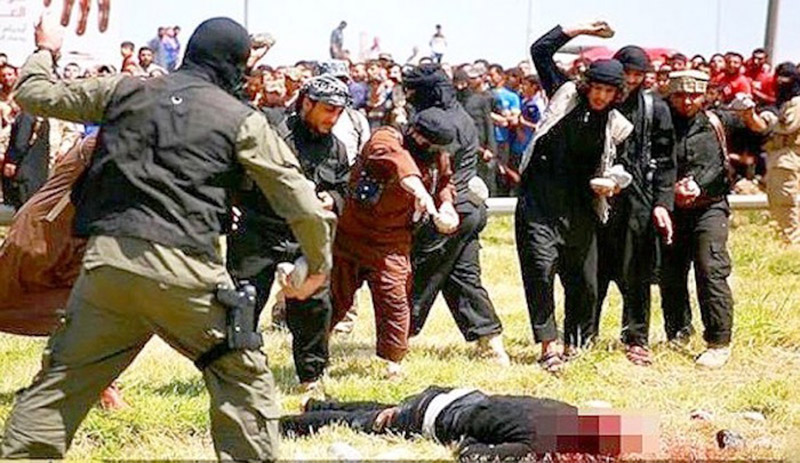
ISLAMIC LAW CALLS FOR DEATH BY STONING OF ADULTERY.
Catholic movie review - The Stoning of Soraya M.
By Harry Forbes and John Mulderig - Catholic News Service
Thursday, 25 June 2009
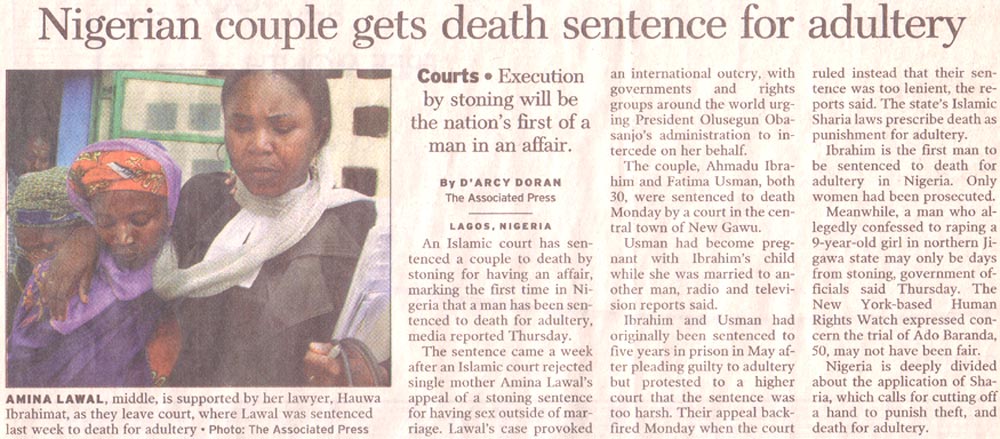
Just last year, a Pakistani couple was stoned for adultery, a Somali
woman met a similar fate on the same charge, and two Iranian men were
executed in this excruciating manner. Five of the world's predominantly
Muslim countries, as well as about one-third of Nigeria's 36 states,
still include stoning among the penalties in their criminal codes.
This barbaric practice is depicted unflinchingly in "The Stoning of
Soraya M." (Roadside/Mpower), a compelling, often moving film version
of Freidoune Sahebjam's 1994 best-seller, based on an actual incident
in 1986. Set in a remote Iranian village, the narrative charts a
harrowing chronicle of oppression and community corruption.
The 1979 Iranian revolution made Shariah -- the ancient collection of
laws derived from the Quran -- the template for the nation's civil
legislation. As a result, adultery, which under the shah was merely
punished with fines or community service, became a capital offense.
The film shows how, seven years after the monarch's ouster,
philandering husband Ali (Navid Negahban) was anxious to be rid of his
devoted wife, Soraya (Mozhan Marno), so he would be free to marry a
14-year-old girl. But, as we see, Soraya resists a divorce, fearing it
will mean economic ruin for her and her four children. (The real-life
Soraya was the mother of seven.)
So Ali falsely accuses Soraya of breaking her wedding vows, knowing
full well that, if convicted, she will be stoned. Soraya's unlikely
lover, Ali claims, is mild-mannered widower Hashem (Parviz Sayyad), for
whom, at Ali's own suggestion, Soraya has been working as a
housekeeper, while helping to care for his mentally impaired son.
Weak-willed Ebrahim (David Diaan), the mayor of their village, is
troubled by the flimsiness of the case. But the revolution has left
real power in the hands of the local mullah (Ali Pourtash), a former
con man whose shady past Ali threatens to uncover. (In reality, the
mullah's pre-revolutionary crime was child molestation.)
Zahra (Shohreh Aghdashloo), Soraya's courageous aunt -- who openly
yearns for what she believes were the more civilized days of the shah
-- passionately resists the mounting conspiracy, boldly confronting
Soraya's accusers.
But Soraya ignores Zahra's warnings. She's committed to her family,
including her two sons, even though one, under his father's macho
tutelage, treats her with gross disrespect, while even the other, more
sensitive boy finds himself tested by his mother's ordeal, with
dismaying results.
The story is told in flashback as Zahra recounts these events to
French-Iranian journalist Sahebjam (Jim Caviezel, who was Jesus in Mel
Gibson's "The Passion of the Christ"). At the film's opening,
Sahebjam's car breaks down near the village.
Soraya's fate at the hands of the self-righteously frenzied community
is presented in such a way that some -- including producer Stephen
McEveety, who also co-produced Gibson's film -- might glean parallels
to Christ's final hours.
Betrayed, falsely condemned and abandoned by all except the faithful
Zahra, Soraya -- Farsi for "peace be with you" -- is handed over to the
bloodthirsty mob, in the midst of which ragamuffin youngsters
rhythmically beat stones together as they anticipate her death. Soraya
is immobilized -- buried up to the waist with her hands bound behind
her -- and exposed, not only to the hurled rocks, but to the insults
and denunciations of her murderers.
The ugly episode certainly brings to mind Jesus' iconic words about casting the first stone (John 8:7).
Aghdashloo is majestic as the outraged matriarch, her sincere and
peaceable religious convictions standing in sharp contrast to the
fanaticism of the townsfolk, which steadily mounts into a mass hysteria
reminiscent of the Salem witch trials. Zahra comforts Soraya with the
promise that "God and paradise are waiting for you." Marno, for her
part, evokes deep pathos, bewildered yet stoic.
Director Cyrus Nowrasteh's script, co-written with wife Betsy Giffen
Nowrasteh, takes an admirable stand against injustice while promoting
women's equality and respect for life and human dignity.
Nearly all the men in the town, though, are seen as either malicious or
weak. Ali and the mullah are outright villains. Ebrahim tries at least
to ensure a fair trial and Hashem initially denies Ali's lie. Yet
Ebrahim yields to the mullah and the pressure of the rabble, while
Hashem knuckles under when threatened with the loss of his son's
custody. Even Soraya's own father eventually joins those calling for
her death.
The disturbing violence and torturous suffering that attend the climax
are conveyed extremely graphically, though one can easily imagine the
reality would be far worse. While this approach effectively conveys the
horror of Soraya's death, it precludes recommendation for many viewers
-- including teens -- who might otherwise have benefited from an
opportunity to explore themes of justice, faith and moral tenacity.
Some viewers at a special Catholic pre-screening -- while recognizing
the significance of the subject matter -- found it difficult to watch,
much like Gibson's film, a majestic work made uncomfortable for some by
what the Office for Film & Broadcasting described as its "visual
grisliness." Others felt this movie would have been enhanced by a
nonfiction postscript of Iranian women bearing witness that Soraya's
experience was not, alas, unique.
In sum, a hauntingly powerful tale whose dramatically justified
depiction of violence may restrict its appeal, even as its treatment of
a serious contemporary issue makes all too vivid a pressing global
concern.
In Farsi, with subtitles, the film contains a sequence of intense
violence, torture, sexual references and one rough and a few crude and
crass terms. The USCCB Office for Film & Broadcasting
classification is L -- limited adult audience, films whose problematic
content many adults would find troubling. The Motion Picture
Association of America rating is R -- restricted. Under 17 requires
accompanying parent or adult guardian.
Forbes is director and Mulderig is on the staff of the Office for Film
& Broadcasting of the U.S. Conference of Catholic Bishops.
Jesus Christ said: "He who is without sin among you, let him throw a stone at her first." John 8:7