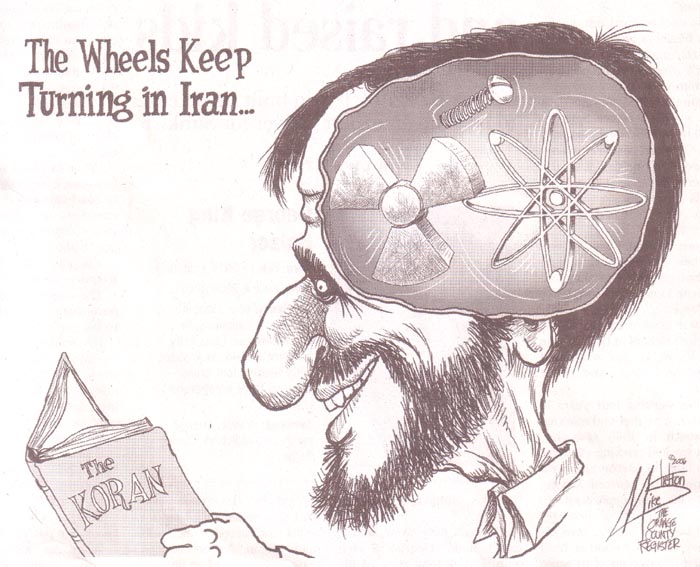
ISLAM WILL NEVER BE A PEACEFUL RELIGION
Why Islam creates monsters
Posted by Nicolai Sennels on September 27, 2013
Psychopathic people and behaviour are found within all cultures and
religions. But one tops them all -- by many lengths. The daily mass
killings, terror, persecutions and family executions committed by the
followers of Islam are nauseating, and the ingenuity behind the attacks
-- always looking for new and more effective ways of killing and
terrorising people -- is astonishing: hijacking jumbo jets and flying
them into skyscrapers, hunting unarmed and innocent people with
grenades and automatic rifles in shopping malls, planting bombs in
one's own body, using model airplanes as drones, attaching large
rotating blades to pickup trucks and using them as human lawn movers,
killing family members with acid or fire, hanging people publicly from
cranes in front of cheering crowds, etc. It makes one ask oneself: what
creates such lack of empathy and almost playful and creative attitude
towards murdering perceived enemies?
This is a question for psychologists like me.
Studying the Muslim mind
Nobody is born a mass murderer, a rapist or a violent criminal. So what
is it in the Muslim culture that influence their children in a way that
make so relatively many Muslims harm other people?
As a psychologist in a Danish youth prison, I had a unique chance to
study the mentality of Muslims. 70 percent of youth offenders in
Denmark have a Muslim background. I was able to compare them with
non-Muslim clients from the same age group with more or less the same
social background. I came to the conclusion that Islam and Muslim
culture have certain psychological mechanisms that harm people's
development and increase criminal behaviour.
I am, of course, aware that Muslims are different, and not all Muslims
follow the Quran's violent and perverted message and their prophet's
equally embarrassing example. But as with all other religions, Islam
also influences its followers and the culture they live in.
One could talk about two groups of psychological mechanisms, that both
singly and combined increase violent behaviour. One group is mainly
connected with religion, which aims at indoctrinating Islamic values in
children as early as possible and with whatever means necessary,
including violence and intimidation. One can understand a Muslim
parent's concern about his offspring's religious choices, because the
sharia orders the death penalty for their children, should they pick
another religion than their parents. The other group of mechanisms are
more cultural and psychological. These cultural psychological
mechanisms are a natural consequence of being influenced by a religion
like Islam and stemming from a 1,400 year old tribal society with very
limited freedom to develop beyond what the religion allows.
Classical brainwashing methods in the upbringing
Brainwashing people into believing or doing things against their own
human nature -- such as hating or even killing innocents they do not
even know -- is traditionally done by combining two things: pain and
repetition. The conscious infliction of psychological and physical
suffering breaks down the person's resistance to the constantly
repeated message.
Totalitarian regimes use this method to reform political dissidents.
Armies in less civilized countries use it to create ruthless soldiers,
and religious sects all over the world use it to fanaticize their
followers.
During numerous sessions with more than a hundred Muslim clients, I
found that violence and repetition of religious messages are prevalent
in Muslim families.
Muslim culture simply does not have the same degree of understanding of
human development as in civilized societies, and physical pain and
threats are therefore often the preferred tool to raise children. This
is why so many Muslim girls grow up to accept violence in their
marriage, and why Muslim boys grow up to learn that violence is
acceptable. And it is the main reason why nine out of ten children
removed from their parents by authorities in Copenhagen are from
immigrant families. The Muslim tradition of using pain and intimidation
as part of disciplining children are also widely used in Muslim schools
-- also in the West.
Combined with countless repetitions of Quranic verses in Islamic
schools and families, all this makes it very difficult for children to
defend themselves against being indoctrinated to follow the Quran, even
if it is against secular laws, logic, and the most basic understanding
of compassion.
And as we know from so many psychological studies, whatever a child is
strongly influenced by at that age takes an enormous personal effort to
change later in life. It is no wonder that Muslims in general, in spite
of Islam's inhumane nature and obvious inability to equip its followers
with humor, compassion and other attractive qualities, are stronger in
their faith than any other religious group.
Four enabling psychological factors
Not only does a traditional Islamic upbringing resemble classical
brainwashing methods, but also, the culture it generates cultivates
four psychological characteristics that further enable and increase
violent behaviour.
These four mental factors are anger, self-confidence, responsibility for oneself and intolerance.
When it comes to anger, Western societies widely agree that it is a
sign of weakness. Uncontrolled explosions of this unpleasant feeling
are maybe the fastest way of losing face, especially in Northern
countries, and though angry people may be feared, they are never
respected. In Muslim culture, anger is much more accepted, and being
able to intimidate people is seen as strength and source of social
status. We even see ethnic Muslim groups or countries proudly declare
whole days of anger, and use expressions such as "holy anger" -- a term
that seems contradictory in peaceful cultures.
In Western societies, the ability to handle criticism constructively if
it is justified, and with a shrug if it is misguided, is seen as an
expression of self-confidence and authenticity. As everyone has
noticed, this is not the case among Muslims. Here criticism, no matter
how true, is seen as an attack on one's honor, and it is expected that
the honor is restored by using whatever means necessary to silence the
opponent. Muslims almost never attempt to counter criticism with
logical arguments; instead, they try to silence the criticism by
pretending to be offended or by name-calling, or by threatening or even
killing the messenger.
The third psychological factor concerns responsibility for oneself, and
here the psychological phenomenon "locus of control" plays a major
role. People raised by Western standards generally have an inner locus
of control, meaning that they experience their lives as governed by
inner factors, such as one's own choices, world view, ways of handling
emotions and situations, etc. Muslims are raised to experience their
lives as being controlled from the outside. Everything happens "insha'
Allah" -- if Allah wills -- and the many religious laws, traditions and
powerful male authorities leave little room for individual
responsibility. This is the cause for the embarrassing and world-famous
Muslim victim mentality, where everybody else is blamed and to be
punished for the Muslims' own self-created situation.
Finally, the fourth psychological factor making Muslims vulnerable to
the violent message in the Quran concerns tolerance. While Western
societies in general define a good person as being open and tolerant,
Muslims are told that they are superior to non-Muslims, destined to
dominate non-Muslims, and that they must distance themselves socially
and emotionally from non-Muslims. The many hateful and dehumanising
verses in the Quran and the Hadiths against non-Muslims closely
resemble the psychological propaganda that leaders use against their
own people in order to prepare them mentally for fighting and killing
the enemy. Killing another person is easier if you hate him and do not
perceive him as fully human.
Why Islam creates monsters
The cultural and psychological cocktail of anger, low self-esteem,
victim mentality, a willingness to be blindly guided by outer
authorities, and an aggressive and discriminatory view toward
non-Muslims, forced upon Muslims through pain, intimidation and
mind-numbing repetitions of the Quran's almost countless verses
promoting hate and violence against non-Muslims, is the reason why
Islam creates monsters.
The psychological problem within Islam
The problem with Islam and Muslim culture is that there are so many
psychological factors pushing its followers towards a violent attitude
against non-Muslims that a general violent clash is -- at least from a
psychological perspective -- inevitable. With such strong pressure and
such strong emotions within such a large group of people -- all pitched
against us -- we are facing the perfect storm, and I see no
possibilities of turning it around. For people to change, they have to
want it, to be allowed to change, and to be able to change -- and only
a tiny minority of Muslims have such lucky conditions.
Far too many people underestimate the power of psychology embedded in
religion and culture. As we have already seen, no army of social
workers, generous welfare states, sweet-talking politicians,
politically correct journalists or democracy-promoting soldiers can
stop these enormous forces. Sensible laws on immigration and
Islamisation in our own countries can limit the amount of suffering,
but based on my education and professional experience as a psychologist
for Muslims, I estimate that we will not be able to deflect or avoid
this many-sided, aggressive movement against our culture.
I do believe that we, as a democratic and educated society can become
focused and organised concerning the preservation of our values and
constitutions, can win this ongoing conflict started by the often
inbred followers of sharia. The big question is how much of our
dignity, our civil rights, and our blood, money and tears will we lose
in the process.
Most Muslims want sharia to be the ‘law of the land’: Pew study
The finding is one among many in a major new opinion survey of more than 38,000 Muslims in 39 countries.
Samantha Stainburn
April 30, 2013
Most Muslims in the Middle East, North Africa, sub-Saharan Africa,
South Asia and Southeast Asia would like sharia, or Islamic law, to be
“the official law of the land,” according to a new survey from the Pew
Research Center.
The idea was most popular among Muslims surveyed in Iraq and
Afghanistan and least popular in Central Asia, Russia and the Balkans,
where less than half of Muslims supported it.
However, the study also reveals that sharia means different things to
different Muslims, the Los Angeles Times reported. Some survey
participants told researchers that it should only apply to Muslims.
Others want religious judges to oversee family law, but not punish
criminals.
Pew researchers interviewed more than 38,000 Muslims in 39 countries in
Europe, Asia, the Middle East and Africa between 2008 and 2012 for the
study, which was released today. Researchers did not visit several
countries with large Muslim populations, including China, India, Saudi
Arabia and Syria, due to political or security reasons.
The poll also detected differences about morality among Muslims
worldwide, the Christian Science Monitor reported. While most said
suicide, homosexuality, abortion and prostitution are morally wrong,
there were regional disagreements on whether divorce, birth control,
polygamy are acceptable.
Violence in Muslim Nations Not About a Video but About Hatred
By Michael Terheyden
9/20/2012
Catholic Online (www.catholic.org)
KNOXVILLE, TN (Catholic Online) - Although many Muslims do not approve
of the violence which has now spread to more than 20 countries since
the embassy attacks in Egypt and Libya that left four Americans dead,
explosive pressures are clearly building in the Muslim world. This
dangerous reality compels us to ask, how can we explain such a
"spontaneous" eruption of violence against America over an obscure,
14-minute movie trailer?
First of all, the video is said to be critical of Muhammad and Islam;
however, it appears highly dubious that this present round of violence
is spontaneous or about a video. After all, the violence broke out on
the 11th anniversary of 9-11, about six weeks after the video was
posted on You Tube. Yet, Muslim leaders around the world are blaming
America and the video. Some of the leaders speaking out publicly are
Egypt's Muslim Brotherhood, the Taliban in Afghanistan, Hezbollah in
Lebanon, and the governments of Iran and Pakistan.
For the most part, their comments are very similar. For instance, they
blame the United States for the violence because the video was made by
a small group of American citizens. Muslim leaders say the video is
inhuman and abominable and provokes hatred and hurts the feelings of
their people. Now, some want the United States to criminalize criticism
against Islam.
The Iranian-backed terrorist group Hezbollah, which has no regard for
people's feelings or rights, says, "This immoral action [the making of
the video] represents the highest degree of aggression against the
sublime human right of respecting beliefs, sanctities, and feelings."
In addition, Egypt has officially charged seven Americans involved in
the video with insulting the Islamic religion; Iran has vowed to track
down the Americans responsible for making the video; and the Taliban
has called for Muslims to kill Americans.
Interestingly, it is not uncommon in some of these same countries to
find hatred toward Christianity, Judaism and America openly expressed
in their newspapers, television programming and school books. There is
also the government sanctioned discrimination and persecution of
non-Muslims; the burning of Christian churches, homes and businesses;
the kidnapping of Christian girls; and the killing of Christians for
their faith.
Those who are interested in a more detailed account of the responses
coming out of the Muslim world might want to read an article by Robert
Spencer posted on Jihad Watch, "Muslim Brotherhood: 'Hurting the
feelings of one and a half billion Muslims cannot be tolerated, and the
people's anger and fury for their faith is invariably predictable,
often unstoppable.'"
I do not know if the information in this video is accurate, or if it is
a falsified, hateful attack against Islam. I do know that Islam is one
of the major religions of the world, but there is clearly some sort of
disconnect here, which brings me back to my original question: How can
we explain such an eruption of violence in the Muslim world against
America over this obscure movie trailer?
While there is no single explanation, Robert R. Reilly's book, The
Closing of the Muslim Mind, offers us a likely explanation for this
explosion of violence and hypocritical double talk coming out of the
Muslim world. In it he analyzes the rejection of reason and truth
within the Muslim world and its relationship to violence, which he
traces back to early Islam.
Reilly tells us that there were two competing schools of thought in
early Islam, Mutazilitism and Ash'aritism. The Mutazilites engaged in
philosophical inquiry. In other words, they used reason to understand
their faith and relate it to their experience of the world. However,
the Ash'arites won out. Apparently their views best served the
interests of the caliph, who did not want his authority or his methods
questioned. The Ash'arites rejected reason and the use of philosophy.
The main reason for the rejection had to do with their beliefs about
God and reality. For instance, the Ash'arites believed that the oneness
of God means that only God exists and everything else is an illusion.
They also believed that God is absolute and unlimited pure will and
power. Thus, they assumed that all events are caused directly by God
and that there are no natural or secondary causes. Consequently, Reilly
says the idea of "cause and effect" does not exist in the Muslim mind.
They do not see an inner logic to things. Everything is uncertain,
unknowable and incomprehensible.
It should not surprise us, then, that Muslim scholars lost interest in
philosophy, and it died out, as did the Greek influence on their
culture. It also became dangerous to do philosophy. Furthermore,
critical thinking was not taught, and education was reduced to rote
learning. As a result, Reilly says that the Muslim mindset became
"insular, regressive and unreceptive to new ideas." Without a
foundation of fixed knowledge, he says, there is only opinion and
sophistry, which promotes irrational behavior and forces people to live
in a world where myth and fantasy seem real.
We can see an indication of such behavior in the way the press operates
and reports news. In Muslim countries, Reilly says, news is generally
rife with conspiracy theories and fantastic accounts of natural events.
It does not mention causal relationships or have continuity, and there
is little effort to place events and facts in a meaningful context.
Rather, the news tends toward narration and description. It focuses on
the partial, successive, isolated, immediate events and facts.
Therefore, the news is generally weak in investigation and analysis,
often distorted and without depth.
Reilly also explains that Muslims have been known not to purchase car
insurance or get polio vaccinations because they believed doing so
would amount to acts of presumption against Allah's will. In another
example, Dr. Pervez Hoodbhoy, a Pakistani physicist and university
professor, says it is not Islamic to say that combining two hydrogen
atoms with one oxygen atom makes water. Proper Islamic phraseology
requires that you say water is created by the will of Allah when you
bring these elements together. The point is that secondary causes and
the principle of causality are not accepted by the Muslim mind.
As you can imagine, science and scholarship have not thrived in this
environment. Reilly tells us that there has not been a major discovery
in the Muslim world for over seven centuries. On average, there are
only 8.5/1000 scientists in Muslim countries. The average is 40.7/1000
in non-Muslim countries. During the past 1000 years, approximately
10,000 books have been translated by the Arab world, while Spain
approximates this many translations in only one year. Not surprisingly,
the Arab world is near the bottom of the scale in all areas of
development such as health, education, GDP, and productivity.
Such thinking also has political ramifications. Reilly says that reason
is a prerequisite for democracy, and that constitutional government is
based on metaphysical support of the natural law. But according to
Muslim belief, there is no free will or freedom of conscience. Only
God's will is free. Therefore, people's actions cannot be said to be
autonomous or moral. It is not for the people to choose right or wrong,
but to obey the will of Allah. As a consequence of these beliefs, the
law has no foundation, the idea of individual rights is alien to
Islamic reasoning and democracy is seen as an affront to Allah.
Reilly says that one of the greatest affronts or humiliations to
Muslims is the decline of their status and power in the world.
According to Muslim belief, Allah promised victory, and Muslims are
obliged to gain power over other nations. Yet, after they failed to
capture Vienna, Austria in the 16th and 17th centuries, halting their
expansion into Western Europe, their status and power began to decline.
Furthermore, in 1774 the Ottomans were forced to sign a treaty with
Russia; there was also Napoleon's victory over the Egyptians in 1798;
then there was the collapse of the Caliphate in Turkey in 1924 and the
subsequent colonization of the Ottoman Empire by foreign powers.
As a result, some Muslims, like the Nazis before them, looked for an
enemy to explain their declining status and power. This drive spurred
the growth of radical fundamentalism and violence. Once the will and
power gain primacy over reason, Reilly says, violence is the only path
left open. So he sees the Islamic upsurge as a force not meant to solve
problems but to intoxicate and incite those who can no longer abide by
their failure to solve them. But he does not believe that the violence
can be fully explained within Islam itself.
For this reason, he distinguishes Islam from "Islamism," which is a
particular view of Islam. To comprehend Islamism, he tells us that it
needs to be viewed in light of Nietzscheian philosophy and Marxism.
Nietzsche believed in the primacy of will, and he said that force was
the instrument of the will. Karl Marx said that "In order to change
humanity, one must use force." Lenin said, "We must hate. Hatred is the
basis of communism."
In conclusion, Reilly believes that Islamism (not Islam) is grounded in
a spiritual pathology and has produced a dysfunctional culture. In
general, he believes the primary reason Muslim countries are poor is
because their culture is dysfunctional. Societies need people who can
relate cause and effect. He says Islam needs a view that integrates it
with the real world. It needs a philosophy detached from religion, but
not in opposition to religion. The Koran has philosophical teaching in
it, he says, but Islam needs a Saint Thomas Aquinas.
Based on Reilly's analysis, it would seem that the drive for status and
power combined with a fantasy-world view and poisonous 20th century
philosophies is the real cause for the violence we are witnessing
today, not America or a video. But this statement is not meant to
trivialize the problems and frustrations of the Muslim people, which
are quite real.
The Muslim people have good reason to be angry, but their anger needs
to be directed at the true cause of their suffering: the failure of
political and religious leadership and complacency. If Muslims have the
will to face the true cause of their problems, I am confident that a
better life awaits them. If, on the other hand, they persist in the
politics of anger, hatred and anti-reason, I expect it will lead to
their ruin.
In the meantime, we need our leaders to do their job. Our federal
government is responsible to protect its citizens from foreign enemies,
without trampling on our rights in the process. If our current leaders
cannot do the job, and do it properly, then Americans need to find
leaders who can.
The Concept of Brotherhood in Islam
(How Muslims View Each Other and How They View Non-Muslims)
by Harold Rhode
November 9, 2011
With the end of the Cold War, a new enemy emerged, Radical Islamic
Fundamentalism, made up of Islamic extremists, terrorists and the
states that support them. If we are to counter them at all, we must
help to understand them as they understand themselves.
In their worldview, they see themselves first as Muslims; as such, they
are not loyal to any geographic entity. The world, in their eyes, is
roughly divided into two groups: the "Abode of Islam" [Dar al-Islam],
and the "Abode of War" [Dar al-Harb] -- or the world which is not yet
Muslim but eventually, they believe, should and will be. If they feel
any sense of territorial loyalty, it is to the Abode of Islam, the
places where Muslims live: "The "Nation of Islam" [Ummah]. In these two
worlds, which do not have geographic borders, Islam is not only a
religion, but the common political – almost familial -- bond that
unites all Muslims.
Historically, the term "Abode of Islam" has meant: Those territories
over which Muslims either rule or have ruled; or where Muslims
predominate but are wrongly ruled by Non-Muslims. During the past 50
years, however, this definition has been modified to include: a) Those
countries whose rulers claim to be Muslims but, in the eyes of the
radical Islamists, are apostates; [1] and b) New territories, such as
Europe, to which Muslims have been immigrating since the end of the
World War II, and where they now form a significant part of the
population. If present demographic trends continue, Europe promises to
be significantly, if not predominantly, Muslim by the end of this
century, and therefore, rightfully in their eyes, part of the "Abode of
Islam."
As there are, from this perspective, only two peoples in the world –
Muslims and non-Muslims -- Islam teaches that non-Muslims are also one
nation [millah] united against the Muslims.[2] . Muslims, whether
observant or secular, not only have a strong affinity toward each
other, but assume that non-Muslims have the same strong affinity toward
each other as well. Although non-Muslims make distinctions among the
many peoples and religions of the non-Muslim world, most Muslims, on a
deep level, see non-Muslims as one unified people -- whose long term
interests are inimical to those of the Muslims.[3]
Whereas the Organization of Islamic Cooperation [OIC], for instance,
cultivates political and religious solidarity among all Muslims,
regardless of the countries in which they live, one cannot imagine a
similar organization in the West of Christians, most of whom seem
divided into different branches of Christianity – from and Roman
Catholicism to scores of Protestant offshoots. Moreover, Western
Christians seem not to care unduly about the plight of their
co-religionists in Iraq, Egypt, Nigeria, Sudan, Lebanon, or anywhere
else in the Muslim world, including even Bethlehem and Nazareth.
If one compares this view of the world to that of the Jews for their
people worldwide, although Jews show a deep concern and sympathy for
Jews everywhere, very few, if any, are prepared to overlook or
rationalize criminal behavior in other Jews: when Baruch Goldstein, for
example, shot and killed almost 30 Muslims praying at the grave of the
patriarch Abraham [4] in 1994, most Jews were ashamed and outraged, and
openly condemned Goldstein.
In the Muslim world, however, Turkish Prime Minister Erdoğan and other
Muslim leaders -- in keeping with what seems to be a cultural inability
to admit wrongdoing or apologize for anything -- seem proud to express
their solidarity with the Turkish IHH terrorists who were part of the
Mavi Marmara Flotilla that tried to break a legal naval blockade; with
the Egyptians after the August 2011 attack on the Israeli embassy in
Cairo, or with the terrorist group, Hamas.
No Muslim leader has yet apologized or expressed any remorse for the
attacks on the United States on September 11, 2001; for the bombing of
the Jewish center in Buenos Aires, or for pushing a wheelchair-ridden
man into the sea – all non-Israeli and non-military targets. Erdoğan
has even said there is no such thing as Islamic terrorism. Does this
mean that whatever Muslims do, no matter how awful, cannot be
considered terrorism because if Muslims do it in the name of Allah or
Islam, that makes it right?
As for non-Muslims living in the Muslim world, they can easily attain
equality and acceptance from their fellow Muslims by converting to
Islam. As kinship is not based on blood or ethnic ties, as in the West,
but above all on religious identity -- irrespective of the level of
religious observance -- their earlier, non-Muslim, origins will be
quickly forgotten. To be a true Arab, Turk, Iranian, or Kurd, all that
is required is to be a Muslim.
This view may account for why Middle Eastern Christians seem to
conclude they have no future in the Middle East, and have been
emigrating to the West. They apparently see that in the end, the
Muslims do not look at them as equals -- as we are currently witnessing
in the ongoing massacre of Christians in Egypt, Sudan and Iraq -- and
that there exists a huge, permanent glass ceiling that prevents them
from advancing in their and their ancestors' countries of birth.
Israel, a small non-Muslim country in the middle of the Muslim world,
is in the same situation as the Christians. No matter what it does --
simply because it is not Muslim – Israel will always be regarded as an
outsider. If the only way to really belong is to be Muslim, Israel can
never be fully accepted by its neighbors in that part of the world.
Being Muslim, therefore, is as much a political identity as a religious
one.
The same holds true for non-Muslims in the US and the West. Unless the
Muslim world undergoes to major revolution in its thinking, we shall
always be regarded as outsiders. Although we might have amicable
relationships, Muslims will always regard us with suspicion: When the
chips are down, they believe, they will be on one side and the
non-Muslims on the other – supporting their own, non-Islamic "brothers"
just as the Muslims would support theirs.
Muslims understand Western support for Israel, or Western concern for
the plight of the Christians in Lebanon or Iraq as a natural and
unchangeable form of religious brotherhood -- like theirs. When
Westerners try to prove the Muslims mistaken by citing Western support
for the Bosnian Muslims, whom Westerners tried to save from being
slaughtered by their Christian neighbors, Muslims seem to have great
difficulty making sense out of why the Westerners "really" did this. It
simply does not conform to their view of Muslim solidarity vs.
non-Muslim solidarity. Muslims, therefore, either choose to ignore
Western support for their brothers, or dismiss Westerners who have
aided Muslims in distress as being part of some deeper plot against the
Muslim world.
Any alliance between a Western country and a Muslim one needs to be seen in this context.
No matter how hard non-Muslim powers plead with them to do otherwise,
Muslim countries will never see themselves as true friends of the
non-Muslim world. Regrettably, the Islamic concept of non-Muslim
brotherhood, or millah, means that the Muslims and the West will
continue to be at odds with one another, unless the Muslims are forced
to re-evaluate their religious sources, most likely as the result of a
massive military loss.
In the US, where people of different ethnic and religious groups might
feel a lack of solidarity toward others of different backgrounds, all
Americans are nevertheless considered equal before the law. For
non-Muslims in the Muslim world, unfortunately, this is not what
occurs. Non-Muslims are, at best, tolerated, "protected"
not-quite-guests, who, under Islamic Shari'a Law, are subject to a
different set of regulations and expectations that place severe
limitations on their ability rise to the highest political and social
levels.
Even though, throughout much of the twentieth century, most of the
Muslim world seemed to Westerners to have abandoned its Islamic
identity in favor of national identities -- such as Arabic, Turkish, or
Iranian -- Islamic identity apparently continued underneath as an
essential component of identity. Loyalty, for a large number of Muslims
-- and most significantly for the Islamists -- is still owed to the
amorphous concept of the Muslim Nation, or Ummah. As the Muslim prophet
Muhammad said, "All Muslims belong to one people, the only difference
among them is in piety." For Muslims throughout the centuries, this
feeling of brotherhood, [5] of belonging to one people – not only to a
religion -- is so deeply engrained that today it even permeates the
world view of secular Muslims, as well.[6]
Even though Muslims feel a sense of brotherhood toward each other, it
does not mean that all Muslims get along well together. Islamic history
is filled with examples of how the Muslims have failed because they
refused to recognize each other as brothers and members of the same
people. The demand from their prophet -- and, later, political and
religious leaders -- again and again that they get along together
indicates that they did not. In general Arabs cannot stand Persians,
who look down on Turks; Shi'ites fear Sunnis; Sunnis intimidate
Shi'ites; most look down on Sufis, and so on.
As in the Iran-Iraq War, or every week on the streets of Afghanistan,
Pakistan and Iraq, many Muslims have no problem inflicting murder and
mayhem upon their Muslim brothers. More Muslims have possibly been
killed by their fellow Muslims than by non-Muslims. In the West,
however, one is judged by one's actions, not by one's thoughts; but in
Islam, if the intent of the killer can be interpreted by Islamic
Shari'a Law as furthering the cause of Islam, murdering one's own
people – or sometimes even family members -- is not only considered
permissible but even at times praiseworthy.
On occasion, Muslims have sided with non-Muslims against their fellow
Muslims.[7] A few years ago, for instance, as the situation in southern
Iraq deteriorated -- largely because of Iranian-armed-and-backed
militias reaping havoc in the area -- the Iraqi Shi'ite Prime Minister,
Nouri al-Maliki, sent Iraqi forces to clean it up. By doing so, he
signaled that he had chosen to side with the non-Muslim Americans who
had liberated his country from tyranny, rather than with his fellow
Shi'ite (though non-Arab) Iranians. Despite the animosity and hatred
toward each other, however, the reflexive reaction of most Muslims
seems to be to side with each other against the non-Muslims -- a
proclivity that has major political ramifications for the non-Muslim
world.
One way of understanding the Islamic concept of brotherhood operates is
to look, as a parallel, at how the American Mafia operates. Each Mafia
family is independent, although the various families often engage in
internal warfare. To the outside world, it appears that they deeply
hate and mistrust each other. But the moment the "Feds" confront them,
they cooperate as members of the same family, unite against what they
see as the common threat, then resume their internal warfare when the
threat disappears.[8]
If our radical Muslim adversaries all view the world as divided into
Muslims and non-Muslims, it is crucial that we understand that when we
are fighting, we are not fighting against a particular country.
International borders are irrelevant. By continuing to respect borders,
we cripple our military and prevent it from defeating the enemy, who,
as we have seen for years in, say, Pakistan and Afghanistan, or Iraq
and Iran, simply keep crossing back and forth across borders as needed.
If we are to win the war against the Islamists, we must adjust our
military and political strategies accordingly.
***
The following sections, some based on the experiences of Western
travelers throughout the Islamic world, illustrate how deeply the
concept of Islamic brotherhood is embedded in the hearts and minds of
the Muslims, whether radical or moderate..
1). Who are the Real Egyptians: the Coptic Christians, Descended from
the Ancient Egyptians, or Recent Muslim Immigrants to Egypt?
In the West, one's religion is often a component of one's identity; in
Islam, it is the basic component. Non-Muslims living in the Arab World
are, in essence, eternal outsiders, never able to fully belong. This is
true even in places such as Egypt, where the true Egyptians are the
Coptic Christians, descendants of the ancient Egyptians. To the
Muslims, a Muslim who immigrates to Egypt from Indonesia is, within a
generation or two, an Egyptian, even though he has only been in the
country for a relatively short time. Not so Egypt's Christian Copts who
make up about 10% of Egypt's population, but, who, no matter how many
centuries they preceded Egypt's Muslims there, are forever regarded by
the Muslims in Egypt as outsiders.
Egypt, especially in Cairo and Alexandria, has long been a great center
to which people from all over the Middle East immigrated, and is known
to many people in Egypt and the Levant as the "Mother of the World"
[Umm al-Dunya]. When Muslims migrated to these cities -- especially to
Cairo – they easily intermarried with local Muslims and became
"Egyptians." But almost all the non-Muslims who settled in Cairo and
Alexandria eventually left. When they stayed, they usually did so
because they had married Muslims and converted to Islam.
There have been massacres in Egypt -- as we are now seeing against the
Copts -- even before the fall of its President, Hosni Mubarak. Since
that time, the massacres have only increased in viciousness, with
security forces driving armored vehicles into gatherings of unarmed
Christians to mow them down, or else merely looking on.
From a Western point of view, no one could claim to be more Egyptian
than these Copts; but most Muslim Egyptians feel a stronger bond with
fellow Muslims in Jordan, Syria, Iraq, or even far more distant lands.
Many laws in Egypt exist to make it easy for Copts to convert to Islam
and become "real Egyptians," alongside other, strict, laws that ban
Muslim from converting to Christianity. In Muslim eyes, the only way
for a Copt to become a "true Egyptian," is to convert to Islam.
2). Turkish Prime Minister Erdoğan's Election Victory Speech
Turkish Prime Minister Recep Tayyip Erdoğan also seems to view all
Muslims as members of the same people, regardless of nationality:
"Believe me," Erdoğan said, after winning another election in June
2011, "Sarajevo won today as much as Istanbul, Beirut won as much as
Izmir, Damascus won as much as Ankara, Ramallah, Nablus, Jenin, the
West Bank, Jerusalem won as much as Diyarbakir."[9] Erdoğan also
mentioned other predominately Muslim places not in Turkey, such as
Sarajevo, the capital of Bosnia-Herzegovina.
From a Western point of view, Erdoğan was running for office of Prime
Minister of Turkey – not of the entire Sunni world. But most of the
places he mentioned – such as Damascus, Ramallah, Nablus, Jenin, the
West Bank, Jerusalem, and Sarajevo -- are not part of Turkey. They
were, however, part of the Ottoman Empire; and most were, and still
are, populated by large numbers of Sunni Muslims.
Imagine a European Prime Minister or American President making a
similar speech with references to places outside their countries; such
allusions would certainly elicit accusations of imperialism. Even the
thought would be unacceptable. But Erdoğan could deliver such a speech
because, in his thinking, the concept of Islamic brotherhood is
paramount -- as can also be seen in many comments he has made about
Israel. He constantly excuses acts of violence committed by his fellow
Muslims, the Palestinians, but condemns the non-Muslim Israelis for
defending themselves against Muslim terror attacks directed at Israeli
border towns such as in Sderot.
Why is Erdoğan is so pro-Palestinian? Is it because he believes in the
right of Palestinians to have their own state as they are his fellow
Muslims; or because Israel, being largely the state of the Jews, is
non-Muslim? If he believes that, as a people, the Palestinians as a
national have the right to a state, then why would he not support the
right of the Kurds – an ancient people without their own country -- to
have their own state, which would include a large part of eastern
Turkey that is historically overwhelmingly ethnically Kurdish? But
Erdoğan repeatedly opposes a Kurdish state.
3). Are the Ruling Alawites of Syria Muslims? The Answer Determines
Whether, in the Minds of Syrian Muslims, They Have a Right to Rule
Syria.
Muslims have long accepted a wide range of diversity in Islam. There
are four separate Sunni legal schools, each of which can have widely
different views on what is legal and what is not. Shi'ites have their
own legal schools, and differ strongly with the Sunnis and among
themselves over important aspects of their religion. All these schools
of Muslim thought, however, agree on one thing: If, according to the
Koran the state exists for the good of, and for the propagation of
Islam, only Muslims have the right to rule. Non-Muslims in the Muslim
state are allowed to live under Muslim rule, but would never have the
right to rule.[10]
The Alawites, whose homeland is the eastern Mediterranean coastal area,
are an approximately 800-year-old offshoot of Shi'ite Islam. As they
are a secretive sect, it is difficult to know exactly what they
believe. What we do know is that, for Alawites, Muhammad's cousin and
son-in-law, Ali, is a Jesus-like figure, possessing at the same time
both human and godlike characteristics. When Alawites greet each other,
one says "Ali is God;" the other responds, "The truest God."
To Muslims, however, Allah never had, or ever can have, a human form of
any kind. Conversely, Muhammad was human -- a messenger and a prophet
-- but with no divine characteristics. To Muslims, therefore, the
Alawite deification of Ali is a heresy.
The question then arises as to whether the Alawites are in fact seen by
other Muslims as Muslims at all; and, by extension, whether Muslims
even consider them as members of the brotherhood of Islam. This is the
question that forms the basis of the uneasy relationship in Syria
between the ruling Alawites, who seized power there in the early 1970s,
and Syria's Sunni majority –- about 70% of the population -- who see
themselves as ascendant in alone having the right to rule their country.
The Alawites understand their precarious situation. In 1972, their
leaders asked Lebanon's highly respected Shi'ite Grand Ayatollah, Musa
Sadr, to issue a religious edict [fatwa][11], according to which the
Alawites would officially be designated a branch of Shi'ite Islam. The
ayatollah, for political reasons, obliged -- to bolster Syria's
government, which he saw as an ally for beleaguered the Lebanese
Shi'ites.
Although this should have helped the Alawites to be accepted as Muslims
-- given that most Shi'ites and Sunnis do accept each other as Muslims
-- the fatwa was tenuous at best. Nevertheless, the Syrian Sunnis still
find it difficult to accept the Alawites as Muslims: if they are not
Muslims, they do not have a right to rule the country.
Knowing that the issue of the fatwa is still unresolved for many
Sunnis, the Alawites go overboard to demonstrate their "Muslimness" --
while at the same time ruling Syria with an iron fist.
The unsettled nature of their religious legitimacy is also the reason
members of the regime cannot -- ever -- sign a peace agreement with
Israel. They fear that if they did, the Sunnis would say that such a
capitulation proves that the Alawites are not really Muslims. The only
people who could possibly sign a peace treaty with Israel and not be
labeled "non-Muslims" would be members of the Sunni majority. The
Alawites can only forever dangle a peace agreement in front of the
Israelis and Americans, negotiating forever, but never signing one.
4). Islamic Brotherhood in the Secular Republic of Turkey
In the late 19th and early 20th centuries, the Ottomans adopted the
European system of internal identity cards. If the cardholders were
Muslim, under the entry "nationality," they wrote "Muslim, regardless
of ethnic or country if origin.
When Turkey and Greece exchanged populations after the Turkish War of
Independence in the early 1920s, it was decided that "Greeks" would be
sent to Greece, and "Turks" to Turkey. What is distinctive is how the
Greek and Turkish governments defined "Greekness" and "Turkishness":
Greeks were defined as Orthodox Christians and Turks were defined as
Muslims. This meant that Orthodox Christians, who happened to be of
ethnic Turkic origin, were "repatriated" to Greece, a "homeland" that
historically had never been theirs; and Greeks, who were descended from
the ancient Hellenic peoples but who had converted to Islam, were sent
to Turkey. Both groups then had to learn their so-called mother
tongues, which their ancestors had never spoken.
In the early 1920s, on the embers of the Ottoman Empire, Atatürk and
his inner circle founded the secular Turkish Republic. Their new
country was to be based on the Western, or geographic, concept of
nationality; not on religion. All citizens, regardless of ethnic or
religious background, were to be called Turks. All were to be equal
before the law and loyal to the republic, the borders of which were
inviolate.
Loyalty to a geographic entity was a novel idea in the Muslim world.
Before then, the Ottoman Empire had been Muslim and had existed for the
good of the Muslims.[12] During the early years of the Turkish
Republic, the government made no attempt to differentiate between the
different residents, but despite what Ataturk had planned, the concept
of Islamic religious brotherhood proved so strong that that Muslims of
this newly established polity used the term "Turk" to apply only to
Muslims. All others – the non-Muslims -- were called "Türk
vatandaşları," or "Turkish citizens," meaning that although they
resided in Turkey, it was more as "honored guests" than as equal
citizens. Atatürk even tried to create a Turkish Christian
patriarchate, but failed.[13]
Even today, more than 85 years after the secular Turkish Republic was
founded, Turks sometimes ask foreigners who live in Turkey and who
speak Turkish, if they are "Turkish citizens."[14] But if the
foreigners are Muslim, they are then asked if they are Turks. To be a
"real Turk," one must be a Muslim.
Even before the current Islamic-fundamentalist-oriented AK party took
power in Turkey, secular senior officials would often talk about
non-Muslim Turkish citizens in ways that implied that these officials
did not believe non-Muslims were Turks. During the 1980s, for example,
Turkish military and political officials said about the Jews of
Istanbul –- most of whose ancestors had lived in what would later
become Turkey since the early 1500s if not before –- that, "the Jews
here have complete freedom. They are free to travel back and forth to
their country [Israel]." During the late 1980s, when an Israeli prime
minister visited Turkey and talked about the Jews of Istanbul, many
Turkish officials referred to "the visits of their [the Jews'] prime
minister" -- as if the Israeli prime minister were the elected leader
of the Jews of Istanbul as well.
Among Turks – even the most secular - the idea of Muslim brotherhood is
so engrained that it forms the basis of their suspicion of Western
policy. Turks tend to see sinister motives, for instance, behind
Western questions about the Kurds of Turkey. As Turks and Kurds are
both Muslims, when Westerners talk about Kurdish rights in Turkey,
Turks fear that by making distinctions between the Muslim citizens of
Turkey, the West is trying to divide and conquer them – in the same way
Westerners used ethnicity and religion in the late 19th and early 20th
centuries to divide up the Ottoman Empire. Sadly, most Westerners do
not realize that, in spite of their best intentions, Turks believe that
Westerners want to "divide up" Turkey into a rump Turkish State and
independent Kurdish State. The more non-Muslims talk with Turks about
these issues, it becomes clear that the words they use to describe
supposed Western intentions are almost the same as those of their
Ottoman ancestors when the Ottoman Empire's mission was to protect and
advance of the cause of Islam throughout the world.
Even though the Turkish military and separatist Kurds in southeastern
Anatolia have from time to time attacked each another -- as many Kurds
claim that the Turkish government discriminates against them because
they are Kurds and not ethnic Turks -- nevertheless, after subduing the
Kurdish terrorists, the Turkish military keeps prodding the civilian
authorities to step in and improve the civilian infrastructure for
their fellow Muslim "brothers" there. At one point, when the military
later saw that the civilian officials were not doing their utmost to
improve the living standards of the Kurds, they complained that the
civilian authorities were not making the Kurds of that area feel as if
they, too, were Turks, and an integral part of the "Turkish"
nation.[15] Not only does the Turkish military go out of its way to
help the Kurds in the southeast, but until today, for example, the
military arranges mass circumcision parties for boys in remote
Kurdish-speaking villages where people do not have the money to put on
the lavish parties expected of them.
As we in the West expect the Turkish military to be "anti-Kurdish"
after being the recipients of terrorist attacks, the above might sound
unusual, but from the Turkish military's point of view, all Muslims
living in Turkey are Turks.
5). Attempts to Bridge the Political and Social Gaps in the Islamic
World between the Non-Muslims and Muslims -- to Negate the Concept of
Islamic Solidarity -- Always End in Failure
In the 19th century, Middle Eastern Arabic-speaking Christians invented
Arab Nationalism as a way to bridge the gap between themselves and the
Arabic-speaking Muslims. These Christians, hoping to attain the
equality they could not have under Islam, invented an Arab "national"
identity.
These Christian-Arab Nationalists started assigning Arab identities to
historic Middle Eastern figures, none of whom was Christian and many of
whom were not even ethnically Arab. The nationalists argued that the
greatest book ever written in Arabic was the Koran, whose language
would form the basis of modern standard Arabic. But for Muslims to say
that the Koran was even written is a sacrilege: to them, the Koran is
eternal, and existed in Arabic long before it was revealed to Muhammad.
As Arabic-speaking Muslims began to read the writings of the Arab
Nationalist Christians, they quickly came to the conclusion that, as
Arab culture was overwhelmingly Islamic, the only "true Arab" was still
a Muslim. When the concept of national Arab brotherhood proved unable
to replace the centuries-old concept of Islamic brotherhood, Middle
Eastern Christians again found themselves left unequal to, and outside
of, the system. Many Christians then turned to Marxism – probably in an
attempt to repudiate all religious identity –- again trying to find an
equality that had eluded them under both Arab Nationalism and Islam.
Eventually many emigrated to the West to find safety, freedom, and true
equality; others converted to Islam; still others remained, especially
in Egypt, where they continue, uneasily, to live..
6). Islam Cannot Be Imperialist, Even if Muslims Conquer Non-Muslim Territories and Force the Inhabitants to Become Muslims.
A Westerner teaching a course on the history of Islamic peoples of
North Africa at an American university, enrolled around 20 students,
mostly secular Muslim Arabs from the Levant, in his class. The lecturer
explained how North Africa became Muslim: Arab Muslims had conquered
the area in the late 600s, sweeping across the coast and decimating the
local cultures, most of which had been were Christian and Berber.
Within a century, Christianity had been obliterated and most of the
coastal peoples had converted to Islam, but the inhabitants had
remained culturally and ethnically Berber.
The lecturer then spoke about the later conquest of the same area by
the French in the 1830s; most of the students agreed that the French
conquests were imperialist, and consequently decried the French for
having seized the land and "imposed" French language and culture on the
locals.
When the lecturer then asked what was the difference between the Arab
conquests in the late 600s and the French conquests of the 1830s --
both, after all, were foreign cultures that sought to impose their ways
on the locals -- the American students concluded that, as both were
imperialist, both were bad.
The Arab students, however, emphatically disagreed. Although they all
had opposed French imperialism, they either refused to, or could not,
fathom the idea that the Arab-Muslim culture could be imperialist. They
argued that the Arab Muslims were bringing their superior culture to
the locals, who should have been grateful to the Arabs for such a gift.
The Arab reaction provoked outrage among some of the Americans, who
then accused the Arabs of being hypocritical. If all imperialism was
bad, the Americans argued, the Arab Muslims had been equally wrong to
impose their culture on the local non-Muslim North Africans, too.
Neither side could even begin to understand or accept the others'
views. To the Arab Muslim students, the Arabs had "liberated" the
Berbers from the ignorance they had "suffered" before the Muslims
arrived. The Americans could not convince even one Arab that these
conquests were the same.
To the Muslims, any conquests launched in the name of Islam against the
"The Abode of War" [Dar al-Harb], or the lands ruled by non-Muslims,
were acceptable; but wars by non-Muslims against Muslims were, and are,
not acceptable.
Today, as Berbers in North Africa and France have been trying to revive
their language and culture -- most notably in Morocco, where Berbers
constitute the majority of the population -- they have been allowed to
do so, but only under strict government supervision. Arab leaders, like
their Turkish counterparts, again perceive the differences in the
languages and cultures of Muslim minorities as ways that non-Muslims
could exploit, divide and conquer their countries.
7). How Muslims View Political Causes of Their Co-Religionists in Distant Regions
As the concept of Islamic brotherhood transcends borders, it is not
surprising that Muslims take up the causes of their fellows Muslims in
far off lands, such as Arab Muslim fighters joining the Chechens to
fight the Russians in the northern Caucasus. This borderless worldview
smoothes the way for holy warriors [jihadis] to be lured to training
centers and causes in Afghanistan, Pakistan, the Philippines and
beyond, even though these jihadis often look down upon the local
Muslims there and their cultures as primitive and backward.
Finally, this view highlights an incident reported in Turkish press
concerning a 2008 meeting between US Vice President Cheney and Turkish
Prime Minister Erdoğan.[16] Erdoğan, according to the report, was
sympathetic to Iran's Muslim fundamentalists' developing nuclear
weapons. His officials and he argued that the US and other Westerners
had a double standard regarding the nuclear issue: the West prohibited
Muslims from having nuclear weapons, but Israel – a non-Muslim country
– was not prohibited from possibly having nuclear weapons.
Cheney and the other Westerners tried to explain that whether a country
was Muslim or non-Muslim was immaterial. The US, he said, took the
position it did because Iran had threatened to obliterate Israel, but
that Israel had never threatened to obliterate anyone. Cheney's
response fell on deaf ears. The Turkish officials either refused to --
or could not -- understand the point the US was making.
8). Religiously Ignorant Members of the Former Ottoman Royal Family and Their Political Affinities
The Sultans of the Ottoman Empire, the forefathers of the former royal
Ottoman family, ruled for 653 years, during most of which time the
Ottoman Empire was the largest and strongest Sunni Muslim power. During
the last 100 years or so of their rule, each Ottoman sultan claimed to
be the spiritual and political leader of the entire Muslim world.[17]
Moreover, huge numbers of Muslims living outside the Ottoman Empire
agreed with him and viewed him as such.
Today, although members of the Ottoman royal family, whose ancestors
Atatürk expelled from Turkey in the 1920s, still get together from time
to time, they are now frequently secular, and few seem to express more
than a rudimentary knowledge of Islam.
One member of the Ottoman royal family who lived in Europe, was, like
most of his relatives, secular: he ate pork, enjoyed alcohol, and had
even demonstrated "philo-Semitic," pro-Israeli tendencies. He had even
asked a non-Muslim friend whether he, a descendent of the Ottomans, was
a Sunni or Shi'ite -- an astounding question from a relative of the
Ottoman Sultan, his not-so-distant ancestor, who had been the spiritual
and the political, leader of the entire Sunni Islamic world
When Israel invaded southern Lebanon in 1982, however, he, who had
never displayed the slightest interest in politics and had virtually no
knowledge of the people living in southern Lebanon, became enraged at
Israel. He said he felt almost personally attacked -- as if Israel had
assaulted his people -- even though, ethnically, it was highly unlikely
that he shared the slightest blood relationship with anyone in Lebanon.
The last Sultan was approximately 1/1258 ethnically Turkish; mothers of
the sultans were almost always European, or Caucasian slaves and
concubines who were part of the Ottoman harem. We do not know of even a
single Arab one.
9) An Iranian Communist Supports His Muslim Brothers, Not the Poor Workers
In Iran, during the time of the Shah, a young Iranian approached an
American visiting the Holy Shrine in Qom. The Iranian, saying he felt
comfortable speaking about politics there as the Shah's police did not
enter the shrine unless there was serious unrest, went on to say that
he was a communist because in the Soviet Union people were free, and
that he hated the Shah and the US because they supported "fascist"
Israel.
The American replied that the Soviet authorities placed serious
impediments on people who visited mosques and holy shrines in the
Soviet Union; the Iranian said that he knew otherwise.
The American then asked why a communist was even visiting a religious
shrine; communists called religion "the opiate of the masses." The
Iranian said that he was just waiting for his mother who wanted to pray
there; that he himself did not pray.
The American then asked which side the Iranian backed in the Lebanese
Civil war, which had been raging for more than two years. The Iranian
replied that of course he supported the Muslims: they were poor and
exploited by the rich Christians.
The American said that he had seen that too, but that he had also seen
rich Muslims exploiting poor Christians. The Iranian then became
agitated and said: "But we have to support our Muslim brothers!"
The words "communist" and "fascist" seemed to him to be nothing more
than superficial values to be superseded by the loyalty and
responsibility with which Muslims defend each other. Newly adopted
foreign ideologies could be easily discarded; what remained were the
traditional bonds of Muslim brotherhood, regardless of nationality,
ethnicity or economic status.
10). A Secular Iraqi and the "Clash of Civilizations"
An Iraqi of mixed ethnic (Kurdish, Arab, and Turkic, and Persian) and
religious (Sunni and Shi'ite) origin had been deeply involved in the
opposition movement to overthrow Iraq's President, Saddam Hussein. When
asked who he was, ethnically and religiously, the Iraqi would reply
that neither religion nor ethnicity meant anything to him. What
mattered, he said, was democracy: this was the only way all Middle
Easterners could be equal. He even refused to refer to himself in
religious or ethnic terms: he was, he said, a Baghdadi; that was all he
cared about.
As he began, however, to hear more and more anti-Muslim feelings
expressed in Europe and the US, he eventually told his Western friends
that in a conflict between the democratic West and Islam, he realized
he would side with Islam: "In the end," he said, "I am part of them."
11). The Turkish View of Southeastern Europe
Muslims immigrants to Turkey from the Balkan states in southeastern
Europe -- ethnically Slavs, with blonde hair and blue eyes -- are
easily absorbed into Turkish society, and can quickly become culturally
"Turkified." Although some of Turkey's senior military leaders speak
Bosnian, Serbo-Croatian and Bulgarian, and are ethnically descended
from the same stock as the Christians of southeastern Europe, as they
-- and the Indo-European Albanians -- converted to Islam about 500
years ago, Anatolian Muslims see them as Turks. At the same time, of
course, they do not view the longtime non-Muslim residents of Anatolia
as Turks.
12). Being an Outsider [Khareji] in Iran and Afghanistan
Although the word Khareji means foreigner, or outsider, in Persian and
Dari (Afghan Persian), it is hard to tell if it refers to non-Afghans,
to non-Iranians visiting these countries, or possibly to any non-Muslim
living there, no matter how for long.
In both Afghanistan and Iran, people were asked to describe the concept of Khareji and explain to whom this term applied.
Iranian Shi'ites said about Sunni Turks that although there is little
love lost between them, Turks were not kharejis; or outsiders; they
were just misguided Muslims, but, because they were Muslims, still
brothers.
Iranian Shi'ites said about Iraqi Shi'ites visiting Iran that they were
not outsiders. Even though Iran and Iraq look askance at one another,
and hold strong prejudices against one another, marriages between them
are common.
Iranian Shiites said about Armenians and Jews who had lived in the
ancient Iranian city of Isfahan for many centuries -- often much longer
than many of the Muslims – that they were kharejis, although a
different type of khareji than Europeans or Americans.
13). Israel: Jewish-Muslim Intermarriages, and the Islamic Identity of its Muslims
Under Shari 'a law, marriages between Muslim men and non-Muslim women
are permitted, but marriages between Muslim women and non-Muslim men
are not, unless the man converts to Islam beforehand.
In the Muslim world, non-Muslims can convert to Islam, but according to
Shari'a Law, converting out of Islam is an act of apostasy that
requires the apostate to be killed, so virtually no one ever converts
from Islam. Those Muslims who leave Islam do so at their peril.
When assimilation occurs, it is usually minorities who assimilate into
majority cultures. It is much rarer to find members of majority groups
joining minorities.
A Jewish woman who marries a Muslim man almost always converts to
Islam. As religious identity in Islam is passed down through the
father,[18] any children born in a mixed union – even if by rape in a
war -- are automatically Muslim.
In Israel, the children of Jews married to Muslims, members of the
minority culture, are almost always raised Muslim, even though, from a
Jewish legal view, the religion is passed down through the mother and
Jews recognize the children as Jews. There are, however, virtually no
instances in which such children identify themselves as Jews. Those few
children who might try to escape Islam risk death – a threat that only
serves to reinforce the solidarity of Islamic brotherhood.
* * *
What then, is the basic difference between the Western concept of solidarity and the Muslim concept of brotherhood?
In the West, citizenship and loyalty to one's country are looked on as
the basic building blocks of political identity. Muslims, however,
apparently feel a solidarity with Muslims worldwide even before they
know what the circumstances are, in a way totally alien to Christians
and others, and one that has that has no parallel in the West. In
Egypt, Muslims feel a closer tie with Muslims in Syria or Saudi Arabia,
than they do with the Egyptian Christians with whom they have been
living for centuries.[19]
Almost universally, the Muslim reaction is to feel an accord with, for
instance, the Palestinian cause, even though very few support the
Palestinians in any significant material way -- casually leaving that
to the US and Europe -- and are content to keep them in squalid living
conditions, ostensibly for their own good .
In Turkey, one time, when a secular, pro-Western Turkish official
criticized Atatürk, the founder of the secular Republic of Turkey, for
not having forced the Turks to adopt Christianity, he was expressing an
underlying thought: We Turks will never fully be accepted by the
Western world because we are Muslims.
"Islam," he said, "claims that all Muslims are members of the same
family. Christians, by this Islamic definition, are members of the
non-Muslim family of nations who, in a crisis, will support each other
against the Muslims."
Had Atatürk forced the Turks convert to Christianity, he implied,
Turkey would then have a chance to be accepted into the European Union,
and would not have had to worry about the Western-Christian-Greek
lobby. He seems to have thought that only as a Christian country would
Turkey have been able to gain full Western acceptance. To him,
religious solidarity overrode everything. He probably would not have
been able to see the situation any other way.
[1] Fundamentalists do not agree on which countries this view includes,
although most agree that it does include much of the Arab world –
especially Egypt, and the pre-AK Party-ruled Turkish Republic. Others
include the rulers of Saudi Arabia and other Gulf countries, whom we
see as deeply religious, but whom the fundamentalists see as lackeys of
the West. As these rulers are therefore to them apostates, they must be
punished according to Islamic law – meaning, they must be put to death.
[2] In Arabic "al-Kufr millatun wahida."
[3] In the Koran, non-believers are called one nation (In Arabic,
al-Kufr millatun wahida.), as can be seen, for example, in a tape from
March, 2008, supposedly from Osama bin Laden. Osama ranted and raved
against Europe for republishing cartoons which denigrated the Muslim
prophet Muhammad. Europe did not republish them. They were reproduced
in Denmark, a tiny country in Europe. And Denmark did not publish them
either. They were published by one publisher, but Osama failed to make
these distinctions because for him, the non-Muslims are all one
political entity -- so by extension, the whole region is guilty of
publishing the cartoons.
[4] http://news.bbc.co.uk/onthisday/hi/dates/stories/february/25/newsid_4167000/4167929.stm
[5] It is important to note that we are not talking here about the political organization called "The Muslim Brotherhood."
[6] Examples will be presented in the following pages.
[7] Ayatollah Khomeini, for example, ruled that the Iranian government
could temporarily abrogate verses from the Quran if doing so served
Iran's national interests – in this instance, enabling Iran to side
with Christian Armenia against Muslim Shi'ite Azerbaijan.
[8] For example, during the 1980's Iran and Iraq bled each other to
death, both countries loosing hundreds of thousands – perhaps more than
a million people each -- during the eight year Iran-Iraq war. But when
the American-led coalition prepared to take back Kuwait from the
Iraqis, Saddam had no qualms about sending 135 airplanes to Iran for
safe protection.
[9] http://www.bbc.co.uk/news/world-europe-13744972. To hear the speech in Turkish, click on the YouTube video:
http://www.youtube.com/watch?v=5VYfqWtGb5w
[10] Lebanon is a special case. In the 1930s, the Christians formed the
majority of the population, but all of Lebanon's ethnic and religious
groups came to an uneasy agreement regarding power sharing. This
agreement subsequently became shaky when the Muslims --the Shi'ites and
Sunnis combined – came to form a majority. Nevertheless, the Shi'ites
and Sunnis look at each other with suspicion, and often look to the
Christians as allies against each other. As Hizbullah does what it is
told to do by both Syria and Iran, it is not clear how long this
agreement will last.
[11] A fatwa is a religious ruling. It can address any topic. It is not, as some believe, just a death sentence.
[12] Historically, Christians and Jews had been allowed to live in the
Empire under Islamic rule, but only as long as they accepted their
status as being politically and socially inferior, and paid additional
taxes [jizya].
[13] He sent a message to an Anatolian Turkish-speaking Christian
prelate living in New Jersey during the 1920s, requesting that he
return to Turkey and lead this "Turkish" church. The prelate refused,
and with his refusal, died the idea of a Turkish Christian church.
[14] It is obvious from their names they are not Muslims, so the question then becomes, are they non-Muslims of Turkey?
[15] This makes sense only when we understand the word "Turk" to mean "Muslim."
[16] http://yenisafak.com.tr/yazarlar/?t=24.11.2008&y=TamerKorkmaz
[17] For Sunnis, a Caliph was and still is considered God's
representative on earth. In addition to his political role as head of
the Ottoman Empire, to his people the Caliph's role as a spiritual
leader is roughly equivalent to that of the Pope in the Vatican.
[18] There are almost never any marriages between Muslim women and
Jewish men. In Islam, the children belong to the father's religion;
children born of a Jewish mother and a Muslim father are therefore
Muslim, irrespective of the fact that Jews claim these children as
Jews. In Jewish law (Halakha), religious identity comes from the
mother.
[19] "The Return of Islam," Bernard Lewis, Commentary Magazine, January, 1976,
http://www.commentarymagazine.com/article/the-return-of-islam/
Muslims and Moral Handicaps
Monday, 04 April 2011 04:54
Daniel Greenfield
Right Side News
Senate Majority Leader Harry Reid wants an investigation into Koran
burning. Supreme Court Justice Stephen Breyer suggested that this form
of free speech could be banned. Senator Lindsey Graham is also looking
for ways to limit free speech, saying, "Free speech is a great idea,
but we’re in a war".
Free speech is more than a great idea, it's a fundamental freedom
untouchable by legislators. But all it takes is a few Muslim murders--
and Reid, Breyer and Graham eagerly hold up their lighters to the
Constitution. Free speech has been curtailed before in the United
States during a time of war-- but only free speech sympathetic to the
enemy. During WW1 a suspected German propagandist filmmaker was jailed.
But could anyone have imagined anti-German propagandists being jailed?
The Wilson administration was behaving unconstitutionally, but not
insanely.
Today we aren't jailing filmmakers who traffic in anti-American
propaganda in wartime. If we did that half of Hollywood would be behind
bars. Instead Democratic and Republican Senators are discussing banning
speech offensive to the enemy. Because even though they're killing us
already-- we had better not provoke them or who knows how much worse it
will become.
Traditionally it's the victors who give their laws to the defeated. But
massive immigration at home and nation building occupations abroad mean
that the defeated of failed states are imposing their Sharia law on us.
We're asked to trade in our Constitutional freedoms out of fear of
Muslim violence. And so the murderers impose the terms of peace on us.
And then don't abide by them.
Violence in the Muslim world is a constant. We have been fighting
Muslim violence since George Washington's time. And we have been
subject to it even longer. Whether it's Muslims killing Hindus,
Christians, Jews, Zoroastrians or any and every religion under the
sun-- there is a pattern here. It's a story as old as time. And it's
not one that we can stop by ladling out honeyed words of appeasement.
Senator Graham warns us to shut up in a time of war-- but is there any
foreseeable future in which we won't be fighting in a Muslim country?
Democrats elected the most anti-war candidate of the bunch only to see
him begin his 2012 reelection campaign by bombing another Muslim
country. And what's surprising about that. Most of the trouble spots in
the world that directly or indirectly affect us are located in Muslim
countries. The major threat to the United States comes from the Muslim
world. And that means we're going to be tied up dealing with the Muslim
world in one way or another, whether as soldiers, diplomats or aid
workers. And even if we weren't-- there are hundreds of thousands of
Americans still living and working in Muslim countries. Hostages to the
latest Muslim temper tantrum.
As Muslim terror has gotten worse, we have started treating the Muslim
world like a ticking bomb-- tiptoeing around them to avoid setting them
off. Whatever they don't like about us, we're willing to change. The
paradigm of the angry dog or the ticking bomb means that we're damned
if we do and damned if we don't. Whatever you do, the dog mauls you and
the bomb blows up. But by pretending that you control the situation,
you can feel better about your role in the outcome.
When a man teases a dog on the other side of a chain link fence-- we
blame the man for provoking the dog, not the dog for being provoked.
Animals have less of everything that makes for accountability. And so
don't hold them accountable. Instead we divide them into categories of
dangerous and harmless, and treat them accordingly.
Our response to Muslim violence in Afghanistan, supposedly touched off
by a Koran burning in Florida, uses that same canine logic. The Muslims
are dangerous and violent, so whoever provokes them is held accountable
for what they do. Don't tease a doberman on the other side of a chain
link fence and don't tease Muslims on the other side of the border or
the world. That's the takeaway from our elected and unelected officials.
But the Muslim rioters are not dogs, they are human beings whose moral
responsibility is being denied by treating their violence as a
reflexive act. Their violence is not unconscious or instinctual-- it
emerges out of a decision making process. There is nothing inevitable
about what happened in Afghanistan. If Muslims had some sort of hair
trigger, then why was the violent rioting confined to a very specific
part of the world. For the same reason that the reaction to the
cartoons took so long. And why was it directed at the UN and not the
US. The Koran burning was not the cause of Muslim violence-- but a
rationalization for existing violence that would have occurred anyway
for reasons having nothing to do with Terry Jones. And by treating
Muslims like the 'Morally Handicapped' who have no choice but to kill
when something offends them, we are not doing any favors for them or us.
It is far more insulting to treat Muslims as if they have no ability to
control themselves and have no responsibility for their actions-- than
it is to burn their Koran. That is an assessment that even many Muslims
would agree with.
To blame Jones for their actions, we must either treat murder as a
reasonable response to the burning of a book, or grant that Jones has a
higher level of moral responsibility than the rioters do. There are few
non-Muslims who could defend the notion that burning the Koran is a
provocation that justifies bloodshed. And virtually no liberal would
openly concede that he believes Muslims are morally handicapped-- but
then why does he treat them that way?
If a Christian had torched a mosque in response to the Muslim arson of
churches in Africa-- is there any liberal columnist or pundit who would
have directed the lion's share of the blame at the original Muslim
arsonists? No. The mosque burning would be treated as an independent
act with no linkage to the church arsons. That is the attitude of
Western jurisprudence which does not allow one crime to justify
another, let alone one provocation to justify a crime. Individuals are
treated as responsible moral actors-- not shooting balls in a pinball
machine. Why then does this standard fly out the window when it comes
to Muslims? Why does the press so easily sink into the rhetoric of
'retaliation and 'provocation', treating Muslim terrorism as a reflex,
rather than a chosen act.
Is it not because for all their fanciful prose about the Religion of
Peace, they do indeed see Muslims as dogs on the other side of a chain
link fence. "Don't tease the dog, son, and it won't hurt you."
Liberalism begins as condescension toward lower class violence and
culminates in complicity with it. Class warfare treated the poor as
less morally responsible than the rich because of their deprivation and
persecution. By treating physical deprivation as equivalent to moral
deprivation, they became guilty of a far worse prejudice than those
they were combating. They had declared that the poor were subhuman.
When class warfare gave way to race warfare, they repeated the same
ugly trick, romanticizing the Black Panthers and empowering thugs and
rioters who destroyed black and white communities. The discriminated
against were not bound by the same moral code as the discriminators.
Their violence was 'purer' because it was a reflex against their
conditions that they could not control. And so liberals who lectured
ceaselessly about racism, were treating minorities as less than human.
Now in the age of Globalism-- Muslims are the new oppressed, exempted
from the norms of civilized society. The morally handicapped who cannot
be expected to turn the other cheek, the way we're supposed to.
But Muslims are not morally disabled-- they are immorally enabled.
Muslim violence is a choice. Their choice. It is not a reflex or a
reaction or a pinball bouncing off the cycle of violence. It is not
something that we are responsible for. It is something that they and
only they are responsible for. By pretending otherwise, we are
immorally enabling them. Treating them like mad dogs or ticking time
bombs just guarantees that they will play their part and fulfill our
expectations by mauling or exploding.
We have never held Muslims morally accountable for anything they do.
Not as a religion or as countries or individuals. Instead we pretend
that Osama bin Laden or Saddam Hussein or Gaddafi are the problem. A
handful of extremists and a few bad leaders somewhere. Not the people
themselves. Never them.
Instead we have treated Muslims as the morally handicapped, too morally
feeble to understand that violence is not the answer to everything from
your daughter sneaking out with a boy to a pastor torching the Koran
for a BBQ. And they have reacted exactly as people do when they know
they will not be held accountable for their actions.
Treating someone as dangerous gives them power over you. They will test
that power and then use it. Allowing yourself to be intimidated is the
first step to being defeated. For many it is also the last step. We
treated Muslims as dangerous and then we insist loudly that we love
them very much and aren't afraid of them at all. Guess who we're
fooling? Only ourselves. Every time there's a terror alert or American
politicians talk about the wonders of the Koran-- the Muslim world sees
it as evidence of their power over us. And when a Koran is burned, that
just means we need further intimidating. It's a cycle of violence, but
we're not the ones driving it except through our appeasement.
Muslims have stifled their own moral development-- but we haven't
helped either. And the only way we can do that is to push them toward a
moral reckoning. Instead we have bought into their genocidal narrative,
enabled their violence and empowered the murderous aspects of their
ideology. It's time that stopped. Lies and flattery will not prevent
the violence. Only the confrontation of truth can force a moral
reckoning.
Senator Graham wishes there was a way to hold Koran burners accountable
for violence carried out by Koran readers, but what we really need is a
way to hold Koran believers accountable for their own violence.
From NY to Jerusalem , Daniel Greenfield Covers the Stories Behind the
News. Daniel Greenfield is a blogger, author and columnists covering
international affairs, the rising threat of terrorism and the growing
problems of socialism.
World War IV
07 February 2011
The Moscow Times
The horrendous bombing at Domodedovo Airport was quickly eclipsed by the Egyptian uprising, but both are incidents in the new world war. That war began on Sept. 11, 2001, with an act of violence as specific as the assassination of Franz Ferdinand in Sarajevo in August 1914 that started World War I.
World War II also began with specific acts of violence — the invasion of Poland and the bombing of Pearl Harbor — but the Cold War, or “World War III,” did not. The Cold War, anomalous in many respects, was about the containment of violence rather than its use.
This new world war will, at the very least, define the first half of the 21st century (already 20 percent complete), just as the Cold War defined the last half of the 20th century. World War I and II were relatively classical with clearly defined enemies and uniformed troops clashing on battlefields. The Cold War was amorphous and only sporadically violent. The New War is also amorphous but more than just sporadically violent without approaching the levels of World War I or II. But if the war widens to include a nuclear Pakistan and India, it has the potential to dwarf its predecessors.
The West had the dubious distinction of being the main arena of the last three world wars, but this one is centered elsewhere, in the Muslim world, a struggle among a daunting array of opponents — aging tyrants and hi-tech youth, Islamists and democrats, mixed with traditions of religious and ethnic hatred that are impossible to sort out. Though there are real grievances against the West, the conflict is ultimately a civil war within the Muslim world. The violence done to New York skyscrapers, Domodedovo and the Moscow and London subways are almost collateral damage.
The war may be centered in the Muslim world, but it’s a moving center. Tunisia one day, Egypt the next, with tomorrow being anyone’s guess. Some commentators have worried aloud about the Egyptian “contagion” spreading throughout the Arab lands. They’re worrying too small. Central Asia is also ripe for revolts of the Egyptian variety. The two largest Central Asian countries, Kazakhstan and Uzbekistan, are ruled by elderly despots who have been in power since the Soviet days. Kazakh President Nursultan Nazarbayev has been working to be made president for life, a position he is already reconsidering in light of recent events in Egypt and Yemen. Uzbek President Islam Karimov has for the first time mumbled something like an explanation, if not an apology, for the massacre of protestors in the city of Andijan in 2005. In fact, Central Asia already has its own model for toppling tyrants in Kyrgyzstan, which has now become the region’s first parliamentary democracy after it sent its corrupt dictator packing.
Many think that the turmoil in Egypt cannot ultimately be good for the United States, not to mention Israel. Likewise, turmoil in Central Asia cannot be good for Russia. As Washington did, Moscow will no doubt opt to support aging tyrants in order to keep terrorism down and avenues of commerce open. But the day of reckoning will be worse for Moscow because Muslim unrest and violence will not only permeate its borders but arise from with the Islamic segment of Russia’s population. The Kremlin has two essential tasks now: to modernize its economy and society and to get on the right side of history, the winning side in World War IV, while there’s still time. Failure to do either will prove ruinous.
The Muslim Mosque: A State Within A State
from Vijay Kumar
Right Side News
Thursday, 22 July 2010
Islam's political documents and law call for the overthrow of our Constitution and our man-made laws, and therefore for the overthrow of our government, which by definition constitutes sedition and treason.
THE KABAH IN MECCA WAS NOT BUILT AS AN ISLAMIC MOSQUE. It was an ancient temple that had been shared by polytheists, Christians, Jews, and Hindus, honoring 360 different deities. In 630 A.D. the Kabah was captured by Islam in its military invasion and conquest of Mecca.
On the day of its capture, Mohammed delivered an address at the Kabah in military dress and helmet, according to Ayatullah Ja'far Subhani in his book, "The Message":
"Bear in mind that every claim of privilege, whether that of blood or property is abolished . . . I reject all claims relating to life and property and all imaginary honors of the past, and declare them to be baseless . . . A Muslim is the brother of another Muslim and all the Muslims are brothers of one another and constitute one hand as against the non-Muslims. The blood of every one of them is equal to that of others and even the smallest among them can make a promise on behalf of others." -Mohammed
Mohammed's address at the Kabah overthrew the Meccan government and declared all of Islam, anywhere in the world, to be a political and military state against all non-Muslims, regardless of the non-Muslims' political, geographical, or national origins.
"If anyone desires a religion other than Islam (submission to Allah), never will it be accepted of him." -Koran 3:85
Although the rightful owners of the Kabah are the many religions that shared it before the Islamic military conquest of Mecca, according to Subhani the Kabah today is under the control of a hereditary regime going back to Mohammed: "currently the 12th Imam from the direct descent of the Prophet of Islam is the real protector, its custodian and guardian."
All Islamic mosques everywhere in the world are required to have a clear visible indication pointing in the direction of Mecca and the Kabah, where the international political and military state of Islam was founded. In most mosques there is a niche in the wall-the mihrab-that points toward the seat of Islamic power. Each mosque, like the Kabah, is governed by an Imam in compliance with the political documents of Islam.
Mosques and the Political Documents of Islam
The Koran is the supreme political document of Islam-its political manifesto and political constitution. It is the only constitution of the nation-state Saudi Arabia, which is the home of Mecca and the Kabah, where all mosques point, and is the birthplace of Islam.
The Koran is a totalitarian constitution. It demands submission by anyone within its jurisdiction. The Koran governs all mosques everywhere in the world.
As a political document, the Koran asserts that everyone in the world is within its jurisdiction. So far, Islam has not been able to enforce that totalitarian claim on the entire world, but has managed to do so through threat, infiltration, violence, terrorism, and coercion on roughly 20% of the world. It is engaged in a 1400-year-long Universal Jihad to dominate the rest of the world. All mosques are its outpost headquarters.
Central to the Koran's political mandates is prohibition of religious freedom and religious tolerance, along with denouncements of religions such as Christianity and Judaism.
"O ye who believe! take not the Jews and the Christians for your friends and protectors: They are but friends and protectors to each other. And he amongst you that turns to them (for friendship) is of them." -Koran 5:51
"Fight and slay the Pagans wherever ye find them, and seize them, beleaguer them, and lie in wait for them in every stratagem (of war)" -Koran 9:5
All mosque leaders must be loyal to and supportive of these political and militaristic mandates.
The Koran as a political document also forbids separation of church and state. That is why every Islamic nation, where Islamic leaders have managed to gain power, is a theocracy, ruled by the Koran and Islamic Sharia law.
The Hadith (reported sayings and acts of Mohammed) and the Sira (the official biographies of Mohammed) are the other political documents that, along with the Koran, constitute the basis for Islam's Sharia law.
"There is only one law which ought to be followed, and that is the Sharia." -Syed Qutb
Sharia law is administered by Islamic Imams who interpret the law and hand down rulings in their sole discretion. Sharia law does not allow trial by jury. Sharia law also mandates a double standard of laws for Muslims (believers) and infidels (non-believers). Sharia law mandates a discriminatory tax, called jizya, on non-Islamic religions and nations:
"Fight those who believe not in Allah...until they pay the jizya with willing submission, and feel themselves subdued." -Koran 9:29
Sharia law also mandates discrimination toward women, and forbids any criticism of Islam or its founder, stifling freedom of speech.
Sharia law also mandates that all men are slaves with no right to freedom of religion:
"Allah's right on His slaves is that they should worship Him (Alone) and should not worship any besides Him." -Mohammed, Sahih Bukhari 4:52:108, Narrated Mu'adh
Sharia law does not allow for separation of church and state. Sharia regards church and state as one inseparable entity governing every aspect of individual and social life, both spiritual and secular. That is why all Islamic nations are theocracies.
In short, Sharia law stands in direct opposition to the American Constitution and Bill of Rights. The implementation of Sharia law demands the overthrow of the American Constitution and our form of government and system of laws. Mosque leaders, in every nation in the world, are loyal to the Koran, the Hadith, the Sira, and consider them divine law, and therefore supreme over all manmade laws.
Other political and military documents of Islam include treaties of Mohammed, which are held in reverence by Islam as models of conduct in relations between nations.
"Ye have indeed in the Messenger of Allah [Mohammed] a beautiful pattern (of conduct) for anyone whose hope is in Allah." -Koran 33:21
"War is deceit." -Mohammed, Sahih Bukhari 4:52:268, Narrated Abu Hurarira
In one treaty proposal, to Jaifer and Abd, Mohammed wrote:
"If you two accept Islam, your country will, as usual, remain with you. But if you refuse or object, it is a perishable thing." -Mohammed
In another, to the Chiefs of Aqaba, he wrote:
"It is better for you either to accept Islam or agree to pay Jizya and consent to remain obedient to Allah . . . If you do not accept these terms . . . I shall have to wage war (to bring peace and security)." -Mohammed
These same patterns and political mandates have been used over and over by Muslims since 610 A.D. to invade and conquer many civilizations and nations throughout the world, and to eradicate human rights and freedoms in those lands. Iran once was called Persia and was Zorastrian. Egypt was Christian. What was once a Hindu civilization was conquered and made into Pakistan, which is now part of the Axis of Jihad, along with Iran and Saudi Arabia. Afghanistan was Buddhist for thousands of years. Now its chief exports are heroin and Islamic terrorism.
"When We decide to destroy a population, We (first) send a definite order to those among them who are given the good things of this life and yet transgress; so that the word is proved true against them: then (it is) We destroy them utterly." -Koran 17:16
In every instance where Islam has conquered and "destroyed utterly" a nation or civilization, the key to the conquest was the establishment of mosques, which are political and military command and control centers for Islam, and which all point toward the seat of Islamic power: the Kabah.
Mosques and the Fallacy of the "Moderate Muslim"
The majority of Germans during World War II were not active members of the Nazi party, were not waging war, and were not involved in the holocaust. The leaders, though, were active members of the Nazi party, were waging war, and were involved in the holocaust.
The majority of Russians and eastern Europeans under the rule of the U.S.S.R. were not trying to spread Communism throughout the world, and were not threatening and waging war and revolution, but were going about their daily lives trying to survive. The leaders, though, were doing everything they could to spread Communism throughout the world, and were threatening and waging war and revolution.
Throughout history, since 610 A.D., the leaders of Islam have been waging Universal Jihad around the world for the purpose of Islamic totalitarian domination of the world. It has never mattered what percentage of the Muslim population was "peaceful" or "moderate." Peace and moderation are not relevant to the totalitarian mandates of Islam's political documents, and Islam's leaders always follow the totalitarian mandates of Universal Jihad contained in them.
There are post-Nazi democracies. There are post-Communist democracies. There are no post-Islamic democracies. Literal Islam, as contained in its political documents, is the consummate totalitarianism. Neither Nazism or Communism had a metaphysical factor, as does Islam. Islam uses its metaphysics as a wedge to drive in its totalitarian political doctrines.
Once Islam has established itself sufficiently in any nation, it seeks to overthrow any existing regime or constitution or law, and replace it with Islamic theocracy. Even the most "moderate" Muslim is bound to obey Islamic law, and so is bound to fight if ordered to fight:
"When you are called (by the Muslim ruler) for fighting, go forth immediately." -Hadith Sahih Bukhari 4:52:79:Narrated Ibn 'Abbas
All Islamic mosques have Islamic leaders (rulers) who can call Muslims for fighting, and as such are satellite headquarters for spreading Literal Islam's political doctrine of world domination and totalitarianism-no matter how many "moderate Muslims" they serve.
Mosques and the Worldwide Islamic State
Islam is a de facto political state wherever it exists anywhere in the world. The Koran is its constitution. The Kabah is its seat of power, still in the control of the regime that occupied it in 630 A.D. All Muslims in the world, regardless of nationality, are required to travel to the Kabah at least once in their lifetime and pay homage to it.
The fact that nations and international political institutions in the world do not recognize Islam as a de jure state is irrelevant. Mohammed himself declared it as a state, and Islam's own political documents declare it to be a state, and, ipso facto, it always is a state-within-a-state, governed by the Koran and Sharia law internally, anywhere that it has not yet gained full power and control.
"The Believers are but a single brotherhood." -Koran 49:10
"A Muslim has no nationality except his belief." -Syed Qutb
"Islam wishes to destroy all states and governments anywhere on the face of the earth which are opposed to the ideology and program of Islam regardless of the country or the nation which rules it. The purpose of Islam is to set up a State on the basis of its own ideology and program." - Syed Abul A'ala Maududi
Just as our Constitution of the United States binds and identifies us as a single political and legal union of non-contiguous states, territories, political groups, and people, so the Koran binds and identifies all Islamic nations and all Muslims as a single political and legal union of non-contiguous nations, territories, political groups and people, regardless of geographic boundaries, whose seat of power is the occupied Kabah. All Islamic Imams, in every mosque everywhere in the world, are bound to the Koran as supreme law.
As we have seen, Islamic law gives Islamic Imams the power to order Muslims to fighting. The German Max Weber, who had considerable influence on international law and politics, defined "state" as that entity that has a "monopoly on the legitimate use of physical force within a given territory."
Islam declares that the Koran and Sharia law are divine, and, as such, are the only "legitimate" law in the world. In that way, Islam "self-legitimizes" its right to use physical force anywhere in the world, and the right of every Imam in every mosque in the world to call for physical force and violence at any time. This makes every Imam in every mosque a military leader.
Islam is a state by every definition and theory, and is a state hostile to and at war with the United States of America and its Constitution.
Mosques and Treason and Sedition Against the U.S.
Islam's political documents and law call for the overthrow of our Constitution and our man-made laws, and therefore for the overthrow of our government, which by definition constitutes sedition and treason. The Islamic documents call for the overthrow of our government-a protector of religious freedom and human rights-through violence:
"I was ordered to fight all men until they say 'there is no god but Allah.'" -Mohammed's farewell address, 632
"I have been ordered to fight with the people till they say, 'None has the right to be worshipped but Allah.'" -Hadith Sahih Bukhari 4:52:196 Narrated Abu Huraira
"He who fights so that Allah's Word (Islam) should be superior, then he fights in Allah's cause." -Hadith Sahih Bukhari 1:3:125 Narrated Abu Musa
"I asked the Prophet [Mohammed], 'What is the best deed?' He replied, 'To believe in Allah and to fight for His Cause.'" -Hadith Sahih Bukhari 3:46:694 Narrated Abu Dhar
"And fight them till there is no more affliction (i.e. no more worshiping of others along with Allah)". -Hadith Sahih Bukhari 6:60:40 Narrated Nafi'
"Soon shall We cast terror into the hearts of the Unbelievers." -Koran 3.151
"I am with you: give firmness to the Believers: I will instill terror into the hearts of the Unbelievers: smite ye above their necks and smite all their finger-tips off them." -Koran 8:12
"Against them make ready your strength to the utmost of your power, including steeds of war, to strike terror into (the hearts of) the enemies, of Allah and your enemies, and others besides, whom ye may not know, but whom Allah doth know." -Koran 8:60
The Koran, as the constitution of Islam and Muslims, is diametrically opposite to the United States Constitution and Bill of Rights. According to Islam and Muslims, the Koran is divine law, uncorrupted and incorruptible, whereas the United States Constitution is man-made and is not infallible, and therefore is corrupt. The U.S. Constitution is the antithesis of the Koran; therefore Muslims have no obligation to obey it.
A mosque in the United States is a command and control center of a foreign political and military state that seeks the overthrow of our government, and an Imam in a mosque is a political and military representative of a foreign state that calls for the overthrow of the United States.
The laws of the United States provide specific criminal penalties for sedition and treason. These laws are not only applicable to those advocating and calling for the overthrow of our Constitution and our government; they are applicable to anyone who gives "aid or comfort" to such declared enemies of the United States, or who "organizes or helps or attempts to organize any society, group, or assembly of persons" so engaged. The terms "organizes" and "organize" extend to "the recruiting of new members, the forming of new units, and the regrouping or expansion of existing clubs, classes, and other units of such society, group, or assembly of persons."
Mosques are just such units.
Vijay Kumar is a Republican candidate for U.S. Congress from Tennessee's 5th District. A native of Hyderabad, India, Mr. Kumar lived in Iran during the 1979 Islamic Revolution, when he came to the United States. A naturalized American citizen, Mr. Kumar has lived in Nashville, Tennessee for 24 years. He has been married to his wife, Robin, a native of Bowling Green, Kentucky, for 27 years, and they have three children, two of whom are adopted.
Will Homegrown Terrorists Turn the Big Apple Into 'New Yorkistan'?
By Judith Miller
Published June 11, 2010
FOXNews.com
They had ambitious dreams, these guys. They would astonish the world,
making it big by killing lots of American soldiers overseas in Somalia
or at home in America. Worst case: they would die as holy warriors and
become, if not rich, famous.
“My soul cannot rest till I shed blood,” Mohamed Mahmood Alessa, the
20-year-old, American-born son of Palestinian parents, told his
putative partner in crime, Eduardo Almonte, 24, according to the
criminal complaint filed in federal district court this week. Alessa
considered fellow Muslim Major Nidal Malik Hasan, the naturalized U.S.
Army psychiatrist who gunned down 13 fellow soldiers and civilians at
Fort Hood last November, a nut and an amateur. “I’ll do twice what he
did,” Alessa vowed. “I wanna, like, be the world’s known terrorist.”
Fortunately, Alessa was plotting not only with Almonte, but also with
an undercover officer from the New York Police Department’s
Intelligence Division, who was recording every word. As a result, the
duo were arrested Saturday night as they tried boarding separate
Cairo-bound planes on their way to Somalia, where they intended to join
an Al Qaeda-affiliated, Somalia-based terrorist group called Al Shabab,
or “the guys” in Arabic. On Monday, they were arraigned in federal
court in Newark, accused of conspiring to commit murder, kidnapping,
maiming, and mayhem in the name of God.
Terror experts from the NYPD and the FBI have just begun analyzing the
latest foiled terror plot against America, and they’ve already come to
some disturbing preliminary conclusions. First, the plot is further
evidence of the NYPD’s once controversial thesis that Americans will
increasingly face a challenge from “homegrown” terrorism. The grim
statistics can no longer be denied.
In a May meeting, Mitch Silber, the NYPD’s top terrorism analyst, told
a gathering of security representatives at police headquarters that the
preponderance of major terrorist plots against Americans since 9/11
were “homegrown,” that is, planned by terrorists either born or raised
in the United States. In fact, Silber said, quoting his latest report
on homegrown terror, 90 percent of the core conspirators of jihadist
plots against America and the West throughout the world between 2004
and 2009 were radicalized in the West.
While Al Qaeda remains a serious problem, the NYPD argued in its
initial report back in 2007, the terrorism threat now comes mainly from
“younger Muslim men between the ages of 15 and 35” who are middle class
rather than extremely poor and have no Al Qaeda connection, but have
been radicalized by exposure to an “extreme and minority
interpretation” of Islam.
Alessa and Almonte fit this bill perfectly. Both are Jersey boys who
grew up less than 15 miles apart in commuter towns across the river
from New York. Alessa, the key plotter, was the troubled young son of
hard-working Palestinian-Americans. He dropped out of high school and
attended a local prep school for troubled students before enrolling at
Bergen Community College. As a teenager, he had hung out with a gang
called the “Arabian Knights,” a moniker that the police eventually
adopted for its four-year surveillance of the two potential
troublemakers.
Carlos Eduardo Almonte, a naturalized American who came from the
Dominican Republic and converted to Islam, highlights another trend
among terrorist conspirators that analysts are beginning to study: the
disproportionate number, not only of converts to Islam, but converts of
Hispanic origin.
Is there something particularly insidious about the combination of
Hispanic “macho” culture among males and conversion to Islam that
drives such young men toward the most violent, extremist
interpretations of the faith? Could this segment of American immigrants
feel particularly marginalized and hence, be vulnerable to militant
radicalization when they convert? No one seems to know.
But Almonte is hardly the first Hispanic convert to turn to terror.
Among the first, and most notorious, was Jose Padilla, a
Hispanic-American citizen radicalized in Chicago and arrested in 2002
for plotting to blow up the Brooklyn Bridge.
Another Hispanic convert is New Yorker Bryant Neal Vinas, the son of
Peruvian and Argentinean parents who became radicalized in the city
before traveling to Pakistan in an attempt to link up with Al Qaeda and
engage in violent jihad.
A second aspect of the latest case spurring debate is the alleged
culprits’ destination. This is not the first time that young
American-based Muslims have been linked to Somalia. Over the last few
years, at least 15 young men of Somali descent were radicalized in
Minneapolis, which has a large Somali-Muslim community, and left the
U.S. to wage jihad there. They, too, joined Al Shabab. Several have
died in Somalia, either in “combat” or perhaps at the hands of their
recruiters, unwilling to permit them to return home with knowledge of
the group’s membership and operational methods.
Are Somalia and other failing African nations becoming terrorism’s new
frontier—a wide-open, lawless land of piracy, corruption, warlords, and
mayhem? With the crushing of its Islamic militant insurgency, Iraq is
no longer a land of opportunity for holy warriors.
Daniel Boyd, the key plotter of the so-called Raleigh Seven (or Raleigh
Eight, as it turned out), made the mistake of traveling with his sons
through Israel to try to help Palestinians engage in jihad. Though he
was skilled in the ways of war, intense surveillance in Israel foiled
Boyd’s plans.
Nor is Afghanistan considered welcoming, since American and NATO
soldiers are for the moment keeping Al Qaeda out and its Taliban
collaborator and sympathizers under pressure.
Saudi Arabia is too expensive for most American jihadi aspirants, and Yemen too dangerous.
Pakistan is being closely watched by American Predator drones and
Pakistani security officials, at least some of whom now consider the
militant Islamic groups they once helped create and coddle a threat to
their own nuclear-armed government.
Judging from the complaint, Alessa and Almonte clearly considered Somalia hospitable.
Counterterrorism officials and terror analysts are now contemplating
what, if anything, they can do to make Somalia less inviting to
aspiring terrorists and terrorists-in-training, and to monitor more
effectively young militants who migrate there.
Further, analysts cannot help but notice that while New York has long
been militant Islamist terror’s Number One target, it has also
increasingly become the main U.S. source of the challenge—“New
Yorkistan,” as one seasoned counterterrorism analyst calls it.
Najibullah Zazi, the Afghan immigrant who allegedly plotted to blow up
New York subway trains, may have moved to Denver, but he grew up in New
York and had friends in the city.
Bryant Vinas, a former Boy Scout and U.S. army enlistee who discussed a
potential attack on the Long Island Railroad with Al Qaeda members in
Waziristan, was born in Queens and raised Catholic in a middle-class
household in Medford, Long Island.
Faisal Shahzad, who tried earlier this year to blow up his SUV in Times
Square, attended the University of Bridgeport and lived in two towns in
Connecticut.
Alessa and Almonte, both of whom grew up in New Jersey, bought some of
the garb and gear they apparently intended to use for jihad in Somalia
at an Army/Navy store in New York City, the complaint alleges. Alessa,
seeing a fire hydrant in Jersey City, fantasized about a fire breaking
out in the city in which “Allah,” “God willing,” would “rain gasoline
down on that fire.” Alessa hated the city and his native country: “God
willing, I never come back” to this “crap hole,” the complaint quotes
him as saying, visions of body bags for American soldiers dancing in
his head.
Finally, the latest foiled plot vindicates the NYPD’s investment in its
long-term undercover intelligence program. The first tip about Alessa
and Almonte’s dreams of killing fellow Americans came in October 2006
from someone who knew them, an associate who saw something and said
something.
For the next four years, police monitored the duo, watching Alessa even
as he traveled to Jordan, allegedly to attend school (another failure).
When it became clear that the two young men’s trajectory was veering
toward violence, the surveillance intensified. The undercover agent won
Alessa’s trust. For an entire year, he watched and listened, recording
the duo’s every action. The evidence is overwhelming.
The foiling of yet another homegrown plot concocted by young men who
were determined and disciplined validates the time and money that the
NYPD has invested in collecting human intelligence.
Judith Miller is a writer, Manhattan Institute scholar and Fox News
contributor. This essay first appeared in the Manhattan Institute's
"City Journal."
U.S. sees homegrown Muslim extremism as rising threat
This may have been the most dangerous year since 9/11, anti-terrorism experts say.
By Sebastian Rotella
Los Angeles Times
December 7, 2009
Reporting from Washington - The Obama administration, grappling with a
spate of recent Islamic terrorism cases on U.S. soil, has concluded
that the country confronts a rising threat from homegrown extremism.
Anti-terrorism officials and experts see signs of accelerated
radicalization among American Muslims, driven by a wave of
English-language online propaganda and reflected in aspiring fighters'
trips to hot spots such as Pakistan and Somalia.
Europe had been the front line, the target of successive attacks and
major plots, while the U.S. remained relatively calm. But the number,
variety and scale of recent U.S. cases suggest 2009 has been the most
dangerous year domestically since 2001, anti-terrorism experts said:
* There were major arrests of Americans accused of plotting with Al
Qaeda and its allies, including an Afghan American charged in a New
York bomb plot described as the most serious threat in this country
since the Sept. 11 attacks.
* Authorities tracked other extremism suspects joining foreign
networks, including Somali Americans going to the battlegrounds of
their ancestral homeland and an Albanian American from Brooklyn who was
arrested in Kosovo.
* The FBI rounded up homegrown terrorism suspects in Dallas, Detroit
and Raleigh, N.C., saying that it had broken up plots targeting a
synagogue, government buildings and military facilities.
Last week, Homeland Security Secretary Janet Napolitano issued her strongest public comments yet on the homegrown threat.
"We've seen an increased number of arrests here in the U.S. of
individuals suspected of plotting terrorist attacks, or supporting
terror groups abroad such as Al Qaeda," Napolitano said in a speech in
New York. "Home-based terrorism is here. And, like violent extremism
abroad, it will be part of the threat picture that we must now
confront."
Officials acknowledged that her tone had changed, though they said
terrorism has been her focus since becoming Homeland Security chief.
In some of the 2009 cases, extremist leanings are suspected but motives are not known.
Army Maj. Nidal Malik Hasan -- accused of killing 13 people in a Ft.
Hood, Texas, shooting rampage last month -- has apparently suffered
emotional problems. But in interviews, officials and experts have also
raised his Muslim beliefs as an alleged motive.
A previous attack on the U.S. military, a shooting in June by an
American convert who killed a soldier and wounded another at an
Arkansas recruiting center, was apparently a case of a lone wolf
radicalized in Yemen, according to Homeland Security officials.
"You are seeing the full spectrum of the threats you face in
terrorism," former Homeland Security Secretary Michael Chertoff said.
"Radicalization is clearly happening in the U.S.," said Mitchell
Silber, director of analysis for the Intelligence Division of the New
York Police Department. "In years past, you couldn't say that about the
U.S. You could say it about Europe."
Europe has suffered a militant onslaught: transport bombings in Madrid
in 2004 and London in 2005, an assassination in the Netherlands in
2004, and close calls such as the fiery failed attack on the Glasgow
airport in 2007.
Hard borders have helped the U.S. ward off the threat. But experts also
said that Islamic radicalization is more widespread in Europe. Crime,
alienation and extremism roil Muslim immigrant communities in places
like tiny Denmark and the vast slums of France.
In contrast, American Muslims are wealthier, better educated and better
integrated because the United States does a good job of absorbing
immigrants and fostering tolerance, experts said. During the last
decade, Americans have been a rare presence in the Al Qaeda-connected
camps in Pakistan and Afghanistan that have trained hundreds of
Westerners and thousands of recruits from Muslim-majority nations.
Nonetheless, recent investigations have run across Americans suspected
of being operatives of Al Qaeda and its allies who were trained
overseas and, in several cases, allegedly conspired with top terrorism
bosses. They include a convert from Long Island, N.Y, who was captured
in Pakistan late last year; a Chicago businessman accused of scouting
foreign targets for a Pakistani network; and at least 15 Somali
American youths from Minneapolis who returned to fight in their
ancestral homeland.
"A larger trend has emerged that is not surprising, but is disturbing,"
Chertoff said. "You are beginning to see the fruits of the pipeline
that Al Qaeda built to train Westerners and send them back to their
homelands. . . . This underscores the central significance of
disrupting the pipeline at its source."
A campaign of U.S. airstrikes launched last year has pounded Al Qaeda
hide-outs in Pakistan. But the flow of trainees gathered momentum in
2007 when Pakistani security forces ceded turf to militant groups,
officials said. The suspect in the New York plot, Najibullah Zazi, and
the Long Island convert, Bryant Neal Vinas, allegedly met in Pakistan
in 2008 and discussed attacks on U.S. targets with Al Qaeda chiefs.
Vinas and Zazi are the first Americans to be accused of joining Al Qaeda in several years.
Meanwhile, Silber said in recent congressional testimony: "There have
been a half-dozen cases of individuals who, instead of traveling abroad
to carry out violence, have elected to attempt to do it here. This is
substantially greater than what we have seen in the past, and may
reflect an emerging pattern."
Some feel radicalization in the United States has been worse than authorities thought for some time.
"People focused on the idea that we're different, we're better at
integrating Muslims than Europe is," said Zeyno Baran, a scholar at the
Hudson Institute, a think tank in Washington. "But there's
radicalization -- especially among converts [and] newcomers, such as
the Somali case shows. I think young U.S. Muslims today are as prone to
radicalization as Muslims in Europe."
In proportion to population, extremism still appears less intense in
the United States. But the Internet functions as the global engine of
extremism. Websites expose Americans to a wave of slick,
English-language propaganda from ideologues such as Anwar Awlaki, the
Yemeni American described as a spiritual guide for the accused Ft. Hood
shooter and other Westerners.
And socioeconomic success will not necessarily prevent Americans'
radicalization. Studies suggest that a quest for identity and the
bonding process among small groups often drive militants more than
personal hardship does.
"The profile in Europe is in general quite different [from U.S.
extremists]: more working-class or even underclass," said a European
intelligence official who requested anonymity for security reasons.
"But it's a bit simplistic to make assumptions. We have seen everything
in Europe -- educated people, doctors involved in terrorism. The
underclass argument is not enough."
The Obama administration began the year with gestures to the Muslim
world. President Obama promised to shut down the prison at Guantanamo
Bay, Cuba, and made a historic speech in Cairo.
The Homeland Security Department leads the administration's
counter-radicalization effort. The Office of Civil Rights and Civil
Liberties, which works with Muslim leaders, held summit meetings with
Somali communities this year in Minnesota and Ohio, said David Heyman,
assistant Homeland Security secretary for policy.
But that office still lacks a director, critics point out, and the department has yet to fill other key posts as well.
"We don't do enough about fostering a counter-narrative," said Matthew
Levitt, a former anti-terrorism official for the Treasury Department
now with the Washington Institute for Near East Policy. "Competing for
space with the radicalizers and challenging their radical ideologies is
the key."
In contrast to the heightened extremist activity in the United States,
Europe has remained relatively calm this year. But the West needs to
keep up its guard on both sides of the Atlantic, said Farhad
Khosrokhavar, an Iranian French scholar who interviewed jailed
extremists for his book "Inside Jihadism."
"You can be middle-class and have bright prospects but become a
jihadist," he said. "We have to broaden the analysis. This idea of
American exceptionalism, the comparison with Europe, should not blind
us to the fact that we are going toward a broader participation in
jihad."
Ultraconservative Islam on rise in Mideast
By PAUL SCHEMM – Oct 19, 2008
CAIRO, Egypt (AP) — The Muslim call to prayer fills the halls of a Cairo computer shopping center, followed immediately by the click of locking doors as the young, bearded tech salesmen close shop and line up in rows to pray.
Business grinding to a halt for daily prayers is not unusual in conservative Saudi Arabia, but until recently it was rare in the Egyptian capital, especially in affluent commercial districts like Mohandiseen, where the mall is located.
But nearly the entire three-story mall is made up of computer stores run by Salafis, an ultraconservative Islamic movement that has grown dramatically across the Middle East in recent years.
"We all pray together," said Yasser Mandi, a salesman at the Nour el-Hoda computer store. "When we know someone who is good and prays, we invite them to open a shop here in this mall." Even the name of Mandi's store is religious, meaning "Light of Guidance."
Critics worry that the rise of Salafists in Egypt, as well as in other Arab countries such as Jordan and Lebanon, will crowd out the more liberal and tolerant version of Islam long practiced there. They also warn that the doctrine is only a few shades away from that of violent groups like al-Qaida — that it effectively preaches "Yes to jihad, just not now."
In the broad spectrum of Islamic thought, Salafism is on the extreme conservative end. Saudi Arabia's puritanical Wahhabi interpretation is considered its forerunner, and Saudi preachers on satellite TV and the Internet have been key to its Salafism's spread.
Salafist groups are gaining in numbers and influence across the Middle East. In Jordan, a Salafist was chosen as head of the old-guard opposition group, the Muslim Brotherhood. In Kuwait, Salafists were elected to parliament and are leading the resistance to any change they believe threatens traditional Islamic values.
The gains for Salafists are part of a trend of turning back to conservatism and religion after nationalism and democratic reform failed to fulfill promises to improve people's lives. Egypt has been at the forefront of change in both directions, toward liberalization in the 1950s and '60s and back to conservatism more recently.
The growth of Salafism is visible in dress. In many parts of Cairo women wear the "niqab," a veil which shows at most the eyes rather than the "hijab" scarf that merely covers the hair. The men grow their beards long and often shave off mustaches, a style said to imitate the Prophet Muhammad.
The word "salafi" in Arabic means "ancestor," harking back to a supposedly purer form of Islam said to have been practiced by Muhammad and his companions in the 7th century. Salafism preaches strict segregation of the sexes and resists any innovation in religion or adoption of Western ways seen as immoral.
"When you are filled with stress and uncertainty, black and white is very good, it's very easy to manage," said Selma Cook, an Australian convert to Islam who for more than a decade described herself as a Salafi.
"They want to make sure everything is authentic," said Cook, who has moved away from Salafist thought but still works for Hoda, a Cairo-based Salafi satellite channel.
In most of the region, Salafism has been a purely social movement calling for an ultraconservative lifestyle. Most Salafis shun politics — in fact, many argue that Islamic parties like the Muslim Brotherhood and the Palestinians' Hamas are too willing to compromise their religion for political gain.
Its preachers often glorify martyrdom and jihad — or holy war — but always with the caveat that Muslims should not launch jihad until their leaders call for it. The idea is that the decision to overturn the political order is up to God, not the average citizen.
But critics warn that Salafis could easily slide into violence. In North Africa, some already have — the Algerian Salafi Group for Call and Combat has allied itself with al-Qaida and is blamed for bombings and other attacks. Small pockets of Salafis in northern Lebanon and Gaza have also taken up weapons and formed jihadi-style groups.
"I am afraid that this Salafism may be transferred to be a jihadi Salafism, especially with the current hard socio-economic conditions in Egypt," says Khalil El-Anani, a visiting scholar at Washington's Brookings Institution.
The Salafi way contrasts with the Islam long practiced in Egypt. Here the population is religious but with a relatively liberal slant. Traditionally, Egyptian men and women mix rather freely and Islamic doctrine has been influenced by local, traditional practices and an easygoing attitude to moral foibles.
But Salafism has proved highly adaptable, appealing to Egypt's wealthy businessmen, the middle class and even the urban poor — cutting across class in an otherwise rigidly hierarchical society.
In Cairo's wealthy enclaves of Maadi and Nasr City, robed, upper-class Salafis drive BMWs to their engineering firms, while their wives stay inside large homes surrounded by servants and children.
Sara Soliman and her businessman husband, Ahmed el-Shafei, both received the best education Egypt had to offer, first at a German-run school, then at the elite American University in Cairo. But they have now chosen the Salafi path.
"We were losing our identity. Our identity is Islamic," 27-year-old Soliman said from behind an all-covering black niqab as she sat with her husband in a Maadi restaurant.
"In our (social) class, none of us are brought up to be strongly practicing," added el-Shafei, also 27, in American-accented English, a legacy of a U.S. boyhood. Now, he and his wife said, they live Islam as "a whole way of life," rather than just a set of obligations such as daily prayers and fasting during the holy month of Ramadan.
A dozen satellite TV channels, most Saudi-funded, are perhaps Salafism's most effective vehicle. They feature conservative preachers, call-in advice shows and discussion programs on proper Islamic behavior.
Cairo's many Salafist mosques are packed on Fridays. Outside Shaeriyah mosque, a bookstall featured dozens of cassettes by Mohammed Hasaan, a prolific conservative preacher who sermonizes on the necessity of jihad and the injustices inflicted on Muslims.
Alongside the cassettes, a book titled "The Sinful Behaviors of Women" displayed lipstick, playing cards, perfumes and cell phones on the cover. Another was titled "The Excesses of American Hubris."
Critics of Salafism say it has spread so quickly in part because the Egyptian and Saudi governments encouraged it as an apolitical, nonviolent alternative to hard-line jihadi groups.
These critics warn that the governments are playing with fire — that Salafism creates an environment that breeds extremism. Al-Qaida continues to try to draw Salafists into jihad, and its No. 2, the Egyptian Ayman al-Zawahri, praised Salafists in an Internet statement in April, urging them to take up arms.
"The Salafi line is not that jihad is not a good thing, it is just not a good thing right now," said Richard Gauvain, a lecturer in comparative religion at the American University in Cairo.
The Salafis' talk of eventual jihad focuses on fighting Americans in Afghanistan and Iraq, not on overthrowing pro-U.S. Arab governments denounced by al-Qaida. Most Salafi clerics preach loyalty to their countries' rulers and some sharply denounce al-Qaida.
Egypt, with Saudi help, sought to rehabilitate jailed Islamic militants, in part by providing them with Salafi books. Critics say President Hosni Mubarak's government sees the Salafists as a counterweight to the opposition Muslim Brotherhood.
The political quietism of the Salafis and their injunctions to always obey the ruler are too good an opportunity for established Arab rulers to pass up, said novelist Alaa Aswani, one of the most prominent critics of rising conservatism in Egypt.
"That was a kind of Christmas present for the dictators because now they can rule with both the army and the religion," he said.
The new wave of conservatism is not inevitable, Aswani maintains, noting that his books — including his most popular, "The Yacoubian Building" — have risque themes and condemnations of conservatives, and yet are best-sellers in Egypt.
"The battle is not over, because Egypt is too big to be fitting in this very, very little, very small vision of a religion," he said.
North African Muslims helping Iraqi insurgents
As Algeria, Tunisia and Morocco have clamped down on cells, terrorists join larger network, U.S. official says.
By TODD PITMAN
The Associated Press
Wednesday, June 15, 2005
DAKAR, SENEGAL – Up to 20 percent of suicide car bombers in Iraq are from Algeria – a sign of growing cooperation between Islamic extremists in northern Africa and like- minded Iraqis, a senior U.S. military official said Tuesday.
The officer said terror cells in the Middle East and northern Africa were increasingly joining forces as they face crackdowns in their own countries, leading to a greater flow of money and Islamic extremists to Iraq.
Forensic investigations have shown that 20 percent of suicide car bombers in Iraq are Algerian and about 5 percent come from Morocco and Tunisia, according to the officer with responsibilities in Europe and Africa. The officer spoke on condition of anonymity, preferring for reasons of protocol to let U.S. commanders speak on the record.
The majority of foreign bombers in Iraq are believed to come from Persian Gulf countries, mainly Saudi Arabia and Yemen, U.S. officials say.
The officer said the numbers had increased, but gave no specific figures. He said growing efforts by Algerian, Moroccan and Libyan security services to fight terror cells have led extremists to join international operations. But he warned that they would later return home.
The United States has reacted by funneling more money and troops into north and northwest Africa to train and equip armies to combat the growing threat from terror and insurgent groups such as Algeria's Salafist Group for Call and Combat, which is believed to have links with the al-Qaida network.
The Algerian group was accused of involvement in the 2003 kidnapping of 32 European tourists in the Sahara and of a raid into Mauritania this month that left 24 people dead.
The officer said North African Islamic militant groups have provided about $200,000 to the Iraqi insurgency, funneling most of it through Europe to Syria and into Iraq.
Underground European networks were providing more cash, while African networks were providing manpower - mostly unskilled militants used to drive and then detonate car bombs that have killed thousands.
Once in the country, extremists join up with the al-Qaida-linked network of Jordanian-born Abu Musab al-Zarqawi. Islamic militants are traveling through Turkey, into Iran and crossing into Iraq - many times through unpoliced areas.
'Barbaric' terror explosions strike London, kill dozens
By Jane Mingay
Associated Press
July 7, 2005
LONDON — Four blasts rocked the London subway and tore open a packed double-decker bus during the morning rush hour Thursday, sending bloodied victims fleeing after what a shaken Prime Minister Tony Blair called "barbaric" terrorist attacks. At least 40 people were killed and more than 350 wounded.
Two U.S. law enforcement officials said at least 40 people were killed. In London, Deputy Assistant Commissioner Brian Piddick said at least 33 people killed in the subway system alone. He confirmed there were other deaths on the bus but gave no figures.
London hospital officials contacted by The Associated Press reported more than 350 wounded.
Blair said the "terrorist attacks" were clearly designed to coincide with the opening of the G8 summit in Gleneagles, Scotland. They also came a day after London won the bid to host the 2012 Olympics.
The explosions hit three subway stations and a double-decker bus in rapid succession between 8:30 and 9:30 a.m. Implementing an emergency plan, authorities immediately shut down the subway and bus lines that log 8.4 million passenger trips every weekday. It brought the city's transportation system to a standstill and left many central London streets deserted. (Map: Locations of blasts)
"It was chaos," said Gary Lewis, 32, who was evacuated from a subway train at King's Cross station. "The one haunting image was someone whose face was totally black and pouring with blood."
Recent mass terror attacks
—March 11, 2004: Simultaneous explosions rock three train stations in Madrid, killing 191 people and wounding more than 1,500 in Spain's worst terrorist attack. Islamic militants claimed responsibility.
—Nov. 15, 2003, and Nov. 20, 2003: Suicide bombings at two synagogues, the British Consulate and London-based HSBC Bank in Istanbul, Turkey, kill 62, including four attackers allegedly belonging to a local al-Qaeda cell.
—Oct. 12, 2002: Bombs kill 202 people in nightclubs on the Indonesian island of Bali. Authorities blame Jemaah Islamiyah, a Southeast Asian terror group linked to al-Qaeda.
—Sept. 11, 2001: al-Qaeda hijackers slam jetliners into the World Trade Center and the Pentagon and a fourth hijacked jet crashes in a Pennsylvania field, killing nearly 3,000 people.
—Aug. 7, 1998: Nearly simultaneous al-Qaeda car bombings hit the U.S. embassies in Dar es Salaam, Tanzania, and Nairobi, Kenya, killing 231 people.
A group calling itself "The Secret Organization of al-Qaeda in Europe" has posted a claim of responsibility for the series of blasts in London, saying they were in retaliation for Britain's involvement in Iraq and Afghanistan. The statement was published on a Web site popular with Islamic militants, according to Der Spiegel magazine in Berlin, which republished the text on its own Web site.
The group threatened similar attacks against Italy, Denmark and other "crusader" states with troops in Iraq and Afghanistan.
"We are united in our resolve to confront and defeat this terrorism," Blair said at the summit, with leaders including President Bush and French President Jacques Chirac standing at his side. "We will not allow violence to change our societies or our values, nor will we allow it to stop our work at this summit." He returned to London after making the statement.
Bush condemned the attacks. "We will not yield to terrorists. We will find them and bring them to justice," he said. He warned Americans on Thursday to be "extra vigilant" as they head to work. (Video: Bush's remarks | Audio)
The Department of Homeland Security on Thursday said it did not plan to raise the U.S. terrorism alert. "We do not have any intelligence indicating this type of attack is planned in the United States," said department spokeswoman Valerie Smith. But the department asked authorities in major cities for heightened vigilance of transportation systems.
Bloodied and bandaged witnesses reported panicked crowds fleeing the blast sites. A witness at the bus explosion said the entire top deck of the bus was destroyed.
Belinda Seabrook said she was on the bus that exploded. "I was on the bus in front and heard an incredible bang, I turned round and half the double decker bus was in the air," she told Press Association, the British news agency.
"I saw lots of people coming out covered in blood and soot. Black smoke was coming from the station. I saw several people laid out on sheets," office worker Kibir Chibber, 24, said at the Aldgate subway station.
"People were covered in black soot and smoke. People were running everywhere and screaming," said Gary Lewis, 32, who was evacuated from a subway train at the King's Cross station. "The one haunting image was someone whose face was totally black and pouring with blood."
Jay Kumar, a business owner near the site of the bus blast, said he ran out of his shop when he heard a loud explosion. He said the top deck of the bus had collapsed, sending people tumbling to the floor.
Police said incidents were reported at the Aldgate station near the Liverpool Street railway terminal, Edgware Road and King's Cross in north London, Old Street in the financial district and Russell Square, near the British Museum.
London Mayor Ken Livingstone said terrorists could not break the city's spirit."Nothing you do, no matter how many of us you kill, will stop that flight to our cities where freedom is strong and where people can live in harmony with one another," Livingstone told reporters in Singapore.
London's cell phone network was working after the explosions but was overloaded and spotty, limiting communication.
Much of Europe also went on alert. Italy's airports raised alert levels to a maximum. The Czech Republic, Hungary, Russia, the Netherlands, France and Spain also were among those announcing beefed-up security at shopping centers, airports, railways and subways.
In Washington, police with machine guns and bomb-sniffing dogs patroled the subway.
Pope Benedict XVI deplored the "terrorist attacks," calling them "barbaric acts against humanity," and said he was praying for the families of the victims.
European stocks dropped sharply after the blasts, with exchanges in London, Paris and Germany all down about 2%. Insurance and travel-related stocks were hit hard, and the British pound also fell. Gold, traditionally seen as a safe haven, rose. The explosions also unnerved traders on Wall Street, sending stocks down sharply in morning trading.
The U.N. Security Council was to meet later Thursday to address the London attacks and was expected to pass a resolution condemning the blasts, an official said.
Muslim leaders denounce some violence
But they aren't clear on the West
July 13, 2005
By JEFFREY WEISS
The Dallas Morning News
Days before the London bombings, many of the Muslim world's top religious leaders declared that much of the violence committed in Islam's name is not spiritually legitimate.
More than 150 Muslim imams and scholars met in Jordan, called by King Abdullah II. The unprecedented statement they released could drain some of the faith-based power behind wars between Muslims in Iraq and elsewhere, some experts say. The impact on attacks like the ones against non-Muslim nations – the U.S., Spain and England, among others – are less obvious. It does not disavow all acts of violence.
The uniqueness of the Jordan announcement lies in the broad base of its support.
Imagine the pope, Billy Graham, the president of the Church of Jesus Christ of Latter-day Saints, the head of the Southern Baptist Convention, Pat Robertson and 150 other assorted Christian preachers and educators getting together – and then hammering out a communiqué.
The Jordan statement, issued on July 6 with little notice outside the Muslim world, said Muslim religious rulings, called fatwas, have no religious validity unless issued by people who have the appropriate, defined training or authority. And it says that all major branches of Islam – including Sunni, Shiite (also known as Shia) and Sufi – are essentially valid. (Sunni and Shiite Muslims are often violently at odds in the Middle East, and their agreement on the Jordan statement is one of the things that makes it remarkable.)
Terrorist justifications
By implication, both assertions reject the religious justifications often offered by Islamic terrorists, who proclaim fatwas to condemn other Muslims as heretics, or "apostates." Islamic law says that Muslims, as a general rule, should not attack other Muslims. But terrorists say that it's a religious duty to attack apostates.
And to the extent that faith is used to recruit fighters, inspire attacks and raise money, the document strikes directly at that support.
Osama bin Laden declared a fatwa to justify the attacks on Americans, though he doesn't have the religious credentials called for in the Jordan statement. Various groups in Iraq have issued their own fatwas to justify killing Iraqis who cooperate with the American-backed government – fatwas that under the Jordan agreement are clearly invalid. Fear of such declarations from local self-styled imams – and the violence that could follow – stifles some moderate Muslims in many countries, experts say.
Nobody believes that Mr. bin Laden, Abu Musab al-Zarqawi or other Islamist terrorists will read the statement, slap their foreheads and exclaim, "How could I have been so wrong?" And nobody is suggesting that any effect of the document will be quickly apparent.
But some experts say that the statement and the attention it is getting in the Muslim world may deter less hard-line Muslims who are considering joining terrorists – or who stand in quiet sympathy when terrorists strike.
"It is not fully appreciated how vulnerable movements such as al-Qaeda are to criticisms concerning their doctrinal propriety," said Stephen Ulph, the London-based editor of the online journal Terrorism Focus and analyst of Islamic affairs for Jane's Information Group.
Muslim world buzzing
All but ignored so far by Western media, the conference has been discussed on several Arab and Muslim Web sites. Reports about it have appeared on the Kuwait and Jordanian official news services, and several Middle East TV and radio networks, including al-Jazeera.
"It happens one step at a time," said Joseph Lombard, an American-born adviser to King Abdullah, who helped organize the conference. "With this, there will be one person somewhere who will get a doubt in his mind and won't do something he otherwise would have done. Then there will be five people and 100 people and so on."
Supporters of the Jordan conference and statement include:
•Grand Ayatollah Ali al-Husseini al-Sistani, the most influential Shiite cleric in Iraq. Shiite Muslims form the majority in that country and control the U.S.-supported government.
•Grand Imam Sheik Al Azhar Mohamed Sayyed Tantawi and Grand Mufti Ali Jumaa, both highly respected Sunni leaders in Egypt.
•Sheik Yusuf Al Qaradawi, the controversial Egyptian-born cleric who has issued a fatwa declaring the legitimacy of Hamas attacks on Israel.
•The Islamic Fiqh Academy of Saudi Arabia, that nation's highest religious body; and the Grand Council for Religious Affairs of Turkey, that nation's top religious body.
Two Americans participated: Brooklyn-based Imam Feisal Abdul Rauf and Ingrid Mattson, an Islamic studies professor at Hartford Seminary.
Attacks on Muslims
The conference statement most clearly applies to Muslim-on-Muslim violence. During 14 centuries of Muslim history, dozens of wars and battles have been religiously justified by one side declaring the other excommunicated, or takfir.
But the Jordan document says that those who follow any of eight long-standing schools of Islamic jurisprudence cannot be declared outside the faith.
The communiqué's application to violence committed against non-Muslims is less clear.
The document says that only fatwas that are consistent with the traditions in the eight defined schools are valid. That means only fatwas that are consistent with traditional interpretations of the Quran are acceptable. Critics of Mr. bin Laden and other Muslims who use Quranic "proof texts" to justify attacks on Christians and Jews say that many of those texts are being used in ways that violate the traditional understanding of those passages.
But the communiqué did not outlaw all violence by Muslims, even by implication. Some leaders whose authority is recognized by the Jordan document, such as Sheik Al Qaradawi, have offered religious support for attacks on Israel, which they regard as self-defense.
Not mentioned
The document is notable in what it does not say. It doesn't mention Mr. bin Laden or any "fake" fatwa by name. The words "violence" or "terrorism" don't even appear.
The omissions reflect the difficulty of reaching consensus across such a broad spectrum, said Peter Khalil, a consultant for the Eurasia Group who spent nine months in Iraq as the director of national security policy for the Coalition Provisional Authority, which ran the country until the new U.S.-backed government took over.
"If they did come out and speak against violence and terrorism more directly, there would have been pressure to talk about violence by Americans against Iraqis and Israelis against Palestinians," he said. "No agreement would have been possible."
Some factors limit the impact of the statement.
•Sunni Islam has no official leader – nothing like a "pope" – so even rulings by the most respected Sunni scholars are not necessarily considered binding. Shiite Islam and some branches of Sufism do have a designated religious hierarchy of authority, but no single leader.
•Even some less radical Muslims dismiss many Arab political leaders, such as King Abdullah II, and official government clerics, including some of the key conference participants, as American puppets or apostates.
"Most religious leaders see monarchy as an illegitimate institution," said Ali Akbar Mahdi, a sociology professor at Ohio Wesleyan University.
•In Iraq, faith doesn't really fuel a lot of the war, Mr. Khalil said. Former Baathists, ex-Army officers and other supporters of Saddam Hussein are driven by politics first and faith second, if at all.
"For the majority of insurgents, religion is not an issue," Mr. Khalil said.
But the ruling could reduce the enthusiasm of some of the fervent young men who travel to Iraq from Syria and Egypt, bent on becoming religious martyrs, he said.
Seeking distance
Even outside of the Jordan conference, some Muslim leaders seem to be working harder to use the tools of their faith to distance themselves from violence committed in the name of their faith.
In the days after the London bombings, British newspapers reported that some of the top Muslim clerics in that country were preparing their own fatwa. It would declare any Muslims found responsible for the bombings as takfir, or excommunicated.
"It is about time we put clear distance between ourselves and so-called Muslim leaders like Osama bin Laden," Murad Qureshi, the only Muslim member of the Greater London Assembly, told the Guardian. "We're not talking about Muslims here. We're talking about a bunch of nutters."
A GLOSSARY OF MUSLIM TERMS
Sunni: About 85 percent of the world's billion or so Muslims belong to this group. The name means "those who follow the Sunnah," the way of life prescribed by Muhammad. Each mosque and religious leader is independent, though different traditional schools of religious law carry particular authority.
Shiite: About 10 percent of Muslims, but a majority of Iraqis and Iranians, belong to this group. Several religious leaders, or ayatollahs, are considered authorities – though there is no single "pope." Shiites (also known as Shia) originally differed with Sunnis on the question of who should have led Islam after the death of Muhammad in 632. The name means "followers of Ali," indicating support for the belief that Muhammad designated Ali, his cousin and son-in-law, as his rightful successor.
Sufi: About 5 percent of Muslims belong to this group – though some Sufis also consider themselves Sunni or Shiite. This is the Muslim mystical tradition, comparable in some ways to Kabbalah or Gnosticism. Some conservatives among the Sunni majority assert that some Sufi practices – such as veneration of saints and maintaining shrines – are not true Islam.
Quran: The book that Muslims believe was dictated to Muhammad by the angel Gabriel.
Hadith: One of the collected sayings of Muhammad and some of his closest followers, considered sacred text.
Fatwa: A ruling based on Islamic law. These are the practical applications of the Quran and hadiths. In places ruled by Islamic law, these are as binding as secular law in the U.S.
Takfir: Excommunicated. A Muslim who has been excommunicated loses spiritual and social protection offered by membership in the ummah, or community. Over the centuries, Muslims have used a declaration of takfir to justify attacking other Muslims. In Iraq, insurgent clerics have declared Muslims who cooperate with the U.S.-backed government to be takfir.
Muslim nations throttle U.N. terror resolution Criticism of suicide bombers censored by global body's Islamic member states
Posted: July 28, 2005
WorldNetDaily.com
U.N. Human Rights Commission meeting
Islamic United Nations representatives blocked an attempt to have the world body condemn killing in the name of religion.
The International Humanist and Ethical Union said it submitted the request to the U.N. Human Rights Commission in Geneva in response to moves by Islamic clerics to legitimize the current wave of terror attacks.
IHEU representative David Littman tried to deliver a prepared text in the names of three international NGOs – the Association for World Education, the Association of World Citizens and the IHEU – but was blocked by the "heavy-handed intervention" of Islamic representatives of the panel.
Littman said that after repeated interruptions, he was unable to complete his speech.
The Muslims members said they saw the text as an attack on Islam.
The IHEU argued Littman's speech was a report on recent critical comment on Islamist extremism by a number of notable Muslim writers.
The intent was for the U.N. Human Rights Commission "to condemn calls to kill, to terrorize or to use violence in the name of God or any religion."
The text referred to recent decisions by high-ranking Muslim clerics to confirm that those who carry out suicide bombings remain Muslims and cannot be treated as apostates.
A Saudi cleric, for example, issued a fatwa saying that innocent Britons were a legitimate target for terrorist action. Also, Yusuf al-Qaradawi, dean of the College of Sharia and Islamic Studies at Qatar University, who has visited Britain, said terror attacks are permissible.
Roy Brown, president of IHEU, said the censorship is "part and parcel of the refusal by the Islamic representatives at the U.N. to condemn the suicide bombers, or to accept any criticism of those who kill innocent people in the name of God."
Islam on the Couch
12/10/2005
KurdishMedia.com
By Dr Showan Khurshid
Terrorism and Islam from the
Perspective of an Evolutionary Political Theory
The definition of Terrorism
Based on
‘Knowledge processing, Creativity and Politics’ and ‘How to respond to
Islamic Terrorism’, terrorism can be defined as one among other modes of
responses, including wars, genocides and totalitarianism, which might be applied
jointly or alternately in order to uphold ideological integrity and dominance
and thus the political power of a particular ideological group. The importance
of this definition is that it locates the root cause of terrorism in the drive
to suppress ideational challenges. This definition differs markedly from the
currently dominant definition, which highlights terrorism as involving unlawful
use or threat of violence to intimidate or coerce into accepting some political
change. [1]
The Shortcomings of the Common Definition
Adopting the latter definition will give the terrorists and their apologists
equal footing to accuse governments like that of the UK or USA of terrorism.
Indeed, anyone can note that the epithet ‘illegal’ is subjective. They can
retort there is a war waged against Islam. Noting the imbalance of military
might, they glorify suicide bombing as the deeds of the brave, disadvantaged yet
motivated against the powerful and aggressive. Terrorist apologists can even
dismiss the unfairness of the claim that terrorists do not discriminate between
civilian and military targets by noting something to the effect: “what about the
thousands of civilians, women, children and old men who are killed in war?”
The prevalent definition also fails to distinguish between a freedom fighter and
a terrorist. It does not accord a special status to an armed group willing to
submit to the rules of liberal democracy fighting an undemocratic and atrocious
regime. It is because of such a definition that the superficial adage ‘One man’s
terrorist is another man’s freedom fighter’, sounds so apt.
Some Terroristic Entities According to EPT
The definition I suggest focuses on the use of violence to deter ideational
challenges. In this light, the governments of Saudi Arabia, Iran, Turkey, Syria,
Sudan, North Korea, China, Cuba and Zimbabwe, and others, insofar as they
oppress intellectual dissent as a means to maintain their ideological dominance,
will be seen as possessing, partially or completely, the inclination that
sanctions or condones terroristic actions, along with other forms of oppressive
actions. This definition will not implicate governments, organisations or
individuals who are prepared to renounce violence and resolve differences
peacefully – it needs be remembered that liberal democracy will be needed if
simple dialogue could not bring about consensus, as argued in ‘Knowledge
Processing, Creativity and Politics’.
The Scope of Islamic Terrorism
Regarding Islam, we should expect to find the greatest concentration of
oppressive actions – whether they are manifested in the form of terrorism or
other kinds of acts which share the same aim – to occur where authorities or
organisations claim legitimacy on the basis of Islam. However, considering that
terrorism, like other modes of ideological interactions is a means to an end, we
might assume that cost-and-benefit analysis would precede commissioning and
performing the acts of terrorism, unless, of course, we make an unwarranted
assumption that these ideological leaderships are feeble-minded and cannot
ponder upon the consequences of their actions. Accordingly, we will need to
consider that the concentration of the ideological actions, including terrorism,
should be within communities that are perceived as constituting viable bases for
building political power.
In fact, the degree of oppression that takes place in Iran and Saudi Arabia is
staggering. Oppression, particularly in Saudi Arabia, involves even more than
stoning, beheading, and enforcing flagrant discrimination against women and
Shiites, (here there is not even a need to mention the term “religious
minorities”, as Muslims did not let any indigenous religious minority group
survive in the country). As importantly, it is the systematic coercion of young
people to prayer and religious schools, and the widespread practice of
shepherding adults who happen to be on the streets into Mosques. These practices
leave no opportunity for autonomy or free thinking. So the wonder is that some
liberals exist at all, rather than the fact that they are weak and few. Perhaps,
this leaves no surprises as to why the land of the Saudis is so prolific in
producing and exporting terrorists. In effect, Saudi Arabia is an incubator of
terrorism. If a greater proportion of the public is not involved in
international terrorism, it is only because the utility calculation they perform
does not encourage it. As for the government, it is more likely to be due to an
awareness of its vulnerability. Throughout its history, and to this day, the
Saudi dynasty faced discourses that have been disputing their legitimacy and
even rejecting the assignation of the name ‘Saudi’ to the land. No doubt, the
West has been an important source of stability for the regime, though more so in
the past during the cold war than now, but the regime is still weak and cannot
afford to challenge the West overtly. Though, through the campaign of building
Madrases (Islamic religious schools), and Mosques, which entrench the
fundamentalist teachings of Islam, the regime can rightfully claim that it has
been fulfilling its religious duties the best it can.
However, about the interplay of the Saudi regime with the West: their attitude
has a spill-over effect. An ideological leadership that is perceived as
submissive or even cooperative with forces deemed as potential enemies of the
ideology – in effect, all non-adherents of the ideology – would be vulnerable to
accusation that it is weak or even unfaithful to the ideology. This is the
reason why Bin Laden could acquire so great a following in Saudi Arabia.
However, the point to be made here is that the ideological groundwork is not Bin
Laden’s, it was already there ready to be used. [2]
The Intellectual Impasse
This brings us to another point. By failing to identify the root causes of
terrorism, the traditional definition of terrorism obstructs liberal democracies
from winning the moral argument. In the allegation and the counter-allegation,
the most crucial and central element, that Islam prescribes oppressive methods
to enforce itself, is lost. The Western governments themselves, before anyone
else, are quick to grant that only some fringe Islamic organisations are
terroristic, while the rest are made up of peace loving individuals whose
culture is just as good as any other culture.
Many Western left or liberal leaning intellectuals volunteer themselves on
behalf of Muslims to argue that the verses that advocate violence in Koran are
just few and far between. In any case, they usually add, all religious creeds
contain similar statements. Yet, not all religions are terroristic. Accordingly,
they conclude, we cannot impute terrorism to Islam on basis of these verses.
This is of course a generalised argument. The Hindu or the Sikhs have also
proved to be capable of establishing violent terroristic movements when they
rely on their religious teachings. So did the Christians, not only in the past
but also in the form of modern day sects, such as David Koresh’s sect. Moreover,
there is no example of a peaceful religious party or movement vying for power
that is not terroristic unless it has committed itself to liberal democracy – or
in the case of Turkey, cowed and circumscribed by an army that has a record of
immense capacity for manipulation and brutality.
The problem is not just with the few Koranic verses, it is the worldview and
tradition. In the heartland of Islam, most ordinary Muslim individuals or
organisations denounce and declare any person who is refusing Islam’s or
Mohammed’s claim of moral superiority as outlaws. In most Islamic countries such
a person will not survive and the elimination of such people usually goes
unnoticed. Nowadays, such individuals are outlawed and hunted even in the West.
Acts of violence can be committed by individuals who may never have had
slightest link with terrorist organisations.
Disappointingly, many of the critical voices in the West who escape murder hide
away and keep silent. No more than speculation regarding the reasons for the
critics’ silence can be offered. Do the Western governments advise such critics
to keep silent, perhaps motivated by economic interests or intimidated by the
Islamic masses? In any case, not to protect and support the critics, similar to
what anti-communists critics were enjoying, is a very short-sighted and wasteful
policy.
Currently, the terrorists, in general, do not give the slightest regard to what
the non-Muslim world thinks of Islam. They are content, obviously, in the
knowledge that the Muslim population is over one billion and there is no
intellectual challenge to Islamic beliefs. Indeed, Islamic beliefs sound
absolutely triumphant despite the flimsy bases it has. This condition needs be
changed. It needs open and candid argumentation. Winning over a substantial
proportion of Muslims is not unfeasible considering the shaky epistemology that
Islam is based on and the many reprehensible aspects and episodes of the Islamic
practices and history. Only a serious image-problem and the risk of loosing
their social bases will force the Islamic priesthood and so-called moderate
Muslims to try harder to curb the militants among them. No doubt, in the short
term, some terrorists will make a greater effort to eliminate their critics, but
they, I suspect, would lose their hold if greater numbers of people joined in
the intellectual engagement.
What is suggested here will work because it reduces the need for using violence
in response to terrorists, and also weakens the motivation for joining terrorist
groups. In the long run, this would bring about real and permanent peace, at
least, as far as Islamic terrorism is concerned. In the meantime, such a policy
would also offer a way out for many Muslims who lack an intellectual lead, to
escape the confines of a religion that does not preach peace, and which puts
them at odds with the rest of the world, who are nonetheless unhappy over what
they perceive as the use of violence by the West against Islamic countries.
Nowadays, most of the critics from the Islamic world and even a great number of
Westerners are either intimidated into silence or in hiding and on the run. What
is needed is support for such people to establish alternative communities so the
apostates will join in.
What underpins the un-peaceful tradition of Islam are not merely a few scripture
verses here and there. In ‘Knowledge Processing, Creativity and Politics’, I
suggested that religions, as primeval ideologies, evolved because of the failure
of humanity to evolve in liberal democracy – perhaps, for understandable
reasons, considering human origin – and that ideologies carry out the role of
preserving a unified set of moral rules that are necessary to maintain political
power. However, unlike liberal democracy, they disallow ideational dissent and
dialogue, and this approach impacts profoundly on the structure, culture and
history of the ideological systems.
However, this is not how the ideologues and their followers perceive themselves.
Early Muslims had the very comfortable thought that they were commanded by Allah
to spread the word of Islam, which is the only true religion, all over the
world. Those who resisted the call to join Islam and denied seeing the obvious
truth that “Mohammed is the messenger of Allah” were condemned as the enemies of
Allah and enemies of Muslims, for whom dreadful punishment was apportioned. [3]
It is not certain what proportion of Muslims are still committed to this
mission. However, it is more likely that the majority of Muslims realise that
implementing the mission is hardly feasible considering the imbalance of power
vis-à-vis non-Islamic countries – although, as mentioned above, many an Islamic
government, organisation or even an individual does not hesitate in meeting out
severe punishment to challengers of the dogmas of Islam, when the actions are
convenient.
However, it seems the limited capacity to have power only in certain countries
and not being able to spread Islam worldwide is giving Muslims the feeling of
helplessness and impotence, or a sense of dereliction of duty, which explains in
great part the frustration that is characteristic of Muslims worldwide.
Obviously, in believing that there is an Allah who is the omnipotent creator of
everything, and that He is the author of Islam, then Islam cannot be wrong. Thus
the blame for whatever goes wrong in the lives of Muslims should be imputed to
some other agent or circumstances. Israel comes in handy. According to most
Muslims it should never have existed. The fact that it does, reflects a very
terrible and profoundly insidious process. Otherwise how could such a small
entity challenge the power of so many hundreds of millions of Muslims? Now if
Israel’s own power cannot explain that, then the accomplices would be the USA
and the UK, and all the “lands of corruption and decadence”, of the West which
can be so easily manipulated by the Jews.
So from this point of view one should expect that had Israel and the USA never
existed Muslims would have blamed some other source, and, being disadvantaged
they may have resorted to terrorism nevertheless. This also implies that had
they not been the weaker party they would have overrun the rest of the world –
this is still the mission in the Koran. [4]
The other usual suspect is lack of piety on the part of individuals in general,
and particularly the leaders. This mentality may explain why there is a tendency
to support those leaders, who the non-Muslims would think of as more militant
and uncompromising, but, of course, who would be perceived as pious and true to
Islam. The ascendance of the Taliban, Bin laden and also Ahmedinejad can all be
seen as cases in point.
The logic of Islamic thinking cannot be simpler: if Islam cannot, by definition,
be fallible, since it is from Allah, and if even the pious leaders are not able
to bring the changes needed in the Islamic world, then you should search for an
external agent as a culprit.
No doubt, with such a worldview no one should have an illusion of having an easy
coexistence with an Islamic community leading to a harmonious integration.
Integration would be hard to come by unless the Islamic communities accept
secularism and liberal democracy.
The Blind Spots
The dominant definition is ignorant of the role of many institutions. Worship
places, religious literature and paid or unpaid preachers are all important
elements in the mobilisation. But they seem to fall in the blind spot of the
conventional definition. To curb terrorism needs, therefore, paying great
attention to these institutions. It is true that these institutions have
recently come into the focus of attention of many Western governments and media.
But the curbing needs greater depth of intervention. The attention misses the
most important target: namely, rejecting and refuting the claim of moral
superiority which is at the core of Islam and indeed any other ideology. Lacking
this focus explains why there is no effort to persuade away Muslims from Islam.
The definition based on EPT would recommend setting up counteracting
institutions that support alternative views. Setting up, what is hoped to be,
European or Western oriented Mosques and religious schools, would appeal only to
opportunity seekers and infiltrators with links to militants. EPT suggests that
Mosques should be seen as sites of ideological mobilisation and should be
treated the same way as had they been pro-Soviet communists’ and Fascist
groups’. However, considering that a great many Muslims would not contemplate,
at least in the current situation, any acts of terrorism, Mosques can be
redefined to be just a place of rituals on condition that the preachers should
submit to liberal democracy and give up their claim of superiority on the basis
of Islam alone.
Here it might be said that worshiping is something that is categorically
different to politicking. There are sermons and rituals that are unique to
religions, e.g., prayers, fasting, pilgrimage etc. Elsewhere (in a book length
manuscript), I suggested that the reasons and functions of rituals and sermons
have to do, firstly, with providing vicarious activities as a compensation for
the loss of real participation in political decision. No doubt, it would feel
very satisfying to think that one is communicating with the “divine” and
participating in a cosmic mission. Secondly, perhaps, it proved effective as a
means for congregating the followers for information and instruction. Thirdly,
this congregation also provides for another psychological function: namely, that
is the sense of security in the company of others who share the same goals and
thus care for each other. These activities and their role must have been
compensating for the denial, characteristic of religions and other ideologies,
of active participation in making moral decisions. [5]
Fourthly, probably anyone can tell that rituals are a good way of brain-washing
and keeping the members of the community under close observation. As such,
rituals must always have been a very useful tool in the hand of rulers.
The definition, based on EPT, also draws the attention to probably the gravest
aspects of terrorism. Terrorism, in this perspective, is to suppress ideational
challenges, and when this task is accomplished we should expect to see that the
ideological group will be formidable and unstoppable. Yet, even serious Western
intellectuals seem to be completely disengaged. This attitude of the Western
intellectual can be attributed to the naïve presupposition that religions are
not concerned with political power. Terrorism, within this “politically correct”
view, becomes an aberration and attributable either to dismal economic
conditions or some historical injustices. In the case of Islam, the background
of terrorism is the events and history of Palestine, and the Western colonialism
and recent invasions of Iraq and Afghanistan, and also economy.
No doubt, I should exclude the tabloid writers from the above generalisation.
Their papers inform the public and uncover information. But they address mainly
the Western readership and mainly to effect change of attitude towards asylum or
the Islamic communities in general and says very little in the way of inviting
intellectual discussion or offering a way out of the religion into alternative
communities. This attitude of tabloid newspapers may only increase the sense of
siege and alienation on both sides. Consequently, we could say that the silence
of serious Western intellectuals make the lives of terrorists much easier.
What Morality?
It is usually said that there was a design to revive Islam in order to halt the
unravelling of the moral fabric of Islamic families and communities in the West.
It is also said that even the government officials in many Western countries
approved of the move as a means to tackle drugs and crimes among the Islamic
youths. It is difficult to say how much truth there is in these propositions.
However, it is obvious that alcohol and drug misuse, and a host of other related
antisocial behaviours are less prevalent among Muslims than among the Western
communities.
No doubt, the hostile attitude toward drug abuse is limited to non-Muslims.
Drugs are produced openly in many Islamic countries; some of them have been or
are under Islamic governments or organisations. One should expect that Muslims
are bound to justify such inconsiderate activities for themselves in a way that
preserves one’s self-respect. How do Muslims justify that for themselves? One
possible line of justification might be to say that drug exportation is a means
to undermine the West, the enemy. However, if we were to ignore this lack of
consideration towards non-Muslims, then of course the drive against crimes and
drug abuse could be seen as a positive achievement. On this basis some
commentators would advice caution in criticising Islam.
Another line of approach taken by some Western critics of Islam is to say: “Why
shouldn’t Western culture be good enough for an immigrant to the country?”
Indeed, the Western governments should feel entitled to demand that immigrants
to their countries respect their culture. However, this is not necessarily based
upon the notion held by some multiculturalists that any and every culture
entitled to equal respect.
The rationale of the entitlement of liberal democracy should be based on the
fact that liberal democratic culture is what allowed the development and the
wealth the West enjoys, which is also the reason that immigrants were attracted.
Moreover, because it is liberal democracy through its belief in human rights
that allows the immigrant to come in. (Perhaps, the reason that the West does
not make such a demand is that the development and the wealth are attributed to
capitalism. Thus Muslims do not waste the opportunity to boast that there is
what they call an “Islamic political-economy,” which is even fairer than
capitalism, on the account that it takes greater care of the poor but is less
amenable to the promiscuity which is associated with communism.)Though, in this
context, no mention is made of the fact that slavery within Islam existed for
centuries, and might still exist today in some Islamic countries, e.g. Sudan,
some Gulf states and Mauritania, and that although writers of the Koran did not
consider it important to forbid slavery outright, but eating pork was
significant enough for Allah to forbid it clearly and unequivocally.
Definitely, a culture that sanctions forbidding apostasy, outlawing infidels,
atheists and flagrant discrimination against women and religious minorities
should not be entitled to equal respect at all. Otherwise, why should we have
opposed fascism and racism or murderous communists like Stalinism and the Khmer
Rouge?
Despite these it cannot be denied that the current liberal democratic philosophy
is leaving a moral vacuum with its vision of social life as no more than an
aggregation of individuals aiming at their interests, without providing a
framework for a sense of belonging or sense of the human collective mission.
Religions, on the contrary, do offer such a framework, which is also the reason
that they can curb antisocial behaviour. Religions offer meaning to individual
commitment, suffering and sacrifice. That is why Christianity is still making an
important contribution to the moral ground of Western societies. This is despite
the admission that it is purely a faith, which implies that it cannot withstand
rational scrutiny. Of course, Islam could also play a similar role, but not
before it submits to liberal democracy and declares the religion is a faith as
rather than the literal truth.
The inference of many politicians is that, in the current condition, some kind
of religions or belief system is needed. Religions, however, have damaging
effects. All religions impair the intellectual capacity of individuals by
captivating them within mistaken and primitive worldviews, depriving humanity
from great intellectual resources which could serve science, the environment and
technology. With Islam, in its present form, the price cannot be graver. It is
even threatening the survival of humanity and the earth as we know it. (No
doubt, those carried out 9/11 would not have hesitated to inflict bigger carnage
if they had had the means.)
Although even if we grant that religions like Christianity and Buddhism do not
lend themselves to terrorism, which is not necessarily completely true, all
religious thinking undermines efforts to finding proper solutions for political
problems.
Had the West been completely free from Christianity, the Western intellectuals
and governments might have dissolved Islam by their criticism or perhaps
ridicules. No doubt, the failure to identify the elements of a belief system
that are responsible for the terroristic nature explains why there is this
unconditional concept that belief in religion is one of the basic human rights.
Consequently, with this right in place many governments and intellectuals just
hold back from participating in any campaign to undermine Islamic beliefs.
Islamic morality is extremely costly for the little benefit it shows. It cares
very little about the environment or the explosion of population. Indeed,
Islamic clerics encourage rapid Islamic procreation. Mohammed told his followers
to reproduce so Allah might boast about them over the nations. It might also be
motivated by a will to out-reproduce non-Muslims and establish majorities.
Islamic religious authorities remain silent in regard to honour killing and also
female genital mutilation whilst these practices are still carried out in
Islamic countries. One can hold Islamic authorities responsible for this. Had
they been as active in issuing fatwa to combat these practices as they are in
their eliminating dissidents, these practices would have become a thing of the
past. Muslims have also little regard to the fate of minorities within their
folds. Indeed, there is no concept of human rights in Islam even for Muslims.
The most valued Muslim is the one who fights for Islam. That is why Islamic
authorities and media are not concerned with victimisation of Muslims at the
hand of other Muslims. Their outcry happens only when the victimisation is
carried out by non-Muslims against Muslims, which is an indication of a cynical
manipulation of the current concern with human right values, in the course of
struggle for dominance. [7] In Kurdistan and Darfor the genocide and abuses that
were committed by Muslims against other Muslims as well as non-Muslims did not
arouse reactions of the Islamic masses and governments. On contrary, Arab and
Islamic governments made a concerted effort in sending emissaries to Western
capitals to contain the protesting voices here and there and to pre-empt any
potential reactions by a Western government.
However, the most serious flaw in Islamic morality is the suppression of
ideational challenge. Without this prohibition all other shortcomings might have
been put right. What matters in political life is not what an ancient book or a
modern political theory says. It is rather how the struggle for power among
different individuals within the political system is resolved and how
arbitration between different political ideas is carried out. Considering that
such struggle is expressed usually through competition of different ideas, then
the central issue which defines the political life of a system would be how
arbitration among different ideas is conducted. Islam does not only respond with
violence and threats of violence against its critics, it also disallows the
moral decision making of its followers, as expected from the perspective of EPT.
[8]
The alternative in my opinion is offered by the evolutionary political theory
(suggested in ‘Knowledge Processing, Creativity and Politics’ and discussed in
more details in my book length manuscript). In short: We all owe a great deal to
our own and nature’s creativity that is achieved by natural selection. Human
creative capacity remits us from resorting to destructive and deceptive
lifestyles. Perhaps, it could be said that the best among us are those who are
creative or able to support creativity and suffer the consequences. We can be
sure that happiness or pleasure is not what nature has intended for us. If there
is a purpose, it is just the meaningless process of the propagation of the
Selfish Gene, as Dawkins argues. Only we can give meaning to this process.
Considering what has been said in this paragraph, what can have a claim on our
gratitude or loyalty more than creativity? We can choose to make producing
knowledge and beauty in our behaviour or in the environment our passion in life.
At least by subscribing to the cause of creativity we can be sure we are
promoting an aspect of our characteristic which brings happiness and prosperity
to the greatest number of humans and preserves the environment. All humanity can
unite on this goal and once we do we will have the same deep experience of
oneness and security. I assume that anyone might know that exploring and
reflecting is not devoid of pleasure. Human being have a built in capacity for
wondering and being intrigued by beauty and discovering patterns in nature.
Moreover, as anyone can tell, if we are able to love other humans it is because
of the kindnesses, morality and creativity of some them.
This evolutionary political theory also assumes that liberal democracy is the
best political arrangement for humans who would conduct political activity
creatively and non-violently. Indeed, it is no surprise that liberal democracy
could achieve so greatly. [9]
The Discrepancy
The definition suggests that terrorism is one of the methods aimed at
establishing ideological dominance and that this dominance is needed to maintain
consensus over a set of unified moral rules which is necessary to maintain
political power. Looking through the perspective of many Muslims who see the
West as a threat to its culture – hence the suppression of the signs of Western
culture in most of the Islamic world and also as an obstacle that frustrates any
aspiration for dominance of Islam over the world, as the Koran extols Muslims to
do, and considering also that the West stands accused of the miseries that
Muslims suffer- we may conjecture that a move to eliminate or, at least, subdue
the whole of the West under Islam, would be desirable to Muslims. But what could
be the point of small scale strikes (eg 9/11 as opposed to taking over a whole
continent), that do not bring the ultimate victory any closer? Would it not have
been more profitable for the Islamic cause to concentrate its efforts in small
scale terrorism, i.e. targeting mainly formerly-Muslims-turned-critics and
critical Western intellectuals, and pressing the Western governments gradually
for laws to respect Islam?
Moreover, has not the “large scale terrorism”, drawn greater critical and
unwanted attention to Islam and precipitated in setting up countermeasures which
disrupted crucial processes, like the steady influx of and increase in Islamic
population, the steady increase in the number of religious schools and Mosques,
the unhindered proselytising campaigns? If the answers are affirmative, then one
should assume that “large scale terrorism” must have damaged the Islamic cause.
Indeed, many Muslims have expressed such feeling and I believe that there is a
genuine anger among some Muslims against the terrorists.
So if concern with the best interest of Islam does not explain the terrorist
acts that take place in Western countries, then we will need to think up some
other explanations. Perhaps, we should consider a proposition that the interests
of the Bin Laden and Al-Qaida do not match the interests of Western based
Muslims or Muslims in general. This is quite possible. It is doubtful that the
Al-Qaida leadership would trust the Western based Islamic leadership and, no
doubt, there is competition among them. So while the Western based Islamic
leadership does not opine itself against the verses in Koran that encourage
violence against infidels and unbelievers, and in the meantime does not express
clear views that contradict the traditional Islamic worldview, outlined above,
it favours and sometimes make, what seems to be genuine calls to Western
governments to expel or curb the extremist preachers and individuals. This is
not unexpected and in this regard they are like the governments of Egypt and
Saudi Arabia. Their attitude here is like saying not to question the book but
expel the ones who read certain verses. Understandably, they do not want to
break up the pedestal of their power but they do not want to be toppled by
outsiders either. However, for non-Muslims there are no guarantees that a time
will not come when these docile leaderships will not read the foreboding verses.
Islamic terrorists may also be motivated by a desire to bring a greater
mentality of siege to Western Muslims and thus facilitate recruiting them.
They could be spurred on by the hardship they are suffering currently, being
chased and forced to go underground everywhere in the world. If so, these
terroristic actions, then, are just expressions of pain or diversion to shift
the focus of the USA and UK.
In any case, in the light of this definition of terrorism we will need to think
of alternative explanations for Western targeted terroristic actions, in terms
other than the greater interests of Islam.
The Psychological Barrier
According to the definition of terrorism, any ideological group failing to
suppress ideational challenges to its ideology should face difficulties and
ultimate disintegration, as criticism would both demoralise the leadership and
followers. [10] This implication would raise a question: Is there such a
large-scale oppressive campaign that can explain the resilience of Islam, in the
West? Even if we granted that in the Middle East, regimes like Saudi Arabia’s
and Iran’s have shielded their population from intellectual influence, such
shielding is not available in the West, yet Islam as a practiced religion seems
formidable.
Some aspects of the strength of Islam in the West can be explained as following.
The presence of thousands of Mosques, many of them funded by Arabic and Islamic
states, and absurdly some by Western government perhaps. The existence of the
moral vacuum that is left in the wake of traditional liberalism, which seems to
have been allowing any and all religious configurations, no matter how absurd
and grotesque they may be. Moreover, we should take into account that Western
criticism of Islam, is mainly left for those who reject the people through the
rejection of the religion. The leftists and liberals (those who subscribe to the
way of thinking characteristic of the Liberal Democratic party of Britain) find
it still politically incorrect to criticise Islam. In general, and unfortunately
for the world, there is a dearth of intellectual debate dealing with the
fundamental outlook of religions.
However, I think that Islam has two other mechanisms that lock individual
Muslims within its confines and undermine socialising with non-Muslims. One of
them is discouraging friendship with non-Muslims. Even though Muslims and Koran
agree that Christianity and Judaism are divine religions there is a clear
injunction forbids socialising. [11] In general Muslims regard the non-Muslim as
unclean. [12]
Women in Islam
Another barrier is the attitude towards women in Islam. This intensely emotive
issue may, more than any other barrier, be undermining any real chance for
integration. The good women in Islamic communities are the ones who avoid mixing
with men, devote themselves to family and worshiping and conform to values that
also accord men higher status than women. It may be true that some women would
enthusiastically conform. [13] It might also be true that some people may
genuinely believe that these characteristics are estimable and thus women should
aspire to acquire them anyway. But then some women are compelled. Many women in
Iraq – not an exceptional case by any means – are harassed and sometimes have
acid thrown in their faces and at their legs, or are made to suffer even worse.
In general, in most Islamic homes the pressure on women is a matter of daily
routine and some of them are inculcated from very young ages so that by the time
they are young adults they lack the capacity to see themselves in any different
way. This is no wonder considering what the Koran enjoins. [14]
It might be thought that this “shortcoming” is of limited importance, since the
potential victims are only a few Islamic women here and there. But there are
wider ramifications. Men marry within this tradition, and belief in its morality
would be likely to reinforce it and thus perpetuate it. They might enlist other
young Muslim men to enforce the tradition. This practice would engender a
feeling that womenfolk are in the custody of men and those men who fail it fail
as men. Within the multicultural area, we can even expect that pressure be put
in order to deter young men from other cultures from contacting Muslim females.
The culture of how to treat women has acquired a life of its own. Muslim men,
whether pious or not, usually restrict the freedom of their womenfolk. Even the
men who would allow themselves out of marriage sexual relations women, Muslims
or non-Muslims, would not allow the same freedom to their female relatives. Men
are made to feel a great stigma for having strange men “accessing their
womenfolk”. This social stigma leads to two outcomes. The first outcome is that
the intensity of the social stigma leads many men and even their womenfolk to
participate in killing their “renegade” female relatives.
However, I should also mention that this EPT does not assume that the so-called
honour killing stems only from the dynamics of preserving male-female
relationships within Islamic culture. The culture of violence arises from
another source as well. This point is outlined more elaborately in my
manuscript; here I will give only a short account. In ideological regimes the
violence would be conducted not only against ideological opponents. There are a
number of dynamics that give rise to violence within the ideological groups.
Violence may be used by the ruler against his rivals for power. Violence may be
used against groups and individuals who oppose the concentration of power, which
is necessary for the survival of ideological regimes. Violence is also used
against the moral dissenters within the ideological group who may oppose the
corruption, which is made possible and easy for the ruler and his henchmen
because of the enormous concentration of power. Violence may also be used
against the different subgroups within the ideology who may feel left out by the
rules. Discrimination against subgroups within the ideological groups happens
because the concentration of power and the immoral acts that are involved in the
process leads to a situation that leaders bring in their relatives and depend on
the kin-loyalty or personal relations as a substitute for loyalty based purely
on the ideology. This would result eventually in favouring one ethnicity against
others, one tribe within other tribes of the favoured ethnicity and one clan
within the favoured tribe.
The corruption and violence and the perception of the injustice would leave
disillusionment in their wake. One perception would be that might is right:
force and terror are what decide everything. This is the intellectual gate for
leading double lives. You try to say what is acceptable or pay lip service to
the ideology but you should also know that reality is different- as people say,
you should not take everything at face value. Behind the scenes of “ideological
political correctness” the degradation of women and minorities, and sexual
abuses of children goes on – also the less ominous activities, like romances,
adultery and homosexuality, which are officially non-extant.
This is a culture which gives a great respect to fearsomeness. And being feared
would ease a person’s life enormously. To prove oneself to be someone, a man
should have proved that, at least, he is feared by his women relatives and the
sign of this is shying away from allowing “other men access to themselves”. In
this sense, honour killing becomes a sign of manhood.
The second outcome is this: because illegal sex within this culture with
someone’s female relative becomes a source of dishonour; it can be used just to
effect that very end. This is the background mentality of the Pakistani village
elders who sanctioned rape against the sister of man accused of relations with
women of a higher cast. Similarly, Saddam’s regime used it extensively to subdue
men or terrorise others away from contemplating dissension. It is also the
reason why, in most Islamic countries, males, in the course of trading insults,
refer to sex with the enemies’ women relatives.
So within this perspective we will not need to assume that all men who oppress
women within the Islamic culture are strictly Islamists in the type of Bin Laden
or Abo Bakri.
However, although neither honour killing nor female genital mutilation are
provided for theoretically in the Koran, Islamic religious authorities have not
outlawed these practices through religious edicts or fatwas. This is consistent
with the general moral attitude of the Koran towards women. This morality is not
concerned with women equality. Nor it could be said that it is aimed at
encouraging sexual abstinence. Sexual restrictions are not imposed on men who
are able to afford to marry or afford to capture at war. [15] Indeed, the fact
that polygamy and sex with prisoners of war are allowed can only give the
impression that women are regarded as sex objects. [16] The restriction, it
seems, is made to apply to women and those men who cannot afford marriage. Seen
from the evolutionary perspective this morality, then, looks like the morality
of a Homo Sapiens alpha male, or a warlord doing the bidding of his genes,
unaware of the evolutionary theory, not minding using violence to gain
dominance, who allies himself with other worriers and in return allows them
access to female Homo sapiens captured in war. [17]
In the West, this morality fits perfectly, those men would not bother to learn
the culture of their host countries, nor would their competition for sexual
partners depend on distinguishing themselves through arts, literature or
science, these men would tune themselves to accumulate wealth and thereby import
for themselves wives from their countries of origin. It is also a morality that
suits greatly anyone who would take advantage of the host country and culture.
In the name of Islam they recruit other young men to police their streets and
women for them and in the process sow a seed of future unrest and potential
civil war.
What is needed, if integration was desirable, is to focus on preventing all
forms of violence and threats of violence against women and also against men
from other cultures who may enter into a relation with Muslim women. Preventing
the imposition of dress codes. Restricting the right for religion schools or
banning them altogether. Strictly prohibiting polygamy and female genital
mutilation.
An Epilogue
It needs to be realised that all religions and other ideologies, like communism
and fascism, are antithetical to liberal democracy. They cannot survive without
rejecting it and undermining it. Communists and Christianity, which submitted to
liberal democracy ,are undergoing disintegration and fragmentation. Ideologies,
like Islam, which have not submitted to liberal democracy yet, are virulent and
dangerous. Specifically, because liberal democracy, with the traditional but
outdated and inaccurate self-image that it has, is exposed and vulnerable.
Liberal democracy, should insist that morality is human artefact and it is
needed to protect creative life styles. Having different groups adhering to
conflicting sets of moral rules or having groups that deny human authorship of
moral values can lead only to conflicts and potentially pending civil and
international wars.
Moreover, traditional Liberal democracy is not equipped with the required moral
outlook. Consequently, it leaves some ground onto which religions and other
ideologies can move and take root without being able to fight them off
effectively.
The multi-culturists’ vision of a colourful society where different cultures are
expected to enrich and inspire each other, has no theoretical room for a reality
posed by Islam. Their vision of social harmony and universal love is just a
misguided and inauspicious illusion. Their vision would have been realistic if
the differences were just limited to arts, cuisines, dances and music and a few
curiosities here and there. When different communities insist on enforcing their
own moralities we can only expect tension and insecurity which might lead to
open civil wars. Multiculturalism when based on ideologies can coexist insofar
as each ideological entity is able to counterbalance the threat of its rivals or
insofar as it can entrench itself behind natural or man-made barriers and
indeed, without giving the slightest regard to human rights or freedom of
thoughts or conscience, when these precepts allowed challenging the system. Even
today the homogeneity and vigour of Islam is due to the rejection of human
right. So within the current liberal democratic intellectual climate allowing an
ideological group is like allowing an extension of a conflicting system into its
domains. To have level field, liberal democracies should demand the same access
into the conflicting systems.
A world that aspires to live together should have universal moral rules that
should be chosen through the liberal democratic procedure because it is the only
peaceful procedure.
To survive Islam and suppress terrorism, liberal democracy needs to take the
lead and abandon this meek and the supplication to Islam. Islamic terrorists
think they occupy the moral high ground and think of what they do as deserving
punishing for moral transgression that others commit. This image has to change
if we are to dry up the well of terrorism. They should be told the truth: that
their morality is primitive and harmful and advised them to give it up. However,
as a first step, every Muslim admitted to the West, at least, should acknowledge
other peoples’ rights to believe and express themselves regarding Islam or
religions without fear.
Most importantly, Muslims should accept that if we are meant to live in one
world peacefully we are then answerable to each other. That is why we should be
able to express our opinion regarding their beliefs and moralities and they are
duty bound to explain themselves and accommodate in accordance with liberal
democratic rules. Having moral rules means having ideas and values about the way
you treat and deal with other people. That is why morality is not a personal
matter or a matter between you and your god. No one is living with a God or
Allah in a country or a house. People live with other people and that is why
their morality should be agreed upon collectively through liberal democracy.
Muslims should be encouraged to abandon Islam. All atrocities perpetrated in
Iran, Iraq, Saudi and Sudan and in hundreds of other areas and countries are the
responsibilities of the Islam. Atrocities are to be expected considering that
Islam is an ideology and this is the way ideologies behave. Islam cannot be
different to fascism, Baathism, communism or racism and it is no wonder that
each has a record full of atrocities, although with Islam it is continuing and
unfortunately hardly challenged.
Notes:
1. (FBI) describes terrorism as ‘the unlawful use of force and
violence against persons or property to intimidate or coerce a government, the
civilian population, or any segment thereof, in furtherance of political or
social objectives’ (Encyclopaedia Britannica).
2. The possibility of the leadership challenges is inherent
within any ideological systems. The systematic use of violence and other means
of domination that prevent the emergence of rivalling leadership is what
forestall the organisation of massive opposition. For Bin Laden therefore being
in Afghanistan was crucial for the emergence of the Al-Qaida movement. In
general, such leadership needed a power vacuum to emerge.
3. This formula allowed Muslims to kill what they call the
infidels and enemies of Allah, and take their possessions and women. This
explains why early Islamic armies had mercenaries from among other religious
groups.
4. Marxists and most leftists view world problems usually as
a manifestation of economic deprivation. One of their prefabricated explanations
of Islamic terrorism is that terrorists come from poor and disadvantaged
backgrounds, and if the economic situation is improved, terrorism will lose its
force. As it could be predicted their inference is that the rich countries of
the world should pour their resources onto the poor. The problem of these
leftists and liberals is that they fail to recognise that the generation of
wealth itself is an outcome of liberalism and not capitalism (for more on this
see my book due to be published soon). Ideological systems around the world have
proved that they ruin economy, culture and civilisation eventually. The
conditions of Muslims are the consequence of Islam. However, if we wanted to
speculate regarding what can happen if the balance of power shifts in favour of
Muslims, we can take our lead from history. Muslims invaded the world when they
had the manpower and organisation fuelled by the pillaging and prospect of
pillaging. Nothing in the culture or mentality of Islam has changed to preclude
this prospect. Muslims are capable of doing the pillaging, massacring and commit
atrocities against each other, as they do in Iran and Sudan and have done in
Iran. So these leftist and liberals who advice humility and self-blame on the
part of the West are just trying to deceive themselves and the world to the
detriment of the world.
5. ‘It is not for true believers—men or women—to order their
own affairs if God and His apostle decree otherwise. He that disobeys God and
His apostle strays grievously into error’ (The Koran, 33:36)
6. ‘The Believers who stay at home – apart from those that
suffer from a grave disability – are not the equals of those who fight for the
cause of God with their goods and their persons. God has exalted the men who
fight with their goods and their persons above those who stay at home. God has
promised all a good reward; but far richer is the recompense of those who fight
for Him: ranks of His own bestowal, forgiveness, and mercy. Surely God is
forgiving and merciful’ (The Koran, Dawood, 4:91, p. 93).
7. These verses give guidance as to what the relation
between Muslims, Christians and Jews should be: ‘Fight against such of those to
whom the Scriptures were given as belief in neither God nor the Last Day, who do
not forbid what God and His apostle have forbidden, and do not embrace the true
Faith, until they pay tribute out of hand and are utterly subdued’ (ibid., 9:29,
p. 190)
8. See the above quotation from the Koran, in which Muslims
are forbidden from ordering ‘their own affairs’ (The Koran, Dawood, 33:36, p.
422).
9. No doubt, many a Muslim may reply that no matter how
Islam is the commitment to it enjoined by God. Now even if we ignore the fact
that there is no evidence that God exists, we will still have a difficult task
to explain, should a merciful and compassionate God exist, why should He
sanction a religion like Islam. Why of all of other methods of communication
should he need to send Gabriel to Mohammed and enjoin wars and mayhem. Why
should God give a brain and then disallow you to design your own morality. More
absurdly, how is it God could not figure out that liberal democracy is the best
way to resolve struggle over political power. This should have been important to
Him since Mohammed’s companion killed each other over power. And of course,
Mohammed did not know of this and thus had to fight and pillage in order to fund
and pour fuel to his warring machine.
10. It was such demoralisation that contributed to the
demise of communism despite the fact that communism as a theory is still
theoretically intractable for traditional liberalism
11. ‘Believers, take neither the Jews nor the Christians for
your friends. They are friends with one another. Whoever of you seeks their
friendship shall become one of their number God does not guide the wrongdoers’
(Koran, Dawood, 5:51, p. 116).
12. ‘O ye who believe! The idolaters only are unclean. So
let them not come near the Inviolable Place of Worship after this their year. If
ye fear poverty (from the loss of their merchandise) Allah shall preserve you of
His bounty if He will. Lo! Allah is Knower, Wise (The Koran, Pickthal, 9:028).
‘It is not for any soul to believe save by the permission of
Allah. He hath set uncleanness upon those who have no sense’ (The Koran,
Pickthal, 10:100).
However, friendship is not allowed even with one’s own
father and brothers if they are not believers in Islam.‘O ye who believe! Choose
not your fathers nor your brethren for friends if they take pleasure in
disbelief rather than faith. Whoso of you taketh them for friends, such are
wrong-doers’ (The Koran, Pickthal, 9:25).
‘Wed not idolatresses till they believe; for lo! a believing
bondwoman is better than an idolatress though she please you; and give not your
daughters in marriage to idolaters till they believe, for lo! a believing slave
is better than an idolater though he please you. These invite unto the Fire, and
Allah inviteth unto the Garden, and unto forgiveness by His grace, and
expoundeth His revelations to mankind that haply they may remember’ (The Koran,
Pickthal 2:221).
13. ‘And tell the believing women to lower their gaze and be
modest, and to display of their adornment only that which is apparent, and to
draw their veils over their bosoms, and not to reveal their adornment save to
their own husbands or fathers or husbands' fathers, or their sons or their
husbands' sons, or their brothers or their brothers' sons or sisters' sons, or
their women, or their slaves, or male attendants who lack vigour, or children
who know naught of women's nakedness. And let them not stamp their feet so as to
reveal what they hide of their adornment. And turn unto Allah together, O
believers, in order that ye may succeed’(The Koran, Pickthal, 24:31).
14. ‘Men Have authority over women because God has made the
one superior to the other, and because they spend their wealth to maintain them.
Good women are obedient. They guard their unseen parts because God has guarded
them. As for those from whom you fear disobedience, admonish them and forsake
them in beds apart, and beat them. Then if they obey you, take no further action
against them. Surely God is high, supreme’ (The Koran 4:34, p. 83).
15. Mohammed allowed himself even to marry prisoners of war.
Likewise, he allowed other Muslim to do so. ‘O Prophet! Lo! We have made lawful
unto thee thy wives unto whom thou hast paid their dowries, and those whom thy
right hand possesseth of those whom Allah hath given thee as spoils of war, and
the daughters of thine uncle on the father's side and the daughters of thine
aunts on the father's side, and the daughters of thine uncle on the mother's
side and the daughters of thine aunts on the mother's side who emigrated with
thee, and a believing woman if she give herself unto the Prophet and the Prophet
desire to ask her in marriage - a privilege for thee only, not for the (rest of)
believers - We are Aware of that which We enjoined upon them concerning their
wives and those whom their right hands possess - that thou mayst be free from
blame, for Allah is ever Forgiving, Merciful’ ((The Koran, Pickthal, 33:50).
Obviously it is not sex which is disapproved. Otherwise, sex
would have been promised in heaven.
‘Lo! for the duteous is achievement - Gardens enclosed and
vineyards, And voluptuous women of equal age; And a full cup. There hear they
never vain discourse, nor lying (The Koran, Pickthal, 78:31-34).
16. Your women are a tilth for you (to cultivate) so go to
your tilth as ye will, and send (good deeds) before you for your souls, and fear
Allah, and know that ye will (one day) meet Him. Give glad tidings to believers,
(O Muhammad)’ (The Koran, Pickthal, 8:11).
17. Perhaps, we call them Homo sapiens
ignoramus, be it a bit oxymoronic.