SOURCE OF MUSLIM VIOLENCE
Note: A demon taught Mo-ham-mad to strive against non-Muslims since they will all be in hell.
Qur'an 16:110 Then surely your Lord, to those who flee after they are persecuted, then struggle hard and are patient, surely your Lord after that is Protecting, Merciful.
Note: Mo-ham-mad taught Muslims not to give up in striving against non-Muslims.
Qur'an 25:52 So obey not the disbelievers, and strive against them a mighty striving with it.
Note: Mo-ham-mad taught Muslims to continue striving against non-Muslims though defeated.
Qur'an 29:6 And whoever strives hard, strives for himself. Surely Allah is Self-sufficient, above the need of His creatures.
Note: Mo-ham-mad taught Muslims that it is for their own good to strive against non-Muslims.
Qur'an 17:33 And kill not the soul which Allah has forbidden except for a just cause.
Note: Mo-ham-mad did not define "just cause" yet he advocates striving against non-Muslims.
Qur'an 8:39 And fight with them until there is no more persecution, and all religions are for Allah. But if they desist, then surely Allah is Seer of what they do.
Note: Mo-ham-mad taught Muslims to keep fighting until everyone honored Allah.
Qur'an 9:5 So when the sacred months have passed, slay the idolaters, wherever you find them, and take them captive and besiege them and lie in wait for them in every ambush. But if they repent and keep up prayer and pay the poor-rate, leave their way free. Surely Allah is Forgiving, Merciful.
Note: Mo-ham-mad taught Muslims never to let someone like a orthodox Hindu live.
Qur'an 9:29 Fight those who believe not in Allah, nor in the Last Day, nor forbid that which Allah and His Messenger have forbidden, nor follow the Religion of Truth, out of those who have been given the Book (Bible), until they pay the tax in acknowledgment of superiority and they are in a state of subjection.
Note: Mo-ham-mad taught Muslims to conqueror all Christians and make them their slaves.
Qur'an 9:30 And the Jews say: Ezra is the son of Allah; and the Christians say: The Messiah is the son of Allah. These are the words of their mouths. They imitate the sayings of those who disbelieved before. Allah's curse be on them! How they are turned away!
Note: Mo-ham-mad cursed Jews and Christians.
Qur'an 9:123 O you who believe, fight those of the disbelievers who are near to you and let them find firmness in you. And know that Allah is with those who keep their duty.
Note: It is the duty of Muslims to fight against all non-Muslims even their neighbors.
AUG 20, 2025 11:00 AM
BY FARAZ PERVAIZ ROSHAN
Suicide is an act that, in one form or another, is seen in every society. Over time, it has taken on new forms, and we can now see several distinct types: Individual suicide, carried out due to personal problems or mental pressure.
Collective suicide, when a group of people agree to end their lives together.
Suicide attacks, where the goal is not only to take one’s own life, but also to target others.
Let’s focus on suicide attacks. Looking at the psychology of suicide bombers, most of Muslims firmly believe that this world is temporary, the real life is in jannah, and there they will be rewarded. For men, the reward is said to be hoors. Islamic scholars and imams, especially mullahs, paint vivid pictures of “jannah” (جنّت), paradise, from their pulpits that captivate listeners. For example, mullahs such as Maulana Tariq Jamil repeatedly describe the physical features of the hoors (the virgins of jannah). Virginal, beautiful, and pure, the hoors are of fair complexion, with large eyes, big breasts and physical attractiveness. They are tall, with well-formed bodies. They have perpetual virginity and eternal youth.
The male believers will have “special relations” with them in paradise. Young Muslim men hear these descriptions, get emotionally and physically excited, and the path toward becoming a suicide bomber doesn’t seem so difficult anymore. Such Islamic speeches act like a drug: pleasant in the moment but dangerous in the long run, because they create a craving for a fantasy world where the supposed shortcut to wine and women is nothing but a suicide attack.
In Islam, strict restrictions are placed on sexual relations, while at the same time, the imaginary hoors are described in great detail. This contradiction breeds sexual frustration, pushing Muslim people toward anxiety and restlessness. Then, when stories of jannah are narrated, they feel like a breath of fresh air to the mind, creating fertile ground for jihadist indoctrination.
In one interview, a failed Muslim female bomber was asked: since men are promised hoors, what reward is promised to women? She replied that women would receive an equal number of men, something that was absurd, as nothing of the kind is stated in authoritative Islamic sources.
There is also a difference between suicide bombers in Pakistan and Afghanistan. In the Islamic Republic of Pakistan, the Taliban often provide financial support to the bomber’s family. In Afghanistan, however, children are sometimes forced into suicide attacks. One Muslim boy, only seven or eight years old, said in an interview that the Taliban promised him money if he carried out an attack. He innocently asked: “But when I die, what will I do with that money in the grave?”
If we look at the root causes, the main motive behind suicide attacks has often been the pursuit of Islamic or nationalist supremacy, or the creation of a separate state. In many places, Islamic teaching emphasizes hostility toward other faiths. For example, the Quran says: “O you who believe! Do not take Jews and Christians as your friends and protectors. They are friends of one another. Whoever among you takes them as friends will indeed become one of them.” (5:51)
Some major suicide attacks in history stand out: In 1945, Japanese “Kamikaze” pilots crashed their planes into enemy ships during World War II. These pilots were, of course, non-Muslims. Most suicide attacks, however, believe that they are gaining a place in jannah.
In 1971, Pakistani pilot Rashid Minhas sacrificed his plane to prevent it from falling into enemy hands.
On September 11, 2001, hijacked planes were used as weapons against the World Trade Center in the U.S.
On September 22, 2013, two Taliban suicide bombers attacked All Saints Church in Peshawar, Pakistan, killing 127 people and injuring more than 250. A twin suicide bombing, carried out by militants linked to the Tehrik-i-Taliban Pakistan (TTP), claimed the lives of at least 127 people and left over 250 injured, shattering a sanctuary that had stood as a symbol of interfaith harmony since 1883.
These examples show that while suicide attacks have been carried out for different motives, but many of them share the same goals of spreading the fear of Islam and inflicting harm on non-Muslims.
In today’s world, the suicide attack has become one of the most effective tools of Islamic terrorism. The aim is not just to kill, but to instill fear in ordinary people, so that they feel unsafe even in their own communities.
It is important to understand that violence does not emerge suddenly. It develops over years of mental conditioning into toxic Islam ideologies, accompanied by social pressures. Some people are naturally cold and detached, others antisocial. When such individuals are fed a narrative filled with hatred, they become easy targets for jihad groups. They are stripped of feelings such as guilt or remorse, and can be turned into killers without hesitation.
Pakistan continues to be among the most religiously hostile countries in the world. Religious minorities, including Christians, are often targeted by jihadist groups, because they are perceived as foreigners.
Blasphemy laws, forced conversions, forced marriage and social discrimination are only a few of the issues faced by the Christian population of Pakistan.
A Calculated Atrocity
Within this context, the 2013 attack on All Saints Church in Peshawar stands as a tragic reminder. Two suicide bombers claimed Christian innocent lives and shattered the sense of safety within the Christians, leaving behind a climate of fear and grief.
On the morning of September 23, 2013, while I was in prison arrested under false charges by the FIA of Pakistan, who sought to silence my Christian ministry, I read in the newspaper about a devastating suicide bombing. The news broke my heart.
My friends and I were overwhelmed with pain and sorrow. That very day, we made the firm decision to expose Islam and its role in spreading violence and hatred.
Christians living in Peshawar, Pakistan are continuing to heal in the wake of the September bombing of All Saints Church. Many are still healing from the physical, mental and emotional scars left by the bombing.
The assault occurred just after Sunday Service, as approximately 600 Christian worshippers gathered on the church’s front lawn for a meal.
Two suicide bombers, each carrying 6 kilograms of explosives in their jackets, approached the church in Peshawar’s Kohati Gate area, a sensitive locality home to multiple churches.
The first bomber detonated his device at the gate, killing one security guard and wounding another, while the second breached the church compound, exploding the explosives in his jacket among the church congregation.
The blasts were devastating, leaving holes in the church’s walls, shattering windows of nearby buildings, and scattering body parts across the church lawn. The clock on the church wall stopped at 11:43 a.m., frozen at the moment of the carnage.
According to dishonest government reports, the attack killed at least 81 people, though the Diocese of Peshawar reported up to 127 confirmed deaths.
Among the fatalities were 34 women, 7 children, and 40 men, as stated by that time Pakistan’s Interior Minister Chaudhry Nisar Ali Khan.
Additionally, 131 people were wounded, with 37 children among them, many in critical condition. The victims included choir members, Sunday school children, and entire families who had come to worship and share.
“Even after tragedies like this, every Pakistani government hides the facts about the lives of Christians.”
The targeting of such a diverse group men, women, and children underscored the indiscriminate brutality of the attackers.
The Perpetrators and Their Motives
The Islamic group Jundallah, linked to the TTP, claimed responsibility for the attack, declaring that Christians and other non-Muslims were “enemies of Islam.”
They justified the massacre as retaliation for U.S. drone strikes in Pakistan’s tribal regions, asserting that their targeting of Pakistani Christians would “cause pain” to the United States, conflating local Christians with Western nations in a perverse ideological leap.
The TTP, however, denied involvement, claiming their affiliate was Jundul Hafsa, not Jundallah, highlighting the murky web of jihadist factions operating in Pakistan.
Regardless of the group’s precise identity, the attack was a deliberate assault on a vulnerable minority, exploiting their faith as a pretext for violence.
A Pattern of Persecution
The All Saints Church bombing was not an isolated incident, but part of a broader pattern of violence against Pakistan’s Christian minority, who constituted just 1-2% of the country’s population of 180 million in 2013.
In March 2013, hundreds of Christians in Lahore’s Joseph Colony were attacked over false blasphemy allegations, their homes burned by a mob.
On March 15, 2015, two suicide bombings by the Taliban splinter group Jamaat-ul-Ahrar targeted St. John’s Catholic Church and Christ Church in Youhanabad, Lahore, Pakistan, during Sunday services, killing at least 15 people, including 7 Christian men, 3 Christian women, and 2 children, and wounding over 70 others, most of whom were Christians.
On March 27, 2016, another suicide bombing by Jamaat-ul-Ahrar again targeted Christians. These Christians were celebrating Easter at Gulshan-e-Iqbal Park in Lahore, Pakistan. The attack killed at least 75 people, including 29 children, 7 women, and 34 men, and wounded over 340 others, with the majority of victims being women and children.
On December 17, 2017, two suicide bombers from the Islamic State attacked Bethel Memorial Methodist Church in Quetta, Pakistan, during a Sunday service, killing at least nine people, including four women and one child, and wounding over 50 others, with at least five women and two children among the injured.
The government of Pakistan has consistently failed to protect its Christian minority, as evidenced by the 2013 All Saints Church bombing and subsequent attacks such as the 2015 Youhanabad church bombings, the 2016 Lahore Easter bombing, and the 2017 Quetta church attack, which collectively killed over 180 Christians, including women and children, and wounded hundreds more.
Despite Pakistan’s constitutional guarantees of religious freedom, the state’s inability or unwillingness to curb jihadist groups such as the Tehrik-i-Taliban Pakistan, Jamaat-ul-Ahrar, and the Islamic State, coupled with inadequate security at vulnerable sites including churches, reflects a systemic neglect of minority safety.
The use of blasphemy laws, forced conversions, rape and social discrimination further exacerbate the plight of Christians, who face relentless persecution in a nation ranked among the most religiously hostile.
The government’s tepid response, marked by insufficient investigations, failure to dismantle jihad networks, and lack of accountability for security lapses underscores a profound failure to uphold its duty to protect all citizens, leaving Christians to bear the enduring physical, mental, and emotional scars of unchecked violence.
Islam will likely remain the greatest threat to Pakistani Christians for the next hundred years or more. This is because most Pakistani Muslims are kept educationally and intellectually deprived, as the Islamic education system is largely controlled by jihadists who use it to brainwash children and pass this poison on to future generations. As a result, attacks on Christians in Pakistan will continue.
After Regensburg the silence is deafening
By Douglas Murray on Monday, 12 September 2011
Catholic Herald
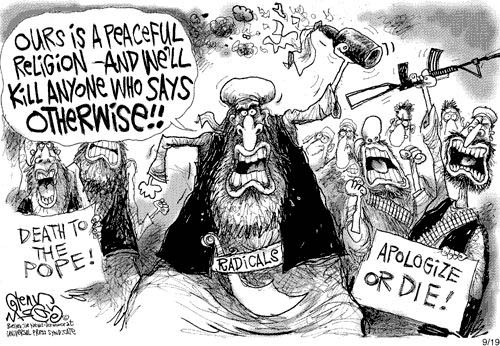
It is five years now since Pope Benedict gave his celebrated address at Regensburg on faith and reason. Deeply thought and beautifully expressed, it is largely remembered for neither of these things. Rather, it is remembered for a single line in which Pope Benedict quoted a 14th-century Byzantine emperor making a disobliging remark about the way in which Islam is spread by violence.
Benedict XVI did not say that he agreed with the line. Indeed, he went out of his way before quoting it to distance himself from it, remarking, among other things, on its “brusqueness”. But this was to no avail.
Around the world, political and religious leaders in Muslim majority countries demanded apologies and threatened repercussions. More striking was the impact on the ground. Across what President Obama calls “the Muslim world”, there were protests and attacks against Christians and Christian sites. In the Palestinian areas and elsewhere churches were attacked and Christians targeted. In the Somali capital, Mogadishu, an Italian nun was shot and killed in an Islamist ambush at a hospital.
Al-Qaeda and other extremist groups promised to respond to a quotation mentioning Islam’s connection with violence by waging a campaign of violence. “Say our religion is peaceful or we’ll kill you” was once again the order of the day.
By 2006, so soon after the Danish cartoons controversy, the world had got used to this. And it expected the inevitable stand-down. Within days the Pope was effectively forced to issue an unprecedented apology.
Culturally and civilisationally, the aftermath of Regensburg was a far greater disaster than the mass-murder in New York and Washington 10 years ago this same month. Such successful intimidation of the head of the Catholic Church by elements of the Islamic faith has had a palpable effect, all but silencing the rightful concern of Christians for their co-religionists.
I am not a Catholic – indeed, I am not even a believer– but I have great respect for the current Pope and for many activities of the Catholic Church worldwide. But in recent years it has become increasingly difficult not to notice a failing at the heart of the Catholic – indeed the whole Christian – world’s outlook. Years of intimidation, thuggery and violence have succeeded in silencing criticism not only of Islam but of violence committed in the name of Islam against Christians. This now amounts to one of the great moral failings of our time.
Not a week, in fact not a day, goes by when Christians are not somewhere in the world the victims of Islamist violence. You can pluck a week, any week, and the story is the same: burnings, lootings, rapes, murders. Every one of the most degrading and terrifying things that one group of people can perform on another is performed by Islamists against Christians.
At the very start of this year, in the once-wonderful city of Alexandria, the Egyptian Coptic Christian community were the target of a massive car bomb placed outside their church as they left New Year’s Eve Mass. Twenty-three worshippers were killed and almost 100 injured.
At Easter this year it was once again Christians in Iraq who were targeted. This time it was a bomb at the Catholic church of the Sacred Heart in Baghdad. Every day the same, or similar, stories occur. Persecution of Christians is so routine that in much of the western press it rarely even appears as “News in Brief” material.
Just this month so far, the Iranian authorities finally released a Christian they have had in detention for 359 days. His “crime”? He was accused of spreading Christianity and of having ties with Christian organisations. As Muslim leaders around the world continue to campaign at the United Nations and elsewhere to try to make illegal – and punishable – any criticism of Islam, restrictions of the rights of Christians continue unnoticed. The government of Kazakhstan is this month preparing to introduce a new law further limiting the rights of Christians.
In other countries often described as “allies” of this one, the rights of Christians are already formally and informally deemed of no significance. Just a few days ago two Pakistani Christians were beaten with iron rods and left for dead by a group of young Muslim men because they refused to convert to Islam. As in many other countries, Christians in Pakistan are regularly threatened with death for so-called “apostasy” or “blasphemy”. Last month a Christian girl was reportedly tortured and sexually abused after refusing to convert, while a 38-year-old Christian was shot dead in a Christian suburb.
Across the Middle East, the Indian subcontinent and much of Africa, wherever Christians are in a minority and Muslims in a majority, Christians are subjected to oppression, murder and violence. In Somalia the terrorist group al-Shabaab is attempting to carry out a genocide against the Christians of Somalia. Similar efforts are ongoing in Nigeria and elsewhere. In other places the effort to “religiously cleanse” whole areas of Christians is more subtle. In Bethlehem the local Christian community has been decimated. Not by the Israelis, but by Palestinian Muslims. Since the Palestinian Authority took control of Bethlehem 16 years ago the local Christians have gone from a majority to a minority community. It is a familiar pattern. Around the region I have spoken to many of these victims. I have heard their stories and seen their tears. And the same question always occurs. The world is often unconcerned. But why are their fellow Christians not doing anything?
There are of course some Christian organisations – notably the wonderful Barnabas Fund – which persist in trying to raise awareness and assist persecuted Christians. But the cause is one of the most unpopular and unacknowledged of our day.
After the bombing in Alexandria at New Year, tenuously, carefully, the Pope expressed concern not only for the Copts of Egypt, but also for the Muslims of Egypt. From the leading imam of Egypt this drew a swift response. The Pope was accused of “bias” and “unacceptable interference in the affairs of Egypt”.
This has become one of the librettos of our time. And it is high time that it changed.
Former PLO Terrorist Blames Muslim Fanaticism, Not Israel
The Record - News
Issue: 11/11/04
By Adina Levine
In an event sponsored by Harvard Law School Alliance for Israel, Harvard University Graduate Student Friends of Israel, Stand With Us, Hasbarah Fellowships and Jewish Community Relations Council of Greater Boston, among others, former PLO Terrorist Walid Shoebat spoke about what made him a terrorist and his ultimate realization of the fallacy of his actions on November 8th.
"The issue is not the issue of occupation," asserted Shoebat. "The issue is the occupation of the minds of the youth. The issue is hatred and anti-Semitism. There is no other explanation for this."
Born in Bethlehem, Shoebat explained that his family and his community had never thought of themselves as Palestinians, but as Jordanians. Reflecting on his childhood, Shoebat asserted that he was told that a Jew was a dog before he even knew what a Jew was. He believed that Jews had type AB blood, and they had type O - that they share their blood, while a Jew doesn't. His father, whose life was saved by a Jewish doctor, said that there was no prayer for the doctor who had saved his life, reiterating the old phrase "I knock at the doors of heaven with Jewish skulls."
"You might think I'm a freak, that this doesn't happen in civilized countries," stated Shoebat. "But myth was taught as fact and we were like sponges believing everything we were taught."
He was told that the Holocaust never happened, that it was a ploy that the Jews made up in order to win sympathy from the world. During Yom Hashoa, he recalls watching the documentaries on television while eating popcorn and laughing. He believed that the graphic scenes of dead bodies were all enacted by the Jewish control of the media.
"We felt the Jews have no shame, that they will take their clothes off to make up this plight called Zionism," asserted Shoebat. "No one ever told me the Holocaust was a reality."
From such a society, Shoebat claimed, it was no wonder he became a terrorist.
"What did you expect me to do?" he asked. "What product did you expect from such a system?"
As a terrorist, Shoebat stoned Jews from a perch above the Western Wall, almost planted a bomb before he saw Arab children nearby, stoned an Israeli who was attempting to get help for a child that he had hit with his car. His cousin was sent to explode a bomb in Ben Yehuda before he was killed by Israelis.
"It took me twenty years to realize who killed my cousin," said Shoebat. "My cousin was not killed by the Israelis, my cousin was killed by the hate pushers. Terrorism is like a drug - you push it on the youth."
Shoebat contrasted the religious frenzy he was taught - that the community had a responsibility to kill as many Jews as possible - with the reactions of Israelis. He recalled a man from his community who was imprisoned by Israelis because the man had sliced off his daughter's neck because she was suspected of adultery. The notion Shoebat could not understand, however, was why the entire community donated money to bail him out. He also compared the community reaction to the Israeli soldiers who were killed in Ramallah - how the community was cheering as they watched the mutilation and the killers held up their hands to show that Jewish blood was in their hands - with the Israeli reaction of outrage and concomitant censure of lone actors such as Baruch Goldstein.
"If you want to understand what happened to my country, look to Nazi Germany," asserted Shoebat. "The Holocaust never ended, but the victims just decided to protect themselves... Antisemitism is alive and well. Antisemitism is alive - even in the west."
Shoebat likened the desecration of Joseph's tomb to Kristallnacht.
"People took axes, defacated on the Torah Scrolls, urinated all over the place," he recalled. "Tonight I ask one question: Have you ever seen a Jew desecrate a mosque or a church?"
The solution, according to Shoebat, lies not in the hands of Israelis, who continuously try to establish peace. The problem, he says, is in the society of hate that he grew up in, the lies he was told, and the fanaticism that is the communal norm.
"Arafat stands and says to mothers 'Give me your children so I can make martyrs out of them,'" Shoebat said. "Why is it that the Jews want peace and we want war?"
Muslim violence: Caution and pity
Posted: February 10, 2006
By Jay Stapleton
WorldNetDaily.com
The confounding and conflicting reports surrounding the Muhammad 'toons are still pouring in. The fast breaking news – cartoon authenticity, religious blasphemy, riots and deaths – is providing a window into the soul of the Muslim community. This time, however, the events can't be pinned on a few Islamic fanatics. The magnitude and scope of Muslim reaction is revealing the hostile mindset of the broad Muslim world. It ought to evoke both pity and caution.
Muslims worship the god Allah; I worship God Who became Man, Jesus Christ. I would choose to die rather than deny Christ is God. Millions of other Christians share the same conviction. When we see images of Jesus submerged in urine, depictions of Him as a sodomite, or movies portraying Him as an adulterer, we're insulted, grieved and angered – but we don't set out to kill the culprits responsible. At least not en masse.
But provoked Muslims are a different story. The demeaning Danish cartoons have ignited mass rage in the Islamic world. We've bewilderedly witnessed the demand for blood, the burning of buildings, threatenings and death. If one compares the Christian community's restrained response to the defamation of Christ with the murderous Muslim outrage over denigrating cartoons, a clear truth emerges – Christians and Muslims are different from one another. Our differences are rooted in our vastly divergent beliefs about God.
As a Bible believing Christian, I know myself to be created in God's image, marred by sin, and loved by God. Jesus Christ died for me, and when I put my faith in Him, God forgave all my sins, and accepted me into His family. I can now talk to God, and know Him personally. I've been promised eternity in Heaven with Him. Not so with the Muslim.
A Muslim worships Allah, but Allah is completely incomprehensible to him. Muslim scholars call this "The Difference." There is nothing about Allah that is comparable to man. To compare Allah to man or to man's thoughts is forbidden. When Allah describes himself in the Quran as "merciful" or "compassionate," he is not to be understood in terms of human mercy and compassion. Such a comparison is considered blasphemous. What does Allah mean then, when he so describes himself? No one knows. No one can know Allah, or be sure of his ways. That's "The Difference."
I've dialogued with a number of Muslims over the years, and they're usually offended at my assurance concerning Heaven. They have no such assurance, for Islam offers no personal relationship with Allah. The relational basis for my relationship with God is that I'm created in His image and likeness. Muslims regard the biblical teaching that man is created in the image of God as perverse.
Islamic theology decrees that man is not made in the image of Allah, cannot comprehend Allah, nor have a direct relationship with Allah. Because Allah is under no obligation to any man, he may cast the most devout Muslim into hell, should he choose to do so. Of course, blowing ones' self up in jihad for Allah will likely tip the balance in one's favor – a strong motive for Islamic martyrdom.
The bottom line is that Allah's complete incomprehensibility and total "otherness" leaves a huge void in the heart of the Muslim. Because man is driven to worship something he can relate to, the vacuum created by the incomprehensible Allah is often filled by Muhammad. Although worship of the prophet of Islam is forbidden, the practice is revealed in the constant reverencing of his name. The problem is, Muhammad makes for a very vulnerable god.
Insult is inflammatory when it strikes a note of truth (like a cartoon can do), and Muhammad's dubious legacy and integrity are defended furiously. The recent Islamic uproar reminds me of the old joke about the preacher who was writing out his sermon notes. Toward the end, he jotted to himself in the margin "Weak point – pound fist, speak loudly." Likewise, in the Muslim rioting and burning, we're seeing evidence of vulnerable weakness, not zealous conviction. I despise public denigration of Jesus Christ, but He needs my defense about as much as a lion needs help from a duck.
I have a sense of pity for these rioting, Muslim crowds. In defending Muhammad (and previously, the flushed Quran), there's a desperate attempt to show some fealty to Allah, the unrelatable one. There's also reason for caution in these events. We're not watching the actions of a few, fundamentalist radicals. These are the actions of a huge, violent and deadly dysfunctional religious family now living in our midst. May the love of Christ – and not resentment – prevail in our hearts.
Former Muslim: Islam causes Middle East violence
By DOMINIC ADAMS
LimaOhio.com
07/20/2006
LIMA — Daniel Shayesteh knows firsthand of the fighting in the Middle East.
And he said he knows why Hezbollah militia is fighting Israel from Lebanon.
“Islam is not a peaceful religion,” Shayesteh said. “We see that Islam is fighting all nations. They blame America. No, look at the Quran. Quran is saying this.”
Shayesteh, 50, was born in Iran and was a self-proclaimed militant Muslim. He helped Ayatollah Khomeini rise to power and force the Shah of Iran into exile in 1979.
Israel and Lebanon have been fighting since July 12. Two Israeli soldiers were captured by Hezbollah guerillas and prompted an aggressive offensive response from the Jewish state.
“The current situation really is not the fighting of two groups of people. It’s the holy war of Islam against the Jews, and it stems from the pages of the Quran,” Shayesteh said. “The Quran is clearly written that Jews should be demolished, and tradition says there should not be a single Jew in Israel.”
Shayesteh has been in Ohio since Monday speaking about his interdenominational organization, “Exodus from Darkness.”
A converted Christian, he will speak at 9 a.m. Sunday at Shawnee Alliance Church, 4455 Shawnee Road. He also spoke in Wapakoneta and in Lima on Wednesday.
“Unless we read the chapters of each others’ lives, a good relationship will not be possible in our society,” said Shayesteh, who became an Australian citizen in 1991. “Let us search for the truths together. Come out from your personal zone and research other religions. You pick the best one, and I guarantee you’ll come to Christ.”
Ralph and Beth Miller invited Shayesteh to stay in their Lima home for two days.
The three of them discussed Shayesteh’s life in Iran late Tuesday night.
“He’s got a passion and his first love is the Lord, and he wants that for everyone,” Beth Miller said. “I don’t think we can understand what he’s been through.”
If Shayesteh returns to Iran, he will be executed. His mother and brothers are still in Iran.
“It makes us realize our freedoms,” Ralph Miller said.
A violent ideology
The people in Iran cannot stand President Mahmoud Ahmadinejad, Shayesteh said. He said more than 95 percent of Iranians hate their government.
Iran fuels the fighting in Lebanon, and Shayesteh said Iran funds Hezbollah.
“This Iranian president is a suicide bomber,” Shayesteh said. “He is just ready to die for Islam and demolish Israel.”
Muslim ideology is cloaked in violence because of the status of its creator, Muhammad, Shayesteh said. He said because the prophet fought in ancient wars, the Muslim holy book seeps with violence.
Following the terrorist attacks on the World Trade Center on Sept. 11, 2001, the U.S. government vowed to eliminate terrorism and any factions that harbored the individuals responsible.
President George W. Bush focused his sites on capturing Osama bin Laden. Laden is not the problem, Shayesteh said.
“Osama bin Laden is the servant of Islam. Islam is the enemy of this country,” he said. “Osama bin Laden can be changed, but Islam cannot. Osama bin Laden is just a tool in the hand of Islam.”
Shayesteh was heavily involved in the Iranian Fundamentalist Revolution and taught Islamic and religious philosophy in Iran.
After Khomeini was in power, Shayesteh helped spread propaganda and gain support from other militant Muslims near his hometown of Talesh in northern Iran.
His candidacy for the Islamic parliament forced Shayesteh to be on the run for the rest of his life.
Ruling with fear
When Shayesteh attended university in Iran, he deepened his militant Muslim ideologies. Iran was in political turmoil when Shayesteh aligned himself with Khomeini.
“Anyone who followed Ayatollah Khomeini must be a radical Muslim,” Shayesteh said. “We were eager to overthrow the kingdom in Iran, and to do that you have to be a militant and radical Muslim.”
Khomeini put Shayesteh in charge of a revolutionary army that had a primary goal of killing all Jews in Israel and recapturing the Holy Land for Arabs.
Shayesteh then began spreading propaganda and training young Muslims.
“That was our main goal to mobilize all the boys and girls of the country and to teach them the terrorist actions,” Shayesteh said. “You have to terrorize Christians and Jews by frightening them. By killing them, you can take Islam to the countries and to the rest of the world.
“Islam is a harsh religion. There is no peace in Islam.”
However, when questions crept into his mind, Shayesteh wanted to discuss them in parliament.
He was silenced, sentenced to death and thrown in jail for six months.
A friend released him and he fled to Turkey in exile.
“Islam does not believe in freedom and democracy. You have to blindly follow the leader,” Shayesteh said. “If you criticize Islam and Muhammad, your fingers should be chopped first and then your head.”
Reluctant convert
Once in Turkey, Shayesteh began visiting a Christian church that was harboring Iranian refugees.
He only went there because there were people there in his situation. He was not interested in Christianity.
“We as Muslims were always taught, ‘Do not touch Christians. They were impure,’” Shayesteh said.
He returned to the church week after week and grew interested in its message. Christians preaching respect of their enemies amazed Shayesteh.
One night he had a dream and Jesus spoke to him, he said.
He was in his father’s house. There were people dying around him, and he was scared to leave the house.
The next week’s sermon spoke of what Shayesteh dreamed.
“He said, ‘Come out of your father’s house, which is the house of killing, of revenge and of pain and live in the house that Jesus has built for you,’” he said. “It is a house of absolute joy, of freedom and peace.”
Shayesteh has been spreading the word ever since.
The Wrath of Radical Muslims
CBN News
October 19, 2006
CBNNews.com- Five years after the attacks of September 11, America continues to face a challenging enemy.
"One which is totally invisible, which is submerged within the civilian fabric of society which wears T-shirts, denim jeans, baseball caps" said Terrorism Analyst M.J. Gohel, but is infected by an ideology of violent global jihad.
Today, radical Muslim terrorists have renewed their war against Jews, Christians, the United States, and other non-Muslim nations.
"They wish to destroy the democratic and secular world," Gohel said.
In its place, they want to impose a 7th century totalitarian ideology that would control all religious, social, and political life on earth.
Gohel said, "They want to impose Islamic caliphates, Islamic super states on the entire world."
In such a world, all debate or criticism about Islam would seize to exist.
Some argue that such a world exists already. Since 9/11, anyone who dares to criticize Islam or its agenda and history, faces the wrath of potentially millions of Muslims.
Case in point: Pope Benedict's citation of a 14th century emperor who called Islam "evil and inhuman" and the cartoon drawings negatively depicting the prophet Mohammed. Both drew violent reactions from Muslims worldwide.
To some, it appears, that Muslims are always ready and waiting to be outraged. But many ask, where's the outrage at the violence committed by Muslims.
For example, where is it when Muslims kill Muslims in Iraq and Darfur, a Catholic nun is gunned down in Somalia, and an Iraqi priest is kidnapped and beheaded in Baghdad after the pope's challenging remarks? Or when Muslims in Indonesia cut off the heads of three teenaged girls on their way to a Christian school?
In Egypt, Iran, Nigeria, Pakistan, Saudi Arabia, Christians are regularly persecuted by Muslims for their faith. And in London, Madrid, Bali, and Amman, Islamic terrorists kill dozens of innocent victims in suicide operations.
In all these incidents, there's no outrage or apology from the Muslim world. Just silence.
Karen Hughes, the Undersecretary of State, says "this is not right." In a letter published in USA Today titled, "Where's the Outrage,"Hughes writes that, "a much louder chorus of voices needs to join in condemning it. Terrorism threatens all of us. It targets the very foundation of a free society."
But those who are engaged in radical Islam's war against the West see themselves as following the examples of the prophet Mohammed. And according to them, anyone who insults Islam or the prophet, should be put to death.
Robert Spencer knows a thing or two about the prophet Mohammed. Spencer takes on the most sacred figure in Muslim history.
His latest book, The Truth about Muhammad: Founder of the World's Most Intolerant Religion, looks at what Islam's founder actually did and taught.
ARE THERE LIMITS TO ISLAMIC VIOLENCE?
Charles Sabillon
January 31, 2007
The constant warring between Pakistan and India is the result of several factors but one of the most important is Islam
In 1947 the British granted independence to South Asia. Originally, the British had no intention of partitioning the subcontinent, but the Muslim minority insisted so much on having a country of their own, that London finally agreed.
The huge territory was thus divided into Pakistan and India, being what is now Bangladesh a province of Pakistan.
Almost as soon as the British withdrew, war broke loose. In the six decades since independence, there have been a total of three wars and more than a dozen armed clashes. Although during the whole period Pakistan remained a far weaker nation than India, all the wars and all the clashes were caused by Pakistan.
That goes a long way to expose the true nature of the Muslim religion. Like all religions, Islam is uncompromising, for it believes that it is the holder of the ultimate truth. However, contrary to the others, it is the only creed born out of an act of violence and the only one that glorifies violence in its holy book.
However, what is even more revealing of its brutal nature is the way in which the relationship of military forces was structured in South Asia. From the start, it was clear to the Pakistanis that they were going to loose. India is exponentially larger in population and in resources, and on top of that New Delhi made a strategic alliance with the U.S. That gave India access to the best military technology in the world.
As all experts predicted, Pakistan was crushed on the three occasions. It was not just crushed, but it was also humiliated because the defeat came quickly due to the overwhelming superiority of Indian forces. Such a situation begs a question.
Who picks up a fight with someone who is many times stronger? More still is: who picks up a fight after having been repeatedly defeated?
On the third war in 1971, Pakistan not only lost the war, but also the province of East Bengal, which declared its independence and became Bangladesh. However, not even such a massive and ignominious loss convinced the Pakistanis to stop provoking its neighbor.
They went on harassing India, claiming that the disputed state of Kashmir belonged to them. In the following decades, they repeatedly financed and armed groups which they encouraged to pierce into India to plant bombs. This of course, led to a military response from New Delhi, which led to numerous border clashes that almost ended in war.
The situation in South Asia over the last six decades, leads to the conclusion that such bravado from the part of Pakistan, can only be the result of the country’s belief in Islam. Only someone who believes in violence per se could be systemically picking up a fight with somebody who is much stronger.
The fact that Pakistan’s claim over Kashmir is not solidly anchored points further in this direction.
Lieberman: World accustomed to Muslim violence
Right-wing minister slams Muslim riots on Temple Mount, demands more severe Israeli response. On other side, Arab MKs condemn ‘premeditated Israeli aggression’ in carrying out renovations at holy site
Roee Mendel
Ynetnews
The government’s Right-wing contingent, Minister of Strategic Affairs Avigdor Lieberman, said the Muslim riots on the Temple Mount were a provocation aimed at distracting attention from the intra-Palestinian conflict in Gaza.
“The world has already grown accustomed to the fact that Muslims react violently,” Lieberman said, “same as after the Pope’s speech and after caricatures of the Prophet Muhammad were printed.”
It is perfectly clear to any rational onlooker that Israel is not harming any Islamic holy sites, Minister Lieberman asserted. He accused the Israeli government rather of discriminating against its Jewish citizens.
“The State of Israel promises freedom of worship to Christians and Muslims in Jerusalem,” he said. But for Jews, it’s a different story, he said. “Since the second Intifada, Jews cannot enter the Temple Mount, and Israel is showing that it is prepared to make compromises and concessions. But there needs to be some rational limit. We cannot agree to an attack on Israel’s sovereignty at the Temple Mount.”
The minister censured the conduct of Israeli Arab Knesset members since the start of the construction work at the Mugrabi Gate. “They are envoys of our enemies,” Lieberman charged.
“Taleb el-Sana called to support Hizbullah. Another MK encouraged the kidnapping of Israeli soldiers. Arab MKs visited Damascus, and it is clear they are collaborating with the enemy. Israel must punish anyone who aligns himself with terrorism,” he noted.
Lieberman criticized Jerusalem police forces, who failed to arrest Islamic Movement leader Shiekh Raad Salah Friday despite his aggressive behavior. “The man attacked policemen, spit in their faces – and he wasn’t arrested. What needs to happen for him to be arrested?” Lieberman demanded.
Arab MKs slam ‘premeditated aggression’
Meanwhile, Israeli Arab parliament members continued to protest the controversial construction, rejecting Israeli explanations that it was structural work on an unstable bridge.
Hadash Chairman MK Mohammad Barakeh called on Prime Minister Ehud Olmert “to pull the occupation forces out of the mosque at once.”
Barakeh slammed the construction work as “premeditated Israeli aggression.”
“This government insists on playing with fire and causing bloodshed, especially after the Palestinians attained a unity government agreement. It is the Palestinians’ right to protest the provocative construction next to the al-Aqsa Mosque,” he said.
MK Taleb el-Sana, who attended prayers at the mosque Friday, said, “I was shocked when even before the prayers ended, Border Guard and police forces stormed the Mount with stun guns and caused unjustified damage.”
“Maybe a few stones were thrown, but this response was exaggerated,” he said.
National Democratic Assembly MK Jamal Zahalka, an East Jerusalem resident, claimed the bridge was being built to enable 300 policemen to storm the Temple Mount at once.
"Wakf, the Jordanian government and UNESCO expressed their fierce opposition to the bridge’s construction, which brutally damages the Mugrabi Gate,” he said.
Jesus Christ preached: "You have heard that it was said to those of old, 'You shall not murder, and whoever murders will be in danger of the judgment.'" Matthew 5:21